
World Birds
Field Guide Plates
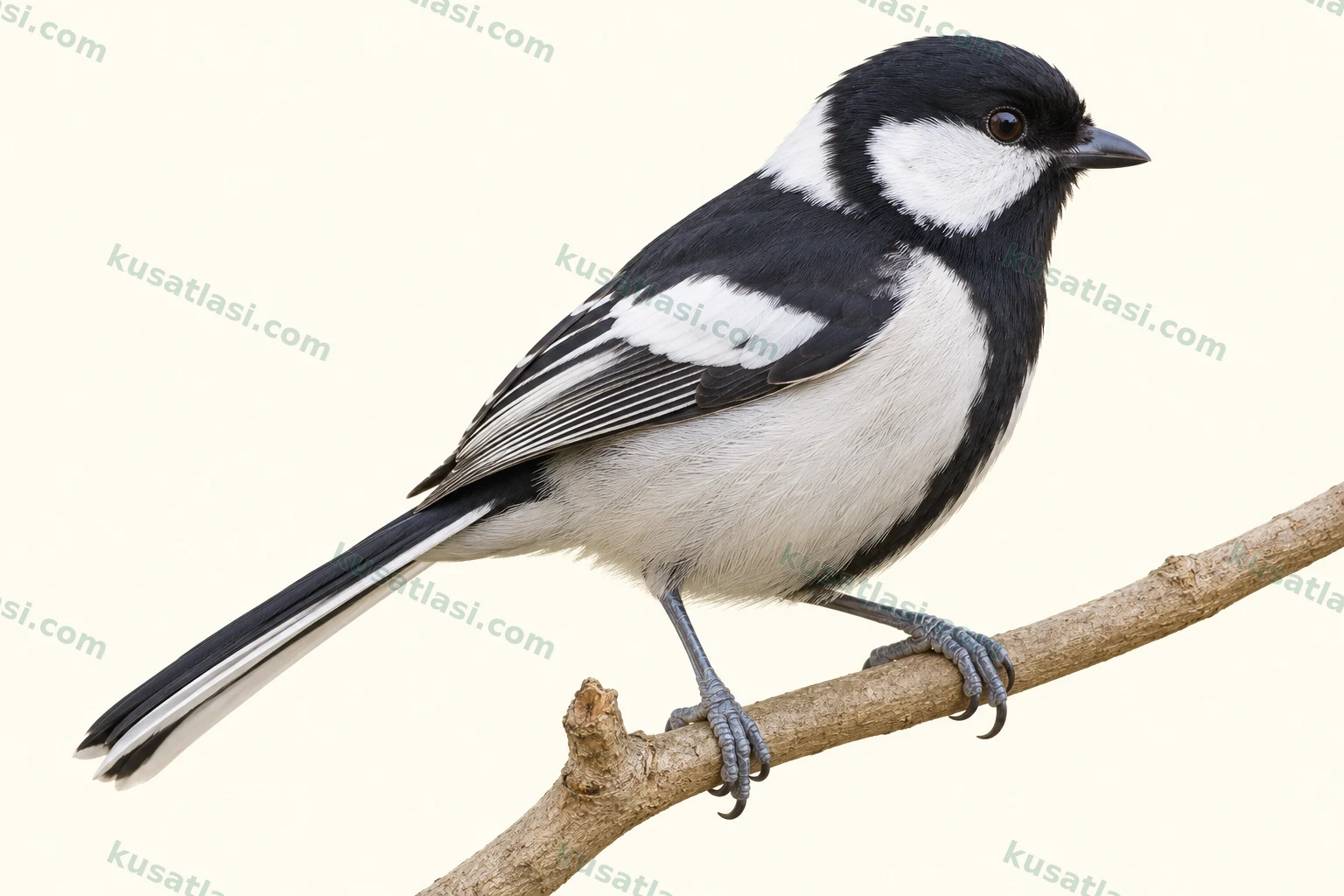
Swipe between the two adult plates.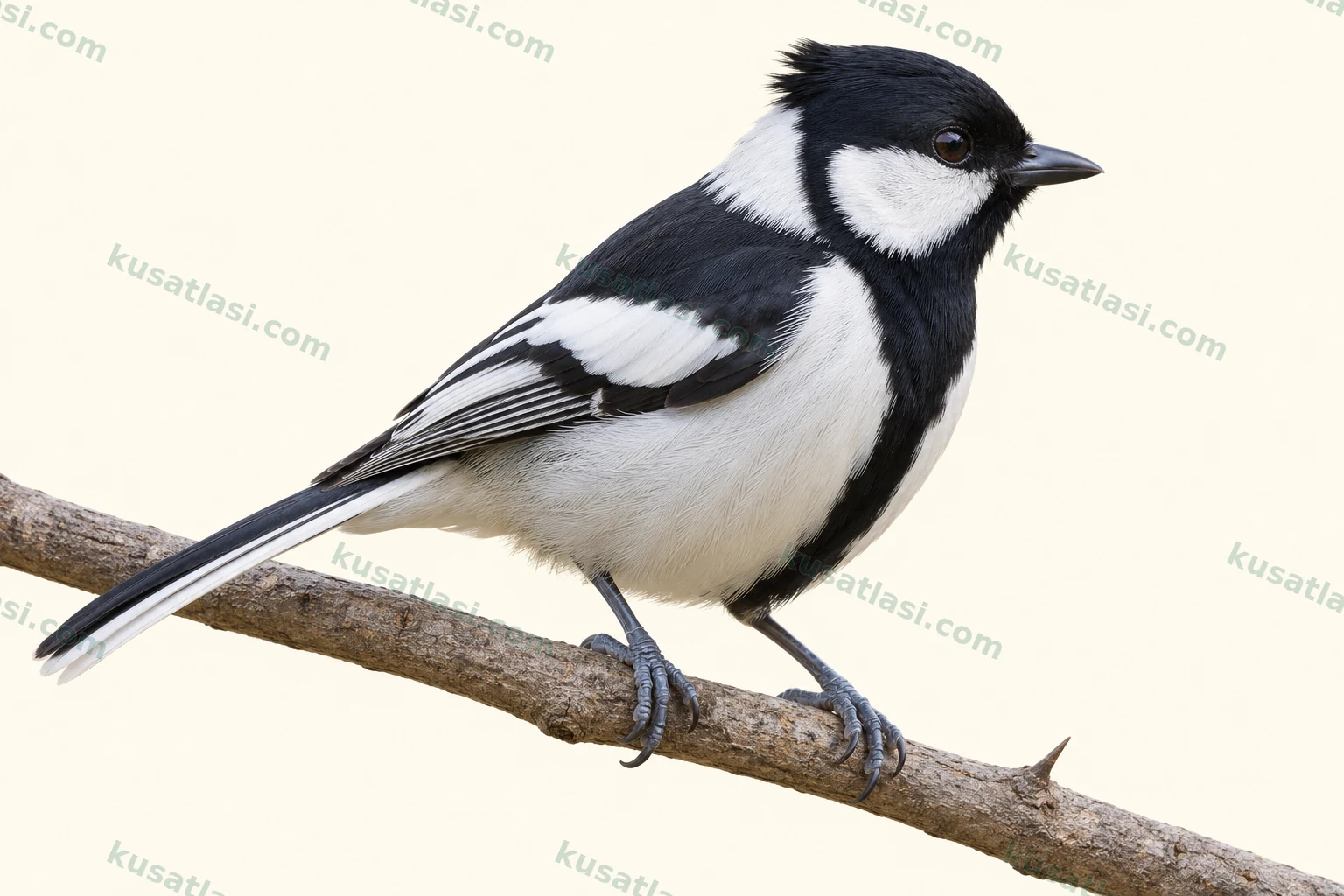
Paridae · Passeriformes
White-naped Tit
Machlolophus nuchalis
Ak Kanatlı Baştankara
Assess the broad white lower-nape and upper-back patch, extensive wing white and black upperparts together.
- Order
- Passeriformes
- IUCN Status
- NTNear Threatened
Biometrics
Length
- Male
- 12–13 cm
- Female
- 12–13 cm
Wing length
- Male
- 6.5 cm
- Female
- 6.5 cm
Weight
- Male
- 13–14.5 g
- Female
- 13–14.5 g
Detailed explanations of these measurements are available on our website, on the same species page.
At a Glance
- Broad nape patch
Pale area between lower nape and upper back.
- Extensive wing white
More than one narrow wingbar.
- Dark ventral stripe
Check with pale cheeks and creamy sides.
Adult males are glossier; females duller, with a browner bib and ventral stripe. Young also lack gloss and may have a creamy-yellow nape patch.
Calendar
Regarded as resident, with possible local dispersal outside breeding. Rainfall and regional habitat differences are not forced into one monthly calendar.
Species Information
Quick Identification
White-naped Tit is an Indian endemic with a strong black-and-white pattern. Adult males combine black upperparts with a broad white patch on the lower nape and upper back and conspicuous white wing areas. Pale cheeks contrast with a dark throat and breast, with a dark stripe continuing down the centre of the underparts. One white nape spot alone is not decisive.
General Appearance and Posture
The male’s forehead, crown, much of the nape and wing coverts are glossy blue-black. The white area between the lower nape and upper back stands out against this dark background. Cheeks, ear-coverts and neck sides are white or creamy white. The dark chin, throat and breast connect to a broad ventral stripe; the sides are mainly creamy.
The wing pattern is more extensive than one narrow white bar. The elongated inner wing feathers are largely white, with additional white at the bases and tips of flight feathers. Some areas show on the closed wing and others become clearer when it opens. Assess the black back and extensive wing white together.
Central tail feathers are black with narrow white tips; outer feathers have much more white. The eye is dark brown, the bill black and the legs slate gray. A foraging bird can cling to fine branches or pods and hold food with a foot while hammering it. These movements can reveal the plumage from different angles; posture alone is not a unique identification feature.
Males, Females and Young Birds
Females are less glossy above and may have a smaller nape patch and less white in the wing. The cheeks are duller, the chin yellowish white, and the bib and ventral stripe sooty brown. Underparts may appear yellower than the male’s creamy colour.
Observations of three pairs in Gujarat, India, in 2011 found female ventral stripes narrower and more irregular than male stripes. Only some females had warm brown flight feathers. A brown wing should therefore not be treated as an infallible sex marker, nor should every female be expected to share that shade.
Young have dull sooty-black head and upperparts, a pale creamy-yellow nape patch and sooty-brown bib and ventral stripe. White in the wing is more restricted, and white on the outer tail can look duller or brownish. Tail tips are more pointed than in adults. Consider age, feather condition and lighting alongside sex differences.
Appearance in Flight
Spread wings reveal the black-and-white contrast, while white outer tail feathers provide another clue. Underwing coverts are pale. After a distant or brief flight view, reassess upperpart colour, the broad nape patch and the stripe from throat towards belly rather than relying on a white flash.
Voice and Behaviour
Contact calls include thin whistled series, short “pit/chit” notes and sharper “tink”-like calls. Song can include a high, thin series and a short ringing trill. Written imitations alone are insufficient for certain identification and should be combined with plumage and habitat.
Moves in pairs or small family parties, sometimes joining mixed feeding groups. Territorial defence towards neighbouring pairs can occur in breeding. The 2011 Gujarat study recorded countersinging and encounters near territorial boundaries; these local records do not establish one territory size for every population.
Similar Species
Comparison with Indian populations of Parus cinereus is important. They also have white cheeks, a black head and throat and a dark ventral stripe, and may show a small pale area on the lower nape. A white nape alone therefore does not establish White-naped Tit.
Male White-naped Tit has black upperparts, a broad lower-nape and upper-back patch and more extensive white in the wings. The gray Indian forms of Parus cinereus have more blue-gray back and wing coverts, with a narrower white wingbar and finely edged flight feathers. Especially in females and young, examine the whole head, back, wing and tail pattern rather than one stripe width.
World Distribution
Endemic to India, with two principal separated areas: suitable parts of the northwest, especially Gujarat and Rajasthan, and fragmented dry forests farther south on the peninsula. Southern records include parts of Karnataka, Tamil Nadu and Andhra Pradesh. The broad gap between these areas is not continuous forest or a demonstrated migration corridor.
Kachchh in Gujarat and the Aravalli region of Rajasthan are important locations for northwestern studies. In the south, January and June 2009 records were published from Karnataka’s Cauvery region. They do not support occurrence restricted to winter, but neither constitute a population study tracking the same individuals in every month.
Status within Its Range
Occurrence is patchy and habitats are fragmented. The editorial note accompanying the 2010 Cauvery paper explicitly calls for confirmation of some older southern records. Disputed historical reports from places such as Anshi, Dharwad and Wynaad are therefore not presented here as confirmed current localities.
India’s 2023 national bird assessment found insufficient data to calculate both the long-term and current annual population trends. This does not establish an absence of threats. Fuelwood collection, tree cutting, heavy lopping and conversion of woodland can reduce foraging habitat and cavity opportunities.
Movements and Migration
Considered resident, with dispersal into surrounding areas outside breeding. Seasonal encounter records in Rajasthan show use of different forest sections at different times. Fewer winter sightings do not establish a direction or distance of migration without tracked individuals. Local wandering should be distinguished from regular long-distance migration.
Breeding Habitat
Inhabits dry thorn woodland and scrub and some dry deciduous forests. Acacia-dominated stony ground and low hills are important in northwestern India. Southern Cauvery records instead come from dry woodland dominated by Albizia amara. The difference argues against dependence on a single tree species everywhere in India.
At Sajjangarh, Rajasthan, the 2007–2009 study recorded birds more often in lower thorn vegetation during summer and in a higher Boswellia serrata zone during the monsoon. All nest records there were in Boswellia trees in that upper zone. This local finding does not require every nest in Gujarat or southern India to use the same tree.
Nest Site
Nests in tree cavities, using suitable natural holes or cavities previously excavated by woodpeckers. The excavator of every hole has not been directly observed. Reported lining materials include plant fibres, soft plant material, hair and wool.
The nest tree need not be entirely dead. In the 2011 Gujarat study the active nest was in a living Acacia senegal trunk, while most nest records in the Rajasthan study were in living branches. Cavities and damaged sections of living trees can also matter.
Information on clutch size in natural cavities is limited. A 2011 project report on artificial nest boxes in Rajasthan reported four to six eggs. That figure explicitly belongs to nest-box observations, rather than a fixed typical clutch established for natural nests throughout the range.
Detailed, verifiable natural-nest data remain insufficient for complete incubation and nestling periods. In the 2011 Gujarat study, eight days when the female was seldom seen were interpreted only as a possible portion of incubation; its full duration was not established. Both parents were observed bringing food to young, and the male sometimes passed food through the entrance to the female inside.
Breeding is associated with the rainy season; regional records are not forced into one monthly calendar. Observe without obstructing the entrance, opening the tree or waiting in the parents’ approach path.
Daily Habitat Use
Forages mainly in tree crowns, also using shrubs and sparse undergrowth, and may enter adjacent gardens and orchards. Feeding trees, roost cavities and nest holes need not be in the same place. A sighting in one stand does not make surrounding forest fragments unimportant.
What Does It Eat?
Reported food includes small invertebrates, particularly larvae and spiders. The expert account also lists some fruit and nectar, but their annual dietary proportions are unknown.
Recognisable items delivered during the 2011 nest study in Gujarat, India, included larvae of several appearances, small caterpillars and other small arthropods. Most food deliveries could not be identified. The few recognised groups therefore do not establish exact dietary percentages or a year-round menu for all adults.
How Does It Forage?
Searches fine branches, foliage and dry Acacia pods. In Gujarat it was observed hammering pods open and sometimes holding them with a foot. Insect damage in discarded pods supported the interpretation that larvae inside were food.
One observation of hammering a Capparis berry in the same study did not resolve whether fruit tissue or small animals inside were being taken. Aerial capture of winged termites during a mass emergence was also observed.
Two Roost Cavities for a Pair
In the pair watched in Gujarat, India, in July 2011, the female spent nights in the nest cavity and the male in another tree crevice. Repeated use suggested fidelity to roost sites, not a broken pair bond.
The study did not cover the entire year or every population, so identical nightly behaviour cannot be assumed for all birds. A bird found at an old site years later does not demonstrate the survival of the same individual unless identity is established.
A Survey Criterion Is Not a Biological Limit
The 2007–2009 Rajasthan study used a minimum entrance diameter of four centimetres when counting potential nest cavities. The active Gujarat nest in 2011 instead had an entrance recorded as 37 × 23.5 millimetres. Actual use of that smaller entrance shows that the earlier survey threshold was not a fixed biological minimum.
A chosen sampling criterion is therefore not the same as every cavity a bird can use. Comparisons of cavity numbers or sites need to retain the methods’ limits.
Nest Visits Are Not Food Mass
At the single monitored Gujarat nest, the male made most entries for which sex could be identified. This does not establish the same division of care in every pair or the same proportion of total food mass. Visit counts, prey size and food actually reaching the chicks are different measurements.