
World Birds
Field Guide Plates
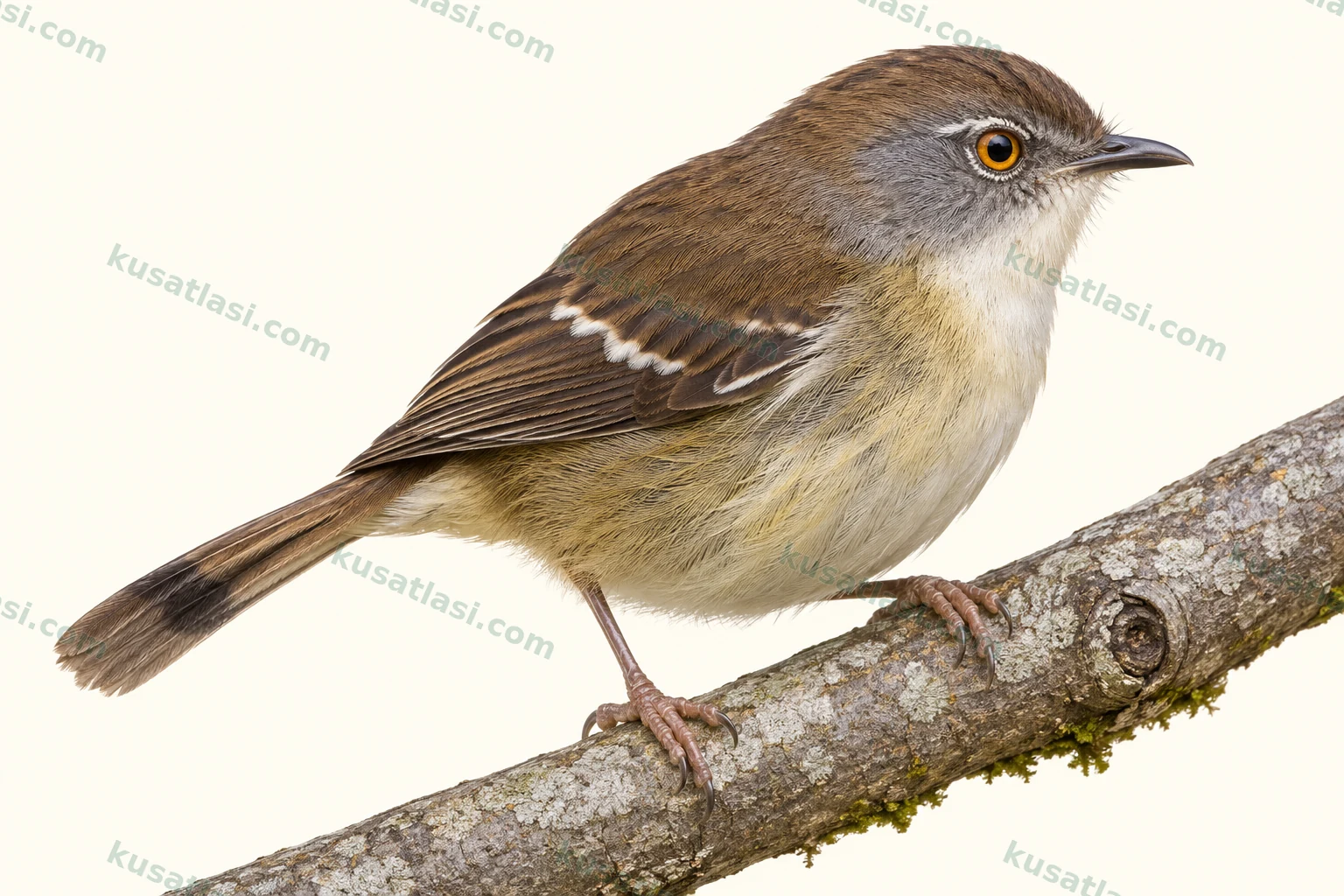
Swipe between the two adult plates.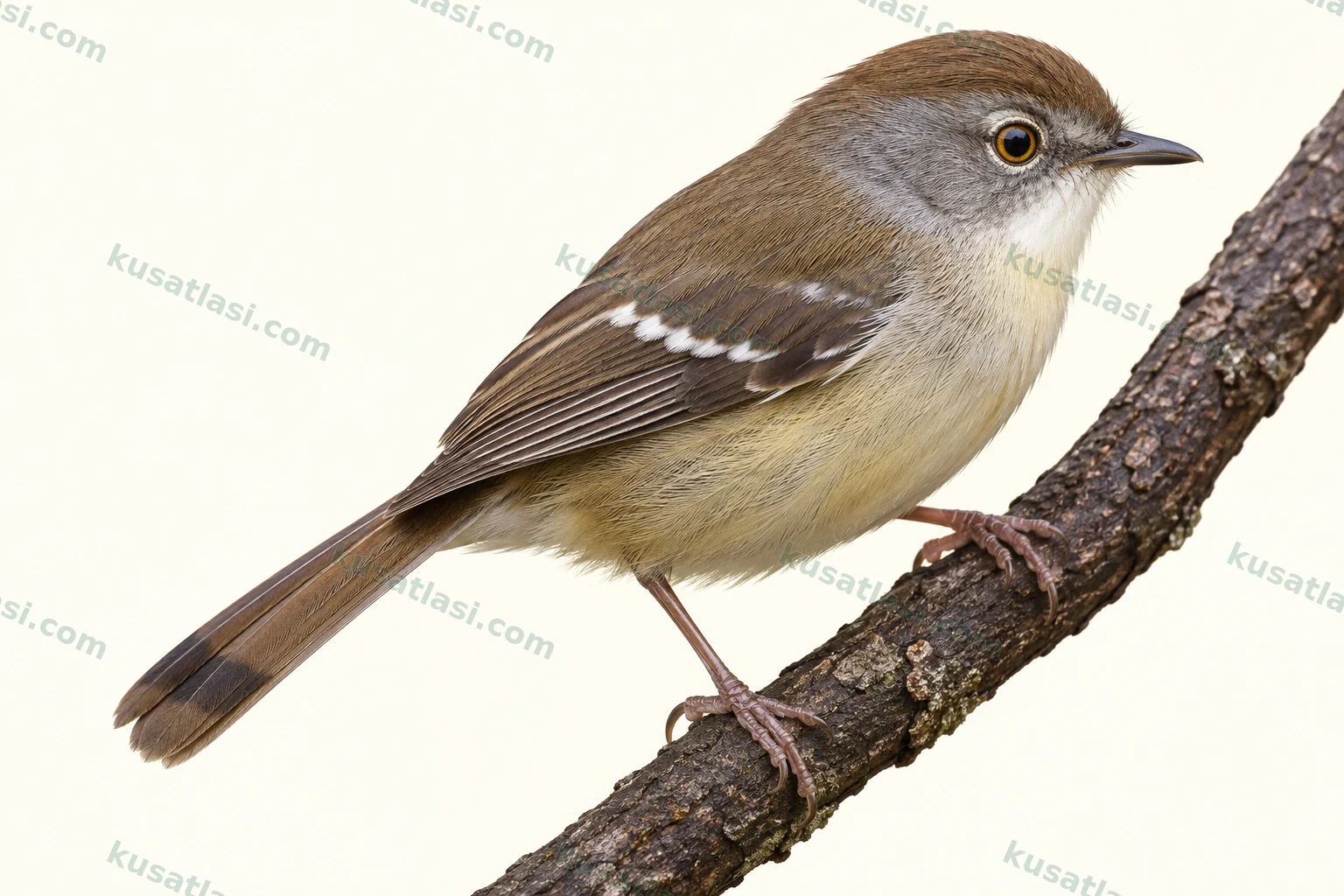
Acanthizidae · Passeriformes
Scrubtit
Acanthornis magna
Ak Gözlü Akantiz
Look for the pale eye, grey face, white wing mark and dark tail band together.
- Order
- Passeriformes
- IUCN Status
- LCLeast Concern
Biometrics
Length
- Male
- 11–12 cm
- Female
- 11–12 cm
Wing length
- Male
- 5.6 cm
- Female
- 5.6 cm
Weight
- Male
- 9.8–11.6 g
- Female
- 9–10 g
Detailed explanations of these measurements are available on our website, on the same species page.
At a Glance
- Grey face and pale eye
A narrow incomplete white ring lies behind and below the eye.
- White wing mark
Look for white-tipped coverts near the shoulder.
- Dark tail band
Confirm the broad black band before the tail tip.
Adult sexes share the same plumage. Juvenile eye colour and wing markings can help at close range.
Calendar
The calendar shows the September–January breeding interval in the Cornell synthesis, rather than exact island- and year-specific starting and ending dates.
January
Reported breeding period
February
Outside the stated window
March
Outside the stated window
April
Outside the stated window
May
Outside the stated window
June
Outside the stated window
July
Outside the stated window
August
Outside the stated window
September
Reported breeding period
October
Reported breeding period
November
Reported breeding period
December
Reported breeding period
Species Information
Quick Identification
Scrubtit is a small passerine of moist vegetation in Tasmania and on King Island. Assess its brown upperparts, pale underparts, grey facial mask and conspicuously pale eye together. The narrow white ring around the rear and lower edge of the eye is incomplete. A white wing mark near the shoulder and a black band before the tail tip provide further clues. The short bill curves slightly downwards at its tip.
Appearance and Posture
In Tasmanian adults, the olive-brown forehead and crown grade into greyer brown on the hindneck and neck sides. A broad pale eyebrow in front of the eye narrows behind it. Grey on the lower lores and ear coverts forms a mask. The head is best read as a combination of pale eyebrow, grey face and pale eye rather than as an undifferentiated brown area.
Olive-brown on the back becomes more reddish brown on the rump and upper tail coverts. The upper tail is dark brownish grey, with reddish-brown feather edges. Beyond its broad black subterminal band, some outer tail feathers have narrow white tips. The black band and the white terminal edges occupy different areas: the tail is neither wholly black nor uniformly white-tipped.
The wing is brownish grey. White tips to the outer greater coverts form a conspicuous mark near the shoulder. A second, smaller white area on the median coverts may be concealed beneath the scapular feathers. Chin and throat are white; the underparts have a light yellow wash, becoming light brownish on breast sides, flanks and undertail. The iris ranges from orange-yellow to yellow-brown, and the bill is dark grey with a potentially paler base to the lower mandible.
When feeding it clings sideways to tree and fern trunks and works both upwards and downwards. It may fly to the foot of a tree fern, climb its trunk and then repeat the search on another. This trunk-hugging movement can recall a treecreeper, but does not establish close relationship or identify the bird on its own.
Males, Females and Young Birds
Adult sexes share the same plumage pattern. Males are generally larger, but apparent size at a distance does not reliably determine sex. The Australian Bird Study Association’s in-hand guide describes a cream-white juvenile iris and an orange-yellow adult iris. Juveniles have less prominent white wing-covert markings. Birds that have replaced much of their first plumage can closely resemble adults, and these details require an adequate close view.
The King Island subspecies greeniana is generally somewhat paler, with a narrower dark band before the tail tip. The Cornell account also suggests a longer bill. These are comparative features of the island population; a small colour difference in an illustration is not sufficient evidence of subspecies identity.
Appearance in Flight
A moving bird may show its white wing-covert markings and dark tail band. The reviewed accounts do not establish a wingbeat pattern sufficient for identification on its own. In a fleeting view through dense cover, verifying the face pattern and tail band is more useful than judging the bird solely by the speed of its movements.
Voice and Behaviour
The song is a short, sweet musical phrase, sometimes preceded by very quiet, thin notes. Soft “peep”-like contact calls help maintain contact; rapid high notes can be given while feeding. The bird nevertheless often forages quietly and inconspicuously, so silence is not evidence of absence.
Birds occur singly, in pairs or in small family parties of up to four. Mixed feeding flocks may include Tasmanian Scrubwren, Tasmanian Thornbill and Golden Whistler. Several birds travelling together are not necessarily all the same species or adult helpers at a nest.
Similar Species
1. Tasmanian Scrubwren (Sericornis humilis): It can share the same moist cover and also has a pale eye, making that character insufficient on its own. Its conspicuous dark throat streaking differs from Scrubtit’s plainer pale throat. Look for Scrubtit’s grey face pattern and broad dark tail band together. Thomas’s Tasmanian study recorded more scrubwren feeding on ground and debris and more Scrubtit feeding on trunks and branches. That behavioural difference supports, rather than determines, identification.
World Distribution
Endemic to the Tasmanian region of Australia. Acanthornis magna magna occurs in Tasmania, while greeniana occupies King Island in western Bass Strait. The two subspecies’ island distributions are not interchangeable. In Tasmania, occurrence is linked to wet forest, more extensive in the west and more fragmented among suitable moist vegetation in the east.
Status within Its Range
In suitable Tasmanian wet forest this bird can easily be overlooked. Thomas’s 1974 study challenged some earlier claims of rarity that insufficiently considered habitat and observation methods. That historical field assessment does not mean that every forest patch supports the same density today.
The King Island subspecies occupies much more restricted, fragmented habitat. Tasmania’s official management profile lists it as endangered under state legislation and critically endangered under Australia’s EPBC legislation. These are legal assessments of greeniana, distinct from the global IUCN category of the species as a whole.
Seasonal Movements
Resident. Birds hold a territory while breeding and are thought likely to remain nearby throughout the year. Young can disperse in late summer and autumn. Such dispersal does not establish a regular migration route between King Island and Tasmania or a seasonal journey undertaken by the entire population.
Breeding Habitat
Cool-temperate rainforest and moist eucalypt forest with dense shrub and fern cover are characteristic habitats. Damp gullies, mossy trunks and a dense understorey are important. In the Tasmanian highlands it also uses densely shrubby subalpine forest, dwarf mountain vegetation and some low, dense scrub. Thomas’s 1974 study reported it in wet forests with few ferns, arguing against obligatory dependence on a particular fern. On King Island, mature Melaleuca ericifolia swamp forest and similar communities with dense undergrowth are especially important.
Nest Site
Breeding is reported from September to January, in pairs. The bulky, domed nest has a sheltered side entrance. It is built in dense cover, often among dead, drooping tree-fern fronds, but also in low bushes or brambles. Tree-fern hairs and fibres are used with bark strips, moss, rootlets, grass and leaves; small feathers and mammal fur may line the interior.
Clutches usually contain three eggs, sometimes four. Reddish or purplish-brown speckling on the pearly-white shell may concentrate near the broader end. Re-laying after clutch loss has been reported. Incubation and nestling durations could not be verified in the reliable sources reviewed, and no values are assigned. Leave the nest’s covering leaves intact when observing parental care.
Daily Habitat Use
It searches tree and fern trunks, branches, mossy surfaces and fallen wood. Much activity is in lower layers, but birds can work higher and occasionally reach the canopy. Its use of dense vegetation should not be reduced to an exclusively ground-dwelling lifestyle.
Diet
Food consists mainly of insects and other small invertebrates. The Cornell synthesis reports beetles, weevils, flies, lepidopterans and cockroach eggs, as well as spiders and small snails. This list does not imply equal consumption of each group or identical proportions across the range.
Thomas reports insect and spider remains from one Tasmanian stomach sample. That single-bird sample cannot quantify the species’ seasonal diet. Stomach contents of Tasmanian Scrubwrens discussed in the same study must not be reassigned to Scrubtit.
Foraging
It probes bark fissures and crevices and systematically searches trunks and branches. Leaves, fern fronds, moss, fallen trunks and leaf litter are also examined. Thomas’s Tasmanian field data emphasised tree trunks, branches and fern surfaces. These observations do not mean that ground feeding is impossible; they show why describing it only as a ground forager is inadequate.
Different Feeding Surfaces in One Forest
Thomas’s 1974 Tasmanian study compared Scrubtit with Tasmanian Scrubwren and Tasmanian Thornbill. Scrubwrens more often used ground debris, thornbills leaves and fine twigs, and Scrubtits trunks and larger branches. Sharing a forest does not mean that the birds use identical feeding surfaces in identical ways.
Foraging surfaces were recorded over 27 hours, with a limit on records per individual to reduce undue influence from one bird. The surface comparison includes 115 Scrubtit observations, not a count of 115 different birds. The differences provide field evidence of resource partitioning; they do not prove that competition never occurs anywhere in Tasmania.
Genetic Structure on King Island
Crates and colleagues’ 2024 study compared samples collected on King Island and in Tasmania during January–March 2021. The three King Island subpopulations were genetically differentiated and had lower genetic diversity than most sampled Tasmanian populations. This does not describe the entire species uniformly; it highlights the importance of connectivity among the small island populations.
An Egg from Another Species
The Cornell account reports brood parasitism by Fan-tailed Cuckoo and Shining Bronze-Cuckoo. Not every egg or chick in a Scrubtit nest can therefore automatically be assigned to the host. These records establish occurrence of brood parasitism, not exposure of every nest or a measured regional parasitism rate.