
World Birds
Field Guide Plates
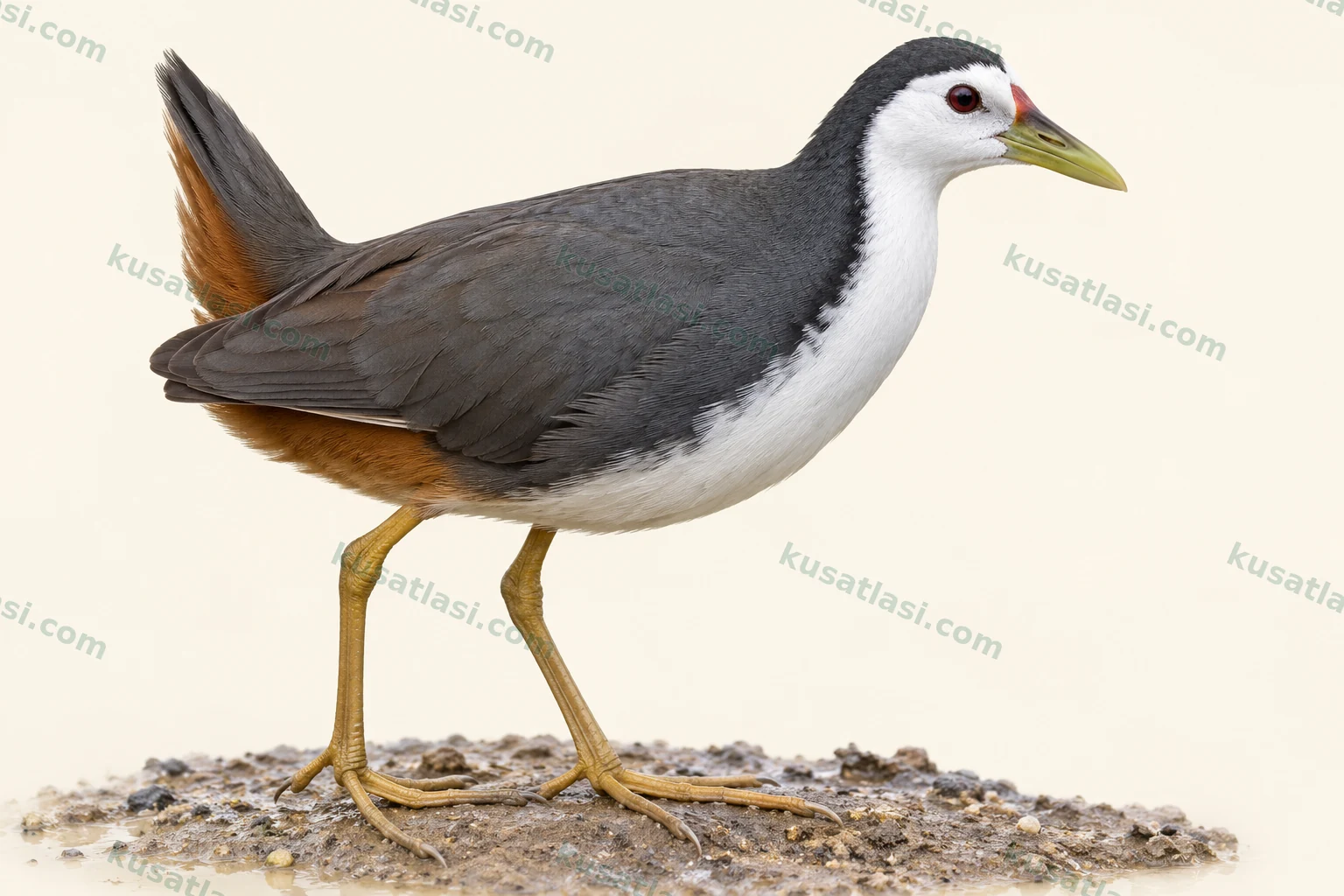
Swipe between the two adult plates.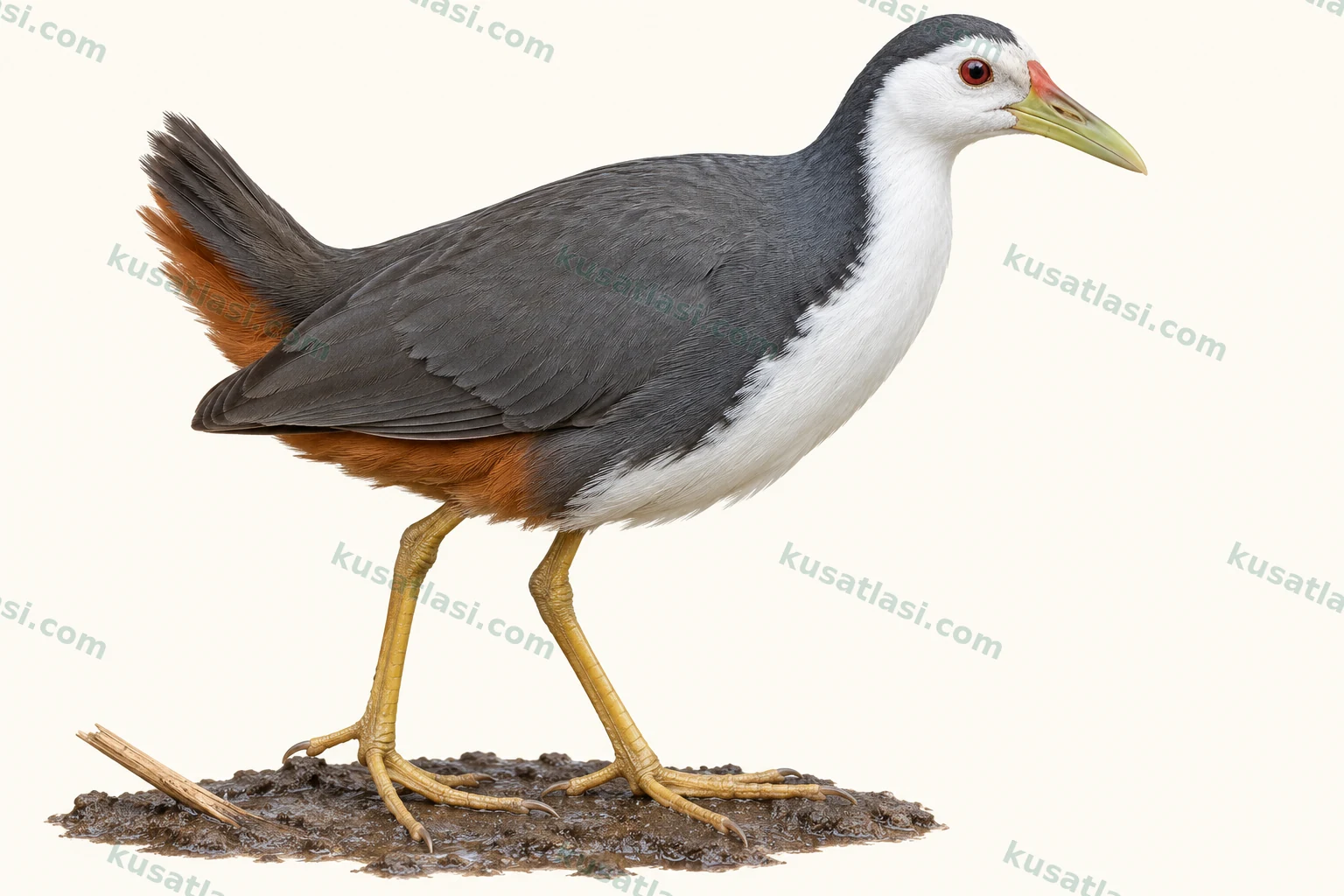
Rallidae · Gruiformes
White-breasted Waterhen
Amaurornis phoenicurus
Ak Göğüslü Suyelvesi
Look for the white face and breast, dark back and rufous undertail together.
- Order
- Gruiformes
- IUCN Status
- LCLeast Concern
Biometrics
Length
- Male
- 28–33 cm
- Female
- 28–33 cm
Wing length
- Male
- 14.7 cm
- Female
- 14.7 cm
Weight
- Male
- 203–328 g
- Female
- 166–225 g
Detailed explanations of these measurements are available on our website, on the same species page.
At a Glance
- White face and breast
Look for the strong contrast with the dark upperparts.
- Rusty undertail
Often more visible when the short tail is raised.
- A ground-walking waterbird
Search banks beside concealing vegetation as well as open water.
Male and female have similar plumage; variable bill colour does not establish sex.
Calendar
This calendar shows only the June–October breeding period reported for India and Pakistan in the Cornell account. Other regional calendars are explained in the Habitat chapter.
January
Outside the stated window
February
Outside the stated window
March
Outside the stated window
April
Outside the stated window
May
Outside the stated window
June
Reported breeding period
July
Reported breeding period
August
Reported breeding period
September
Reported breeding period
October
Reported breeding period
November
Outside the stated window
December
Outside the stated window
Species Information
Quick Identification
White-breasted Waterhen is a short-tailed rail often encountered walking out of waterside vegetation. In adults, the white face, throat and breast contrast strongly with a dark slate back, while a rusty patch beneath the tail provides a third conspicuous colour. Rather than identifying a partly concealed bird from its breast alone, look for the combination of a white face, dark flanks and rufous undertail on the same individual.
A yellow-green bill and red at the base of the upper mandible complete the familiar adult appearance. Their intensity changes with age and breeding condition, however, so a dull-billed individual glimpsed behind reeds should not immediately be assigned to another species. Leg colour also varies, from dull yellow towards brighter orange-yellow, and is not an independent test of either age or sex.
Appearance and Posture
The body looks full in side view, with a short tail and conspicuous legs and toes. A dark crown and nape lead into similarly dark upperparts and upperwing coverts. The lower back and rump can have a brownish wash. White extends from the forehead and face through the throat and breast to the centre of the belly, leaving darker sides to the breast and flanks. The rufous area is mainly beneath the tail and around the rear lower body, rather than a bright patch on the tail itself.
As it walks, the bird frequently flicks its short tail, alternately exposing and concealing the rusty undertail. Long toes help it negotiate floating plants and muddy vegetation. Although it swims competently, searching open water alone can miss birds that are walking along the bank or slipping between stems. Its usual setting and way of moving are useful supporting clues, but neither replaces the plumage characters needed for identification.
Males, Females and Young Birds
Males and females have similar plumage. Females may average smaller and can have duller bills and frontal shields, particularly during breeding, but these are overlapping tendencies. Apparent size or colour in a single photograph does not establish sex. In breeding adults, the red area at the bill base can enlarge and brighten; outside breeding it may shrink and become browner. Seasonal condition therefore needs to be considered before treating a colour difference as a difference between male and female.
Newly hatched chicks are covered in very dark, almost black down and have dark bills and legs. Older young birds do not yet show the clean white-and-slate contrast of adults. Their upperparts can be browner, the face and underparts dingy white or greyish, and the undertail less richly coloured. An incompletely white face does not by itself rule out a young waterhen. Dull bill and leg colours should be assessed with the whole plumage and, when present, accompanying adults.
Birds retaining some juvenile feathers can show differences in colour and wear among their wing coverts. The Cornell account explains how contrasts between older juvenile feathers and renewed coverts may assist ageing. The extent of this early molt varies, however, and aspects of it still require study. An exact calendar age should not be assigned from a distant photograph of a bird with its wings closed, especially when the relevant feather tracts cannot be examined.
Appearance in Flight
The wings are rounded and the tail is short and rather square-ended. The upperwing continues the dark appearance of the back. From a suitable angle, the white face and underparts and the rufous rear underbody can remain useful in flight, although a brief take-off may reveal only part of this pattern. A single dark section of wing is not enough to confirm the species without other visible characters.
Frequent encounters on the ground should not be taken to mean that the species cannot fly. It makes flights between locations, and some northern populations undertake seasonal movements. Conversely, a short flight across a pond is not evidence that an individual is migrating. What a bird is doing at the moment and the seasonal movement pattern of its population are different kinds of information and should be interpreted separately.
Voice and Behaviour
The voice can be surprisingly powerful and varied, combining harsh cries, croaking or grunting notes and chuckling sequences. Repeated notes resembling “kru-ak” may form part of an extended calling bout. Calling is especially conspicuous early in the morning and in the evening, and can also be heard at night. The caller may remain hidden, or may be positioned towards the top of a shrub or a stand of bamboo rather than directly beside the water.
Birds are usually seen singly or in pairs. They can conceal themselves in vegetation yet emerge to feed quite openly at places where they tolerate people. They also climb bushes and trees, so a calling bird should not be searched for only at ground level. Waiting quietly for it to emerge provides a better observation opportunity than opening the vegetation or attempting to drive it into view, particularly where young birds or a nest may be present.
Similar Species
1. Common Moorhen (Gallinula chloropus): Adults have a dark face and breast, a white line along the flank and white undertail coverts. Adult White-breasted Waterhen instead combines a white face and breast with a rufous undertail. Juvenile moorhens can have a pale throat, so throat colour alone is insufficient: the flank line and undertail pattern should also be checked.
2. Ruddy-breasted Crake (Zapornia fusca): Adults have a deep reddish face and underparts, red legs and a dark bill, differing from the extensive white face and breast of an adult waterhen. Young Ruddy-breasted Crakes can have a white chin and throat; compare their barred underparts and the complete head-and-body pattern rather than a small pale patch. A partly hidden young bird may need a better view before it can be identified securely.
World Distribution
Its natural range extends from Pakistan and the Indian subcontinent to eastern China, south through Southeast Asia and the Philippines into the Indonesian islands. Sri Lanka, the Maldives and the Andaman and Nicobar islands are included in this broad distribution. It also occurs on Sulawesi, in the western Moluccas and in the Lesser Sundas. Seasonal occurrence towards the northern limit should be distinguished from year-round occupation of tropical islands.
Status within Its Range
The species is resident across much of its range, but its local abundance is uneven. In Singapore it is a very common resident that also uses parks, ponds and urban drains. That local status does not demonstrate an increase throughout Asia. Its ability to live near people should likewise not be read as evidence that vegetative cover and wetland conditions are unimportant wherever it occurs.
Seasonal Movements
Some northern breeding populations move south for winter. The Cornell synthesis reports wintering birds on Sumatra between November and April, and records extend west to Arabia. The extent of departure from the northernmost breeding areas and the detailed seasonality of these movements remain incompletely understood. A single fixed route or universal arrival and departure date would therefore misrepresent the species.
Range expansion towards Japan also shows that a species described as largely resident can reach new areas. Occurrence at a new locality, confirmed breeding there and the establishment of a persistent population are separate stages; one sighting does not demonstrate all three.
Breeding Habitat
Breeding settings include grassy and reedy marshes, rice-field margins and dense growth around ponds and ditches. Shrubs, bamboo and tangled waterside plants also provide nesting cover. Timing is regional: the Cornell account gives June–October for India and Pakistan and April–October for the Ryukyu Islands, while breeding on some tropical islands may occur in widely separated months. These populations do not share one universal nesting calendar.
Nest Site
The nest is a shallow cup or pad of twigs, creeper stems and leaves of wetland plants. It may be placed on the ground among grass or tangled growth near water, or above ground within a shrub or bamboo clump; some nests are away from water. The Cornell species account reports clutches of 4–9 eggs and an incubation period of about 20 days, with both sexes incubating. Dark downy chicks leave the nest soon after hatching, and both parents feed and care for them. Early mobility should not be confused with independence from parental care.
Daily Habitat Use
Outside the immediate nesting context, use of habitat is not restricted to freshwater banks: mangroves, forest edges, damp scrub and vegetated areas near habitation are also occupied. Feeding openings and nearby concealment are both used. When watching a family, avoid moving between adults and chicks or parting vegetation to locate a nest.
Diet
Both animal and plant foods are taken. Reported items include worms, molluscs, insects and their larvae, spiders and small fish, as well as grass seeds and the shoots and roots of marsh plants. This list is not a measured dietary proportion shared by every individual. The bird should not be characterised exclusively as a fish predator or a seed eater, and observing one kind of food does not describe its complete diet.
Foraging
It searches while walking, picking small items from the ground and also pecking seeds from standing grasses. Open edges and shallow water provide feeding opportunities, and its long toes help it move across floating vegetation. Feeding on beaches at low tide has been reported in the Maldives, so its foraging cannot be confined to freshwater ponds alone. When recording a feeding observation, identify the item actually seen being taken rather than assuming the presence of an unseen prey animal from a peck or a movement of the head.
Concealment in the Activity Record
At one lake on the Jahangirnagar University campus in Bangladesh, observations from May 2007 to April 2008 assigned 35.46% of recorded daytime activity to foraging and feeding and 26.75% to hiding. The study covered 48 field days and 309 hours. These are results from scan observations at a particular site, rather than fixed proportions for the entire species, and they do not measure nocturnal activity or a complete 24-hour budget.
Breeding beyond the Former Range
Buden and Retogral’s 2010 paper reports a breeding population on Woleai Atoll in Micronesia. The suggestion that the birds arrived in the early 1970s comes from islanders’ accounts, rather than observations made by the authors at that time. Confirmation of breeding and reconstruction of an earlier arrival date therefore have different evidential bases. The paper separately discusses local reports from neighbouring atolls.
A Common Species Can Decline Locally
Hong Kong breeding atlases recorded the species in 18.2% of squares in 1993–1996 and 9.6% in 2016–2019. This is a change in recorded atlas-square occupancy, not a calculation of the same percentage decline in individual birds. Local contraction can coexist with expansion elsewhere. Easy observation at some sites therefore does not show that every wetland with historical records still supports the species.
Geographical Variation
The 2023 Cornell revision treats five subspecies. The extent of dark colouring on the head and flanks varies geographically, and some island birds show more extensive white. An individual differing from a familiar mainland appearance should not automatically be labelled young, female or a different species. Assessing subspecies requires locality and the broader pattern of variation, rather than a single colour difference.