
World Birds
Field Guide Plates
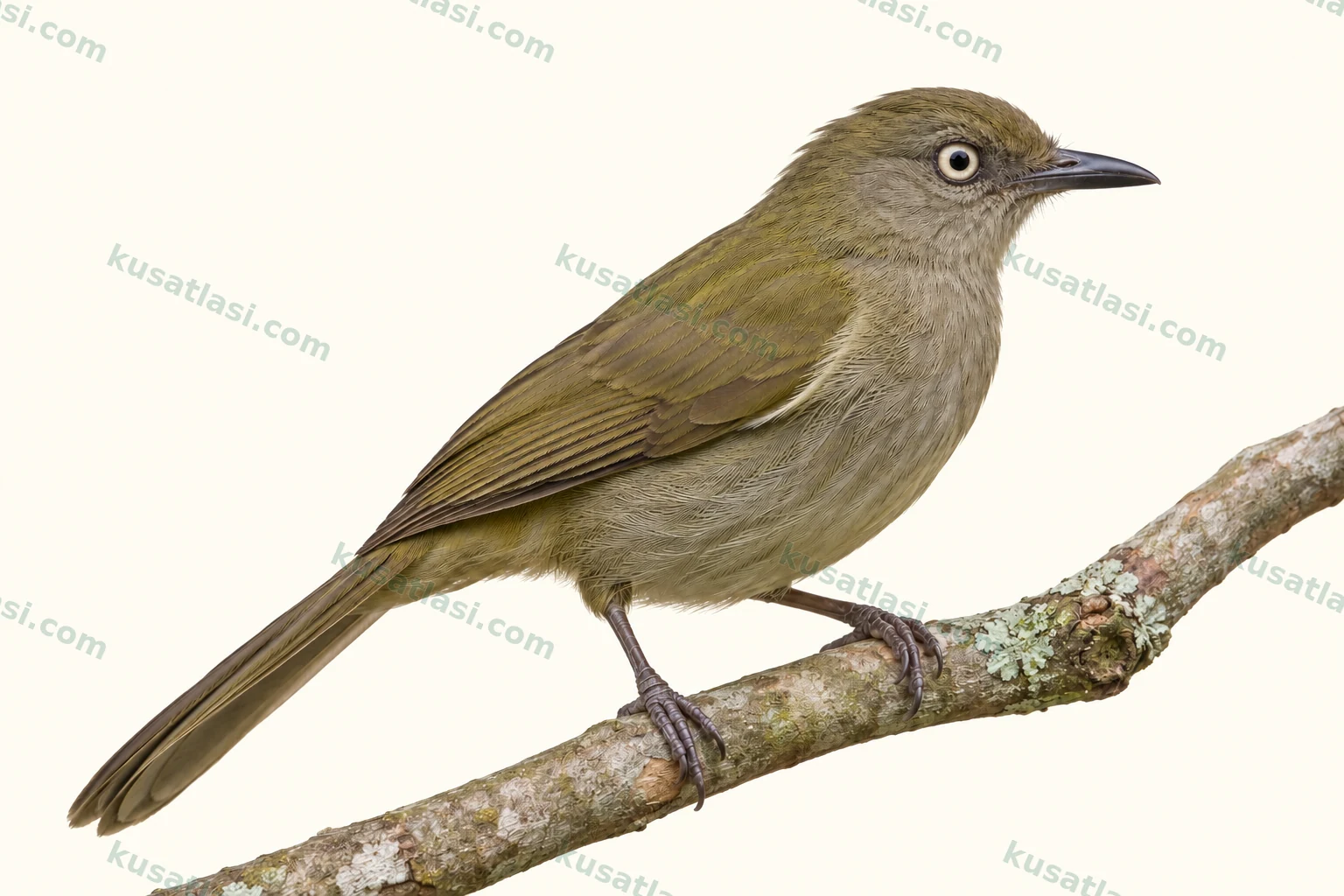
Swipe between the two adult plates.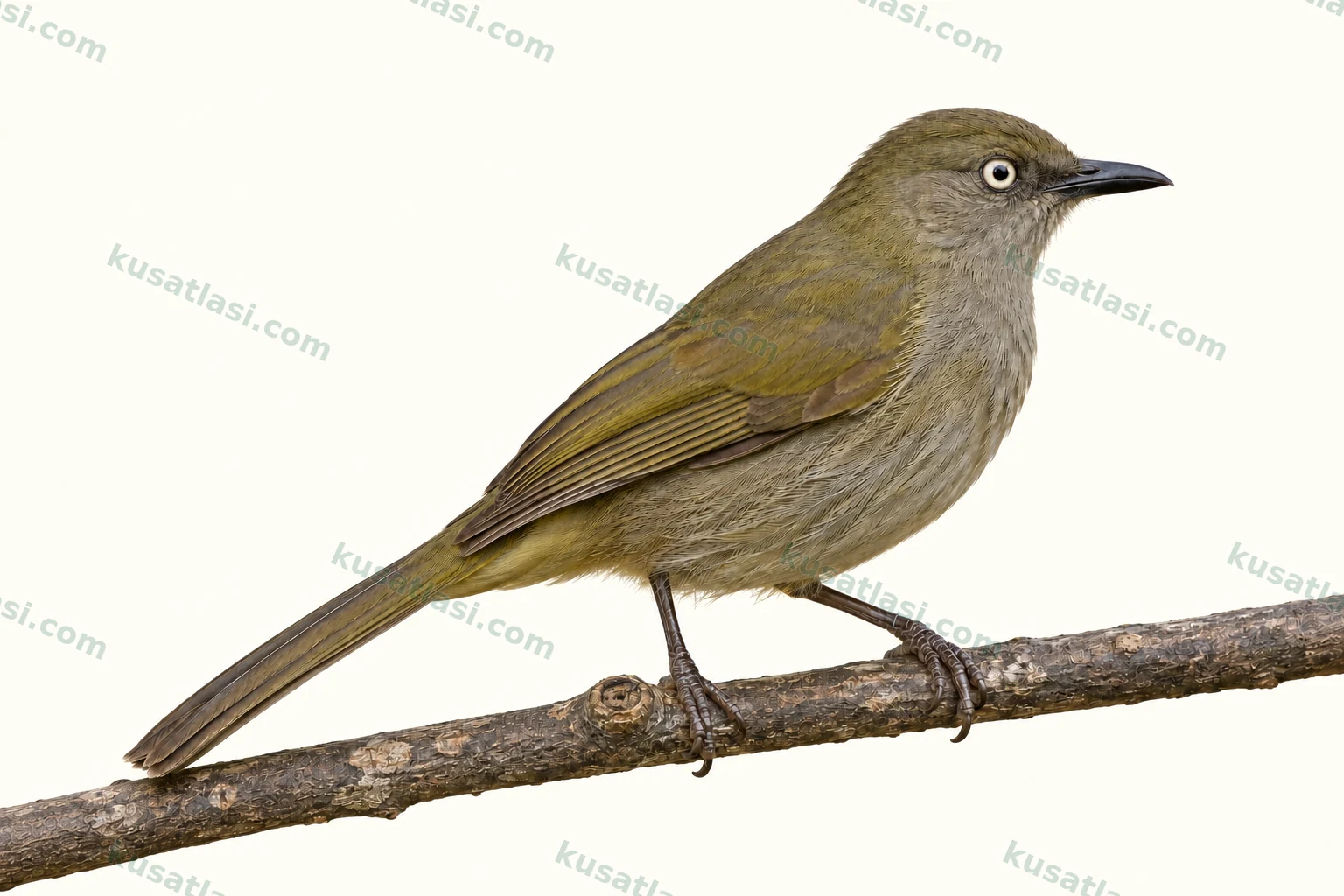
Pycnonotidae · Passeriformes
Sombre Greenbul
Andropadus importunus
Ak Gözlü Yaprakbülbülü
Combine the plain olive body, pale adult iris and geographically variable underpart colour.
- Order
- Passeriformes
- IUCN Status
- LCLeast Concern
Biometrics
Length
- Male
- 15–18 cm
- Female
- 15–18 cm
Wing length
- Male
- 8.89 cm
- Female
- 8.89 cm
Weight
- Male
- 25–40 g
- Female
- 22–33 g
Detailed explanations of these measurements are available on our website, on the same species page.
At a Glance
- Pale adult iris
Initially brown in young.
- Plain olive upperparts
No prominent body spotting.
- Loud persistent calls
The bird may remain concealed in foliage.
Sexes look alike; young initially have dark eyes. Yellow intensity also varies geographically.
Calendar
Resident. Nesting months differ in Kenya, Zanzibar and South Africa; regional records are described separately.
Species Information
Quick Identification
Sombre Greenbul is a plain olive-green bulbul of dense vegetation in eastern and southern Africa. In adults, the white or pale yellow iris contrasts with a largely unmarked body. The amount of yellow below varies geographically; not every individual has the same dull greyish belly.
It often remains concealed in foliage and is first detected by its loud voice. Young initially have dark eyes, so the pale adult iris should not be required at every age.
Appearance and Posture
In the southern nominate form, head, back, wings and tail are dark olive-green. Throat and underparts are olive-grey, with a slightly paler belly. The bill is black or slaty and the legs can appear dark grey, blackish or dark olive-brown. Plain body plumage alone does not identify any small greenish bird.
The more northerly insularis form is generally paler and browner olive, with a pale yellow belly. Oleaginus has stronger yellow from the lower breast to the undertail, while hypoxanthus is described as greener above and brighter yellow below. These are geographic differences; two differently coloured birds should not automatically be labelled male and female.
When feeding, it can clamber through leafy branches. It sometimes emerges to sing from a bush top or exposed branch, retreating quickly into cover when alarmed. Such brief appearances can offer a useful view of head and eye.
Males, Females and Young Birds
Males and females share similar plumage, with females averaging smaller. Apparent size or the amount of yellow on one bird does not provide reliable sex identification.
Young can be richer olive-green above and brighter yellow below, with an olive-green wash across the breast. Initially the iris is brown, the eye-ring yellow and the gape orange. These bare parts gradually approach adult appearance; development of the pale eye and changes around it are progressive. A single photograph should not establish an exact age in months.
Appearance in Flight
Usually observed within dense cover. It may occasionally catch a flying insect in the air. That feeding flight alone does not identify the species. On landing, assess the plain plumage, iris and geographically variable underpart colour together.
Voice and Behaviour
Gives loud persistent vocalizations throughout the year, potentially through much of the day during breeding. In the South African form, a penetrating “willie” can be followed by a rapid jumble ending in a wheeze or downslurred whistle. Kenyan insularis has different short rapid sequences that may rise at the end. One regional written rendering should not be treated as the unvarying song of the entire species.
Usually seen alone or in pairs, with larger groups possible at abundant fruit outside the breeding season. Hearing a strong voice without seeing its source is consistent with its habit of staying within foliage. Cover need not be disturbed to obtain a view.
Similar Species
Yellow-bellied Greenbul, Chlorocichla flaviventris, can be confused especially with yellow-bellied geographic forms. It looks larger and darker-headed, with prominent white eyelids but a dark brown, reddish-brown or red iris. A white eyelid is distinct from a pale iris within the eye. Assess head, eyelid, iris and voice together; juvenile eyes do not always provide the adult distinction.
World Distribution
Occurs in eastern and southern Africa, from extreme southern Ethiopia and southern Somalia through Kenya and Tanzania to suitable parts of Mozambique, Malawi, Zambia, Zimbabwe, Eswatini and South Africa. The coastal belt is important, but riverine vegetation and wooded valleys also carry the range inland.
Four subspecies are recognized. Insularis occurs in the northeast and Zanzibar; hypoxanthus includes southeastern coastal Tanzania, Mafia Island and parts of the interior farther south. Oleaginus is associated with southern Zimbabwe, southern Mozambique and northeastern South African lowlands. Nominate importunus extends from higher northern South African areas south along the coastal belt to the Western Cape. These are broad geographic outlines, not presence throughout every country.
Status within Its Range
Common or locally abundant through much of its range. Although it favours natural vegetation, it can also use wooded gardens and some secondary habitats. Such flexibility does not make loss of dense scrub and woodland irrelevant. Older regional density estimates should not be treated as a current total African population.
Seasonal Movements
Sedentary. A 2014 analysis of southern African ringing records reported strong adult site fidelity and suggested limited juvenile dispersal. This does not mean that no individual ever moves. Groups may wander locally for fruit outside the breeding season, without establishing regular intercontinental migration.
Breeding Habitat
Dense coastal scrub, thickets and forest are principal habitats. It also uses riverine bush and forest strips, thick cover within thorn woodland and some wooded gardens. In South Africa it follows wooded valleys up mountain slopes into evergreen mist-belt forest; in Mozambique it is also recorded in riparian reedbeds. It is not restricted to one vegetation community throughout its range.
Nest Site
The female builds a shallow open cup of fine twigs, dry grass stems, rootlets, lichen and plant fibres, lining it with finer material. It may sit in the fork of a densely foliaged small tree or shrub, or near a branch tip, attached with cobwebs. A nest near a branch tip can also be supported by foliage.
Clutches contain one to three eggs, usually two. The female incubates and the male has been seen bringing her food. The expert synthesis gives twelve to seventeen days of incubation and a nestling period of ten and a half to sixteen days. Both parents feed young; brooding is by the female alone at some nests and by both adults at others. Fledglings may be fed for about another three weeks. These durations are not fixed deadlines for every individual.
Timing varies geographically. Nesting records include April–October and December in Kenya; mainly September–January, also May–June, in Zanzibar. South African records extend from July–May in the Eastern Cape and September–April in the Western Cape, with an October–November emphasis in both. Such broad record ranges do not mean that a pair breeds continuously throughout those months. Observe nests from a distance without flushing adults.
Daily Habitat Use
Usually forages in the leafy canopy of forest and thickets, but may descend into lower growth or leaf litter beneath low scrub. Concealment is characteristic, though occasional exposed perches are normal. A gathering at a fruit source should not be interpreted as the number of family helpers attending one nest.
What Does It Eat?
Fruit and berries are the principal foods. The expert account includes figs, Commiphora, Rhus and many other plant genera. Arthropods and small snails are also taken, so it should not be described as eating fruit exclusively. A long plant list does not establish obligatory dependence on one fruit or identical dietary proportions in every region.
How Does It Forage?
Clambers among leafy branches to gather fruit and other food. Although usually foraging in the canopy, it may search ground litter and occasionally catch flying insects. Groups may gather at abundant fruit outside breeding. Such feeding aggregations do not establish permanent large flocks throughout the year.
Two Rhythms in Courtship
In the courtship display described by the expert account, partners face each other on a horizontal branch. The male bobs his head in an elliptical motion while occasionally turning completely around, with raised crown and nape feathers and slightly spread, quivering wings. The female also bobs, but out of phase, while both give soft calls. Plain plumage therefore need not imply an uncomplicated display; the observation does not establish an unchanging lifelong pair bond.
Geography of Moult
A 2014 analysis of southern African ringing data reported progressively later onset of primary-feather moult towards the north, while moult duration did not vary significantly with latitude. Start date and total duration can therefore show different patterns: beginning later need not mean taking longer. This is a regional data-analysis result, not one monthly schedule for the whole of Africa.