
World Birds
Field Guide Plates
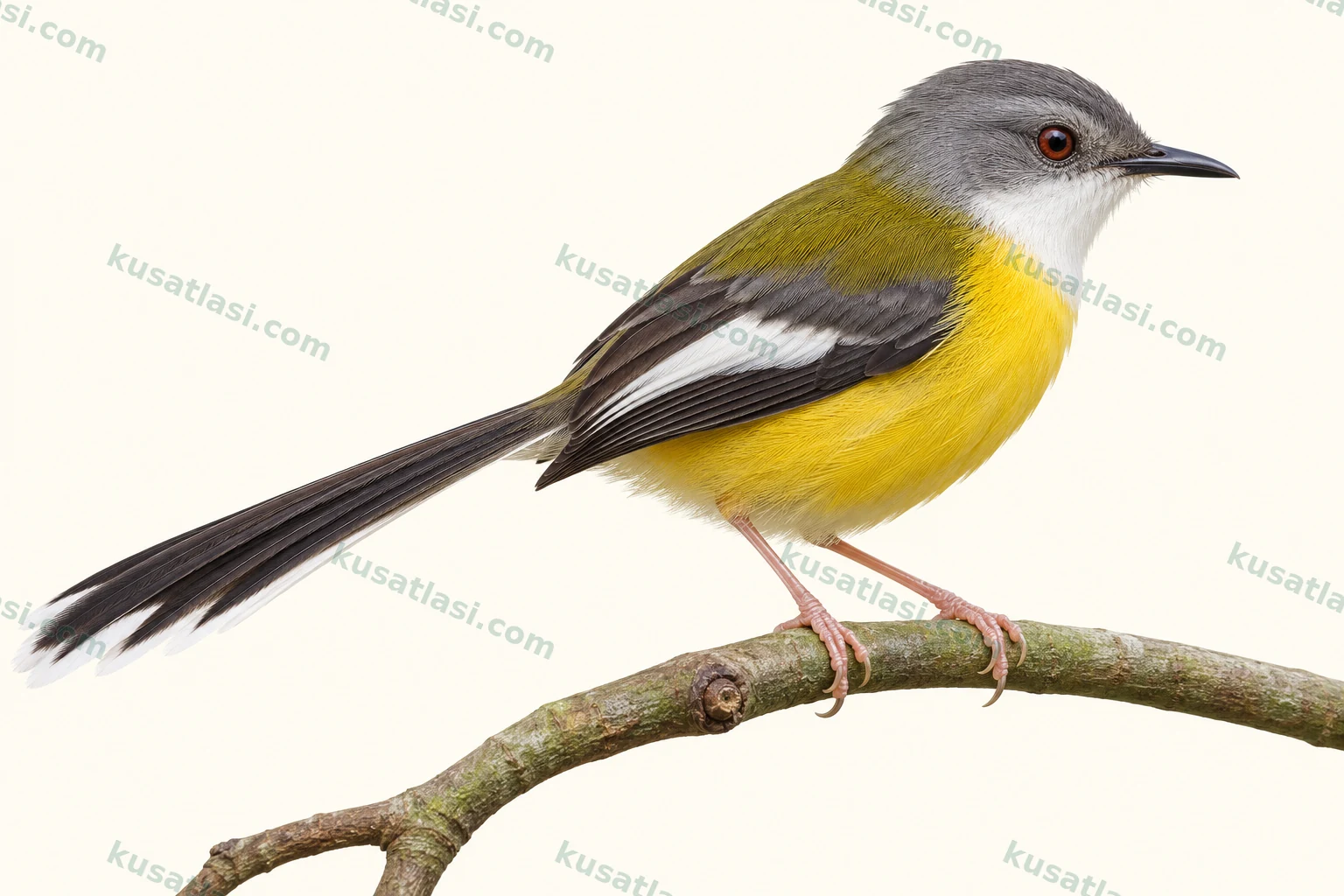
Swipe between the two adult plates.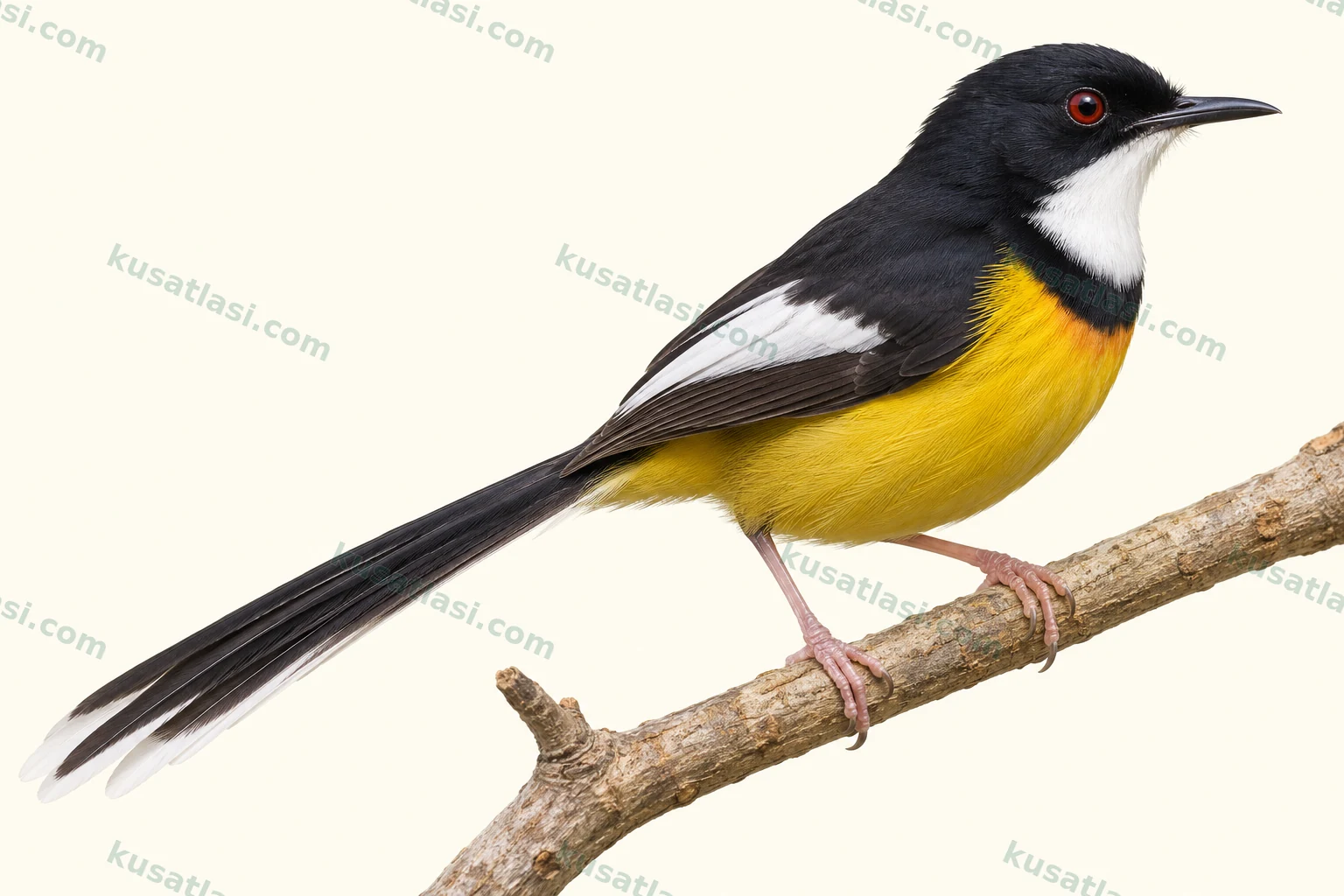
Cisticolidae · Passeriformes
White-winged Apalis
Apalis chariessa
Ak Kanatlı Apalis
Assess the yellow underparts, white wing panel and very long graduated tail together.
- Order
- Passeriformes
- IUCN Status
- NTNear Threatened
Biometrics
Length
- Male
- 12–13 cm
- Female
- 12–13 cm
Wing length
- Male
- 5.15 cm
- Female
- 5.15 cm
Weight
- Male
- Data unavailable
- Female
- 8 g
Detailed explanations of these measurements are available on our website, on the same species page.
At a Glance
- White wing panel
Conspicuous among dark wing feathers.
- Yellow underparts
Dark breast band below a white throat.
- Strongly graduated tail
Increasing white and shorter feathers towards the outside.
Adult males are black above; females have a gray head and olive back. Both sexes show the white wing panel. Young resemble females but are duller and shorter-tailed.
Calendar
Generally resident; possible local and elevational movements remain poorly understood. Malawian breeding observations are not converted into the same monthly calendar for other countries.
Species Information
Quick Identification
White-winged Apalis is a colourful bird of fragmented East African forests, usually seen high in tree crowns. Assess its conspicuous white wing panel together with yellow underparts and a long tail whose outer feathers are much shorter than the central ones. Adult males are glossy black above; females show olive-green and gray tones. Both sexes have a white wing panel.
General Appearance and Posture
Adult males have a glossy black forehead, crown, nape, face, back and rump. The chin, throat and neck sides are white. A black upper-breast band separates the white throat from warmer colours below. An orange band beneath it merges into the yellow belly and flanks; the undertail coverts are white. Some males have little orange.
Male wing feathers are blue-black. Broad white edges on the inner flight feathers form a conspicuous panel on the closed wing. The whole wing is not plain white: the arrangement of dark feathers and the pale panel matters. Male underwing coverts and the area at the body–wing junction are also white.
Females have a slate-gray forehead, crown and head sides, with an olive-green back and rump. The chin, upper throat and neck sides are white. The upper-breast band looks sooty gray rather than the male’s black, with orange-buff along its lower edge merging into the yellow belly and flanks. The wings combine dark gray-blackish areas, olive feathers and the white panel.
Both sexes have a strongly graduated tail: central feathers are long and the outermost ones much shorter. White increases towards the outside, with the outermost tail feather entirely white. The amount of visible white can consequently vary as the tail opens or the viewing angle changes.
The bill is black, the eye brown, and the legs and feet pinkish brown. Birds move actively among high branches. Combine the yellow belly and white throat seen from below with the wing panel in a side view and, when visible, the long tail pattern.
Males, Females and Young Birds
Head and back colour are useful for sexing adults: glossy black in males, contrasting with a gray head and olive back in females. The white wing panel is not restricted to males. Consider the breast-band colour and surrounding plumage together.
Young observed in Malawi resembled females but were duller and shorter-tailed. A short tail alone does not establish female sex or juvenile age; assess feather condition and the complete pattern. Detailed molt information is limited, so reduced orange should not be used to assign a precise age.
This plumage description mainly concerns macphersoni, the subspecies living in Tanzania, Malawi and Mozambique. Historical Kenyan specimens of the nominate chariessa should not be assumed to match every detail of birds seen today.
Appearance in Flight
An open wing reveals contrasting white and dark areas, while the graduated tail shows more white towards its outer feathers. White underwing coverts may also be visible in males. After a distant or brief flight view, reassess the yellow underparts, throat and head-and-back colour rather than relying on a white flash. Detailed flight behaviour is poorly documented, so no particular wingbeat pattern is offered as decisive.
Voice and Behaviour
Its prominent song is a tightly coordinated duet. The basic four-note unit contains two notes from the male and two from the female. Rapidly repeated phrases resembling “tee-lu dee-lu” can sound like one bird. A male sometimes gives its own two notes and leaves a gap for the female. Hearing two notes does not establish that only one bird is present.
Usually seen in pairs or small groups, which may be families but are not all confirmed relatives. Frequently joins mixed-species feeding parties. Tanzanian observations particularly emphasise use of the highest parts of tree crowns.
Similar Species
Throat or breast colour alone is insufficient among apalises in the same forest. White-winged Apalis combines bright yellow underparts, a very long graduated tail and a conspicuous white wing panel. Seeing that combination is more dependable than one dark breast band.
In Tanzania it can occur in the same elevational zones and forest types as Apalis melanocephala. Membership of the same mixed flock therefore does not settle identification. Position within the tree crown can help observation, but is not a rule replacing plumage details.
World Distribution
The principal currently known range consists of separated forest areas in Tanzania, Malawi and Mozambique. Tanzanian sites include the Uluguru and Udzungwa Mountains and Sali Forest in the Mahenge Mountains. The latter is reported in the 2025 expert account as the author’s July 2025 field observation, rather than a detailed population census.
In Malawi there are records from southeastern highlands, the Zomba area, Thyolo and Mulanje, among other sites. Mount Chiperone and Mount Namuli are known localities in Mozambique. The gaps between mountains should not be treated as continuous occupied range or a mapped migration route.
Status within Its Range
For the nominate chariessa of forests along Kenya’s lower Tana River, no confirmed record is known after 1961. The 2025 expert account considers that Kenyan population locally extinct. This is not extinction of the species as a whole: macphersoni survives in the other countries.
Forest loss is a major pressure, especially in Malawi’s small remnants and some Mozambican mountain forests. A historical record does not establish that the same forest survives today. Local estimates of pair numbers are not equivalent to a current, complete global census.
Movements and Migration
Generally considered resident, although local and elevational movements remain poorly understood. Birds seen in a small, lower-elevation Tanzanian forest fragment during the cold season suggested possible seasonal altitudinal movement. Without tracking the same individuals, the record does not establish an annually repeated route.
Breeding Habitat
Mostly uses large, spreading crowns of lightly foliaged trees in mid-elevation forest. Clearings, forest edges and some riparian woodland are important. In Malawi it spends considerable time in trees such as Albizia and Newtonia. Not every part of dense closed forest should be assumed to provide equivalent habitat.
Regional differences matter. Malawian records emphasise relatively dry Albizia forest, while Tanzanian records also regularly come from clearings in wet, luxuriant mid-elevation forest. The association with drier forest in one country should not be generalised into avoidance of humid forest throughout the range.
Nest Site
Direct nest information comes from Malawi. Historical records describe bag-shaped nests of hanging Usnea lichen, suspended from branches. White silky plant fibres line the cup and the entrance is from above. Historical natural nests on high branches are not the same sampling conditions as lower nests built on human-supplied lichen in a Zomba garden.
Three eggs were recorded in one historical Malawian nest; the current expert account suggests that two may sometimes occur. Eggs are described as pale green with faint underlying gray marks and yellow-brown spotting. Seeing three fledglings does not directly document three eggs unless the clutch was counted.
A 2020 observational account of assisted garden nests in Zomba, Malawi, inferred incubation of about seventeen days and a nestling period of seventeen to eighteen days. Starts and hatching were inferred from behaviour such as quietness and food delivery, rather than continuous observation of eggs. These are approximate local observations, not fixed exact periods established for every country.
In the same Zomba records both sexes built, and the male brought food to the incubating female. Both parents fed young and removed faecal sacs. Breeding starts were recorded at different times in Malawi, with some pairs raising two broods in a year; the same calendar has not been established for Tanzania.
Daily Habitat Use
Usually forages in tree crowns but may descend to lower branches around gaps and edges. Use of large garden trees does not establish independence from surrounding natural forest. Assess riparian strips, mature trees and the remaining forest patches together.
What Does It Eat?
Detailed dietary information is scarce; insects and other small invertebrates are considered its main food. At nests in Zomba, Malawi, the male brought mainly caterpillars to the incubating female. Caterpillars and spiders were also directly recorded being delivered to young.
These records document food delivery during breeding, not exact year-round adult dietary percentages or prey composition in every country. Feeding by the male does not mean the incubating female remains in the nest continuously: the same account also records brief departures.
How Does It Forage?
Gleans small animals from leaves and fine twigs. While moving through the upper canopy it may join mixed feeding parties. Tanzanian records include other apalises, drongos and weavers in these groups. Association does not establish identical prey proportions or permanent dependence on one another.
A Nest Attached to Another Nest
An unusual nesting event was observed in Zomba, Malawi, in January 2002 and published in 2021. The observer found an apalis nest attached to the modified entrance of a Ploceus ocularis weaver nest. The male carried material and the female incubated in the structure.
This one event does not replace the description of a normal nest. The observer reported never seeing the behaviour again. His suggestion about the internal lining fibres was an assumption, rather than verified inspection. The record does not establish that every pair requires a weaver nest.
Assisted Nesting Is a Distinct Context
In the Malawian garden observations, birds used lichen supplied by people. This is valuable behavioural evidence, but not an experiment with a control group. Later observations of additional pairs nearby do not alone establish that nest assistance caused a population increase.
Nor does it establish that a few garden trees could meet all the species’ needs while forest loss continued. The Zomba setting, with surrounding natural woodland, remains part of the observation’s context.
A Later Taxonomic Correction
Macphersoni was described as a separate species in 1934, then treated as a subspecies in 1935 after the earlier chariessa name was recognised. The current expert account retains two subspecies. A different name in an old publication does not necessarily represent a separately recognised species today.