
World Birds
Field Guide Plates
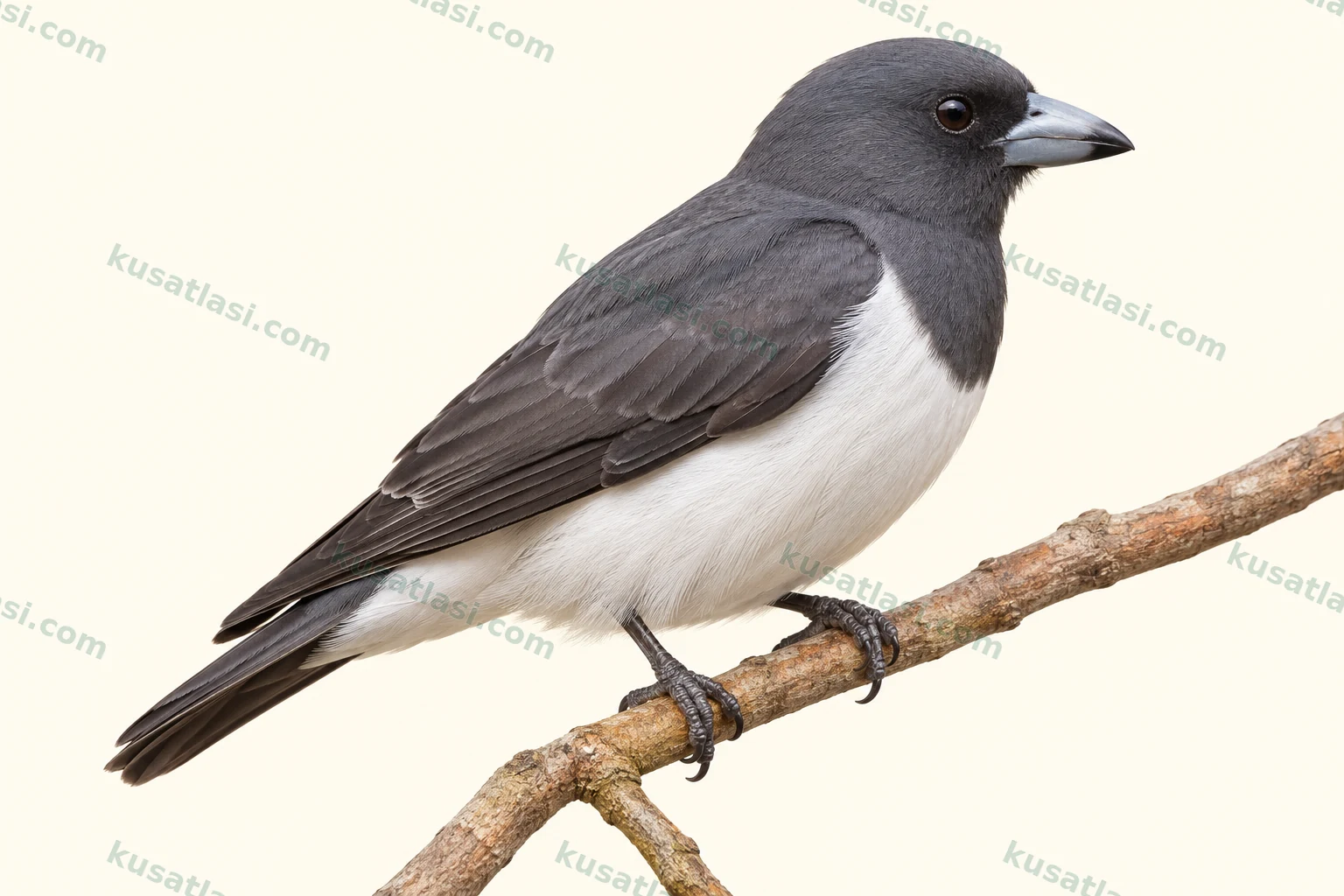
Swipe between the two adult plates.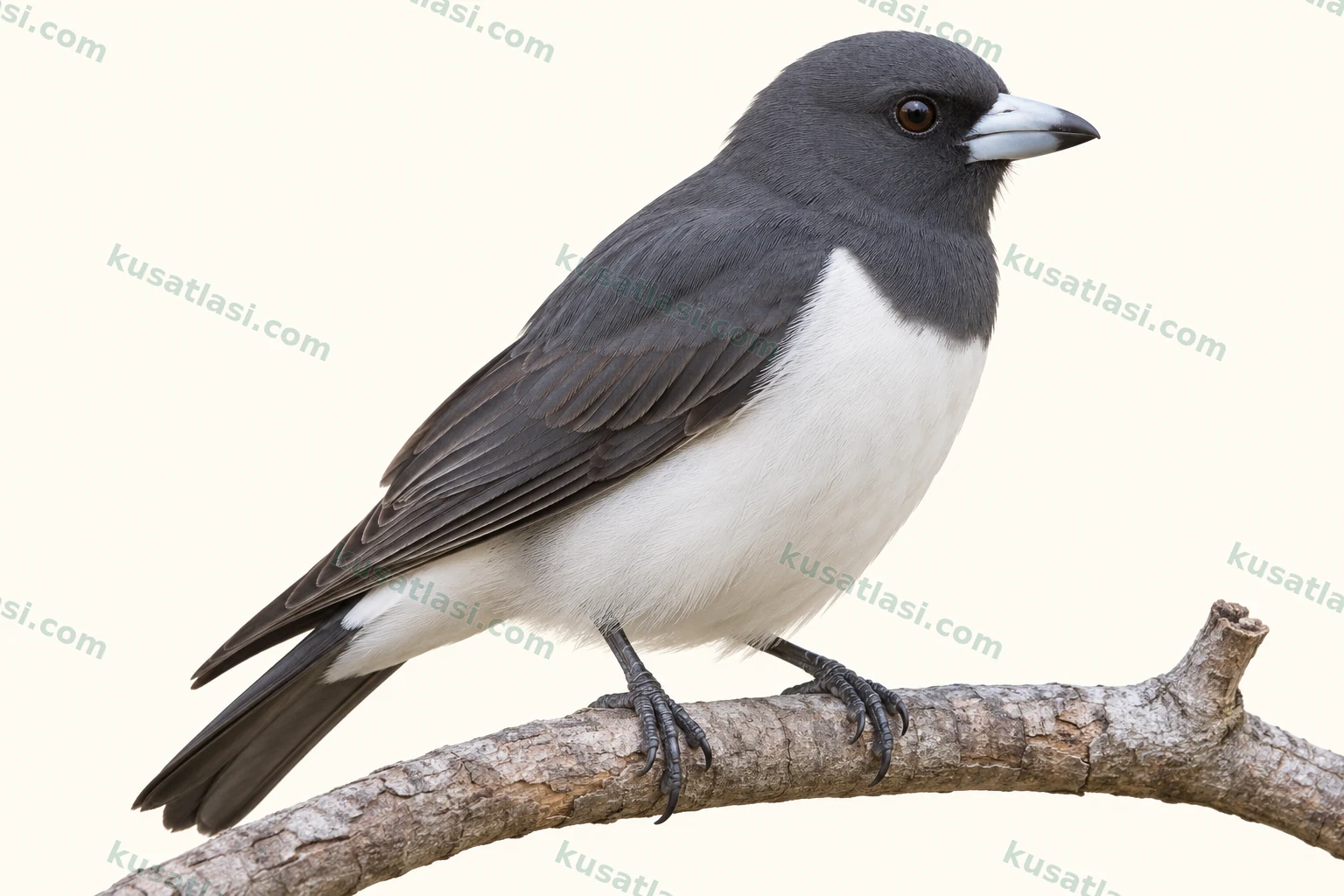
Artamidae · Passeriformes
White-breasted Woodswallow
Artamus leucorynchus
Ak Göğüslü Ormankırlangıcı
Assess the white rump, dark head and pale blue, black-tipped bill together.
- Order
- Passeriformes
- IUCN Status
- LCLeast Concern
Biometrics
Length
- Male
- 18 cm
- Female
- 18 cm
Wingspan
- Male
- 33–38 cm
- Female
- 33–38 cm
Weight
- Male
- 36–49.6 g
- Female
- 36–49.6 g
Detailed explanations of these measurements are available on our website, on the same species page.
At a Glance
- White rump
Compare the rump with the white breast and belly.
- Mottled young birds
Cream tones and a dark bill are useful when assessing age.
- Aerial-foraging passerine
It can sally for prey from wires and branches.
Male and female cannot be reliably separated by external appearance.
Calendar
This calendar shows a regional Australian breeding period. Breeding can also follow rain in dry areas; this is not a shared timetable for all island populations.
January
Main breeding window
February
Within broader window
March
Outside main window
April
Outside main window
May
Outside main window
June
Outside main window
July
Outside main window
August
Within broader window
September
Main breeding window
October
Main breeding window
November
Main breeding window
December
Main breeding window
Species Information
Quick identification
A White-breasted Woodswallow combines a dark head and upper body with striking white underparts. The head and throat range from grey to almost black; the back and folded wings can appear grey, blue-grey or brownish. The white rump, breast and belly form an important combination with a pale blue-grey, black-tipped bill. It is a social passerine in Artamidae, a different family from the true swallows.
Appearance and posture
The dark head and throat meet the white breast in a clear boundary. Wings and tail remain dark around the pale body; this is not a bird covered in scattered black-and-white patches. The iris is dark brown. The Mimika field guide specifically identifies the white rump, the area between back and tail, which should not be confused with white tail feathers.
Bare branches and overhead wires are conspicuous perches. Birds can line up closely and press against one another, with communal roosts used by day as well as at night. BirdLife Australia describes a fanning and twisting movement of the tail, particularly just after landing. This can reveal the rump–tail boundary differently from a closed resting posture. In a tight cluster, the colours of overlapping birds should be assessed on each individual.
An adult's pale bill base and dark tip contrast with its face. Age matters because a young bird's bill may look different. Blue-grey upperparts should not be expected to appear equally blue in every light: the head and throat boundary, rump, underparts and bill are more useful in combination.
Island populations do not all share the same dark tone. Rowley and Russell describe the Andaman–Coco form humei as paler slate-grey on the head, whereas Palau's pelewensis has black head and back without grey or brown traces. The New Caledonian form melaleucus combines a black head with a lighter brown back. These are geographical differences, not a basis for labelling a black-headed bird male and a paler-backed bird female.
Males, females and young birds
Male and female plumage does not provide a reliable field distinction. The Australian Bird Study Association's handling guide states that the species is not sexually dimorphic in plumage or size. It also records incubation by both sexes, so a bird sitting on the nest should not automatically be labelled female.
Young birds have brown, mottled upperparts, a cream wash below and sometimes a fine cream eyebrow. Their bill may lack the adult's pale blue appearance. Australian immatures can retain juvenile wing-coverts, flight feathers and tail feathers with pale fringes. The ABSA guide notes that these fringes narrow and become less conspicuous with wear; a single pale feather edge is consequently not an infallible age marker.
The ABSA handling guide describes pale yellow gape corners in juveniles, compared with flesh-grey or pale blue-grey in adults. These are close-examination details; an unseen gape on a distant bird should not be assigned a colour. The young bird's brownish-grey bill and retained pale feather fringes are assessed together rather than from one ambiguous photograph.
In flight
The white underwing is conspicuous with the pale underbody against the dark head and tail. Flight combines flapping and gliding, with turns in pursuit of airborne insects and sallies from a perch. Aerial feeding alone does not identify the species, since other woodswallows and true swallows also catch flying insects. On a banking bird, the upper and lower wing surfaces must be distinguished: a dark view from above does not contradict a white underwing.
Voice and behaviour
The repertoire includes short metallic “pirrt”-like calls, louder chatter and soft twittering; expert accounts also describe mimicry. For New Guinea, the Mimika guide gives rasping “wek” and rising “cheep” descriptions. Such syllables are observers' written approximations, not evidence that differently written sounds belong to different species. Calls should be linked to the bird producing them rather than assigned from the surrounding flock.
A resting flock and a group attending a nest are different observations. A line of birds on a wire does not by itself establish which are parents, offspring or relatives. Observers can also alter behaviour near a nest, so food-carrying birds should be watched at a distance without blocking their approach.
Similar species
1. Great Woodswallow Artamus maximus in New Guinea also has a white rump and pale underparts. The Mimika guide describes a larger, sootier bird associated especially with mountain slopes and ridges. A white rump alone is insufficient; overall appearance and setting should be considered together.
2. Adult White-browed Woodswallow Artamus superciliosus has a conspicuous white eyebrow. The NSW Scientific Committee's comparison highlights the White-breasted species' white rump and underparts. A juvenile's fine cream eyebrow should not be equated with the adult White-browed's strong head pattern.
3. Welcome Swallow Hirundo neoxena, encountered in Australia, is a true swallow. Compare its adult rusty forehead and throat, metallic dark upperparts and long forked tail. Perching on wires or catching insects in flight does not make these birds the same species.
Global range
The native range extends from the Andaman and Coco islands through Southeast Asian islands to New Guinea and northern and eastern Australia. It includes the Philippines, Borneo, Sumatra, Java, Bali, Sulawesi and relevant parts of the Lesser Sundas, with Pacific populations in Palau, Vanuatu and the New Caledonian region. These names describe an island distribution, not an uninterrupted belt of occupied land.
Within the native range
Northern and eastern Australia are major parts of the range, with occurrence farther south varying regionally and seasonally. Bas van Balen and Pratita Puradyatmika describe it as widespread in the Mimika lowlands of New Guinea; this is a regional account, not an assertion of equal abundance at every elevation. Older descriptions including Fiji require care, because current comparative checklists recognise Fiji Woodswallow Artamus mentalis separately.
Seasonal movements
Australian expert accounts describe partial migration: southern birds may move north in cooler months and south in spring, alongside nomadic movements. This does not establish a common migration route for every bird from the Philippines to Australia. Island occurrence and Australian seasonal movements should be assessed separately; a list of islands is not a tracked journey.
Breeding habitat
Australian habitats include eucalypt woodland and forest near water, as well as mangroves. It is not confined to untouched forest: open airspace together with trees and perches provides feeding opportunities. In Mimika it forages over lowland forest, clearings and towns. The Australian Museum gives August–January and breeding after rain in dry areas, while Rowley and Russell's broader synthesis gives August–February, mainly September–January, in Australia. Neither window is a shared timetable for every island population.
Nest and development
The nest is a shallow cup of grass, fine twigs and roots. Australian institutional accounts describe fine grass lining, while Rowley and Russell also report an unlined cup; identical lining should not be expected in every nest. It may occupy a tree fork, hollow stump or an abandoned Magpie-lark Grallina cyanoleuca nest. Both sexes build, incubate and feed young. The amydrus nest followed in Perak, Malaysia, in 2020 instead occupied a steel bracket on a utility pole near a former mining pond, illustrating use of an artificial support.
Rowley and Russell's expert species synthesis gives a usual clutch of 3–4 eggs within a reported range of 2–5. Four fledglings at the observed nest do not mean that four eggs were counted. Incubation duration could not be determined there, and the Cornell account supplies no reliable general duration. The authors' estimated nestling period of 31–33 days depended on a suspected hatching date rather than a precisely observed start. First flight and independence are different stages: the young continued receiving food after fledging. Nest observation should not involve climbing the tree or utility pole.
Daily use of habitat
Perches and the airspace used for hunting are complementary parts of the habitat. Open branches, wires and poles near water provide places from which birds depart to feed. Foraging can also occur in the canopy or on the ground. A resting group on a wire does not by itself establish an active nest nearby; nesting, roosting and feeding sites are distinguished by observing their use.
Food
Insects are the principal food, with nectar also taken from flowers; these are not necessarily equal dietary components. At the Perak nest, identified prey delivered to young included dragonflies, butterflies, ants, termites and other insects. The observers saw no fruit being delivered. That describes their nest observations, rather than proving that every age class throughout the range avoids fruit in every season.
Foraging
Flying insects are caught in the air, often on sallies followed by a return to a perch. Transferring large prey to a foot in flight has also been directly observed. In Perak on 10 December 2020, Amar-Singh HSS watched a bird eat a large butterfly while holding it in a foot during flight. The suggestion that the observer's approach triggered this was an interpretation; a fear of having its prey stolen by a person was not demonstrated. Food delivered to a young bird should also be distinguished from prey eaten by the adult itself.
More than two carers
At the Perak nest, Khoo and colleagues' 2023 report describes six different adults sharing incubation, with collaborative care and nest defence. Adults sometimes fed another adult brooding the young. The observers could not establish how all these birds were related, whether helpers were offspring from previous years, or whether all nestlings belonged to one pair. Observed shared care is not a substitute for genetic parentage evidence.
Selective nest defence
The same Malaysian observations recorded alarm calling and group pursuit of raptors, while some starlings on nearby wires and passing herons were left alone. Defence was therefore not a uniform attack on every bird nearby. Successful fledging of four young at one nest also does not demonstrate that extra carers caused greater success: the report did not experimentally compare large samples of nests with and without helpers.
Why the scientific spelling matters
Older works may use leucoryn., leucorhynchus or other spellings. In Opinion 2455, published in 2020, the International Commission on Zoological Nomenclature conserved leucorynchus, the spelling used here in Artamus leucorynchus. This history helps trace older records of the bird, but does not make data from a separate island species interchangeable. The species boundary involving Fiji birds and the historical spelling question are different matters.
A nectar-capable tongue
Woodswallows have a divided, brush-tipped tongue capable of taking nectar. The Australian Museum emphasises that White-breasted Woodswallows nevertheless feed mainly on insects. An anatomical capacity to use a food does not establish that food as the largest part of the daily diet. The bird illustrates why observed feeding and anatomical possibilities should be considered together.