
World Birds
Field Guide Plates
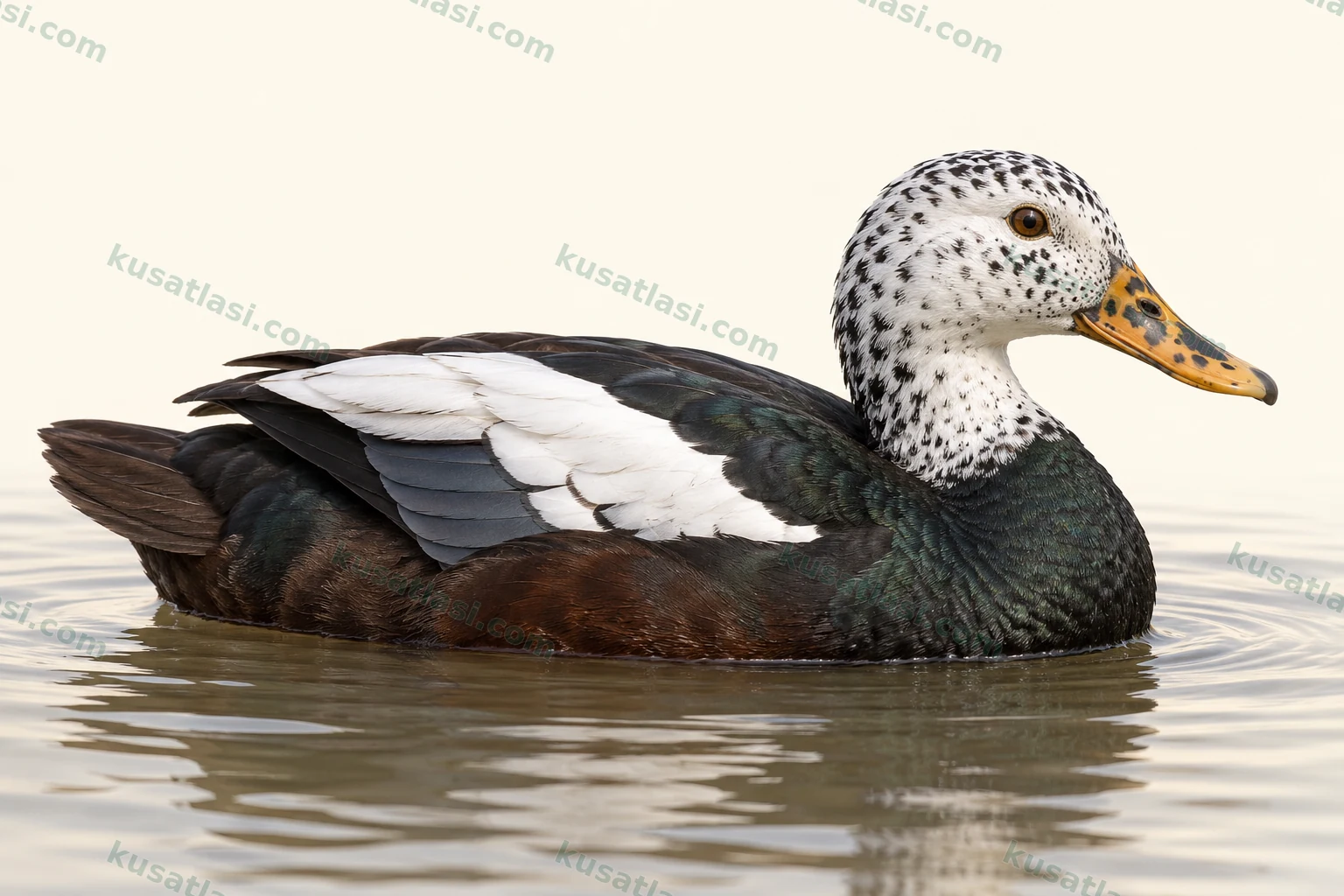
Swipe between the two adult plates.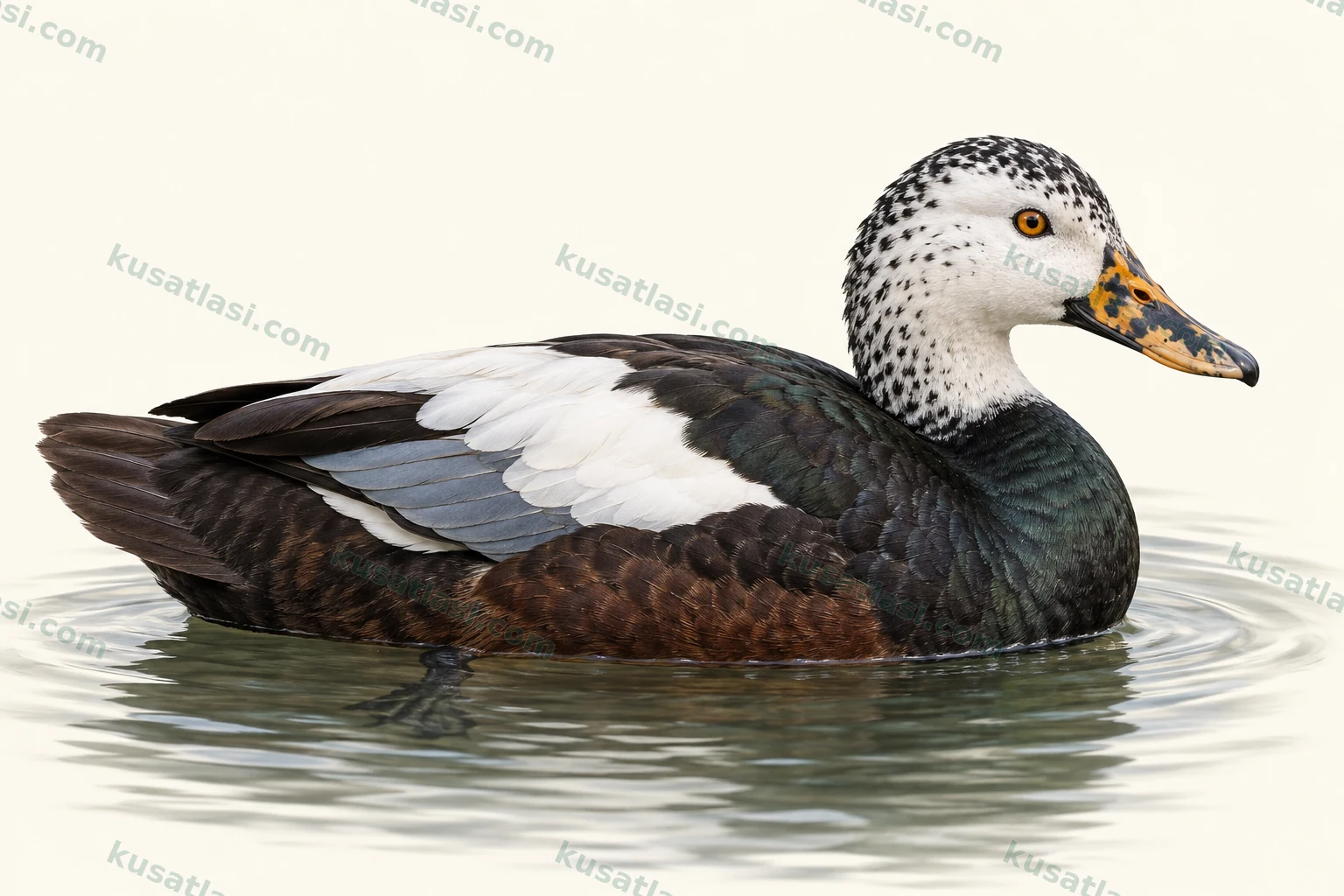
Anatidae · Anseriformes
White-winged Duck
Asarcornis scutulata
Ak Kanatlı Ördek
Check the freckled white head, dark body and white forewing together.
- Order
- Anseriformes
- IUCN Status
- CRCritically Endangered
Biometrics
Length
- Male
- 66–81 cm
- Female
- 66–81 cm
Wing length
- Male
- 34.16 cm
- Female
- 34.16 cm
Weight
- Male
- 2.2–4.3 kg
- Female
- 1.7–3.6 kg
Detailed explanations of these measurements are available on our website, on the same species page.
At a Glance
- Freckled white head
The extent of white varies among individuals.
- White forewing
The whole wing is not white.
- Forest waters
Scan shaded pools, swamps and slow-flowing water.
Sexes look similar; females usually have heavier head freckling, but whiteness alone is not definitive.
Calendar
Breeding records are regional; no verified monthly calendar covers the entire range.
Species Information
Quick Identification
The combination of a dark body, black-freckled white head and neck, and broad white forewing is distinctive. This is a duck of tropical forest wetlands.
General Appearance and Posture
The body is dark brown to blackish, with greenish gloss on some feathers. Both the extent of white on the head and the density of dark freckling vary among individuals. When swimming or resting on a shaded bank, posture may conceal part of the pale wing area.
Males, Females and Young Birds
Adult males and females share the same general colour pattern. Females usually have heavier head freckling, but the amount of white alone is not a definitive sexing character. A 1976 account of breeding in captivity in England describes immatures as browner than adults and already possessing the white wing patches. This appearance does not provide an exact daily age for a wild bird.
Appearance in Flight
With the wing spread, the white forewing contrasts strongly with the dark body, while the outer flight feathers remain dark. The entire wing is not white. In distant or poorly lit views, assess the head pattern and overall plumage as well as a single pale patch.
Voice and Behaviour
Calls have been described as horn-like or containing whistling elements. Historical accounts disagree about their assignment to males and females, so pitch alone should not be treated as a definitive sexing key. Birds are often seen singly or in pairs, although larger gatherings have been recorded at some waters. Activity commonly increases around dawn and dusk, but the species is not exclusively nocturnal. Observations in Sumatra and Bangladesh also document daytime feeding and resting in shade.
Similar Species
It resembles Muscovy Duck (Cairina moschata). Check the freckled white head, dark body and broad white forewing together. A single white wing patch is not a reliable key among variably coloured domestic ducks. Their resemblance does not mean that the two species are currently placed in the same genus.
World Distribution
Its historical range from northeastern India through Southeast Asia to Sumatra is now highly fragmented. The 2024 global assessment lists surviving populations in India, Myanmar, Thailand, Cambodia and the Indonesian island of Sumatra. This does not imply continuous occupation throughout those countries.
Status Within Its Natural Range
Bangladesh, Java, Laos, Malaysia and Vietnam are listed as possibly extinct within the same assessment; historical records do not establish present resident populations. Its global category is Critically Endangered (CR). Forest and wetland loss, disturbance and hunting threaten the small, isolated populations.
Movements
It is generally treated as non-migratory. Residency does not, however, mean remaining at a single pool throughout the year. Observations in Sumatra document local habitat use linked to water conditions and seasonal gatherings at some waters. A fixed migration route or monthly movement calendar for the whole range has not been verified.
Breeding Habitat
Small pools, swamps and standing or slow-flowing waters within or beside forest are core habitats. Resting and nesting trees are important alongside water. Some historical breeding observations in Bangladesh came from secondary forest, so breeding should not be restricted categorically to undisturbed primary forest.
Nest Site
It nests in tree cavities, with leaves, grasses and root fragments recorded as lining. Bangladesh data from 1976–1978, reviewed by Green in 1993, recorded 3, 4 and 7 eggs in three nests respectively. These are not a fixed clutch range for the entire species. Observations of three pairs found females incubating and males remaining nearby; this does not document males incubating the eggs.
Incubation and Development
Wild incubation duration and time to first flight were not adequately verified in this review. The 1976 account of captive breeding in England records 35 days of incubation at Peakirk and describes fledging at approximately 14 weeks in captivity. These are not universal values measured at wild nests. Observe from a distance rather than approaching the cavity or flushing birds from a nesting tree.
Daily Habitat Use
Feeding, shaded resting and tree roosting need not occur at the same place. Studies in Sumatra found some waters used mainly at night and others during the day. Breeding pairs in Bangladesh were also recorded resting on banks or logs around midday. These differences argue against expecting one fixed daily schedule everywhere.
What It Eats
It takes both plant and animal foods. Green’s review reports aquatic plants, small fish, aquatic snails, spiders and insects from Bangladesh. Observations in Sumatra also recorded grasshoppers, dragonflies, tadpoles and fish. These are local food records, not evidence of identical proportions across the range or consumption of every item by every individual.
How It Forages
It collects food while wading in shallow water or moving at the surface, and may immerse its bill to search just below the surface. Diving for fish was also recorded in Bangladesh. Variation in technique and feeding time indicates that the species is not tied to a single foraging method. Detailed diet percentages representative of its entire range remain unverified.
Resemblance Does Not Mean the Same Genus
Older publications use the name Cairina scutulata. The current name is Asarcornis scutulata, while Muscovy Duck remains in Cairina. This change does not make the older breeding or feeding observations records of another bird; recognising the historical name helps trace the correct species through the literature.
Interpreting Genetic Differences
A 2026 genomic study compared India-derived captive birds in the United States with samples collected from wild birds in Sumatra in 1999–2001. The groups were genetically differentiated. However, there was no matched sample from wild Indian birds, and the result does not itself establish formal recognition of a new subspecies. The current species account recognises none.
Captive Conservation Involves More Than Numbers
The same study highlighted the importance of retaining genetic diversity in the US captive population. Among 16 birds with known ages, greater inbreeding was associated with earlier deaths, most involving avian tuberculosis. This observational relationship does not establish inbreeding as the sole cause or imply that every wild individual carries the disease. Historical and more recent captive groups may also have differed in their exposure.