
World Birds
Field Guide Plates
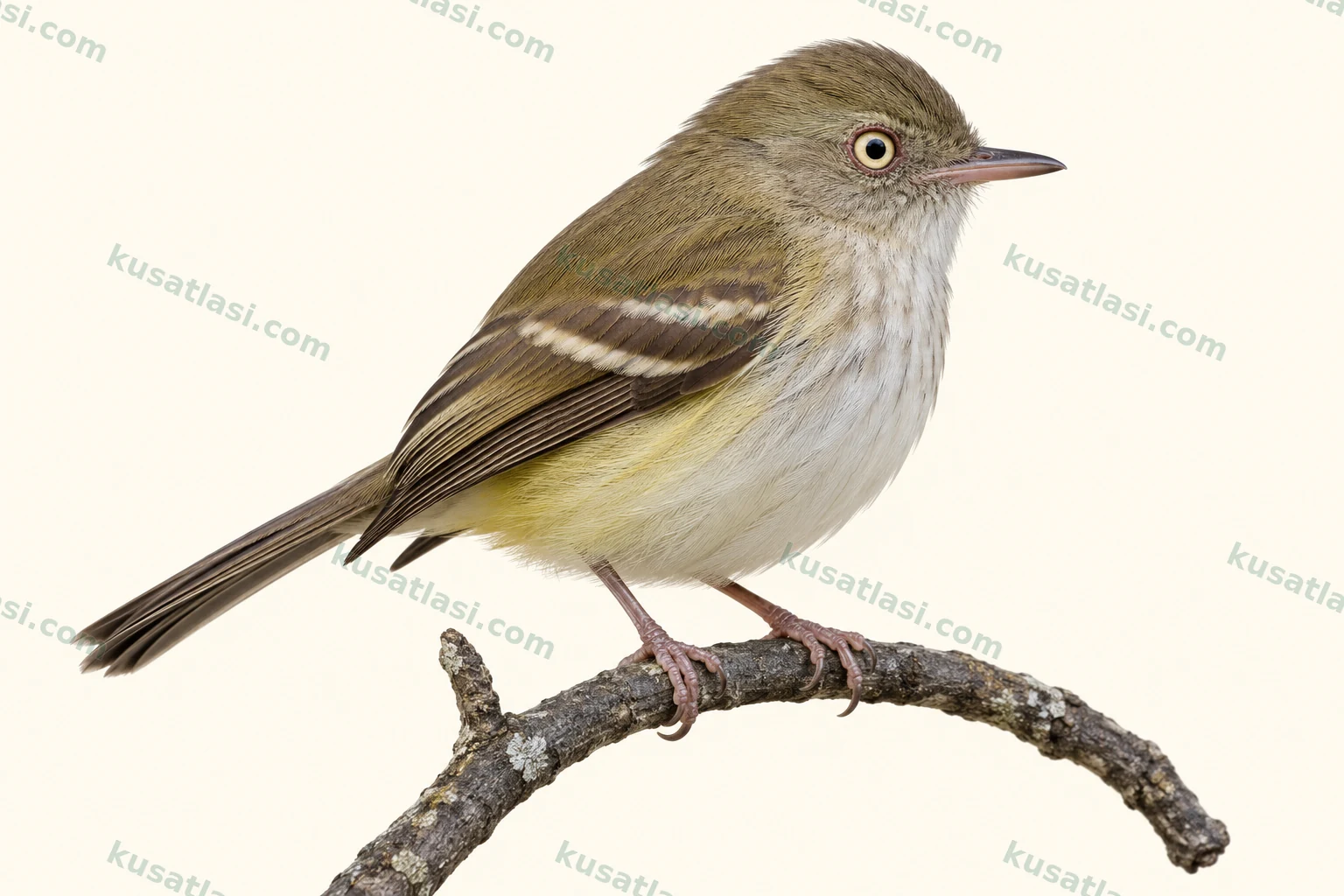
Swipe between the two adult plates.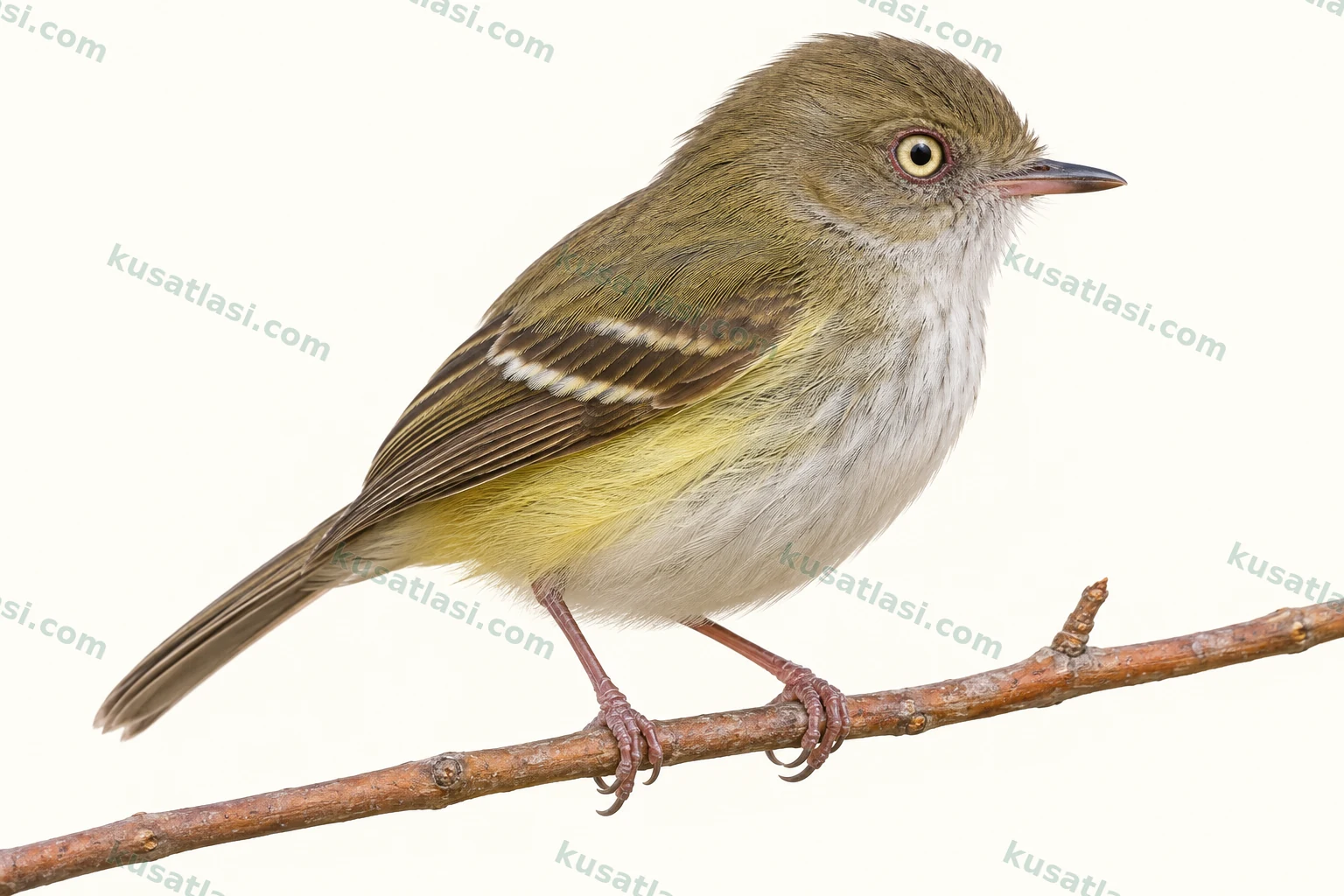
Tyrannidae · Passeriformes
Pale-eyed Pygmy Tyrant
Atalotriccus pilaris
Ak Gözlü Küçük Tiran
Assess the two pale wingbars, small bill and pale underparts together with voice.
- Order
- Passeriformes
- IUCN Status
- LCLeast Concern
Biometrics
Length
- Male
- 9 cm
- Female
- 9 cm
Wing length
- Male
- 4.12 cm
- Female
- 4.12 cm
Weight
- Male
- 6 g
- Female
- Data unavailable
Detailed explanations of these measurements are available on our website, on the same species page.
At a Glance
- Olive upperparts
Some geographic forms have a greyer crown.
- Two pale wingbars
Yellowish when fresh, sometimes whiter with wear.
- Small bill and usually pale iris
Young and some adults can be dark-eyed.
Adult sexes look alike; iris colour alone establishes neither precise age nor sex.
Calendar
Breeding records differ among countries and study areas. No shared monthly worldwide window is assigned; see Habitat for regional information.
Species Information
Quick Identification
Pale-eyed Pygmy Tyrant is a small olive flycatcher of Panama and northern South America. Assess the two pale yellow wingbars, pale underparts, small bill and usually light iris together. The lack of a striking crown pattern and co-occurrence with similar small birds can complicate identification. Voice is particularly helpful when the bird remains among leaves.
Appearance and Posture
The upperparts are generally olive-green. In some geographic forms a greyer crown contrasts with the green back. Two pale bars mark the dark wing; yellowish markings on fresh feathers can fade towards whitish with wear. The tail is dark. A pale area lies between eye and bill, with buff and grey on the head sides.
Throat and underparts are mainly whitish. Faint dark streaking may occur on chin, throat and breast sides, varying in prominence. Lower flanks and undertail can show a slight lemon tinge. The small dark bill has a paler, sometimes pinkish base; legs and feet are pinkish.
It may sit upright and alert, remaining motionless within cover before making short movements. Such pauses make an otherwise present bird easy to overlook. Assess head, wing and underpart tones as the bird moves rather than relying on one lighting angle.
Males, Females and Young Birds
Males and females share broadly similar plumage; body colour alone does not reliably establish sex in the field. Juveniles can be duller, browner olive, with buff-washed wingbars. Their underparts can look cleaner white and lack the adult’s faint streaking.
Young birds can begin with dark irides that subsequently pale. However, research using museum labels and captured birds in Venezuela also recorded dark-eyed adults and pale-eyed juveniles. Neither “dark eye proves juvenile” nor “pale eye proves adult” is a valid rule. Feather condition and several characters must be considered together when assessing age.
Appearance in Flight
Foraging involves short abrupt sallies towards nearby foliage, sometimes with a brief hover. Dark wings and tail may contrast with the paler body, while iris and faint facial details are easily lost. Rather than identifying a fleeting silhouette alone, check the head and wingbars when the bird perches again.
Voice and Behaviour
It gives dry “tic” notes and rapid nasal trills of variable length, often combining single notes and trills. Calls also include a short rough phrase rising then falling in pitch. Some sounds are weak and others surprisingly strong for such a small bird; neither loudness nor a fixed sequence length is a universal key.
Usually encountered in pairs or groups of three, with frequent calls maintaining contact. Direct observations in Caracas, Venezuela, recorded more singing in the earlier morning. That local daily pattern does not establish exact hours throughout the range. Use voice to locate a bird for distant observation rather than repeatedly playing recordings to draw it from cover.
Similar Species
1. Pearly-vented Tody Tyrant (Hemitriccus margaritaceiventer): Larger and longer-billed, with browner upperparts and more conspicuous streaking below. Iris and orbital region can look more orange. Assess Pale-eyed’s smaller bill, light yellowish iris and faint streaking together with voice.
2. Slender-billed Tyrannulet (Inezia tenuirostris): A very fine white eye stripe extending from the bill base beyond the eye provides a useful supporting character. Pale-eyed’s weaker facial markings do not produce the same extended line. Dry woodland habitat alone does not distinguish them; compare bill, face, wings and voice together.
World Distribution
Ranges from the Pacific slope of western Panama through Colombia and Venezuela to western Guyana and Roraima in extreme northern Brazil. Colombian occurrence includes northern regions, the Magdalena Valley and some areas east of the Andes. In Venezuela it occupies suitable areas around the Maracaibo basin, northern and central regions and the Orinoco. This sequence of countries does not imply continuous occupation of every intervening forest and mountain.
Status within Its Range
Can be frequent at suitable sites and is a commonly encountered small flycatcher in Venezuela. Use of secondary or disturbed vegetation permits occurrence in wooded urban patches. Frequent captures in one park nevertheless do not measure a national population. Boundaries among its four geographic forms remain incompletely resolved, especially in eastern Colombia; uncertain subspecies limits should not be forced onto an observation.
Seasonal Movements
Resident and generally considered sedentary. The reviewed sources do not establish regular long-distance migration or a shared departure-and-return calendar for all populations. Short foraging flights within woodland or joining other birds do not constitute seasonal migration evidence.
Breeding Habitat
Uses dry scrub, open woodland, deciduous and semi-deciduous forest and humid gallery forest. Botanical gardens, urban forest patches and wooded crop borders can also provide habitat. It is primarily a lowland bird: the Cornell account gives a usual range below 800 metres but also Colombian records reaching 2000 metres. These elevations are not identical breeding limits in every region.
Nest Site
The described nest is a suspended enclosed bag with a small awning over the side entrance, made using dried grasses and reed-like material. A historical nest hung about 1.2 metres above a forest pool. A described egg was white with reddish-brown spots. Description of one egg does not establish a typical clutch of one; incubation and nestling durations also remain unverified in the sources reviewed.
Breeding records vary regionally. May–June is reported for Henri Pittier National Park, Venezuela, whereas the urban-forest study in Caracas recorded birds showing breeding condition in late 2013 and early 2014. Colombia has records of nesting, breeding-condition adults and fledged young in several different months. These records do not define one continuous worldwide season. Preserve cover around nests and leave the entrance route unobstructed.
Daily Habitat Use
Uses dense lower vegetation as well as middle and higher tree layers. Caracas observations documented pairs and small groups foraging between mid-level and canopy. Search leafy perches above the lowest scrub layer as well as the undergrowth.
What Does It Eat?
Insects predominate, with spiders and occasional fruit also consumed. Droppings from venezuelensis in the Arboretum forest patch in Caracas, Venezuela, contained beetles, ants, orthopterans, lepidopterans and other arthropod remains. Only two of 20 samples contained fruit pulp and seeds. This demonstrates the importance of animal food in a local sample, not an invariant calorie or mass percentage throughout the range.
The broader bird-community study using September 2013–July 2014 samples from the same Caracas site also classified the species as mainly insectivorous with occasional fruit. Recognisable remains in droppings are affected by digestion; readily identified hard parts alone do not provide exact proportions of every food eaten.
How Does It Forage?
From a perch it makes a short abrupt sally towards nearby foliage, sometimes hovering momentarily to take prey. Approaching the underside of a leaf from below is frequent, although strikes from above also occur. It may forage alone or in pairs. Mixed flocks with other small flycatchers and vireos are reported from Venezuela and Colombia, without making such association obligatory at every encounter.
Specialised Outer Wing Feathers
The four outermost primary feathers are unusually short and narrow. Venezuelan museum specimens show sex-related differences in some outer feathers. These are differences measured under close examination, not an easy colour character permitting certain field sexing from a distance.
A buzz accompanying rapid wing vibrations may be enhanced by the specialised feathers and may relate to display. The sound mechanism and behavioural function remain incompletely explained. A possible display connection should not be presented as an experimentally established sole function.
Two Activities in the Same Months
During the 2012–2014 research in Caracas, Venezuela, periods with birds in breeding condition overlapped partly with periods containing moulting birds. Population-level calendars need not have a sharp boundary between those activities. Recording both in the same months does not prove that every individual was simultaneously incubating and undergoing extensive moult. Nor should the sampled urban forest’s annual pattern be assigned unchanged to populations in other countries.
One Species in a Genus,Several Geographic Forms
The Cornell account treats Pale-eyed as the only species in Atalotriccus while recognising four subspecies within it. A genus containing one species is not the same as a species lacking subspecies. Older works or alternative classifications may use Lophotriccus pilaris. When using research, confirm that such a name refers to the same bird.