
World Birds
Field Guide Plates
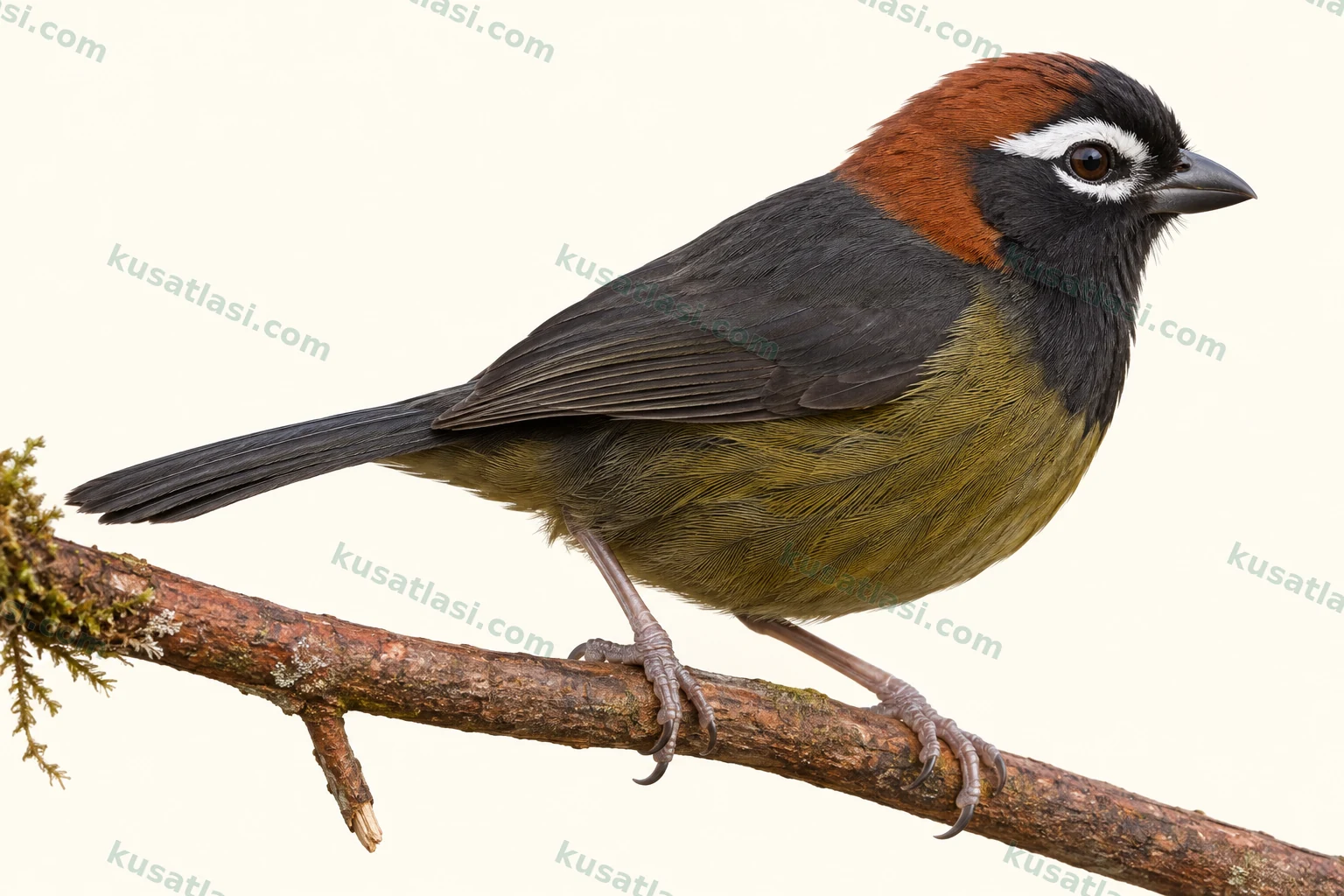
Swipe between the two adult plates.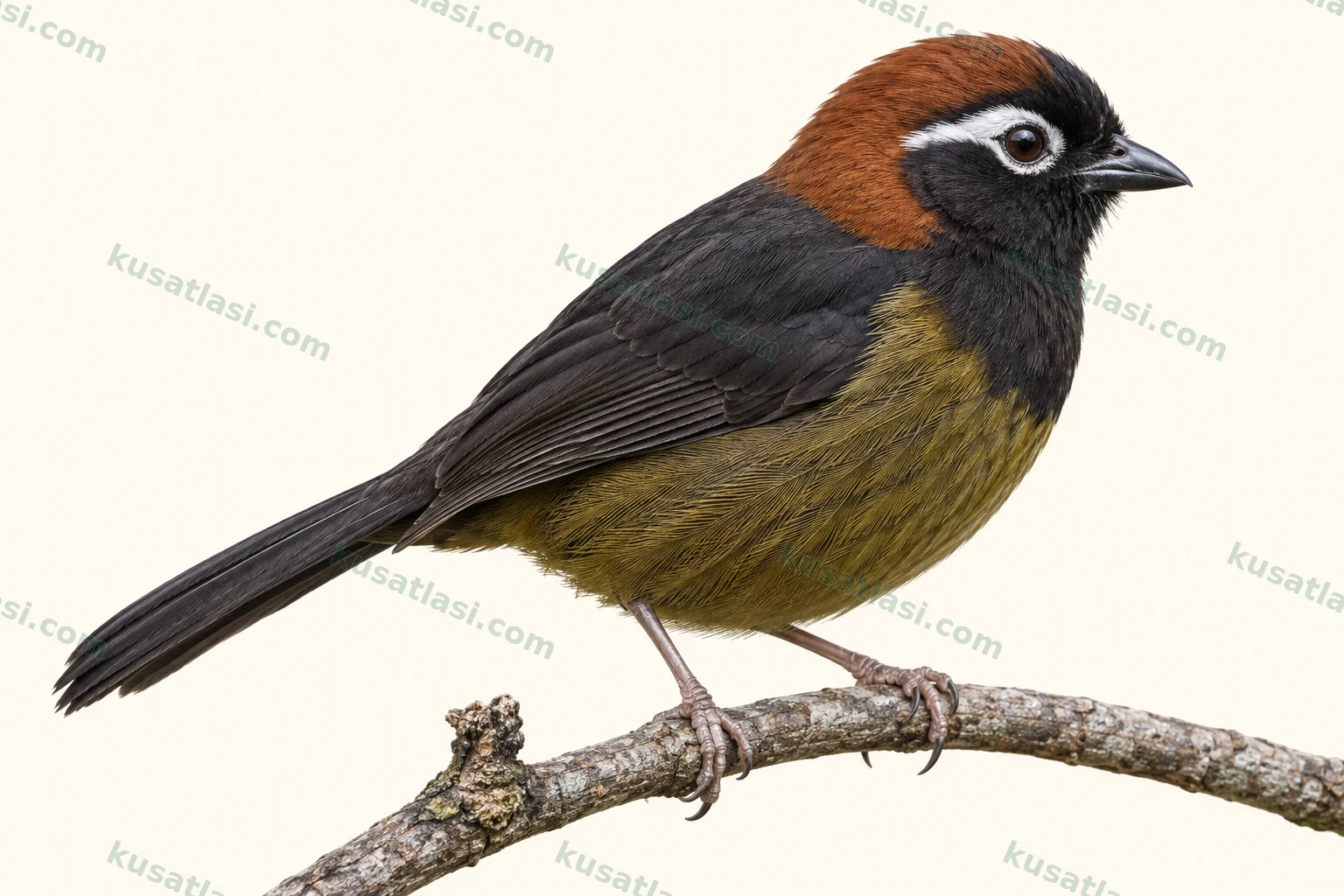
Passerellidae · Passeriformes
White-rimmed Brushfinch
Atlapetes leucopis
Ak Gözlüklü Çalı Serçesi
Check the broad white eye surround, dark iris, rusty crown and dark olive underparts together.
- Order
- Passeriformes
- IUCN Status
- LCLeast Concern
Biometrics
Length
- Male
- 18 cm
- Female
- 18 cm
Wing length
- Male
- 7.98 cm
- Female
- 7.98 cm
Weight
- Male
- 43 g
- Female
- Data unavailable
Detailed explanations of these measurements are available on our website, on the same species page.
At a Glance
- Broad white spectacles
The iris itself is dark brown.
- Rusty crown stripe
Assess alongside the black face.
- Humid montane forest
Dense understory and regenerating thickets.
Sexes look alike. Immatures can have an olive-washed crown and more patterned underparts.
Calendar
Resident. Nest records include October in Colombia and December in Ecuador; a range-wide monthly calendar is unverified.
Species Information
Quick Identification
White-rimmed Brushfinch is a dark bird of humid Andean forest in Colombia and Ecuador. The broad white area around each eye extends into a short point behind it, producing a spectacled appearance against the black face. The iris itself is dark brown; the white surround should not be confused with a pale iris.
Appearance and Posture
A dark rusty stripe runs along the crown, while the black face extends into the malar region beside the bill. Upperparts, wings and tail are blackish-grey, with a hint of olive on the rump. The throat is dark grey and the underparts dark olive. Slight darker breast scaling can give a mottled impression; flanks and undertail are a little darker than the central belly.
The blackish bill is relatively thick at the base, with an evenly curved upper profile. Legs range from dull fleshy to dusky grey. Assess overall darkness, crown stripe and white eye surround together; an olive tone glimpsed in dim forest is insufficient.
Males, Females and Young Birds
Males and females share similar plumage. Prominence of the eye surround or darkness of the body alone does not identify sex. Immatures can have an olive wash on the crown, more obvious barring on throat and breast, and faint belly streaking. These features do not establish an exact age in months.
Appearance in Flight
A separately verified diagnostic flight-pattern key is unavailable. Before identifying a dark bird passing through cover, check the white eye surround, rusty crown and dark olive underparts when it perches again.
Voice and Behaviour
A thin, high single “zeee”-like contact call can help locate a concealed bird. Songs include sequences of distinct whistles, while rambling duets contain whistles, trills and more complex notes. Differences were reported between March songs in Putumayo, Colombia, and recordings from Napo and Imbabura in Ecuador. One written syllable sequence should not represent every population without qualification.
Seen alone, in pairs or in small groups of up to three. Mixed-species flock associations have been reported, but none was observed during the 1997 Putumayo observations. That local result does not mean the species never feeds alongside other birds.
Similar Species
Dusky-headed Brushfinch, Atlapetes fuscoolivaceus, of Colombia’s upper Magdalena Valley can also look dark-headed and olive. It has a yellow throat and underparts, however, with a yellow submoustachial area separated by a narrow dark lateral throat stripe. For White-rimmed Brushfinch, seek the broad white eye surround, rusty crown stripe and dark throat together. Less distinctive immature head patterns also require care.
World Distribution
Restricted to the Andes of southern Colombia and Ecuador. Colombian records extend from Huila at the southern head of the Magdalena basin to eastern Andean slopes in Caquetá, Putumayo and southeastern Nariño. In Ecuador it is recorded on the western slope in Imbabura and on the eastern slope in Sucumbíos, the Cordillera de Guacamayos in Napo, Azuay, northwestern Morona-Santiago and farther south in Loja.
The distribution is discontinuous. A 1998 study summarized four population areas known at that time. This historical grouping is not a census showing that only four populations survive today. Presence in a country does not imply occupation of all its montane forest.
Status within Its Range
Generally rare to uncommon, although it was locally relatively common near El Mirador in Putumayo, Colombia, in March 1997. Concealment and difficult terrain complicate observation; encounter frequency at one site does not establish the total population.
Seasonal Movements
Resident. A regular seasonal migration route connecting the separate montane populations has not been established. Gaps in the range should not be interpreted as migration corridors.
Breeding Habitat
Uses dense understory in very wet montane forest, thick forest edges and mosaics of forest and regenerating thickets. The expert synthesis gives a general elevational band of 2,000–3,100 metres; this is not an absolute limit, as older specimen records include higher sites.
The 1997 observations in Putumayo, Colombia, emphasized steep landslide terrain, vegetation at different stages of regeneration, and stream and roadside edges. This does not show that any form of land clearance benefits the species. The habitat described combines forest with dense regenerating cover.
Nest Site
In December 1996, two birds in the Cordillera de Guacamayos, Napo, Ecuador, carried nesting material into a hole in a moss clump in a large tree fork. This does not prove that they built the entire moss clump themselves.
The other nest, found on 13 October 1997 in Putumayo, Colombia, was concealed in a small cavity behind tall herbaceous vegetation at the foot of a landslide. It was a coarse bulky cup of fine twigs and grasses. It contained one very pale cream to greenish-white egg with chestnut-rufous blotches. The paper identified the returning bird as female; because the sexes have similar plumage, this observation does not establish that every nesting bird can be sexed by appearance.
One nest with one egg is insufficient to establish typical completed clutch size. Verified incubation and nestling durations and the full division of parental care were not found. October and December records should not become a continuous breeding season across the range. Avoid flushing birds or obstructing the nest entrance.
Daily Habitat Use
Usually forages on the ground and in low understory. In the Putumayo observations, birds moved slowly through dense herbaceous and woody vegetation and sometimes ascended above ground level. A nest record in a tree fork does not establish that daily feeding occurs throughout the upper canopy.
What Does It Eat?
Diet information is limited. In Putumayo, Colombia, during March 1997, birds were observed eating understory berries; one pair fed on brilliant blue fruits of the Melastomataceae. Identification to plant family does not establish the plant species.
These short-term observations do not show exclusive year-round fruit feeding or establish a dietary percentage. Insect lists from other brushfinches should not be transferred to this species.
How Does It Forage?
Moves slowly through dense understory while gathering food, alone, in pairs or in small groups. Views at fruit sources can be brief among leaves and stems; clearing vegetation is unnecessary for observation.
White Spectacles, Dark Eye
The white feature in its name is not the iris. A broad patch of white feathers extends behind the eye against the black face, while the iris remains dark brown. The distinction helps when comparing it with similarly named pale-eyed birds.
One Locality Name Does Not Establish One Microhabitat
The appendix to a 1995 museum-based Andean bird study lists White-rimmed Brushfinch and Atlapetes schistaceus under the same locality names at Llorente in Colombia and Palmas in Ecuador. The authors caution that older collecting labels could combine different elevations and habitats around one camp. These records do not establish occupation of the same individual thicket or experimentally prove competition.