
World Birds
Field Guide Plates
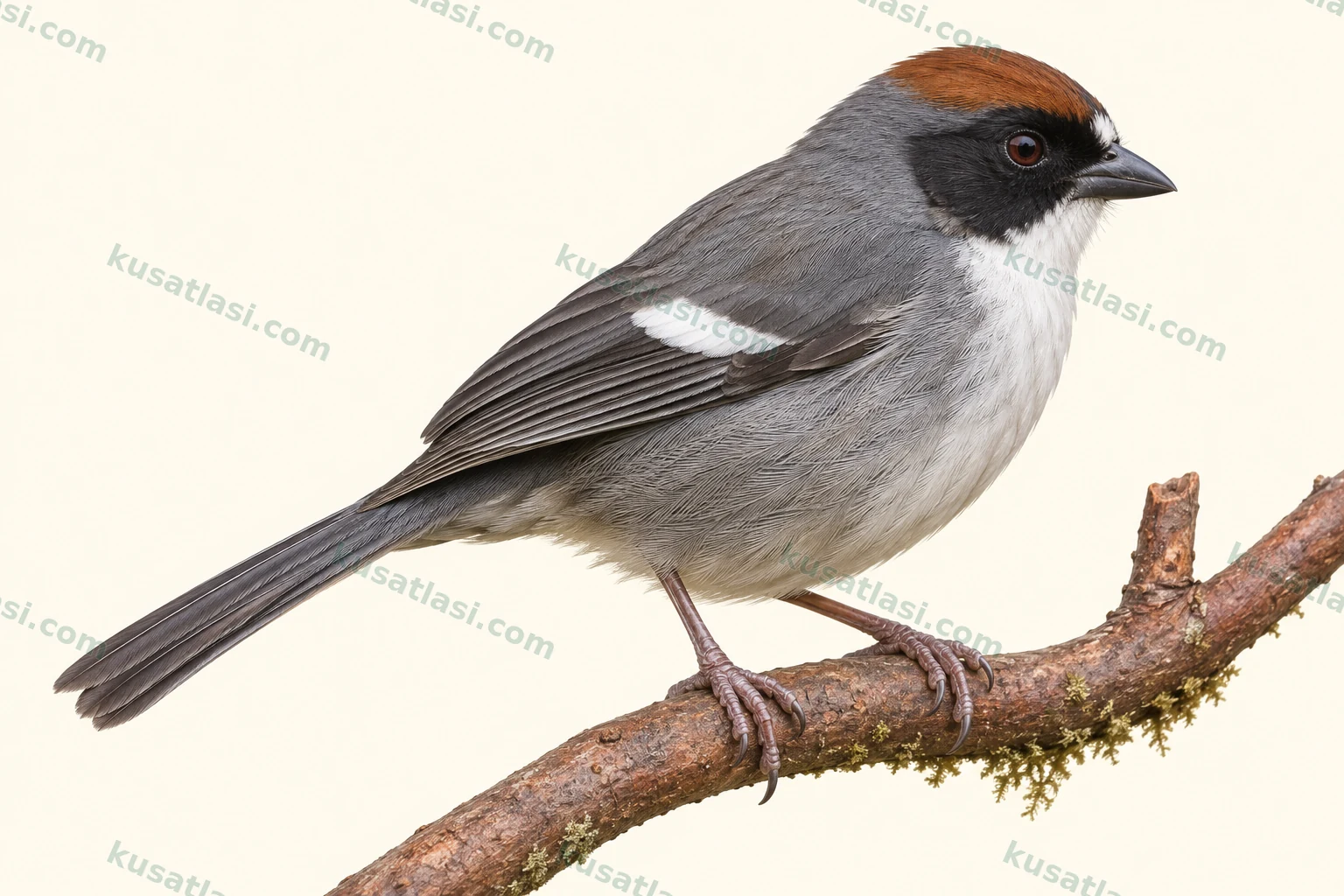
Swipe between the two adult plates.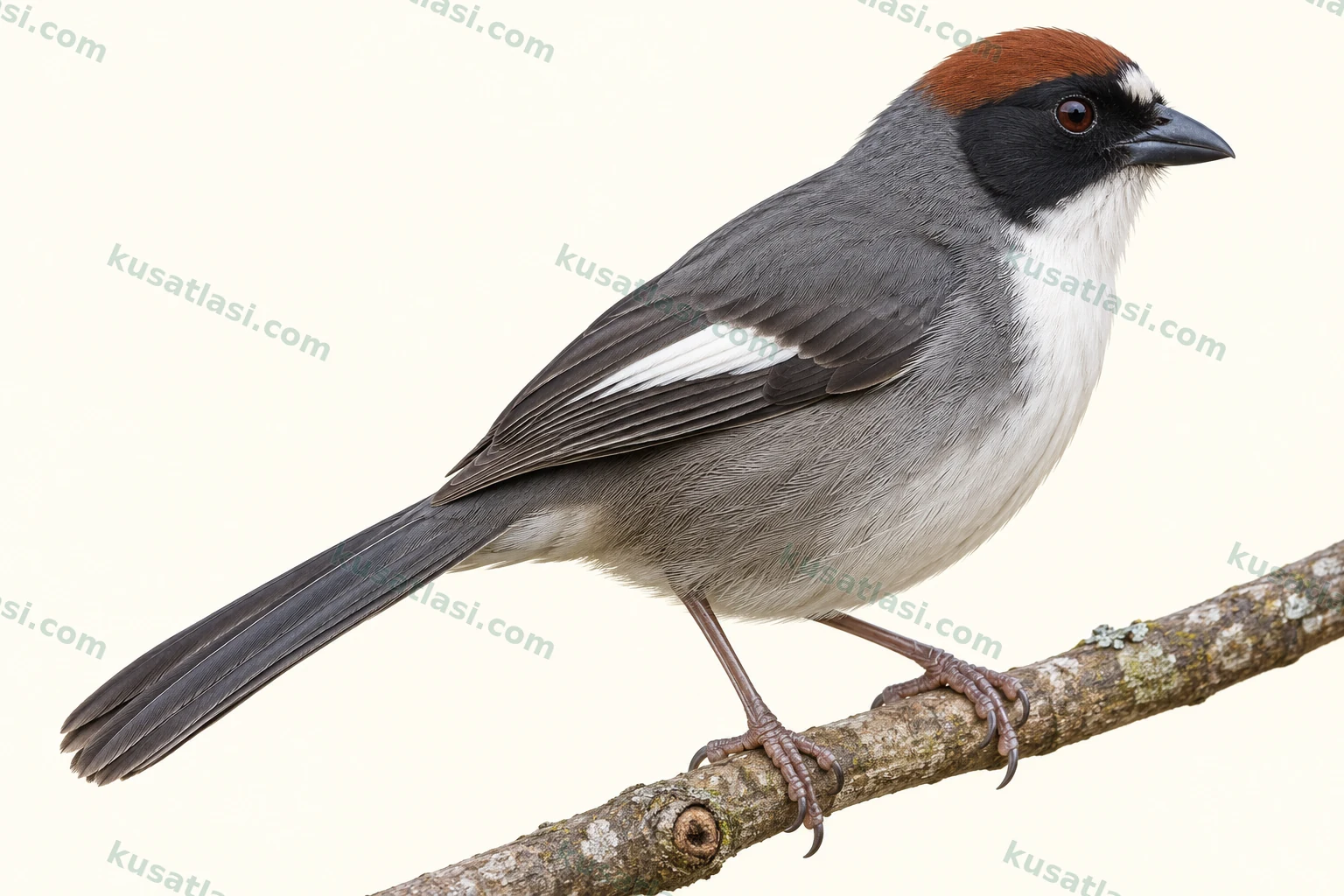
Passerellidae · Passeriformes
White-winged Brushfinch
Atlapetes leucopterus
Ak Kanatlı Çalı Serçesi
Look for the dark-gray back, pale underparts and white flight-feather bases together. Head pattern varies between subspecies.
- Order
- Passeriformes
- IUCN Status
- Source-taxon assessment
Biometrics
Length
- Male
- 15–17 cm
- Female
- 15–17 cm
Wingspan
- Male
- Data unavailable
- Female
- Data unavailable
Weight
- Male
- 20.7–26 g
- Female
- 19–26.1 g
Detailed explanations of these measurements are available on our website, on the same species page.
At a Glance
- White wing patch
The entire wing is not white.
- Variable head pattern
Russet, tawny or creamy crowns can be regional.
- Low foraging
Scratches through leaf litter.
Males and females are similar; facial white does not determine sex. Juvenile paynteri has not been verified.
Calendar
Resident. Young recorded at different places and years do not establish a shared monthly breeding schedule.
Species Information
Quick Identification
White-winged Brushfinch inhabits the Andean region of Ecuador and Peru. It has a dark-gray back, whitish underparts and a large white patch at the bases of the outer flight feathers. The whole wing is not white. Head pattern varies markedly between regions: russet, pale tawny and creamy-white crown patterns can belong to different subspecies of this species.
General Appearance and Posture
The bill is rather long and blackish, the eye dark brownish red and the legs brownish black. Wings and tail are dark gray. The white throat can be bordered by a dark lateral stripe or dark speckling. White small coverts also form a narrow pale edge at the bend of the folded wing.
Nominate leucopterus has a russet crown, darker on the forecrown than towards the hindcrown and nape. The face, superciliary area and neck sides are blackish, with a contrasting whitish-buff spot above the area between eye and bill. Sides and flanks can show gray and buff washes.
Dresseri has a dark forehead and a pale tawny stripe beginning on the mid-crown. Facial white is highly variable, ranging from a limited area around the eye to much of the face. This variation should not simply be assigned to sex or age.
In paynteri, the hindcrown and nape range from creamy buff to white, sometimes mottled black. The forehead is usually black. There is conspicuous white above the bill base and a narrow dark stripe beside the throat. Pale-gray underparts become white on the lower belly and undertail. This form also retains the white primary bases.
Males, Females and Young Birds
Adult males and females have similar plumage. Facial white and crown colour do not provide certain sexing, because these areas vary between subspecies and individuals.
Juvenile nominate leucopterus is described with a buff crown stripe, olive upperparts and streaking on the breast and flanks. This description is not transferred to every subspecies. In particular, the reviewed expert account leaves juvenile paynteri undescribed.
Appearance in Flight
An opened wing contrasts the white flight-feather bases with the darker wing. This patch and the narrow pale edge at the folded-wing bend involve different feather groups. After a brief white flash, check head pattern and the gray-and-whitish body when the bird lands.
Voice and Behaviour
Songs of leucopterus and dresseri have two or three parts: a high introductory note followed by one or two short trilled series. Note number, pace and pitch vary. Paynteri songs are generally described as slower and more musical. Limited recordings prevent treating every vocal difference as a decisive species boundary.
Calls include a thin clear tink and a descending buzzy tsew. In interactive pair calling, one bird can begin with high notes and another join with lower, rapid chatter. Which sex gives each component has not been established, so these parts are not assigned confidently to male and female.
Foraging birds occur in pairs or small groups, sometimes joining larger gatherings with other brushfinches. Small groups have been suggested to be family parties, but association alone does not establish kinship.
Similar Species
Slaty Brushfinch (Atlapetes schistaceus) resembles it in overall plumage, but White-winged Brushfinch is paler below. Assess the head pattern and white flight-feather bases together.
Very white-faced dresseri can suggest White-headed Brushfinch (Atlapetes albiceps). The retained pale tawny crown stripe is an important detail in dresseri. Facial white alone is insufficient in a brief or shaded view.
World Distribution
The natural range extends from Ecuador to northwestern and northern Peru. Nominate leucopterus occurs on Ecuador’s western Andean slopes south to the Chumbo Valley. Dresseri ranges from El Oro and Loja in southwestern Ecuador into Peru, from Tumbes to Cajamarca.
Paynteri occurs in southern Zamora-Chinchipe, Ecuador, and the Cordillera del Cóndor in northern Cajamarca, Peru. This eastern Andean component means the range is not confined to western slopes. The species is not endemic to Ecuador; Peru is also part of its natural range.
Status Within Its Natural Range
The expert account includes leucopterus, dresseri and paynteri as three subspecies. Some publications have treated the pale-crowned paynteri as a separate species. This account covers all three within Atlapetes leucopterus; assessments made under a split treatment cannot automatically be applied to this broader taxon.
Movements and Migration
Described as resident. The reviewed sources do not give a regular long-distance migration route. Young recorded in different regions and years are not combined into a tracked journey by the same individuals.
Breeding Habitat
Uses dry to fairly humid scrub, low woodland and forest edges. In southwestern Ecuador it can occupy very dry shrubby slopes with scattered Bombax trees. Gardens, villages and edges of humid forest or cloudforest are also reported. It should therefore not be portrayed as restricted to closed humid forest.
Nest Site
Nest structure, eggs, typical clutch size, incubation duration and nestling period could not be verified for this species in the reviewed sources. The expert account relays an early-November record of an adult carrying nesting material in northwestern Ecuador; that does not describe a completed nest.
The regional study published in 2020 records an adult feeding a fledgling at El Empalme, Loja, Ecuador, on 18 June 2002. An older fledgling was recorded at Limón de Porculla, Piura, Peru, on 21 April 2015; that entry does not report feeding. These are local evidence of reproduction, not nest counts, clutch sizes or a complete breeding calendar.
Records from different places and years do not establish one uninterrupted November-to-June season. Avoid entering dense scrub to search for nests or obstructing adults carrying food.
Daily Habitat Use
Forages on or near the ground, characteristically scratching through leaf litter. Watch the junction between scrub and ground cover for both posture and feeding behaviour; the bird need not be exposed at the top of an open branch.
What Does It Eat?
Insects, seeds, berries and other fruit are reported, with the expert account characterising the evidence as anecdotal. Their year-round dietary proportions have not been established.
The expert account relays one stomach containing mostly ants and grit. One sample does not mean every bird feeds exclusively on ants, and grit is not counted as animal prey.
How Does It Forage?
Obtains food by scratching in ground litter or taking items close to the ground. Pairs and small groups forage, sometimes in association with other brushfinches. Such association does not establish identical food choices or dietary proportions across species.
A Pale Crown and an Unresolved Taxonomic Question
Paynteri’s creamy-white crown and vocal differences help explain why some authors have treated it separately. Appearance alone does not establish reproductive isolation or genetic divergence. The three-subspecies scope of the expert account is kept explicit rather than silently mixing taxonomic treatments.
Feeding Another Species’ Young
The expert account relays a photographic record of this brushfinch feeding a young Shiny Cowbird (Molothrus bonariensis). It documents feeding, without identifying every egg in an examined nest or establishing the population frequency of brood parasitism. A single photograph does not provide a prevalence estimate.