
World Birds
Field Guide Plates
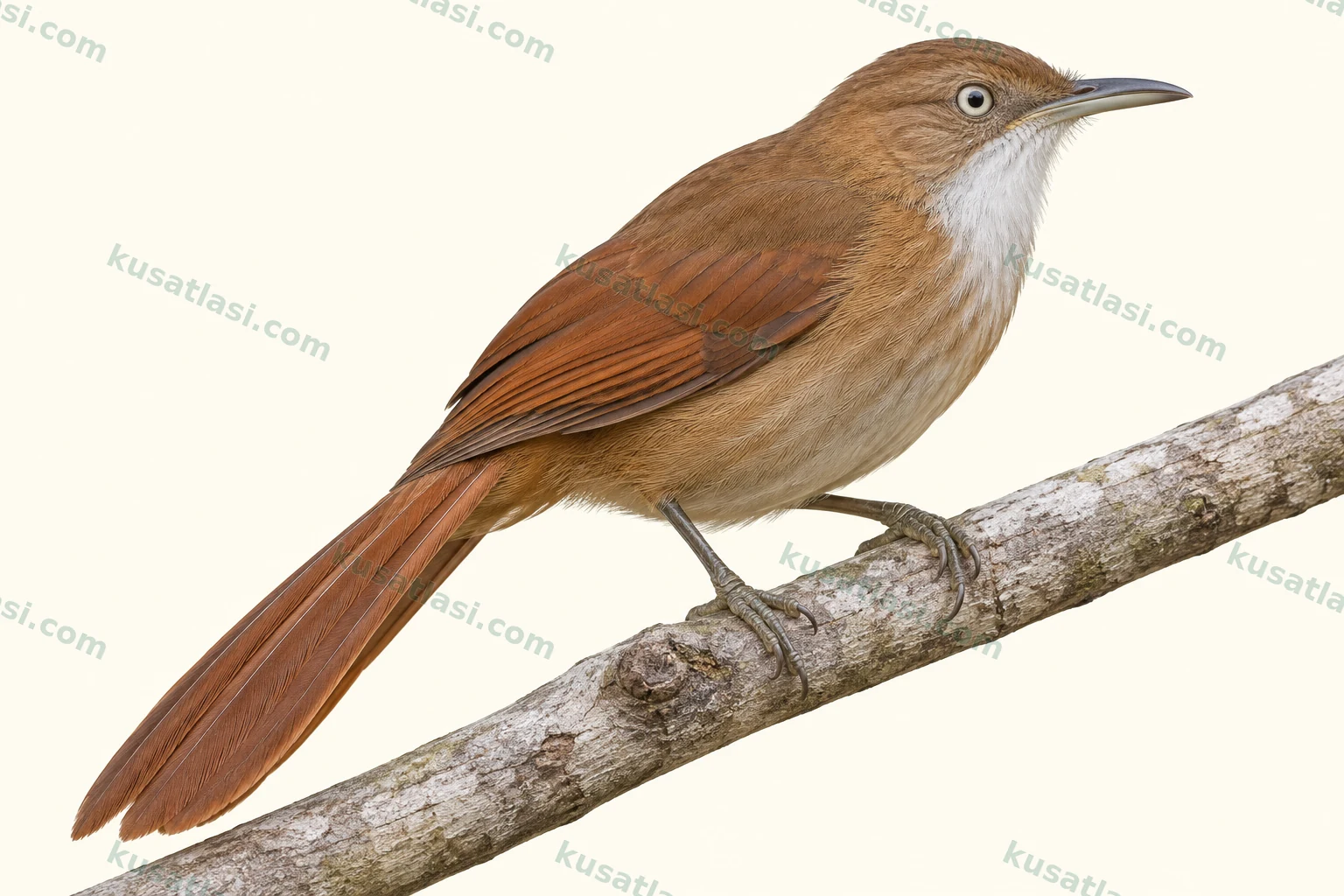
Swipe between the two adult plates.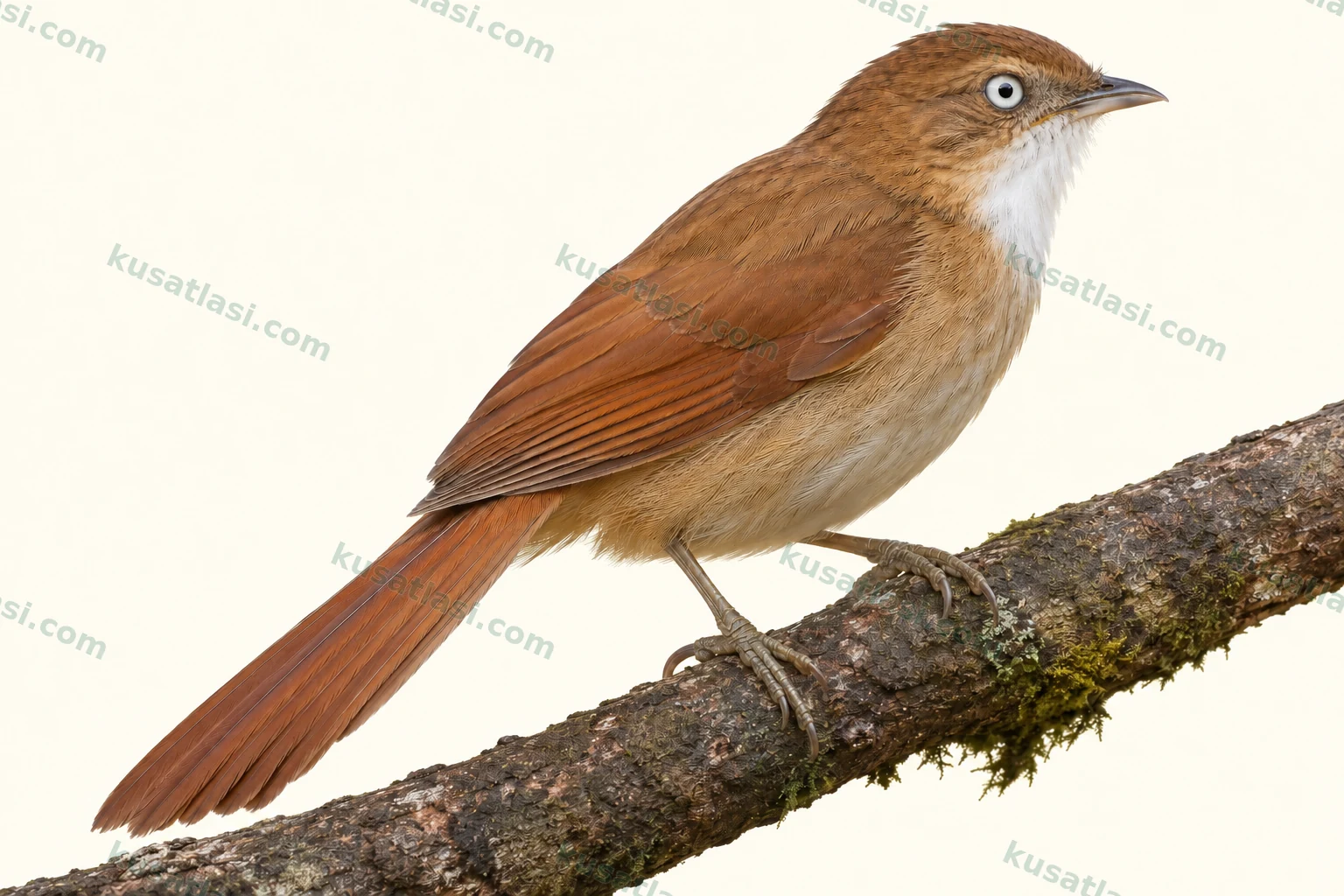
Furnariidae · Passeriformes
White-eyed Foliage-gleaner
Automolus leucophthalmus
Ak Gözlü Yaprakkarıştıran
Combine the white throat, pale iris and rufous tail with its Atlantic Forest distribution.
- Order
- Passeriformes
- IUCN Status
- LCLeast Concern
Biometrics
Length
- Male
- 19–20 cm
- Female
- 19–20 cm
Wing length
- Male
- 9.08 cm
- Female
- 9.08 cm
Weight
- Male
- 25–38 g
- Female
- 25–38 g
Detailed explanations of these measurements are available on our website, on the same species page.
At a Glance
- White throat
May be more obvious than the eye.
- Pale iris and rufous tail
Check alongside the other features.
- Forest understory
Searches suspended dead-leaf accumulations.
Sexes look alike. Young can have darker sides and more uniform upperparts.
Calendar
Resident. September–December breeding evidence is recorded in Minas Gerais; a range-wide monthly calendar is unverified.
Species Information
Quick Identification
White-eyed Foliage-gleaner inhabits the South American Atlantic Forest. Assess its warm brown upperparts, rufous tail, white throat and pale iris together. Despite the name, the white throat may be more conspicuous than the eye during a brief view through foliage.
Appearance and Posture
Head and back are dark reddish-brown, with fine rufous crown streaks visible at close range. Rump and tail are more strongly rufous. The white throat grades into the pale central breast, while breast sides and flanks are warmer ochraceous-brown. The bill is dark above and paler below, and the legs are grey.
The widespread southern form sulphurascens generally has a paler back and tail and less rufous flanks. Geographic colour differences do not identify the sexes. Shade can mute these colours, making several views of tail, throat and eye useful.
Males, Females and Young Birds
Males and females look alike. Young have a more uniform crown and back, shorter crown feathers and darker brown sides; breast and belly can also be slightly darker. These differences do not establish an exact age in months.
Appearance in Flight
The rufous tail may stand out as a bird changes perches, but many forest birds share this colour. A single patch glimpsed in flight is insufficient for identification. On landing, check the white throat, pale iris and brown upperparts together.
Voice and Behaviour
Gives loud, rapid series of repeated two-part notes as well as short harsh calls. Written syllables are approximate memory aids. Vocal variation between forms means that one recording should not represent every population without qualification.
Forages in the understory and sometimes at mid-levels, and may join mixed-species feeding flocks. Association with other birds does not imply identical prey or dietary proportions.
Similar Species
Pernambuco Foliage-gleaner, Automolus lammi, was formerly treated as a subspecies. Its plumage is very similar; vocal differences were important in recognizing the split. Historical northeastern Brazilian records require reassessment against current species limits. A white throat alone does not separate them reliably.
Amazonian Automolus infuscatus also resembles it, but their natural ranges are separate. The warmer rufescent appearance and pale iris of White-eyed Foliage-gleaner help; first establish which species occurs at the observation locality.
World Distribution
Endemic to the Atlantic Forest biome, extending from eastern Brazil to eastern Paraguay and Misiones in northeastern Argentina. It is therefore not endemic to Brazil. The biome encompasses more than one country and extends beyond the immediate coast.
Two subspecies are recognized. Nominate leucophthalmus occurs in eastern Bahia. Sulphurascens ranges more widely, from southeastern Mato Grosso and southern Goiás through southern Bahia to Rio Grande do Sul, also reaching eastern Paraguay and Misiones. These broad limits do not imply suitable habitat throughout the intervening landscape.
Status within Its Range
Local abundance varies with forest conditions. Persistence in some small fragments and well-developed secondary forest does not establish immunity to Atlantic Forest loss. The northern nominate form is less well known; older regional abundance reports are not a current population census.
Seasonal Movements
Classified as resident. The account does not establish a regular long-distance migration route. Residency does not mean that an individual remains at one point throughout its life.
Breeding Habitat
Uses humid lowland evergreen forest and tall secondary growth. Understory vegetation, accumulated dead leaves and debris retained on plants provide foraging sites. Nest records from forest fragments in Minas Gerais do not imply that open pasture or cropland provides equivalent habitat.
Nest Site
A shallow cup of dry plant material is described at the end of a horizontal tunnel in an earth bank. The expert synthesis reports three to four white eggs for the southern form sulphurascens.
A field study in Minas Gerais, Brazil, found two nests. The narrow entrance of one in a streamside bank, monitored in November 1995, prevented inspection of its contents; two nearly fully feathered young were caught in December. A second nest in a roadside bank in October 1998 contained three eggs. That cavity had been occupied by another bird the previous year. These observations do not prove that the foliage-gleaner initially excavated the tunnel.
Laying onset and hatching dates were unknown, so incubation and nestling periods cannot be calculated from these observations. Parental division of labour also remains insufficiently documented. Brood patches recorded in Minas Gerais during September–December indicate regional breeding activity, not a range-wide monthly calendar. Observe without approaching the entrance or obstructing the birds.
Daily Habitat Use
Usually forages in the understory, sometimes ascending to mid-levels. It can search dead leaves retained at epiphyte bases, on understory palms and in bamboo. Forest litter is not confined to the ground; accumulations suspended among vegetation also provide feeding surfaces.
What Does It Eat?
Feeds on insects and other small invertebrates. A study sampling birds in Minas Gerais, Brazil, during 2000–2001 reported beetle, adult butterfly or moth, caterpillar and ant remains in two stomach samples from this species. This small sample cannot establish dietary proportions throughout the year.
A separate diet study near Belo Horizonte, Brazil, during the 1999–2000 wet season also classified it as insectivorous. The total sample across all bird species in either study is not the sample size for this foliage-gleaner.
How Does It Forage?
Searches dead leaves and debris retained on vegetation, gleaning invertebrates from these accumulations. It may forage in mixed-species flocks. Using a plant as a foraging surface does not establish that it eats the plant’s leaves.
Similar Plumage, Different Voices
Plumage alone did not determine recognition of Automolus lammi as a separate species. The South American Classification Committee’s 2008 assessment drew on vocal differences and reciprocal playback experiments. Birds sharing a white throat need not be the same species, and historical literature must be checked against the taxon it originally included.
Successive Occupants of One Cavity
The cavity containing the 1998 nest in Minas Gerais, Brazil, had housed another forest bird the previous year. This does not demonstrate simultaneous sharing or cooperation between species. Successive occupation in different years is a local example of a suitable cavity serving more than one bird species.