
World Birds
Field Guide Plates
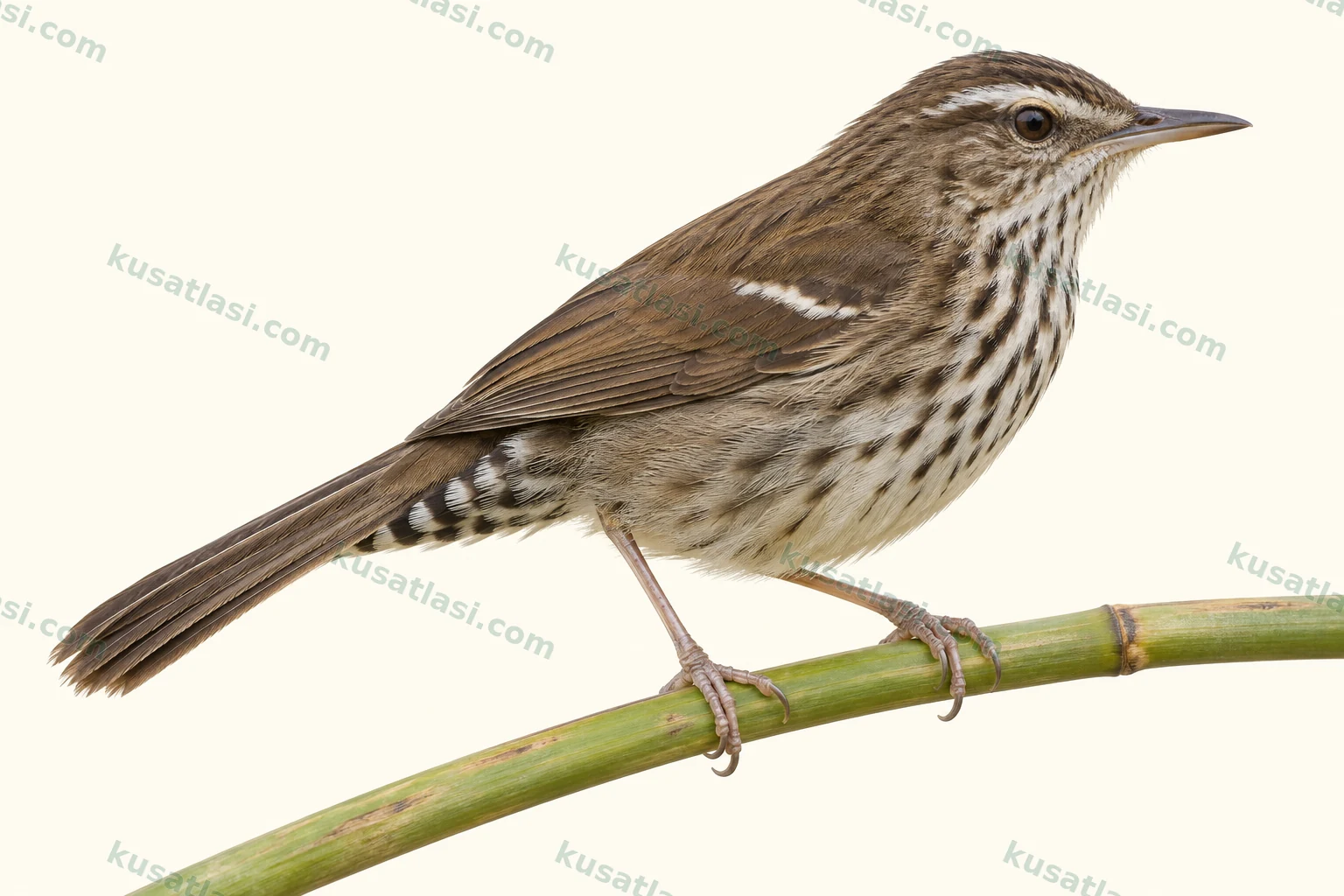
Swipe between the two adult plates.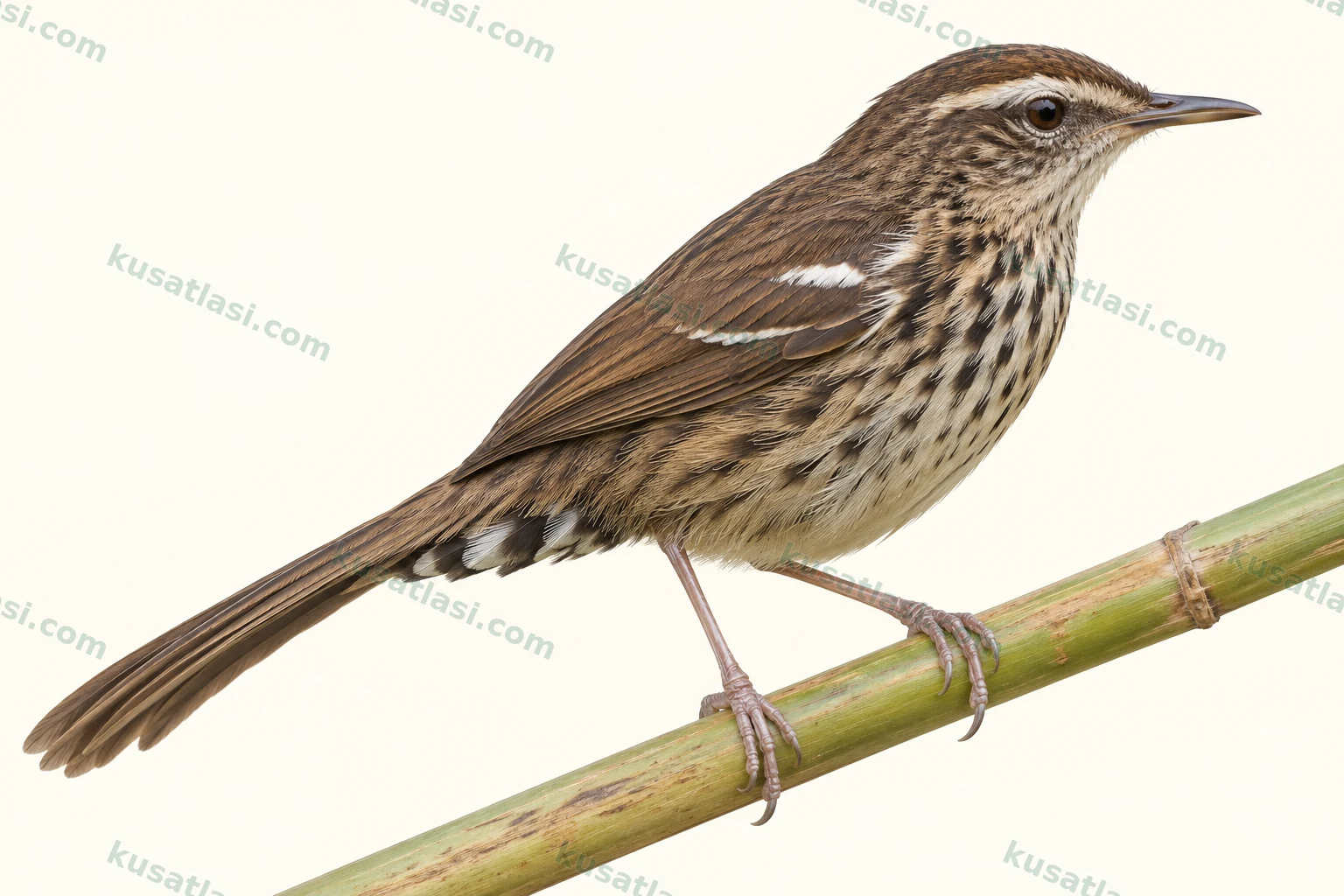
Locustellidae · Passeriformes
White-winged Swamp Warbler
Bradypterus carpalis
Ak Kanatlı Bataklık Ötleğeni
Look for the pale eyebrow, streaked throat and breast and white at the wing bend together.
- Order
- Passeriformes
- IUCN Status
- LCLeast Concern
Biometrics
Length
- Male
- 16–17 cm
- Female
- 16–17 cm
Wing length
- Male
- 6.78 cm
- Female
- 6.78 cm
Weight
- Male
- 18.9–26.2 g
- Female
- 19–23 g
Detailed explanations of these measurements are available on our website, on the same species page.
At a Glance
- Streaked pale breast
Adults show bold dark streaks on a whitish ground.
- White wing bend
The whole wing is not white.
- Dense papyrus
May remain concealed low in the interior.
Males have more white at the wing bend. Females and especially young may show less; a brief view is insufficient for certain sexing.
Calendar
Regarded as sedentary. No verified species-wide monthly breeding schedule was established.
Species Information
Quick Identification
White-winged Swamp Warbler is a secretive bird of African papyrus swamps. Look for dark olive-brown upperparts, a pale eyebrow and bold dark streaks on the whitish throat and breast. The name refers especially to pale edging on small coverts at the bend of the wing, not an entirely white wing.
General Appearance and Posture
The crown, hindneck and back are dark olive-brown. The eyebrow is buffish white. Flight feathers are dark brown, with paler tips or edges on some coverts. Visibility of the white wing marking depends on wing position; a closed wing need not reveal every pale area at once.
The whitish throat and breast carry strong dark streaks, with olive-brown flanks. Dark undertail coverts have broad pale edges. The long, bulky-looking tail is graduated, with central and outer feathers of different lengths. The eye is brown, the bill mainly black with a paler base to the lower mandible, and the legs pinkish brown.
It can move slowly and mouse-like through low, dense papyrus growth. This concealed behaviour makes prolonged open views difficult. A glimpse of a dark back alone is insufficient without assessing the breast streaking and markings at the wing bend.
Males, Females and Young Birds
Males and females share the general plumage pattern. Males have broader white edging on the lesser wing coverts, so the wing bend can appear largely white; females have less white. Wing position also affects the exposed area, so its size during a brief view is not sufficient for confident sexing.
Young have a creamier throat with less distinct dark streaks, brown-tinged underparts and reduced white wing markings. Strong wing white and bold adult breast streaking should therefore not be expected to show equally clearly in every juvenile.
The expert account describes Zambian birds as blacker above, with darker throat streaking. The species is nevertheless treated as monotypic. Regional colour variation alone does not establish a separate species or subspecies.
Appearance in Flight
A brief flight may reveal the contrast between dark wings and pale covert markings, together with the long graduated tail. No separate, definitive identification rule based only on the underwing was verified. If the bird reappears, reassess the eyebrow, throat and breast streaks and wing bend together.
Voice and Behaviour
Song can resemble a bouncing ball: initially spaced low notes accelerate and then fade, sometimes ending in a low trill. The expert account also reports conspicuous wing-snaps accompanying song; these mechanical sounds are distinct from vocal notes. Short calls are described as “chup” or “chick”.
Sound can help locate a concealed bird. Written imitations do not replace recordings or establish identification alone. Quiet observation from the edge is preferable to entering the vegetation to flush the bird.
Similar Species
A briefly seen brown bird in papyrus should not be assigned to this species by colour alone. When comparing similar Bradypterus, assess the adult’s bold breast streaks, pale eyebrow, white wing bend and graduated tail together, remembering that young may show weaker white and streaking.
Several wetland songbirds can occupy the same swamp. Suitable habitat and an accelerating song sequence do not automatically identify a poorly seen bird. An uncertain record is preferable to a confident assignment without sufficient combined evidence.
World Distribution
Occurs patchily in suitable swamps of eastern and central Africa. The current specialist taxonomic checklist includes northeastern and eastern Democratic Republic of the Congo, Rwanda, eastern Burundi, southwestern and southern Uganda, western Kenya, northwestern Tanzania and northern Zambia. This does not imply continuous occurrence or presence in every wetland in those countries.
Large gaps between papyrus areas mean that a country-level range does not by itself identify suitable local habitat. Northwestern Tanzania is explicitly included in the current checklist, extending the country coverage of the older expert account.
Movements and Migration
Regarded as sedentary in the expert account. This does not prove that individuals never move locally. No verified long-distance migration route or shared monthly movement schedule was established, so none is presented.
Breeding Habitat
Dense papyrus swamp is the principal habitat. Open water or a narrow strip of shoreline plants alone does not provide the same habitat. Mixed papyrus–Miscanthidium vegetation is also reported in Rwanda, so occurrence should not be restricted to pure papyrus stands.
A comparative study published in 2003 recorded the species only in the undisturbed Ugandan papyrus stands examined, not in the sampled burned or polluted stands. This local finding is not a universal rule of absence from every modified swamp.
Nest Site
The expert account provides insufficient breeding information. Additional habitat and distribution research did not establish a verified nest description, typical clutch, complete incubation period or nestling period. Nest traits and development times of related birds are therefore not transferred to this species.
The older account’s tentative April–June suggestion for Kenya is not used as a confirmed species-wide breeding calendar. Surveys conducted during a breeding-season window do not themselves demonstrate observation of every stage of laying and chick development in this species.
Daily Habitat Use
Forages low in the vegetation, including among old, decaying papyrus. Dense interior cover and swamp edges are not interchangeable. Drainage, intensive cutting or burning can alter the vegetation structure it uses, making habitat quality important alongside the mapped extent of a wetland.
What Does It Eat?
The reliable expert account summarises the diet as insects. The sources examined did not verify a detailed prey list, seasonal proportions or dietary differences between adults and chicks. Spiders, seeds or fruit eaten by other swamp birds are therefore not added as confirmed foods of this species.
How Does It Forage?
Searches slowly through low papyrus and old, decaying vegetation. Its concealed, mouse-like movements make observation difficult. This describes foraging location and movement, not a dietary sample identifying each captured insect. Aerial hunting, diving or regular seed feeding are not added to fill the gaps in the verified account.
More Species Need Not Mean Better Habitat for a Specialist
In the 2003 study, disturbed papyrus stands sometimes held more bird species, yet White-winged Swamp Warbler was not recorded there. Added generalists can conceal the loss of an interior specialist. Total species richness alone is therefore an inadequate measure of habitat condition for this bird.
Swamp Shape Can Matter Too
A 2014–2015 study around Lake Bunyonyi, Uganda, compared occurrence between years. Models associated persistence with larger, more circular papyrus patches, and colonization with greater circularity. These results concern local occupancy, not individual lifespans, and are not a recommendation to reshape wetlands physically.
Wing Sounds and Vocal Notes Are Different
Reported wing-snaps accompanying song show that the display can include sounds produced mechanically as well as vocally. Separating the snaps from sung notes helps describe the sequence accurately. A snap alone should not be assigned to this species without the complete sound pattern and supporting visual evidence.