
World Birds
Field Guide Plates
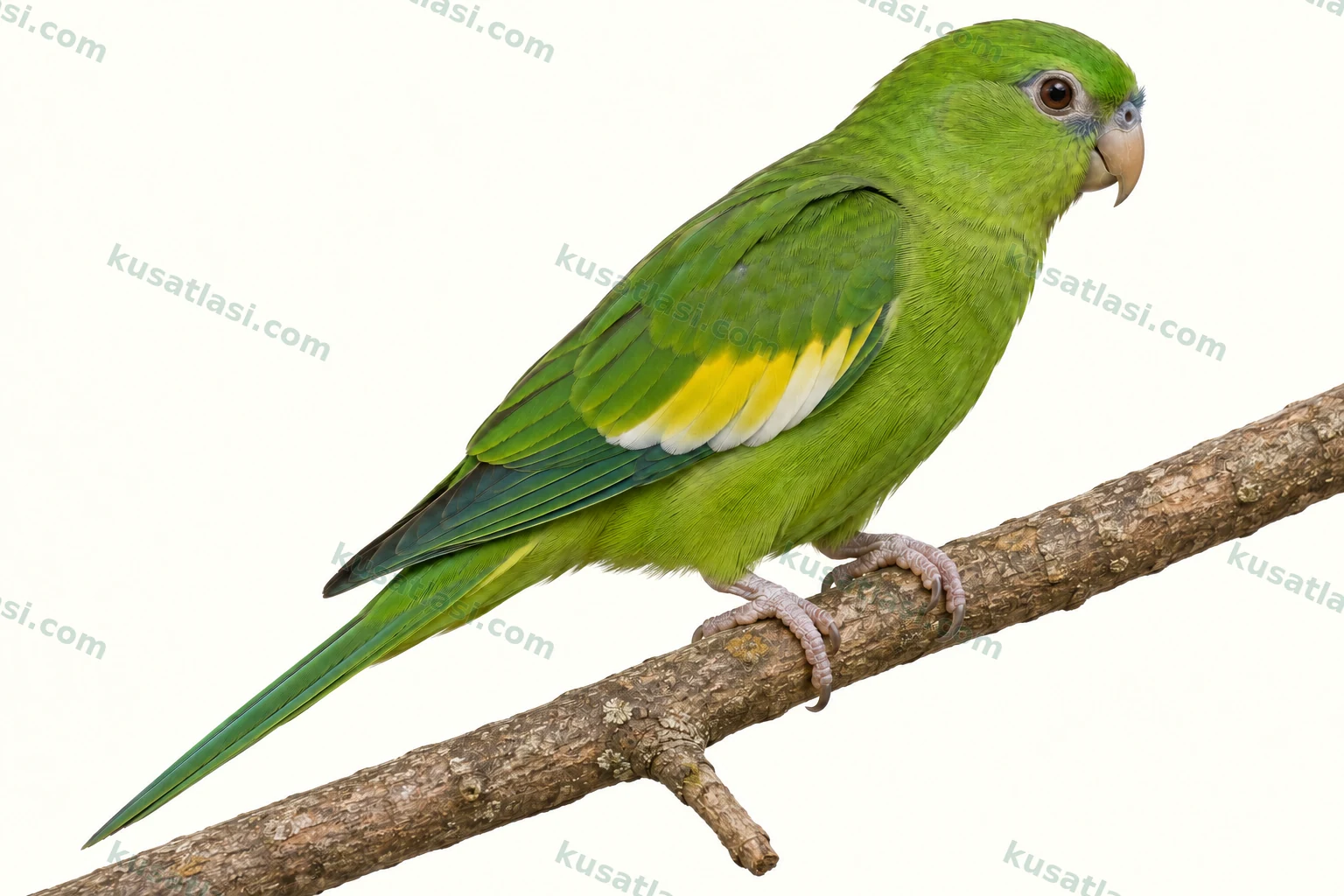
Swipe between the two adult plates.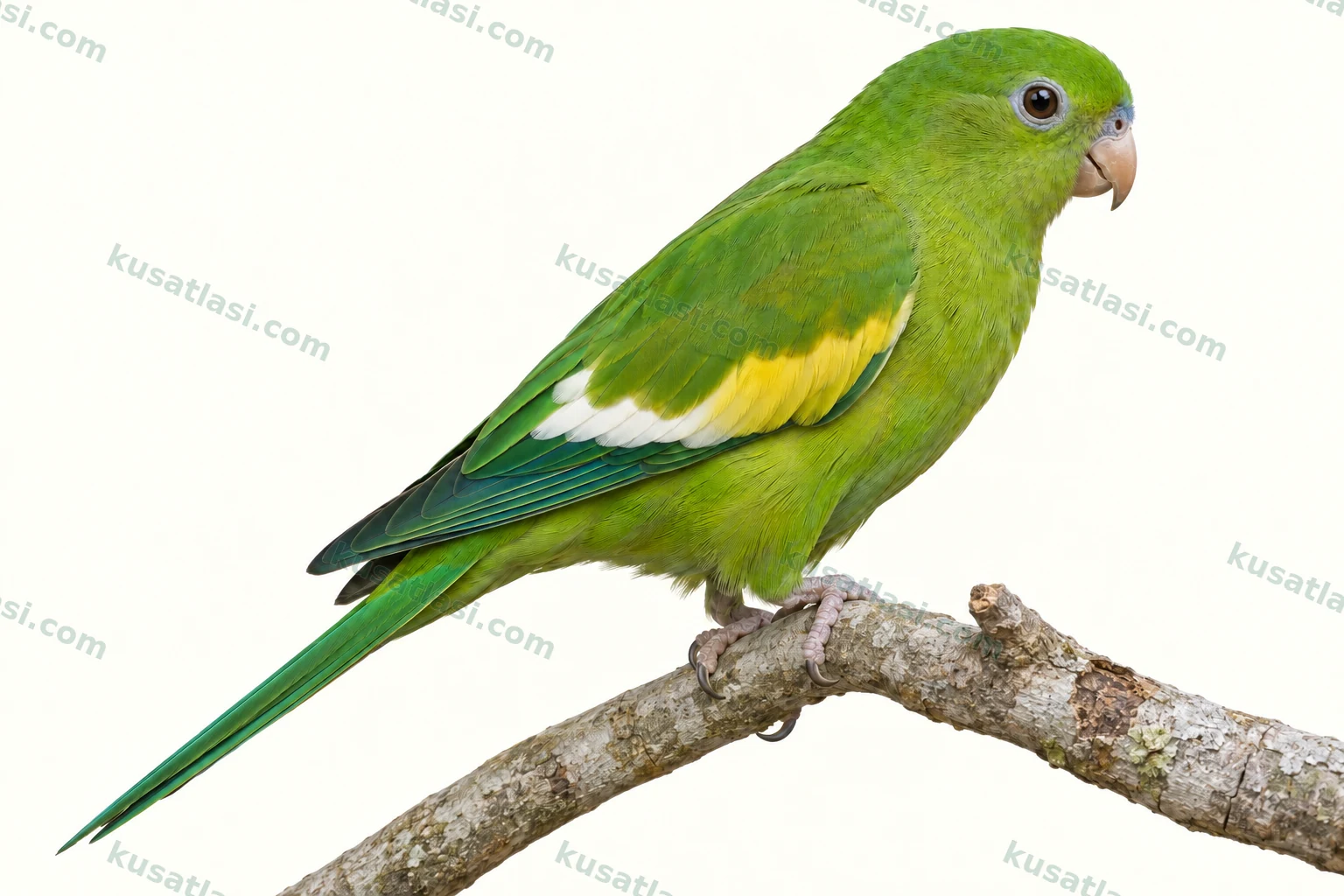
Psittacidae · Psittaciformes
White-winged Parakeet
Brotogeris versicolurus
Ak Kanatlı Papağan
Check the green body, yellow wing area and white revealed by the open wing together.
- Order
- Psittaciformes
- IUCN Status
- LCLeast Concern
Biometrics
Length
- Male
- 22 cm
- Female
- 22 cm
Wing length
- Male
- 11.4 cm
- Female
- 11.4 cm
Weight
- Male
- 64.9–80.8 g
- Female
- 61.7–74.3 g
Detailed explanations of these measurements are available on our website, on the same species page.
At a Glance
- White wing area
Brotogeris chiriri lacks the same white pattern.
- Yellow coverts
Assess together with the white primaries.
- Pale bill
Green body plumage alone is not diagnostic.
Adult sexes look similar; juveniles may show less white in the wing.
Calendar
Local breeding inferences from Puerto Rico do not define a calendar for the entire Amazon basin.
Species Information
Quick Identification
A green, pointed-tailed parakeet with yellow and white in the wings. White in the spread wing is particularly useful.
General Appearance and Posture
The bill is pale horn-coloured, the eye dark, and the bare eye-ring pale gray. Green body plumage alone is not diagnostic.
Males, Females and Young Birds
Adult sexes look similar. Juveniles may have fewer white primaries, tipped green; wing whiteness alone does not establish an exact age or sex.
Appearance in Flight
White primaries and yellow coverts become conspicuous as the wing opens; the entire wing is not white.
Voice and Behaviour
It gives shrill, metallic flight calls. Birds feed, travel and roost in groups, while pair members often remain together. Observations at San Germán, Puerto Rico, documented flocks leaving roost trees in the morning and dispersing to feeding areas.
Similar Species
Yellow-chevroned Parakeet (Brotogeris chiriri) also has yellow in the wing but lacks the same broad white area. Both species were formerly combined as Canary-winged Parakeet; older records under that name require checking their scientific name and taxonomic scope.
World Distribution
Its native range is centred on the Amazon basin of South America, including lowlands of southeastern Colombia, Peru and Brazil. This native distribution should be distinguished from populations established elsewhere through human introduction. It is treated as monotypic.
Status Within Its Natural Range
The 2019–2020 feeding study in Manaus, Brazil, documented the species in an urban landscape within its native geographic region. The Puerto Rican population, by contrast, originated from birds introduced from South America. Counts at San Germán and San Patricio in 2007–2010 showed local growth, not the same trend throughout the Amazon basin.
Movements
It is generally considered non-migratory. Daily flights between roosts and feeding areas are not long-distance seasonal migration. Puerto Rican roost counts varied seasonally, and a decrease at one roost does not necessarily represent an equivalent number of deaths. No monthly route covering its entire range has been verified.
Breeding Habitat
It can use tree cavities and arboreal termite nests. Research in Puerto Rico recorded nesting in Nasutitermes termite mounds on both native and introduced trees. The presence of a mound does not mean that every such structure will be used.
Nest Site
Two nests inspected with a camera early in the breeding season in the Puerto Rican study contained three and four eggs respectively. These are local observations, not a fixed clutch range for the entire species. Wild incubation and nestling durations were not adequately verified in this review. Observe from a distance without opening the cavity or mound, blocking its entrance or obstructing adults.
Daily Habitat Use
Communal night roosts and daytime feeding areas can differ. The 2005–2006 San Germán study distinguished evening movements near roost trees from morning departures. In Manaus, feeding was recorded around forest-fragment edges, tree-lined roads and gardens. Such use does not demonstrate that urban trees replace every function of native forest.
What It Eats
Observations in Manaus, Brazil, from April 2019 to February 2020 recorded fruit pulp, whole fruits, seeds, flowers, leaves and nectar. Fruit pulp predominated in this sample, and both native and introduced plants were used. Percentages pooled across the entire parrot assemblage should not be presented as exact proportions for this species.
How It Forages
It exploits tree foods in groups. The Manaus study recorded 88 feeding bouts for this species and a broad list of plants, while feeding nevertheless concentrated more strongly on some plants. These bouts do not represent 88 separate sampled individuals. Puerto Rican research also reported flowers, seeds and sap alongside fruits; the two regions should not be collapsed into one universal dietary composition.
A Termite Mound as a Bird Nest Site
Use of a termite mound does not mean eating the same food as the termites. Its documented role in Puerto Rico is as a nesting site holding eggs and chicks. The researchers propose abundant mounds as a possible contributor to establishment success, rather than experimentally demonstrating them as the sole cause of population growth.
Counting Roosts Is Not Counting Nests
Monthly roost counts were conducted at San Germán, Puerto Rico, during 2005–2006. Fewer roosting birds in January–March were interpreted as some birds leaving to breed. This can help estimate breeding participation, but it is not a census in which every nest was located individually. Likewise, an increase in returning birds does not mean that all young were followed directly.
A Broad Diet Can Still Be Uneven
The Manaus study found a wide range of food plants alongside disproportionate use of some resources. A bird with many dietary options need not use every option equally. Urban feeding flexibility does not demonstrate benefits from deforestation or absence of impacts from capture for trade.