
World Birds
Field Guide Plates
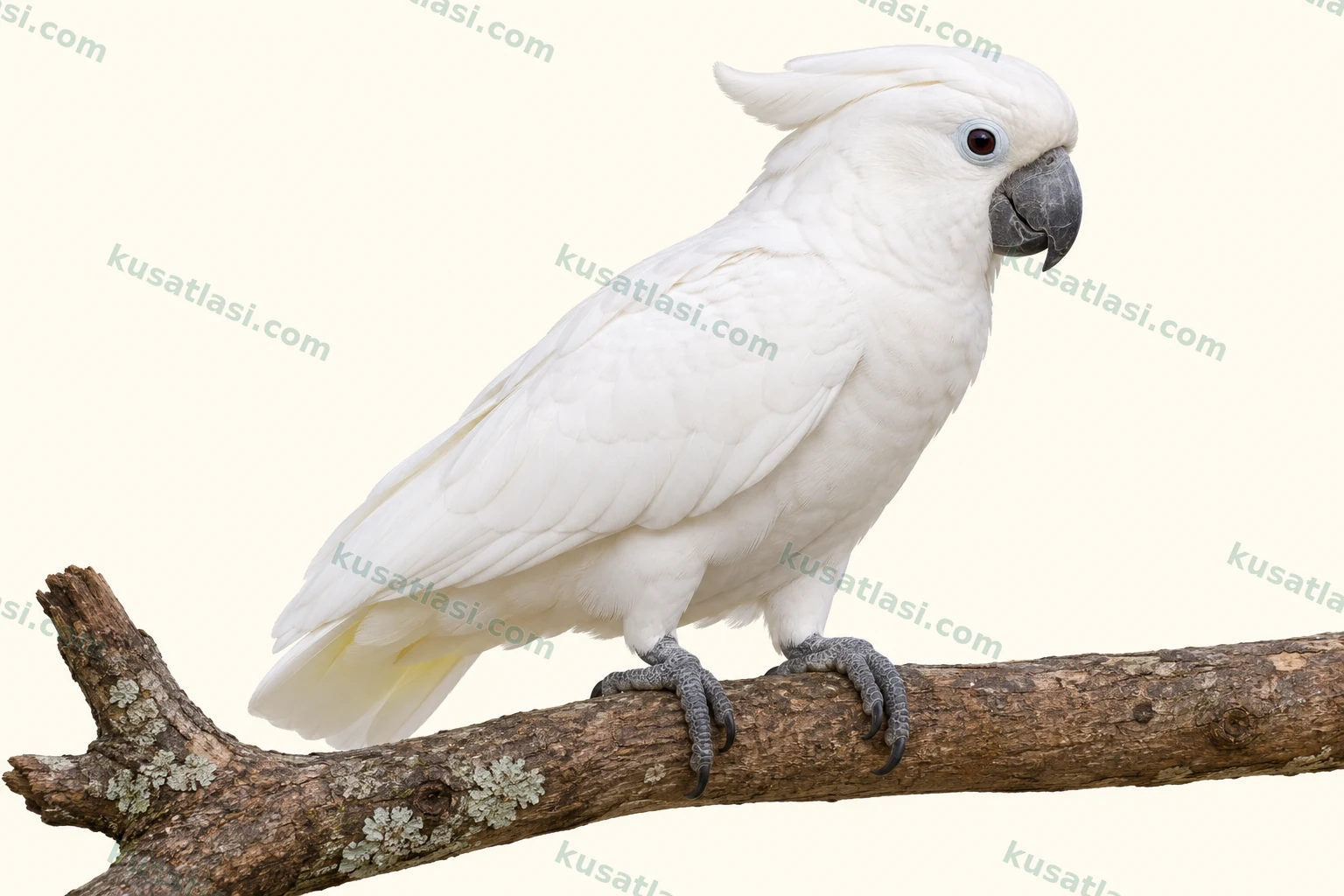
Swipe between the two adult plates.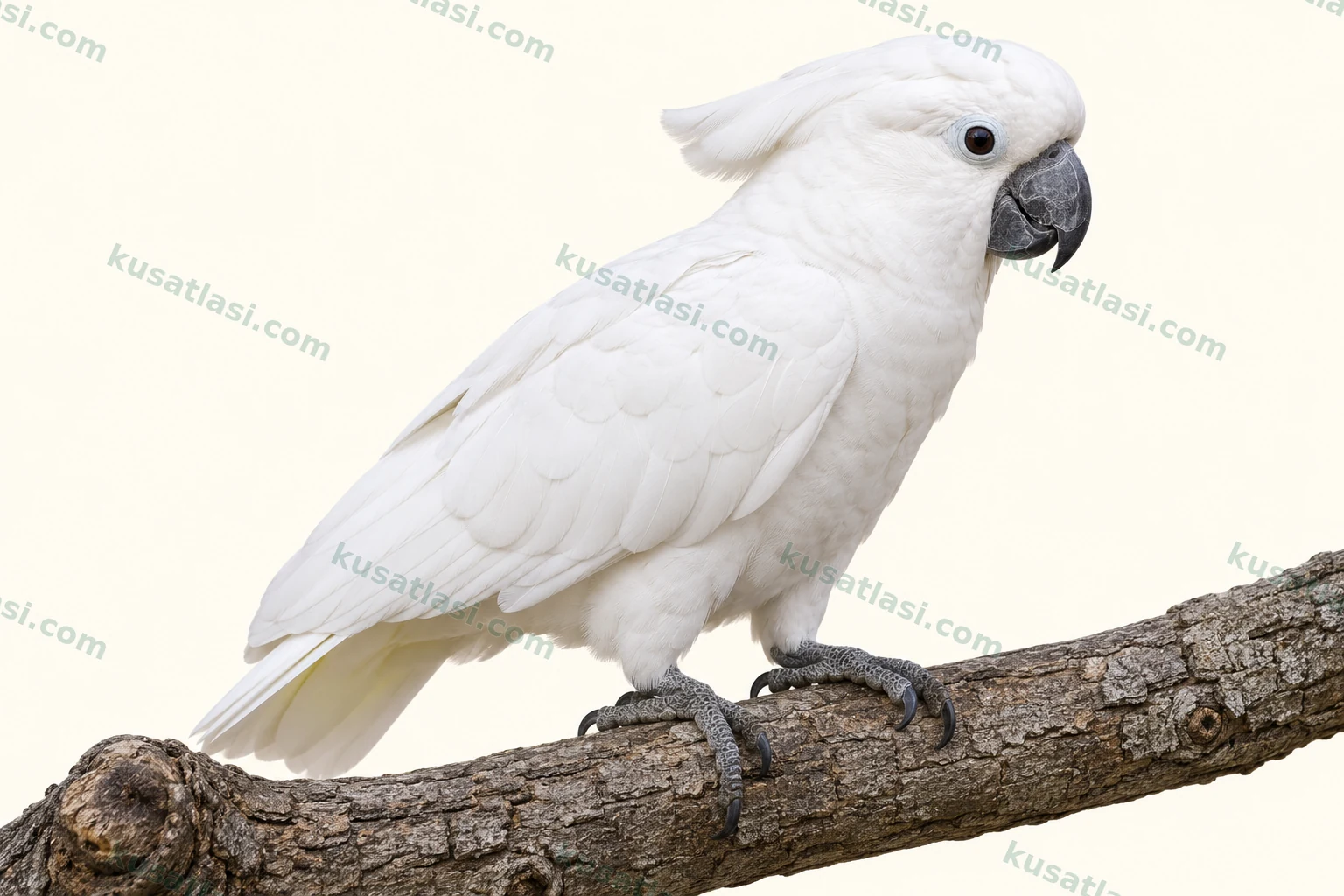
Cacatuidae · Psittaciformes
White Cockatoo
Cacatua alba
Ak Kakadu
Check the broad white crest, dark bill and pale eye-ring together.
- Order
- Psittaciformes
- IUCN Status
- ENEndangered
Biometrics
Length
- Male
- 46 cm
- Female
- 46 cm
Wing length
- Male
- 28.15 cm
- Female
- 28.15 cm
Weight
- Male
- 550–570 g
- Female
- 550–570 g
Detailed explanations of these measurements are available on our website, on the same species page.
At a Glance
- White crest
Spreads upwards and sideways.
- Yellow beneath wings
The crest itself remains white.
- North Maluku forest
Search high branches and large cavity-bearing trees.
Adult females have red-brown irides and males very dark ones. Juveniles also have dark eyes, so iris colour alone does not always establish sex.
Calendar
Wild nest records exist from Halmahera and Ternate. Autumn laying dates were back-calculated estimates, not a fixed monthly calendar for every island.
Species Information
Quick Identification
White Cockatoo is a white-plumaged cockatoo native to the North Maluku islands of Indonesia. Its broad white crest spreads upwards and sideways, contrasting with the dark bill and pale skin around the eye. Pale yellow beneath the wings and tail accompanies the white plumage; it does not make this a yellow-crested bird.
General Appearance and Posture
The head and body are white. When folded, the crest slopes backwards; when raised, it greatly broadens the apparent head. Assess crest shape and colour together with the rest of the head.
The bill is gray-black and the feet and legs gray. The bare eye-ring is whitish to yellowish white. The dark bill stands out against the pale face. Slight yellow at feather bases and beneath the wings may become visible in closer views of a bird that looks entirely white at a distance.
Often noticed on high branches and in the upper forest layers. During 1991–1992 research in North Maluku, Indonesia, most sightings were in the canopy and emergent trees, although some birds were seen lower down.
Males, Females and Young Birds
Males and females share white plumage and a white crest. The adult male iris is described as very dark brown or blackish, while the adult female has a red-brown iris. This difference concerns the iris, not the pale bare skin surrounding the eye.
Young resemble adults in overall plumage and have a dark gray iris. A dark-eyed bird should therefore not be called male without considering age. Iris colour may be difficult to assess at a distance or in shade; crest posture and white plumage alone do not establish sex.
Appearance in Flight
The undersides of spread wings and tail can reveal pale yellow. A fully expanded crest should not be expected in every flight view, as it may be folded or indistinct at a distance. Recheck crest colour, dark bill and pale eye-ring after the bird lands.
Voice and Behaviour
Common calls include nasal, one- or two-syllable sounds resembling “keh” or “keeh-ah”. It also gives rapidly repeated, harsher short notes. These represent variation within the species; one brief syllable should not be treated as a decisive distinction from every other cockatoo.
Seen in pairs and small groups, with larger gatherings possible at communal roost trees. About eight cockatoos came to roost in a tree watched on Halmahera, Indonesia, in November 2014. That local count is not a fixed flock size for every island.
Similar Species
Cacatua moluccensis differs in its soft peach-toned body and conspicuous darker peach or salmon colour in the expanded crest. White Cockatoo has a white crest. If a bird is seen only as a pale silhouette, wait for a better view rather than assuming colours hidden by shade.
Cacatua sulphurea also has a white body but differs in its yellow crest and yellow ear-coverts. Yellow beneath a White Cockatoo’s wings should not be interpreted as a yellow head crest. Consider natural island distribution alongside head pattern and bill.
World Distribution
The natural range comprises Halmahera, Bacan, Ternate, Tidore, Kasiruta and Mandioli in Indonesia’s North Maluku islands. Its restricted island distribution matters for the protection of native populations.
Historical specimens attributed to Bisa and Obi may have involved escaped or transported birds. A single record outside the natural range does not establish an indigenous population there.
Status within Its Range
Trapping and forest loss are major conservation concerns. Occurrence is uneven, and encounters at some well-wooded sites do not establish secure populations on every island.
Research in North Maluku from October 1991 to February 1992 identified this cockatoo among the heavily traded species. Its population estimates belong to that historical sampling period and are not present-day totals. Differences in survey area and method must be considered before interpreting old estimates and newer encounters as population change.
Movements and Migration
Movements remain poorly known. Pairs or groups may move between feeding and roosting areas. A verified regular seasonal migration route or monthly movement calendar covering all islands was not found in this research.
Breeding Habitat
Principally inhabits lowland forest on flat or gently sloping terrain. It uses both unlogged forest and selectively logged stands and may visit tall trees at edges or left in recently cleared land. This flexibility does not remove its need for large cavity-bearing trees.
Nest Site
Nests in cavities in large forest trees. Two probable nest sites found on Bacan, Indonesia, in October–November 1991 were holes where major branches had broken from the main trunk. They were not two nests confirmed by inspection of eggs.
At Mou-Mou forest on Halmahera, Indonesia, two chicks were observed in a nest on 3 February 2014; one departed with its parents while the other remained in the cavity. Three birds were seen around another nest in a Pometia tree at Aketajawe later that month, possibly two adults and a fledgling. That second observation does not document three chicks.
These wild nest records establish neither a species-wide typical clutch size nor exact developmental durations. Directly monitored wild incubation and nestling periods were not verified in this research; frequently quoted durations can derive from captivity. Detailed wild observations of how parents divide incubation and care also remain incomplete.
The authors assessing the 2014 observations suggested breeding may extend from October to May or June. Autumn laying dates were back-calculated from development rather than established by direct egg observations. They are therefore not a fixed monthly calendar for every island. Observe active cavities without approaching or obstructing access.
Daily Habitat Use
Foraging is mainly arboreal. Birds can gather in tall roost trees that may also be used by other cavity-nesting birds. In the 2014 observations on Halmahera, Indonesia, cockatoos roosted in a tree containing an active hornbill nest. Sharing a tree does not establish cooperative rearing in the same cavity.
What Does It Eat?
Arboreal seeds and fruits are the principal foods. Expert accounts from North Maluku report Canarium fruits, some cultivated fruits and maize. Use of forest plants and crops shows that feeding is not confined to one cultivated food, although verified year-round dietary percentages are unavailable.
Birds on Bacan have been observed peeling bark and investigating epiphytic plant clumps. Such behaviour suggests possible invertebrate feeding but does not itself identify captured prey. It cannot establish a detailed, confirmed list of insect species.
How Does It Forage?
Usually searched for in food-bearing trees in the upper forest layers, including fruiting trees at forest edges. The 2001 compilation of North Maluku records also reports ground feeding among old maize plants; this does not make it a predominantly ground-foraging species.
Two Species around the Same Cavities
Five cases watched on Halmahera and Ternate, Indonesia, in 2014 documented interactions between White Cockatoos and the hornbill Rhyticeros plicatus around cavities. Three involved cockatoo nests and two hornbill nest holes; they were not five cockatoo nests. Hornbills inspected all three cockatoo cavities.
A cockatoo nest on Ternate apparently became inactive after a visit, but the subsequent abandonment was reported by a local guide and was not directly shown to have been caused by the hornbill. The paper discusses possible competition rather than treating every inspection as successful usurpation. Because suitable cavities were not comprehensively surveyed, an actual shortage was not measured.
The authors also considered whether partly different breeding times might allow the two species to use a cavity sequentially. That possibility is different from simultaneous joint nesting or demonstrated cooperation across all islands.
Large Trees and Trapping Pressure
The 1991–1992 North Maluku study highlighted two connected effects of logging: valuable cavity-bearing trees can be lost, while logging roads can give trappers access to previously difficult terrain. Forest area alone therefore does not describe every aspect of nest-tree availability and trapping pressure. These findings belong to the period and region studied; historical trade volumes are not substituted for current annual totals.