
World Birds
Field Guide Plates
Swipe between the two adult plates.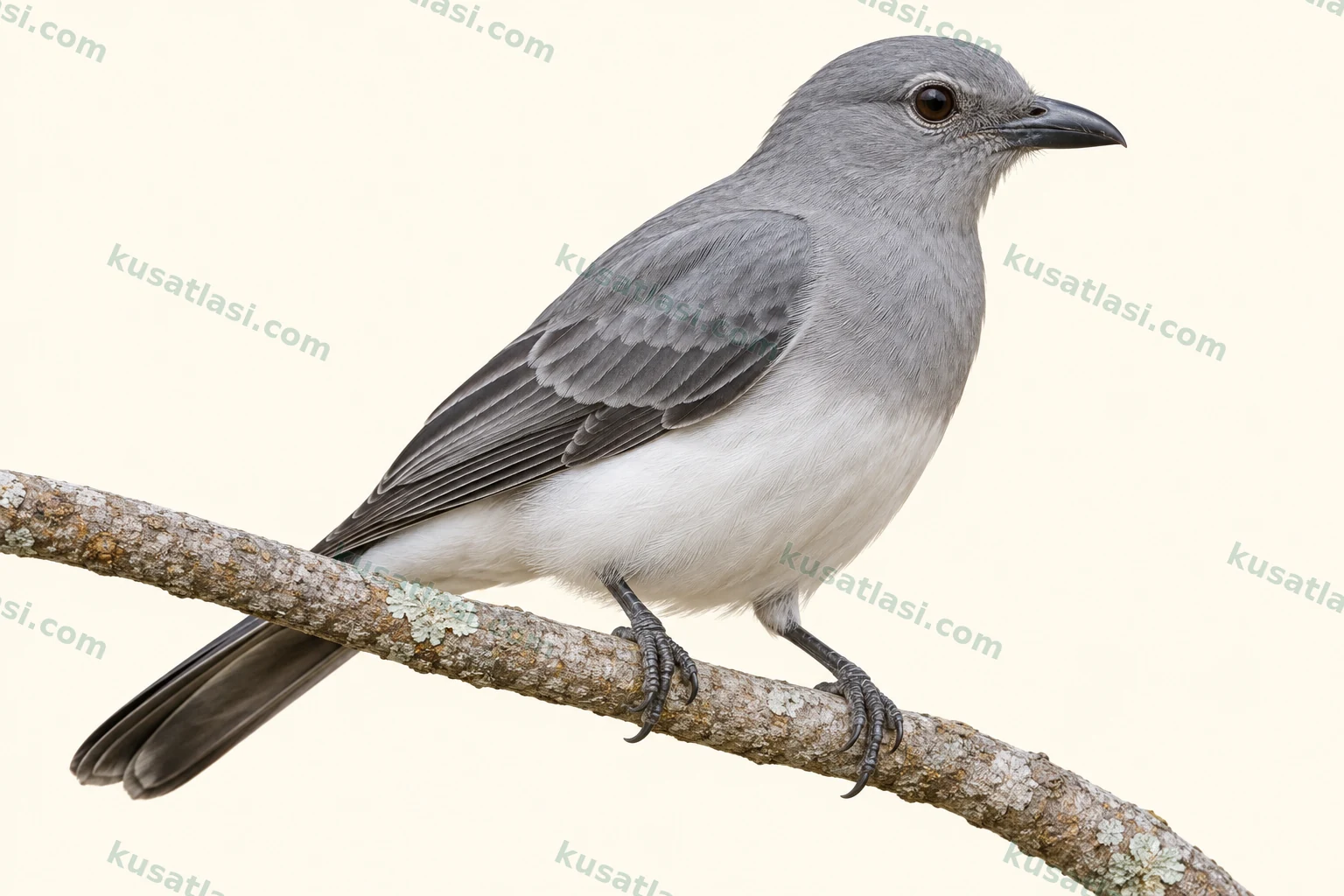
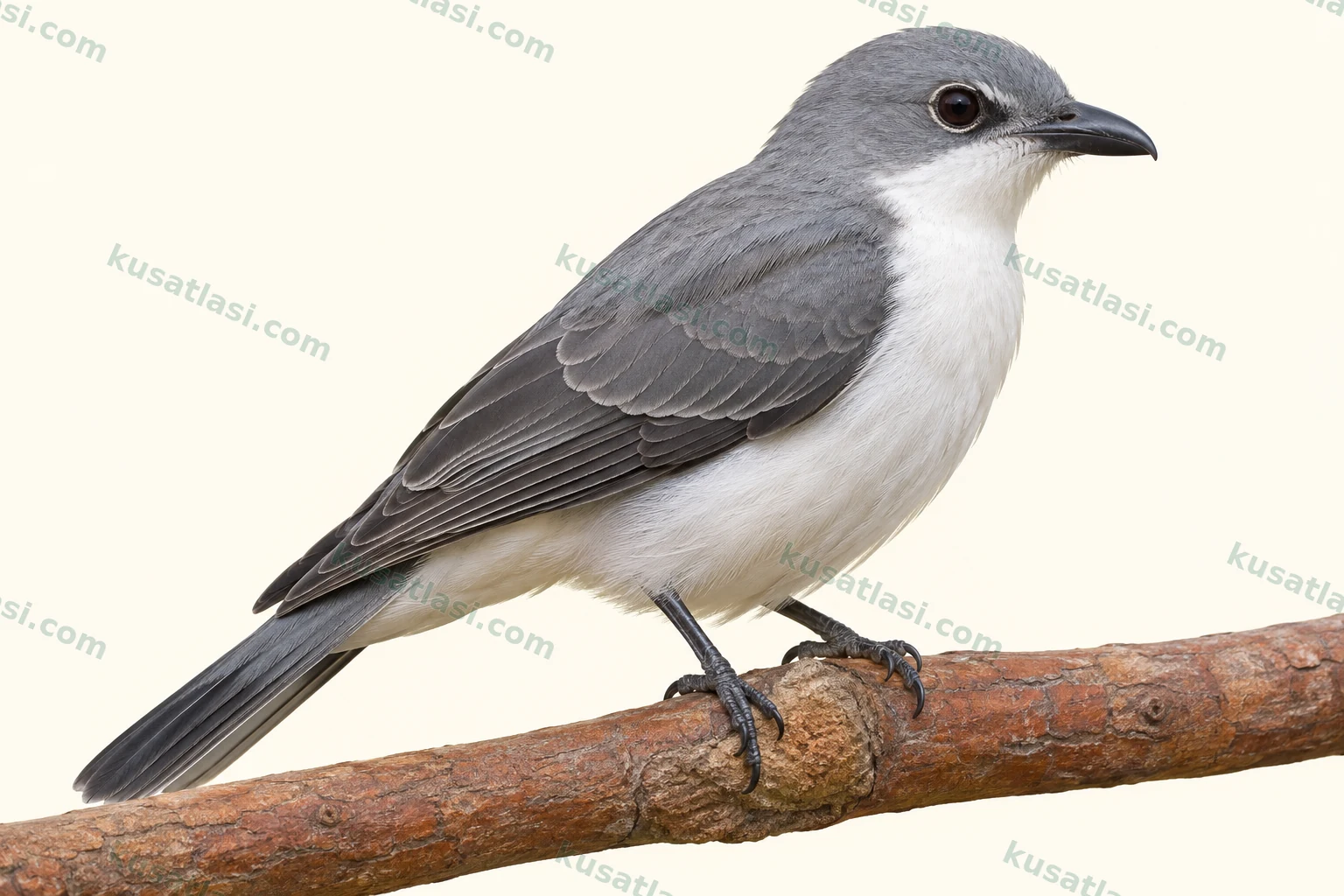
Campephagidae · Passeriformes
White-breasted Cuckooshrike
Ceblepyris pectoralis
Ak Göğüslü Tırtılyiyen
Assess the grey head and upper breast with the white belly and dark wing.
- Order
- Passeriformes
- IUCN Status
- LCLeast Concern
Biometrics
Length
- Male
- 25–27 cm
- Female
- 25–27 cm
Wing length
- Male
- 13.87 cm
- Female
- 13.87 cm
Weight
- Male
- 49–58 g
- Female
- 49–58 g
Detailed explanations of these measurements are available on our website, on the same species page.
At a Glance
- White lower underparts
Look for white extending from lower breast to undertail.
- Fine white eye-ring
The eye itself is dark; distinguish it from the surrounding ring.
- Female’s white throat
Assess throat and facial pattern together.
The female has a white chin and upper throat; the male has a darker throat. Juvenile markings need separate assessment.
Calendar
This calendar shows the August–December breeding period reported for Zambia and Zimbabwe. Other countries can differ; see Habitat for the regional context.
January
Outside the stated window
February
Outside the stated window
March
Outside the stated window
April
Outside the stated window
May
Outside the stated window
June
Outside the stated window
July
Outside the stated window
August
Reported breeding period
September
Reported breeding period
October
Reported breeding period
November
Reported breeding period
December
Reported breeding period
Species Information
Quick Identification
White-breasted Cuckooshrike is a grey-and-white passerine of African woodland. Adults have grey on the head, back and upper breast, with white extending from the lower breast to the undertail. Dark flight feathers contrast with the pale underbody. A fine white eye-ring, black bill and black legs provide supporting characters. The throat differs between the sexes, so equal darkness should not be expected in every adult.
Appearance and Posture
The male has black immediately in front of the eye. Its forehead is paler than much of the head, whereas the throat and upper breast are darker. White begins below this upper-breast area and continues along the belly and undertail coverts. When viewing a bird from below, check the transition between breast and belly rather than judging the entire underbody from its uppermost visible patch.
The flight feathers and primary coverts are nearly black with grey edging. The central pair of tail feathers is grey, while the remaining tail feathers are darker, blackish brown. Describing the whole wing or tail as uniformly grey would therefore miss useful detail. The iris is dark brown: the pale ring surrounding the eye should not be confused with a pale eye itself.
It usually forages high in trees, moving along branches in long hops and pausing to inspect possible prey sites. During a pause, the bird can be difficult to pick out among branches and foliage. A view that shows face, throat and underparts together is more useful for identification than an isolated silhouette.
Males, Females and Young Birds
The female shares the male’s general grey-and-white pattern but has a white chin and upper throat grading into pale grey on the upper breast. There is less black between eye and bill. Some females show very faint grey bars on the lower breast and flanks. Their visibility is variable, so they should be assessed with the throat and facial pattern rather than treated as an equally conspicuous feature of every female.
Juveniles differ markedly from the plain-looking adults. White on the crown and hindneck bears dark arrow-shaped marks. Dark brown upperpart feathers have white margins and bases, while the white underparts are spotted dark brown. White edging on the wing feathers also differs from the grey-edged dark wing of an adult. This extensively marked juvenile plumage should not be confused with the faint barring sometimes present in adult females.
Appearance in Flight
The underwing coverts and the feathering beneath the wing-body junction are white, while the flight feathers remain dark. The underside of the wing is therefore not wholly white. From above, the contrast between dark flight feathers and grey upperparts is also useful. Different parts are exposed at different angles, so a pale section of wing alone does not confirm the bird without supporting views of the face and breast.
Voice and Behaviour
Vocalisations include a high, descending whistle with a slightly buzzing quality. Thin whistles resembling “seeu”, short “tsip-tsip” sequences and rolling notes have also been described. The Cornell account associates a soft, whistled “duid-duid” with the male. Such written renderings are approximations of different call types and should be assessed with the bird’s appearance and locality.
It regularly joins mixed-species feeding parties. Membership of such a party should not be mistaken for a large flock composed entirely of cuckooshrikes. An individual pausing in the foliage may be overlooked among smaller, more conspicuously active companions.
Similar Species
1. Grey Cuckooshrike (Ceblepyris caesius): Underpart colour is the key comparison. White-breasted Cuckooshrike has a white lower breast and belly, whereas Grey Cuckooshrike retains grey below. Where they occur together, White-breasted is more associated with lower woodland and Grey with forest. Habitat is a supporting clue rather than an identification by itself.
2. Grauer’s Cuckooshrike (Ceblepyris graueri): The Cornell account distinguishes White-breasted by its larger appearance and paler head, upperparts and upper breast. Compare those plumage areas together rather than relying on the apparent size of a distant bird.
World Distribution
The range extends both north and south of the equator in Africa. In the west and north it reaches from southern Senegal and Sierra Leone east to South Sudan, western Ethiopia, northwestern Kenya and northern Uganda. A further broad area extends from southern and eastern Democratic Republic of the Congo through Rwanda, Burundi and western and southern Tanzania to Angola, northeastern Namibia, northern Botswana, Zimbabwe, Mozambique and extreme northeastern South Africa.
Status within Its Range
Occurrence and encounter frequency are uneven within this broad range. The southern African atlas describes a local woodland bird that is easily overlooked. Its inconspicuous canopy behaviour may contribute to sparse records, but fragmentation of suitable woodland can produce a similar pattern. Sparse dots on a map do not by themselves distinguish those explanations.
Seasonal Movements
It is largely resident, with seasonal and elevational movements in some regions. The Cornell synthesis reports movements to lower elevations in Malawi, Zambia and Zimbabwe, and occurrence chiefly during the austral winter in northern South Africa. Northward movement with the rains has also been reported in Sudan. These regional patterns do not define a single transcontinental route or a synchronised migration undertaken by the entire species.
Breeding Habitat
In the south it is associated especially with tall, broadleaved woodland, including miombo, Baikiaea and mopane. North of the equator, mature savanna woodland and bushy savanna with groves of tall trees are also used. The southern African atlas describes breeding birds as requiring extensive, well-developed woodland. Individuals using smaller stands in winter should not all be assumed to breed in those same patches.
Nest Site
The shallow cup nest is usually set in a broad, fairly flat tree fork. Materials include weed stems, tendrils and leaf stalks or veins, with lichens and spiderweb contributing to its covering and attachment. Building is usually undertaken by the female, although the male or both sexes may participate. The Cornell account reports 1–2 eggs and a 23-day incubation period shared by both sexes. August–December is reported for Zambia and Zimbabwe; Malawi records include October–February and also May.
Daily Habitat Use
Most daily feeding takes place in the canopy. Outside breeding, some birds move into drier savanna or smaller woodland patches. At a suspected nest, observe the adults’ normal arrivals and departures from a distance rather than approaching the branch or exposing the fork.
Diet
Insects form the diet, with caterpillars particularly important. Reported groups also include orthopterans, hymenopterans including ants, termites and mantids. The emphasis on caterpillars should therefore not be interpreted as exclusive dependence on a single prey group. The account does not provide a measured percentage for each group, and no numerical caterpillar share is assigned here.
Foraging
Prey is gleaned from trunks, branches and leaves. Long hops are followed by pauses to examine promising surfaces, rather than all feeding taking the form of aerial pursuit. It also catches insects in the air, including winged termites, and occasionally collects prey from the ground. Canopy gleaning, aerial capture and occasional ground feeding are different methods used by the same species; observing one method does not establish that the others are absent.
Leaving the Nest Is Not Independence
The Cornell synthesis reports that chicks leave the nest at 24–30 days but remain dependent on their parents for a further 2–3 months. Young may stay with their parents until the following breeding season. A fledgling perched away from the nest should therefore not automatically be regarded as fully self-supporting. Nest departure and the end of parental dependence are different developmental stages.
Interpreting Winter Records
The southern African atlas does not explain higher winter reporting in Zimbabwe solely as an influx of birds. It discusses both greater visibility after leaf fall and wider wandering at that season. A seasonal rise in records is therefore not, on its own, a measured increase in population size or proof that every individual is migratory.
A January Nest Observation
Tony Curtis’s account of a Zimbabwe outing on 31 January 1999 describes a male sitting on a lichen-camouflaged nest near Mt Mwenje. The observers explicitly state that they could not see into the nest. The report is useful evidence of possible breeding behaviour outside the usual regional window, but it is not an observation of eggs or a confirmed January laying date.
A Change of Scientific Genus
Older publications use Coracina pectoralis. The 2024 Clements taxonomy update transfers this African group to Ceblepyris. The new genus does not make every ecological observation published under the former name a record of a different species. Older work remains useful when its taxon concept is checked against the accepted species.