
World Birds
Field Guide Plates
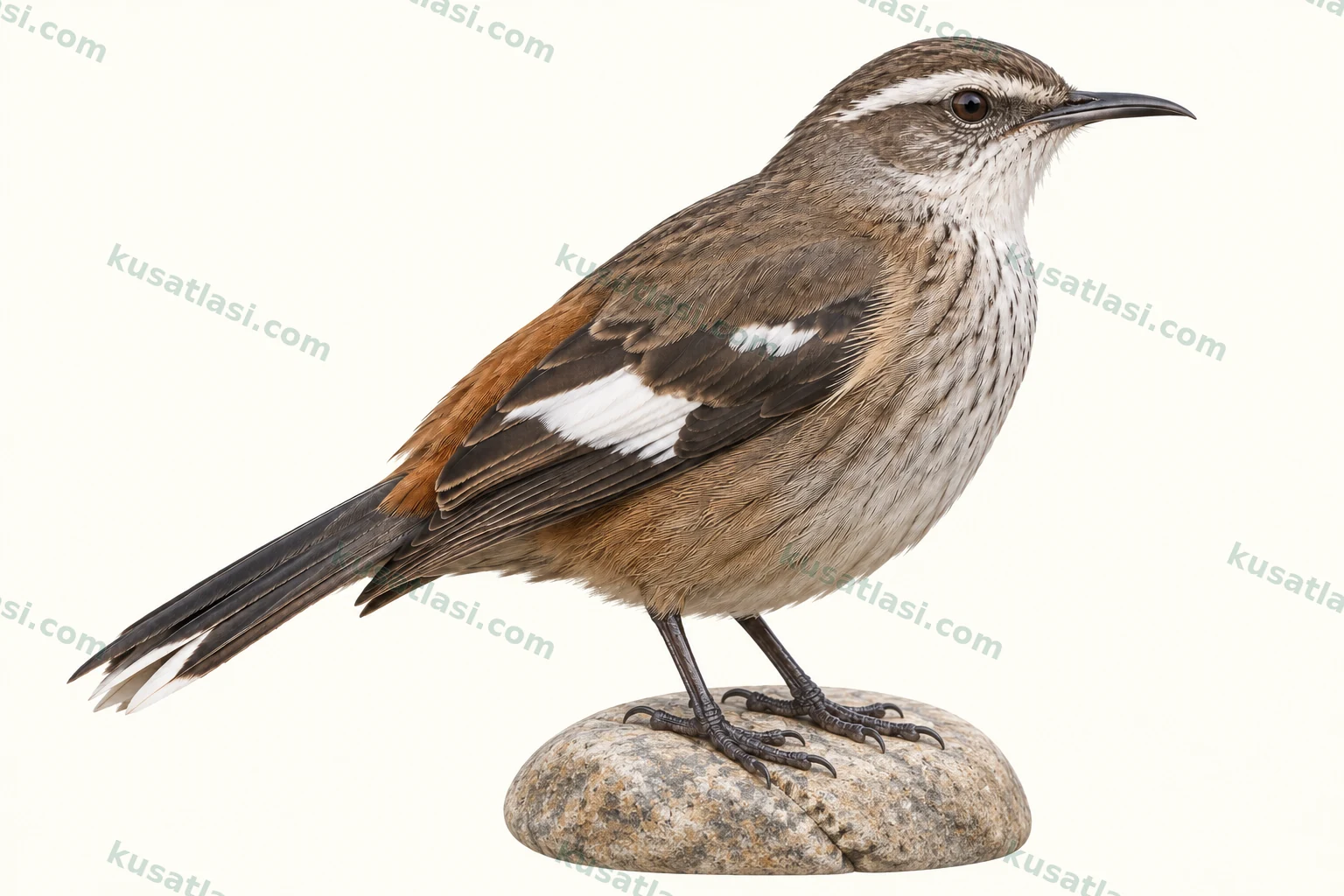
Swipe between the two adult plates.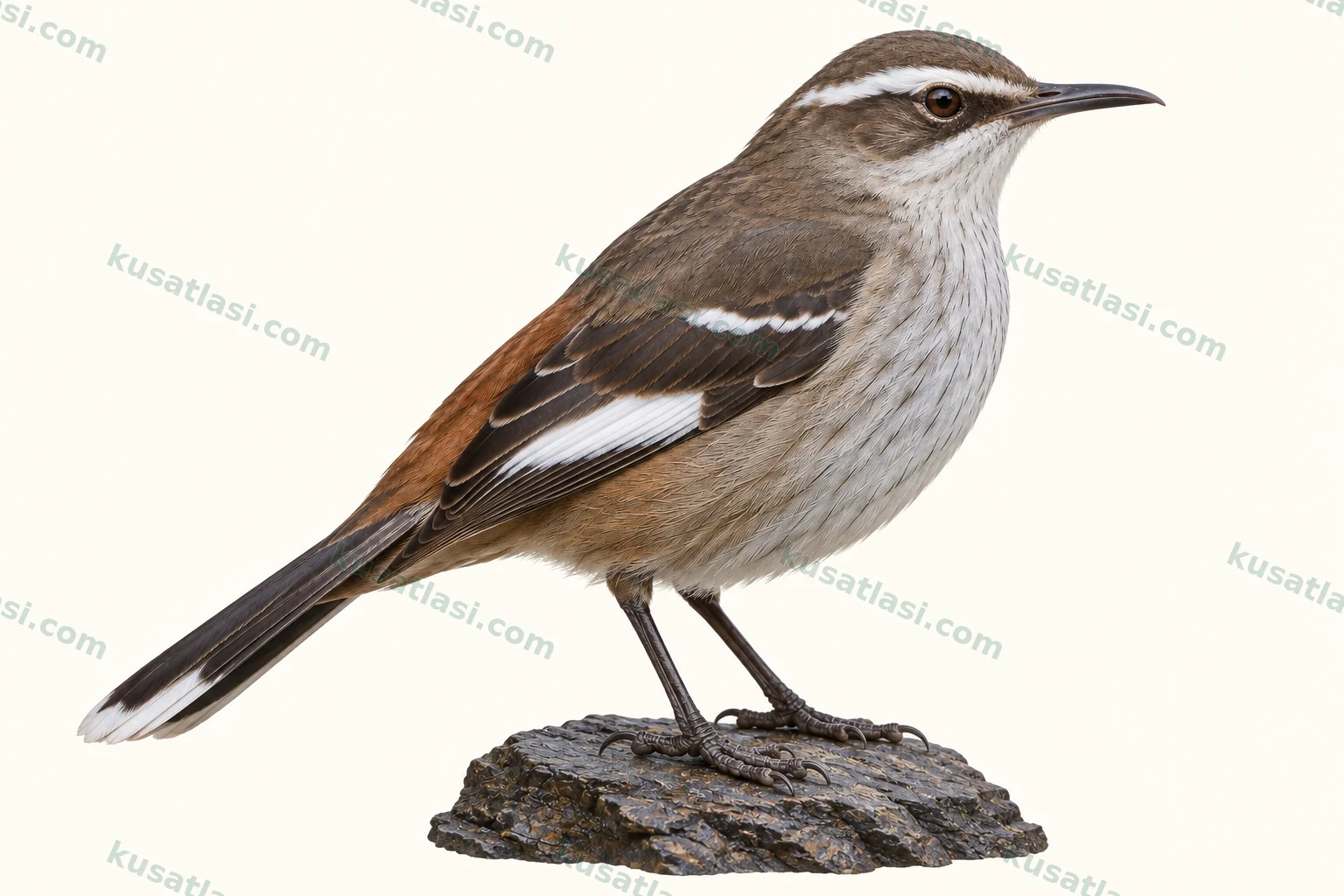
Furnariidae · Passeriformes
White-winged Cinclodes
Cinclodes atacamensis
Ak Kanatlı Sinklot
Check the chestnut back, white eyebrow and white wing band together.
- Order
- Passeriformes
- IUCN Status
- LCLeast Concern
Biometrics
Length
- Male
- 19–20 cm
- Female
- 19–20 cm
Wing length
- Male
- 11.04 cm
- Female
- 11.04 cm
Weight
- Male
- 45–56 g
- Female
- 45–56 g
Detailed explanations of these measurements are available on our website, on the same species page.
At a Glance
- Wing
Broad white band.
- Tail
White outer feather tips.
- Throat
White, with brown underparts.
A verified key for definite photographic sexing and exact daily age was not found.
Calendar
Nest records from Pampa de Achala, Argentina, fall in October–December.
Species Information
Quick Identification
Check the chestnut back, white eyebrow and broad white wing band together.
General Appearance and Posture
The throat is white and the underparts brown. The folded wing is similarly chestnut to the back; outer tail feathers have white tips.
Males, Females and Young Birds
This review did not verify a species-specific key sufficient for reliable photographic sexing or precise ageing of young. Do not treat one plumage shade alone as a male or female marker.
Appearance in Flight
The broad white band becomes conspicuous when the wing opens; white outer tail tips also help. Avoid identification from one brief wing flash.
Voice and Behaviour
It is relatively quiet, singing and displaying less readily than smaller cinclodes. A detailed diagnostic call was not verified in this review.
Similar Species
Against Cream-winged Cinclodes (Cinclodes albiventris), check the prominent white wing area, white throat and eyebrow, and outer tail tips. Association with running streams supports identification but habitat alone is insufficient.
World Distribution
It occurs in Peru, Bolivia, Chile and Argentina. Cinclodes atacamensis atacamensis extends from central Peru through the Andes to central Chile and northwestern Argentina. Cinclodes atacamensis schocolatinus occupies western Córdoba and northeastern San Luis in Argentina. It is not restricted to the Atacama Desert.
Status Within Its Natural Range
The Bolivian expert guide reports infrequent encounters along clear streams of the upper eastern Andes and Altiplano. This regional encounter frequency is not a census of the entire range.
Movements
Cornell’s public account describes it as resident. This review did not verify a monthly migration route based on tracking individual birds.
Breeding Habitat
In the 1982–2006 study at Pampa de Achala, Argentina, nests occurred in earthen stream banks and rock crevices. These records concern Cinclodes atacamensis schocolatinus.
Nest Site
A nest found in Salta, Argentina, on 30 November 1978 occupied a dry-grass-lined chamber at the end of a hole in an earthen bank and contained two white eggs. Two white eggs were also reported in each of eight Pampa de Achala nests. The examined publications did not provide verified incubation or nestling durations for this species. Avoid blocking parental access to nest entrances.
Daily Habitat Use
In Bolivia it uses stream margins through open grassland, scrub and woodland, as well as lakeshores near streams. It can forage on dry ground, mud and in shallow water.
What It Eats
It feeds on invertebrates. The examined species-specific sources did not establish a reliable prey list or dietary percentages for the entire range.
How It Forages
The Bolivian guide describes ground foraging along streams, singly or in pairs.
A Freshwater Cinclodes
A comparative study in Chile in 2000–2003 examined four White-winged Cinclodes from Arroyo Chuzmiza. Tissue carbon signatures were consistent with freshwater and terrestrial food webs, differing from marine feeding in Cinclodes nigrofumosus. This small regional sample does not prove that the species never approaches saline shores or eats only one insect.
Contributions From Both Parents
The Pampa de Achala study in Argentina observed both parents feeding young.