
World Birds
Field Guide Plates
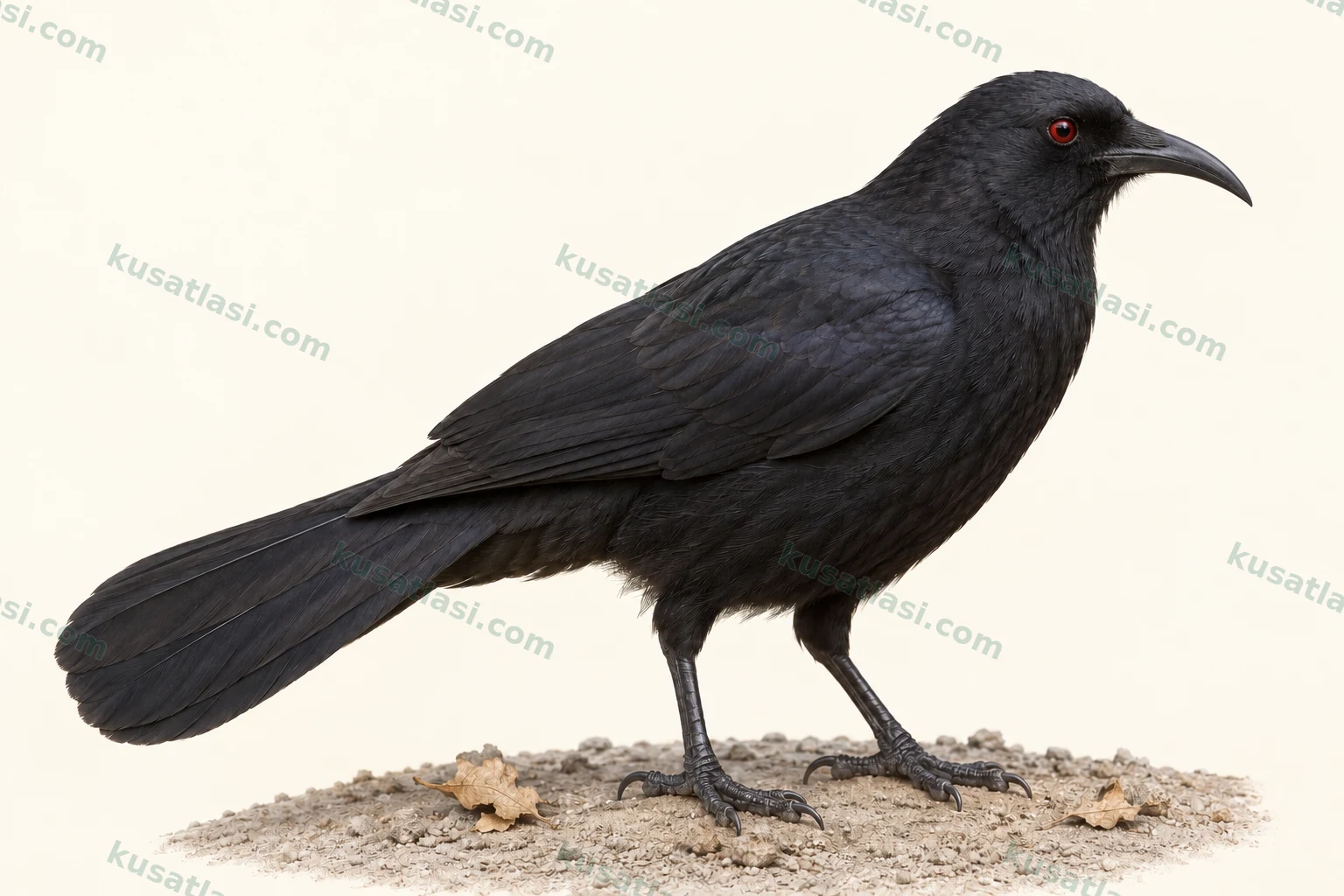
Swipe between the two adult plates.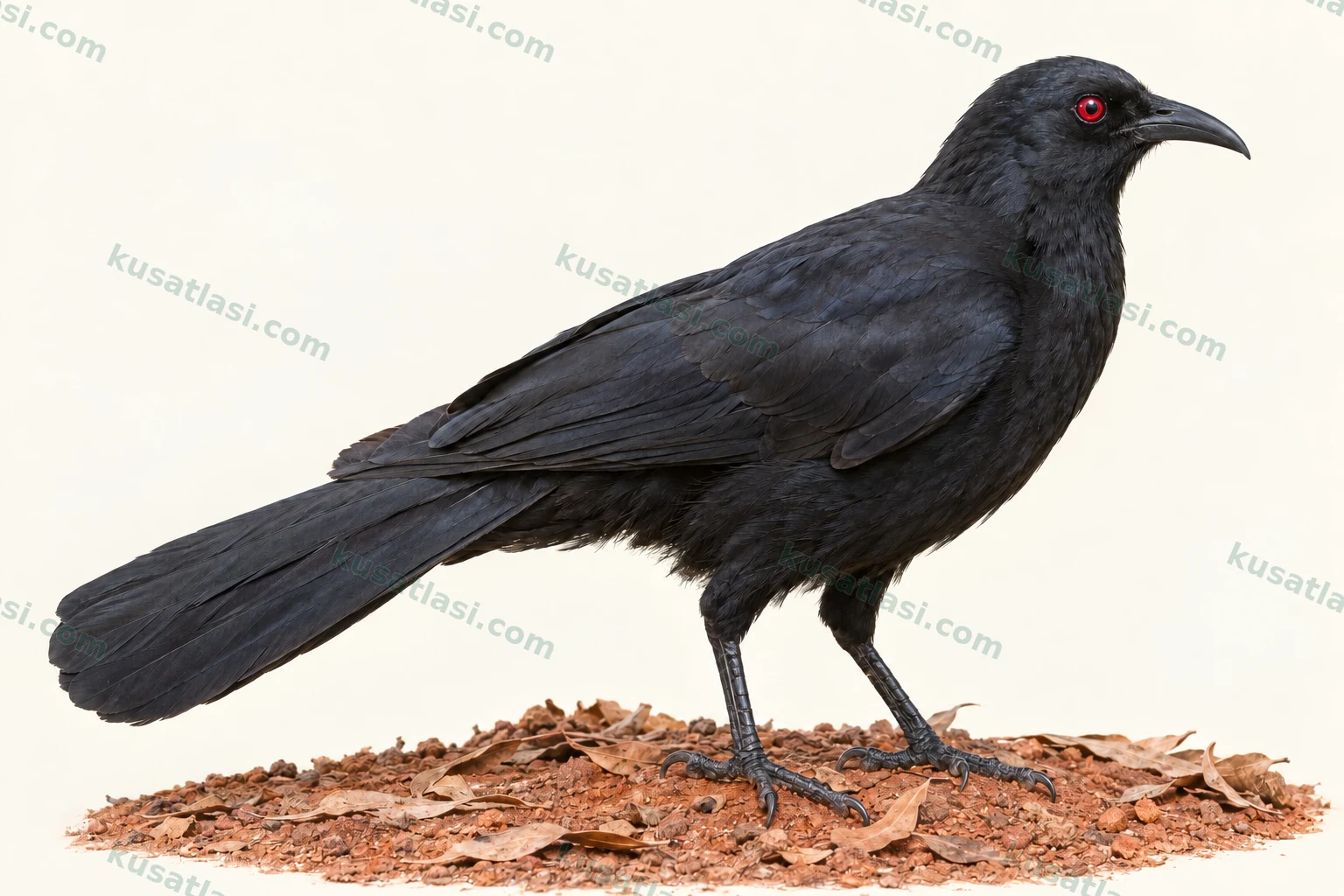
Corcoracidae · Passeriformes
White-winged Chough
Corcorax melanorhamphos
Ak Kanatlı Karga
Check the red eye, curved bill and white exposed by the open wing together.
- Order
- Passeriformes
- IUCN Status
- LCLeast Concern
Biometrics
Length
- Male
- 44–50 cm
- Female
- 44–50 cm
Wingspan
- Male
- 61–70 cm
- Female
- 61–70 cm
Weight
- Male
- 280–425 g
- Female
- 280–425 g
Detailed explanations of these measurements are available on our website, on the same species page.
At a Glance
- Curved black bill
Slender and down-curved.
- Red adult eye
May still be brown in young birds.
- White in open wings
Can be hidden when folded.
Adult sexes look alike; young eyes change from brown through orange toward red.
Calendar
The 2023 Canberra study ran August–November; this sample is not a precise whole-range breeding calendar.
Species Information
Quick Identification
The adult’s black body, red eye and slender down-curved bill form a useful combination. A large white wing patch appears when the wing opens; a walking bird with folded wings can look almost entirely black. Its name does not imply that white must be visible in every posture.
General Appearance and Posture
It walks and runs strongly on long legs and spends much of its time on the ground. That is a more typical encounter than a lone black bird perched in a tree. Bill and legs are black, and young birds are not as dark and clearly colored as adults.
Males, Females and Young Birds
Males and females share the same plumage pattern and cannot reliably be sexed from appearance alone. Young birds initially have brown eyes, changing through orange toward red as they mature. This is an age-related change, not a red-eye marker of males.
Appearance in Flight
White lies in the outer half of the wing; the museum account describes the panel as visible from above and below. It can also be exposed during wing-waving displays. A disturbed group may fly noisily into nearby trees.
Voice and Behaviour
A mournful descending whistle often reveals the birds first. Disturbance elicits a harsher rattling call. They form social feeding groups that can contain breeding adults and nonbreeding helpers. Group size alone does not reveal the number of breeding pairs.
Similar Species
Australian Raven (Corvus coronoides) and other local Corvus species can look similar but lack the same white wing panel. Pied Currawong (Strepera graculina) has yellow eyes and additional white tail markings. Check the red eye, curved bill and open-wing white together, remembering that young choughs may not yet have red eyes.
World Distribution
It occurs in eastern and southeastern mainland Australia, excluding northern Queensland, and is naturally absent from Tasmania. It should not be portrayed as ranging throughout Oceania. It belongs to Corcoracidae; the common name does not place it in the genus Corvus.
Status Within Its Natural Range
It uses some suburban habitats as well as open woodland. A 2008 regional account for Adelaide and the Mount Lofty Ranges, South Australia, reported local declines and persistence in woodland retaining leaf litter. That historical regional finding is not a current population trend for all Australia.
Movements and Migration
The global expert assessment treats it as resident and non-migratory. Daily travel among feeding sites or individual transfers between neighboring groups do not amount to regular intercontinental migration. No long-distance migration route is supplied.
Breeding Habitat
It inhabits open forest and woodland, including eucalypt woodland. Leaf and twig litter provides feeding substrate, while moist mud supplies nest material. Mud alone does not make a site suitable; foraging ground and appropriate trees also matter.
Nest Site
A large mud bowl is built on a horizontal tree branch and may be reinforced with grass or bark. BirdLife Australia gives a clutch of 2–5 eggs. The South Australian expert summary reports 19 days of incubation and a 28-day nestling period. Young from earlier years can assist with nest building, incubation and feeding. Eggs are cream with large brown markings. Newly departed young are not immediately strong fliers; do not split the group while watching them.
Daily Habitat Use
Groups move together through grass and fallen leaves. Removing litter to tidy woodland ground can reduce feeding substrate. The South Australian account records persistence in some mixtures of mature pines and native woodland where extensive litter-covered ground remained; that does not establish all plantations as equivalent habitat.
What It Eats
Insects and their larvae are important foods; earthworms and snails are also taken. Seeds, fruit and fresh shoots contribute plant material. These food groups are documented by expert accounts, not a fixed diet in identical proportions across regions and seasons.
How It Forages
It rakes litter and soil with its bill and can dig for prey around roots. Heinsohn’s southeastern Australian field observations describe young birds persisting at unproductive spots while experienced birds choose more rewarding substrate. His 1991 research on Canberra birds found a prolonged, gradual transition to feeding independence. Leaving the nest does not imply adult foraging proficiency.
Greater Nest Defense in Town
Of 21 groups studied around Canberra, Australia, in August–November 2023, nine nested in suburbs and twelve in nature reserves. The 2025 paper reported more potential nest predators and more defensive interactions in suburban groups. It did not fully support a continuous increase in defense as offspring grew, and its sample could not establish that greater defense necessarily produced higher reproductive success.
Bringing Food Is Not Always Delivering It
In an Australian study of the 1995–1996 breeding season, Boland and colleagues observed some young helpers eating food they had carried to the nest rather than delivering it to chicks. The behavior declined markedly in supplemented groups. The authors interpreted this as deception; the observed food transfer and an inference about mental intent are different levels of evidence. The experiment is not advice to feed wild groups.
Not Every Group Consists Only of Relatives
BirdLife Australia reports that young from other groups may be recruited in events described as kidnapping. Birds feeding together therefore need not all be offspring of the same parents. This does not establish avoidance of inbreeding as the single purpose of the behavior.