
World Birds
Field Guide Plates
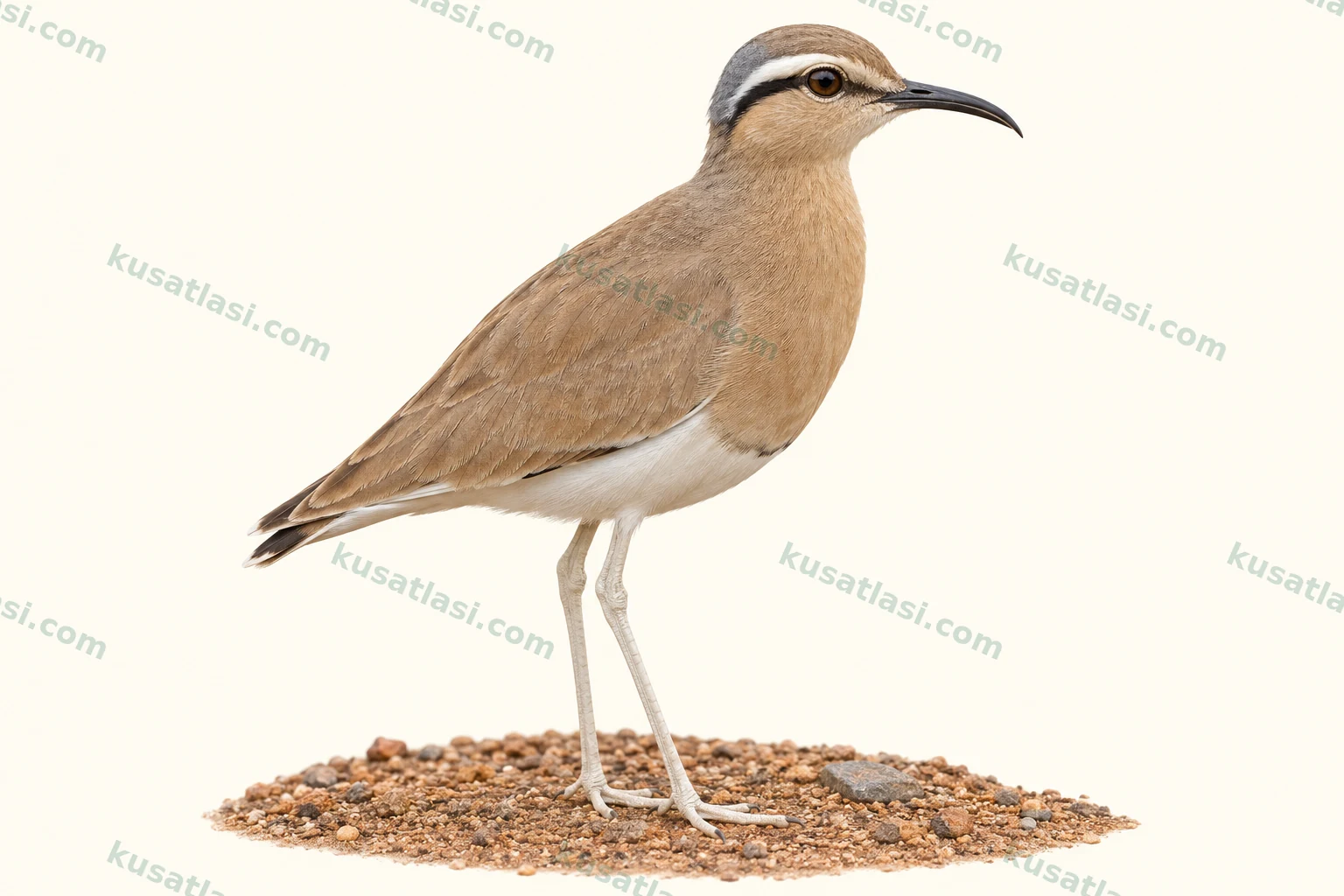
Swipe between the two adult plates.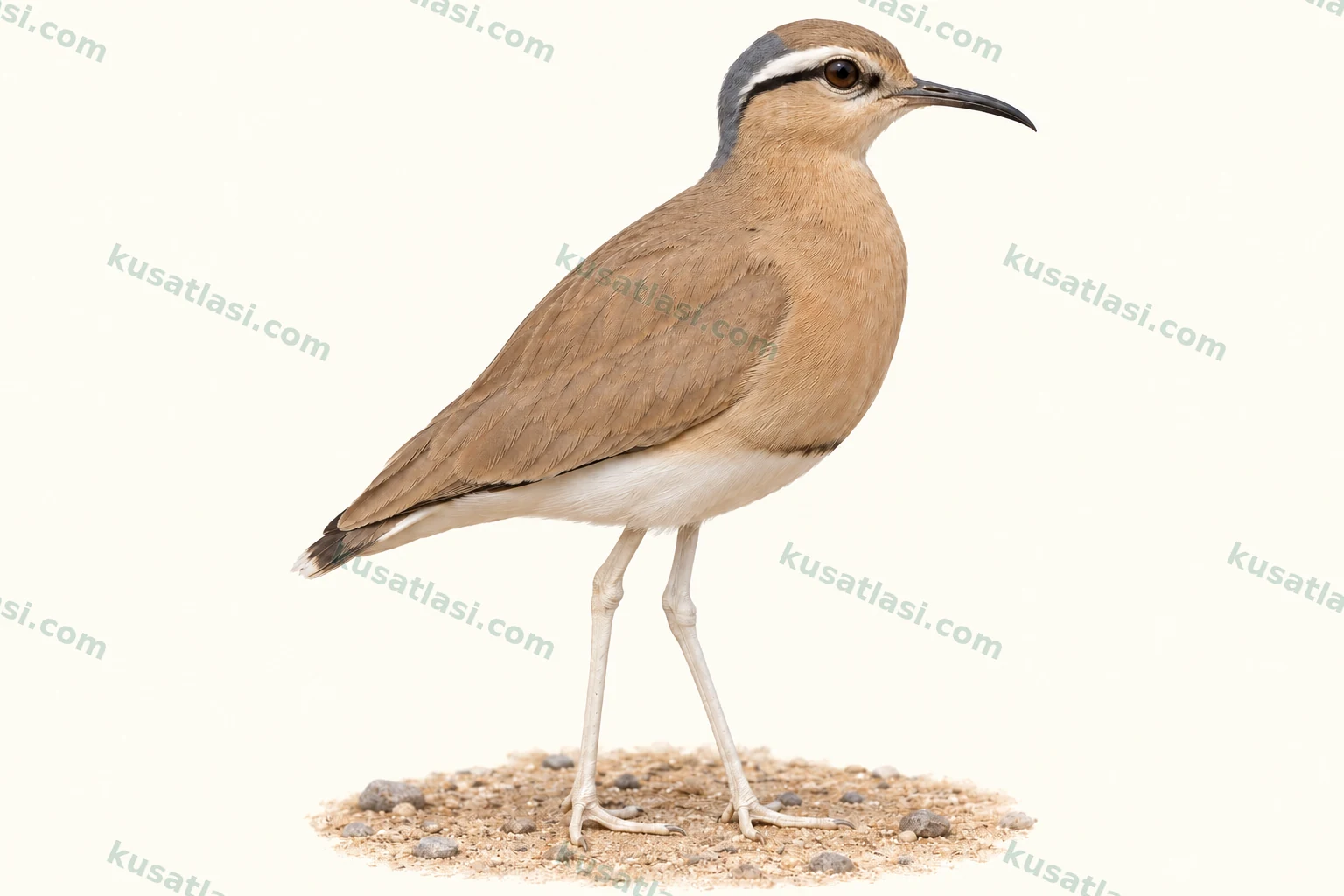
Glareolidae · Charadriiformes
Burchell's Courser
Cursorius rufus
Ak Kanatlı Çölkoşarı
Assess blue-gray hind-crown, pale legs and white trailing wing edge together.
- Order
- Charadriiformes
- IUCN Status
- LCLeast Concern
Biometrics
Length
- Male
- 20–22 cm
- Female
- 20–22 cm
Wing length
- Male
- 13.3 cm
- Female
- 13.3 cm
Weight
- Male
- 76–112 g
- Female
- 61–90 g
Detailed explanations of these measurements are available on our website, on the same species page.
At a Glance
- Blue-gray hind-crown
A useful adult clue.
- White wing edge
Inner trailing edge in flight.
- Run and pause
Foraging over open ground.
The sexes are alike; young have less distinct adult head markings.
Calendar
Breeding timing varies regionally; Namibian records are not reduced to one southern schedule.
Species Information
Quick Identification
A long-legged ground bird of arid southern Africa. On adults, assess the blue-gray hind-crown, white line extending behind the eye and dark boundary between brown breast and white belly together.
General Appearance and Posture
Upperparts are sandy rufous brown and the dark bill is curved downwards. Birds can stand upright, then run rapidly and pause to scan. Earth-toned plumage makes a stationary bird less conspicuous than a moving one.
Males, Females and Young Birds
The sexes look alike. Young birds are more mottled above, with less distinct head markings. Plumage research in Namibia emphasises that transition towards adult appearance cannot be aged by one simple colour threshold; wear and retained feathers also affect the pattern.
Appearance in Flight
In flight, a broad white trailing edge shows on the inner wing. This is useful against other coursers in the region. The whole wing is not white.
Voice and Behaviour
Birds occur in pairs or small groups, alternating short runs with pauses and pecking. Flight calls have also been recorded.
Similar Species
Temminck’s Courser (Cursorius temminckii) is an important comparison. Adult Burchell’s has a blue-gray hind-crown and a useful white trailing wing edge in flight. Young birds should not be expected to show the full adult head pattern; age, overall plumage and regional alternatives must be considered together.
World Distribution
Recorded mainly in Namibia and South Africa, also southwestern Angola and Botswana. Occurrence is erratic and locally patchy rather than continuous across every arid plain.
Status Within Its Natural Range
The 2025 regional assessment for South Africa highlights concern over contraction and decline. A regional assessment is distinct from a global IUCN category. Nomadism and limited coverage of remote country increase uncertainty in abundance estimates.
Movements and Migration
It makes locally nomadic movements, apparently associated with rainfall. Detailed regular long-distance routes have not been established. Sudden arrival of a small group does not establish an annual route through that site.
Breeding Habitat
It uses open short or sparse grassland, stony and gravelly semi-desert plains, dry savanna and saltpan margins. Pairs nest separately rather than in a dense colony.
Nest Site
Usually one or two eggs are laid directly on the ground without a constructed nest. Grass tufts, stones or animal droppings may surround the site. Both sexes are reported to incubate, but a reliable typical total incubation and fledging duration was not verified in this review. Do not pursue birds to locate nests or lift concealed chicks.
Daily Habitat Use
Foraging birds search open ground in short runs. Occurrence in ploughed, fallow or grazed areas does not imply that every farming or grazing practice is beneficial; habitat degradation remains a separate threat.
What It Eats
The diet is predominantly insects, including harvester termites, beetles, weevils, ants and lepidopteran larvae, with occasional seeds. This list does not establish identical dietary proportions in every region.
How It Forages
After running and pausing, it picks prey from the ground and can dig with its bill in soft soil.
One Breeding Calendar Is Insufficient
South African expert summaries emphasise August–December, whereas the 30 Namibian nest records discussed in the 2024 paper span a wider part of the year. A month without records in that sample is not proof of no breeding anywhere. One monthly schedule is therefore not imposed throughout the range.
Small Samples Do Not Give Certain Age Keys
The original Namibian moult sample comprised seven birds. The authors documented detailed differences between adult and young plumages while still treating age determination as approximate and calling for more research. One plain-looking feather tract does not establish exact age or sex.