
World Birds
Field Guide Plates
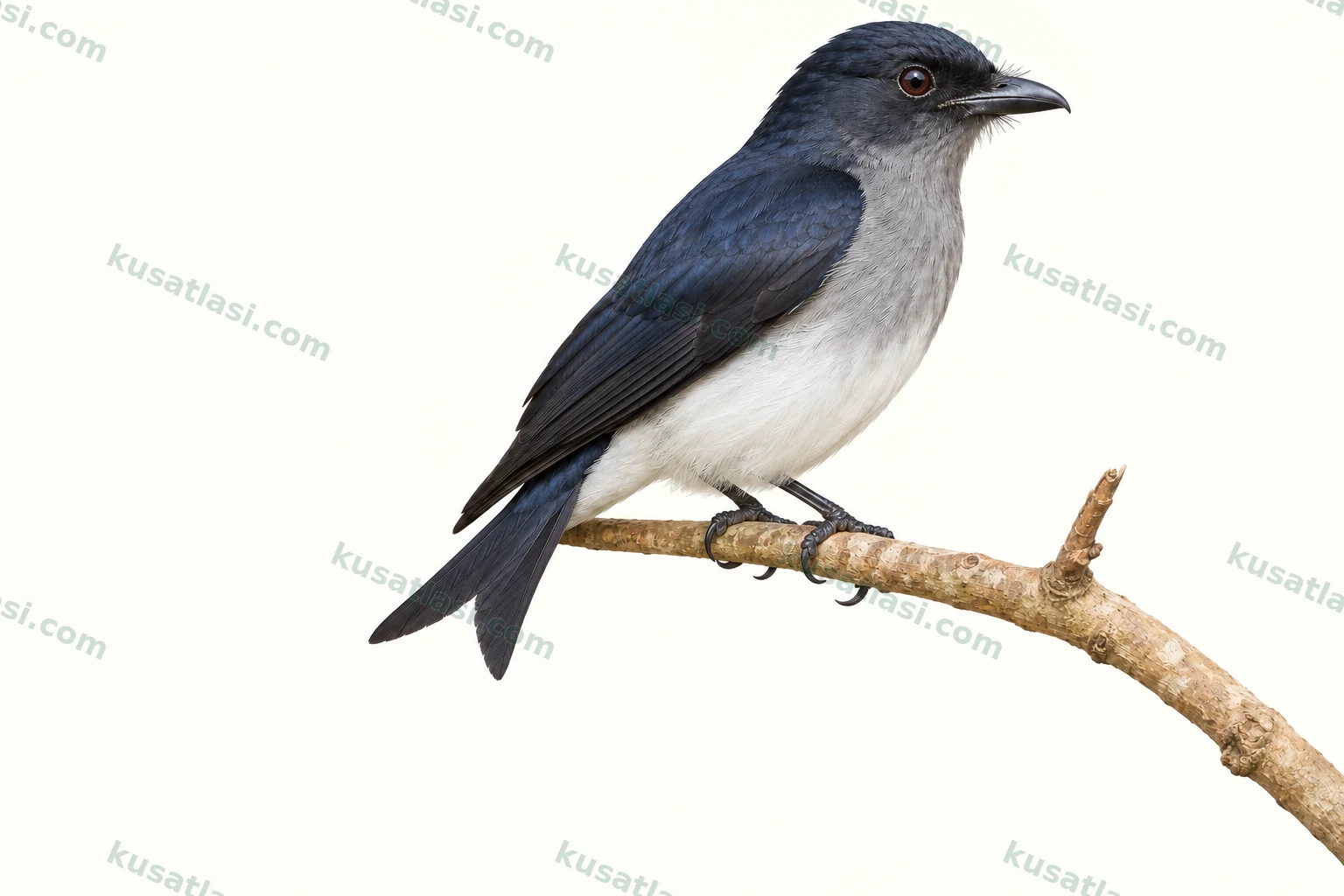
Swipe between the two adult plates.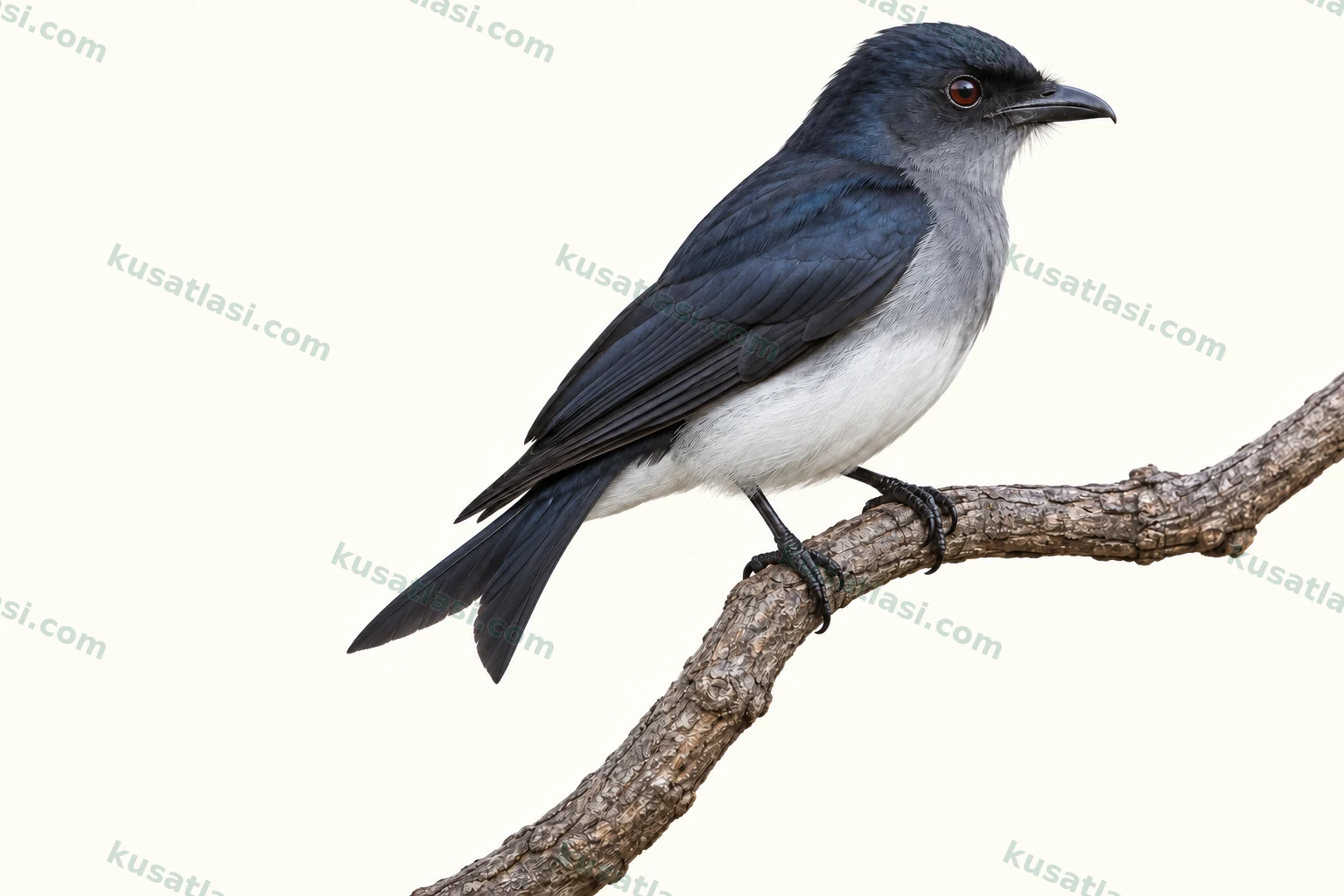
Dicruridae · Passeriformes
White-bellied Drongo
Dicrurus caerulescens
Ak Karınlı Drongo
Forked tail; geographically variable belly.
- Order
- Passeriformes
- IUCN Status
- LCLeast Concern
Biometrics
Length
- Male
- 24 cm
- Female
- 24 cm
Wing length
- Male
- 11.89 cm
- Female
- 11.89 cm
Weight
- Male
- 39–41 g
- Female
- 39–41 g
Detailed explanations of these measurements are available on our website, on the same species page.
At a Glance
- Back
Dark.
- Tail
Forked.
- Belly
May be dark in Sri Lankan birds.
Sexes look alike.
Calendar
Monthly laying calendar unverified.
Species Information
Quick Identification
Look for a dark back and forked tail. In the white-bellied form, the dark grey breast merges diffusely into the white belly.
General Appearance and Posture
The tail is relatively short. The Sri Lankan form may show white confined to the vent.
Males, Females and Young Birds
Sexes look alike. Young birds are brownish, with faint white barring on breast and flanks.
Appearance in Flight
It makes short, twisting sallies after prey.
Sounds and Behaviour
It gives mellow whistles and can mimic other birds.
Similar Species
Juvenile Dicrurus macrocercus and D. leucophaeus may also show pale underparts. They are larger, with less white mixed with dusky colour or scaling.
World Distribution
It occurs naturally in India, Nepal and Sri Lanka. AviList 2026 recognises three subspecies: caerulescens in the southern Nepal foothills and Peninsular India, insularis in northern Sri Lanka and leucopygialis in the south.
Status Within Its Natural Range
BirdLife’s 2024 assessment gives no quantified global population. Its decreasing trend is a precautionary assessment that tree-cover loss within the range may have affected numbers, rather than a global decline rate measured by direct bird counts.
Movements
It is not classified as a regular migrant. AviList reports local seasonal dispersal; this does not define one long-distance route followed by all birds.
Breeding Habitat
At Mangar Bani woodland near Delhi, India, several individuals, including juveniles, were recorded in summer 2015. Vyas’s 2019 review reports that regular nesting was subsequently confirmed there.
Nest Site
W. Howard Campbell’s 1906 field note describes nests at Ramondrug and Horsleyhada in India. The birds generally selected a branch fork well above ground. He reported a more substantial structure than in other drongos, with a well-developed lining of fine grass. These are historical observations from particular localities, rather than evidence that every nest uses the same support.
Daily Habitat Use
It uses lowland and foothill woodland, bamboo, plantations and gardens. BirdLife identifies dry forests and dry savannas among its important habitats.
What It Eats
It mainly eats insects, also taking nectar and occasionally small birds.
How It Forages
It launches from a perch, catches prey in the air, then returns to the same or a nearby perch.
Clutch Size Depends on the Source and Locality
Campbell’s historical Indian nest observations reported three or four eggs. They were described as pale salmon, with reddish and purplish markings concentrated towards the broad end. This observation does not establish four eggs as a universal clutch.
Parents Share Duties
Ali and Ripley report usually two or three eggs, occasionally four. Both sexes build, incubate and care for young.
A New Breeding Record Is Not a Measured Population Increase
Around Delhi, India, this bird had formerly been treated mainly as a vagrant. Confirmation of nesting at Mangar Bani changed the regional picture. The population-trends appendix to Vyas’s 2019 study explicitly notes that the sites had not previously been adequately studied and trends could not be assessed without comparable data. Finding breeding at a new site alone proves neither population growth nor climate-driven expansion.
Geographical Plumage Variation
Southern Sri Lanka’s leucopygialis is a subspecies of the same species. This appearance is not female-specific.