
World Birds
Field Guide Plates
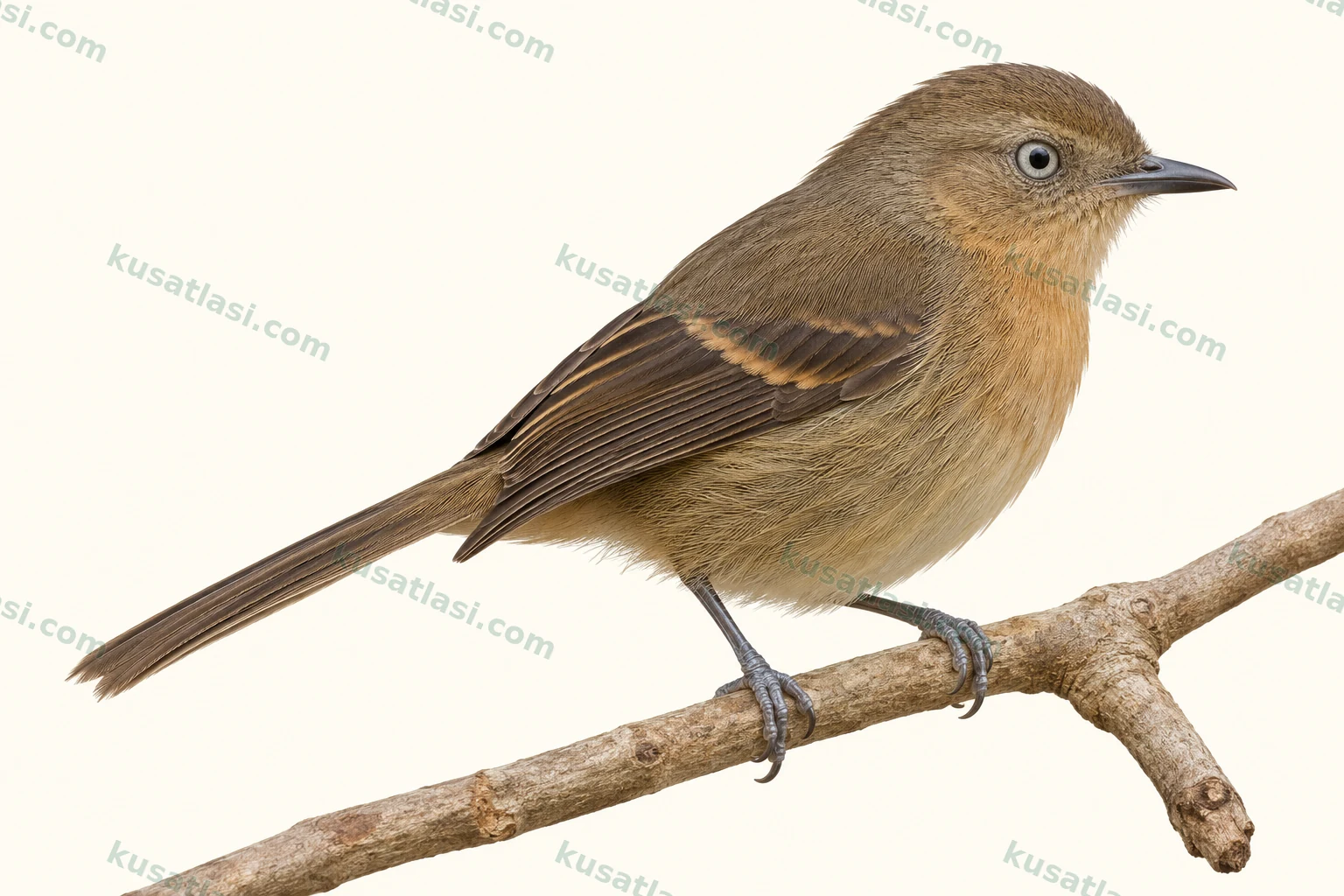
Swipe between the two adult plates.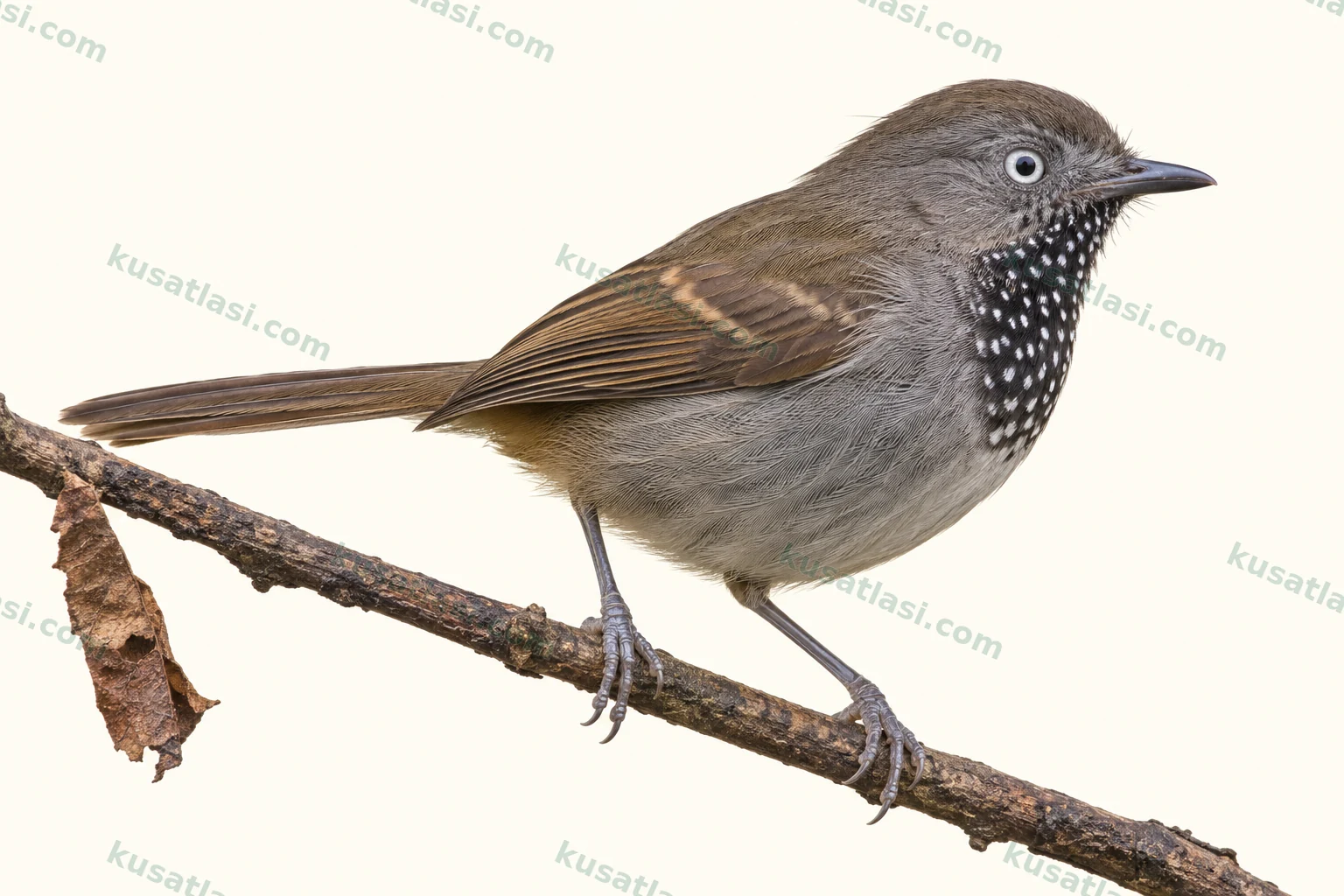
Thamnophilidae · Passeriformes
White-eyed Stipplethroat
Epinecrophylla leucophthalma
Ak Gözlü Karıncaçıvgını
Assess the male’s spotted black throat, brown upperparts and pale wing markings together.
- Order
- Passeriformes
- IUCN Status
- LCLeast Concern
Biometrics
Length
- Male
- 9–11 cm
- Female
- 9–11 cm
Wing length
- Male
- 4.95 cm
- Female
- 4.95 cm
Weight
- Male
- 8–10.7 g
- Female
- 9.4 g
Detailed explanations of these measurements are available on our website, on the same species page.
At a Glance
- White-spotted black male throat
Females have cinnamon throats.
- Pale-tipped wing coverts
Tone and extent vary geographically.
- Usually pale iris
Brown-eyed birds also reported; use several characters.
Females have cinnamon throats; iris colour alone is not an ageing key.
Calendar
Nest building was reported on 15–20 October at Cocha Cashu, Peru. The full breeding season is unverified, so no monthly window is assigned.
Species Information
Quick Identification
White-eyed Stipplethroat is a small insectivore of forest understorey in southern Amazonia. In males, assess the white-spotted black throat, grey breast and brown upperparts together. Pale tips to the wing coverts form conspicuous rows. A light iris supports identification but does not establish the species on its own.
Appearance and Posture
In the nominate male, crown and back are grey-brown, with redder flight feathers and tail. The dark wing coverts have cinnamon-washed white tips. Breast and upper belly are grey, while the lower underparts have an ochraceous tinge. Small white throat spots should not be mistaken for a wholly pale throat patch.
Geographic forms differ in tone. In phaeonota between the Madeira and Tapajós, both sexes have more distinctly reddish-brown upperparts. Pale covert tips also vary geographically from white to cinnamon. Some subspecies boundaries are treated cautiously in the sources; one colour detail is insufficient for a definitive subspecies identification.
Males, Females and Young Birds
Females have cinnamon throats, with warmer pale olive-brown head sides and underparts than males. The centre of the breast and upper belly can be variably tinged cinnamon. The male’s black-and-white throat pattern should not be expected in females.
The iris is generally pale, but the Cornell synthesis also mentions brown-eyed individuals and suggests a possible age relationship. That is not an established ageing key. The reviewed sources do not provide a detailed plumage-and-iris sequence reliably separating young birds in every region, so a brown iris alone does not prove a juvenile.
Appearance in Flight
Reddish-brown flight feathers and tail continue the generally brown appearance. During brief movements through dense undergrowth, throat spots and iris colour can be missed. Seek views of the throat, coverts and underparts on a perched or foraging bird. The reviewed sources do not establish an independently diagnostic flight rhythm.
Voice and Behaviour
The conspicuous song is a sequence of downslurred notes. An often longer opening note is followed by shorter notes as delivery accelerates and pitch falls slightly. Calls include short abrupt notes, doublets or triplets, and a rubbery rattle. Length and pace vary, making a fixed note count inappropriate.
It usually joins mixed understorey flocks of insectivorous birds. Confronting males may lower their heads, fluff the back and pivot sideways while giving rougher, more complex vocalisations. These encounter sounds have a different context from the usual song sequence.
Similar Species
1. Ornate Stipplethroat (Epinecrophylla ornata): Males have a more solid black throat and greyer body, whereas male White-eyed has white throat spotting and browner upperparts. Female Ornate can show a black-and-white throat, contrasting with female White-eyed’s cinnamon throat. Ornate also varies geographically, so compare sex, locality and voice together. The two can occupy the same bamboo habitat in some areas, making habitat alone unreliable.
World Distribution
Occurs in southern Amazonia from eastern Peru through northern Bolivia and Brazilian forests south of the Amazon River, reaching the lower Tocantins in the east. Some Peruvian populations are isolated. Forest regions between major rivers are important when describing its geographic forms. The current expert treatment recognises leucophthalma, dissita, phaeonota and sordida.
Status within Its Range
Can be fairly common in suitable forest and occurs in Peruvian protected areas such as Manu and Tambopata, as well as large reserves in Bolivia and Brazil. It should not be expected equally in every forest patch. Understorey structure and the presence of similar species are associated with local microhabitat use.
Seasonal Movements
No regular migration is reported; presumed resident. Daily foraging with a mixed flock should not be interpreted as seasonal migration. The reviewed sources do not establish a long-distance route or shared monthly migration calendar.
Breeding Habitat
Dense understorey of lowland evergreen forest is characteristic, including forest not regularly inundated and transitional forest. Most records in the Cornell account are below 700 metres, with occasional higher occurrences. Dead leaves trapped in vines and small palms are important components of its foraging habitat. This general habitat description does not establish verified nesting in every microhabitat.
Nest Site
The Cornell synthesis reports nest building on 15–20 October at Cocha Cashu in Madre de Dios, Peru. This brief record cannot delimit the entire breeding season. Reliable sources reviewed did not establish this species’ nest architecture, typical clutch size, incubation duration or nestling period. Enclosed nests in some congeners do not justify assigning the same structure to this species. Watch any nesting activity remotely without disturbing surrounding cover.
Daily Habitat Use
Rapid hops can alternate with prolonged investigation of one leaf cluster. It may be left behind as more active flock members move on. The layers used within the understorey can vary with the distribution of leaf accumulations and palms.
What Does It Eat?
Eats insects and spiders. The expert synthesis of stomach contents from 18 birds in Peru and Bolivia highlights orthopterans such as katydids and crickets, and cockroaches; beetles, spiders and other insect groups also occur. This local sample does not establish identical proportions in every country and season. Searching dead leaves means finding animal food inside them, not eating the leaves.
How Does It Forage?
Its main search surface is curled dead foliage suspended above ground. It progresses along slender branches and palms, reaching, leaning or hanging upside down to investigate crevices. The bill, and sometimes the entire head, enters a leaf curl. Methodical examination of individual clusters differs from pursuing exposed prey rapidly through live foliage.
Larger prey may be taken to a nearby horizontal branch and beaten against it. Leaf investigation and prey handling can occupy considerable time. The synthesis of Peruvian studies and Brazilian observations describes lower foraging and use of larger leaves, especially palms, relative to co-occurring Ornate Stipplethroat; this local relationship is not an invariant threshold for every forest.
Specialisation Can Concern the Search Site
Rosenberg’s comparison in Amazonian forests of Peru and Bolivia, published in 1993, included White-eyed among dead-leaf specialists. Species searching different surfaces nevertheless consumed similar major prey groups. The distinction is that specialising on a search surface need not mean preferring completely different prey. This conclusion concerns the species and sites compared in that study.
Bamboo Does Not Mean the Same Habitat Everywhere
Records from Pando, Bolivia, associate it with streamside bamboo and disturbed forest. In Mato Grosso, Brazil, it uses upland and transitional forest, with Ornate Stipplethroat generally replacing it in bamboo. Yet in Madre de Dios, Peru, both regularly occur together in bamboo. Neither “restricted to bamboo” nor “never uses bamboo” accurately describes the whole species. The distribution of other birds and available search surfaces also matters.
A Genus Name Referring to Dead Leaves
The 2006 description explains Epinecrophylla as a name referring to searching dead leaves. Older literature may use Myrmotherula leucophthalma and White-eyed Antwren; the current English name is White-eyed Stipplethroat. Matching these older names connects research to the correct bird, without making every congener’s nest or breeding data interchangeable.