
World Birds
Field Guide Plates
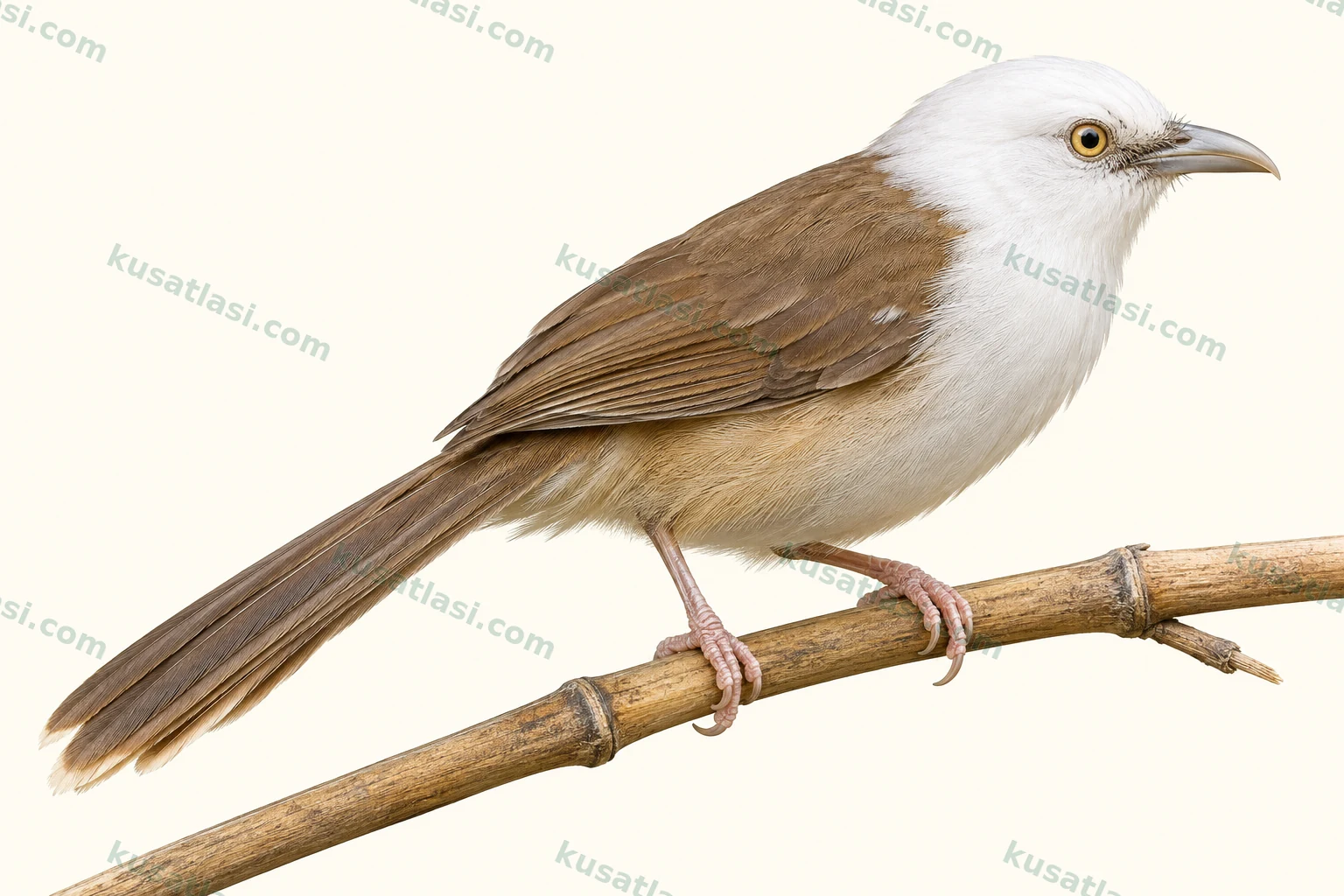
Swipe between the two adult plates.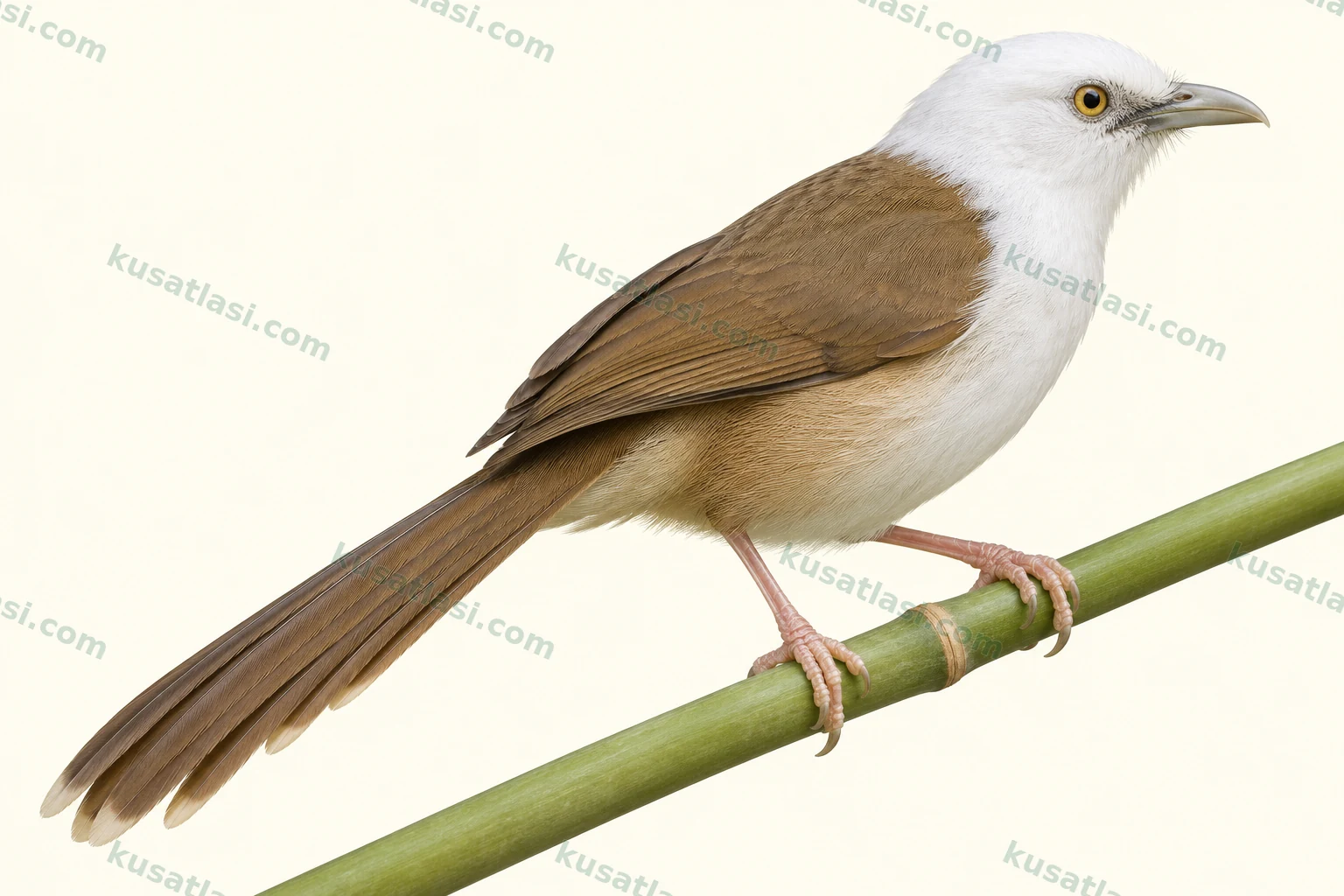
Pellorneidae · Passeriformes
White-hooded Babbler
Gampsorhynchus rufulus
Ak Gövdeli Kasapardıcı
Assess the white head and breast, sandy-brown back and long tail together.
- Order
- Passeriformes
- IUCN Status
- LCLeast Concern
Biometrics
Length
- Male
- 23–24 cm
- Female
- 23–24 cm
Wing length
- Male
- 9.8 cm
- Female
- 9.8 cm
Weight
- Male
- 37 g
- Female
- Data unavailable
Detailed explanations of these measurements are available on our website, on the same species page.
At a Glance
- White head and breast
Contrasts with the sandy-brown back in adults.
- Variable white shoulder
The white wing patch is not equally visible in every view.
- Long tail
Assess the narrow pale tips with the other plumage characters.
Adult sexes look alike; juveniles have a rufous head and breast sides.
Calendar
The calendar shows the April–August breeding interval reported in the Cornell synthesis, rather than a separately verified monthly schedule for every region.
January
Outside the stated window
February
Outside the stated window
March
Outside the stated window
April
Reported breeding period
May
Reported breeding period
June
Reported breeding period
July
Reported breeding period
August
Reported breeding period
September
Outside the stated window
October
Outside the stated window
November
Outside the stated window
December
Outside the stated window
Species Information
Quick Identification
White-hooded Babbler is a long-tailed passerine of bamboo and the middle forest layers. In adults, the white head and breast contrast with sandy-brown upperparts. A pale yellowish eye, a sturdy bill with a hooked tip and a variable white shoulder patch provide supporting characters. White grades into buff on the belly and flanks, so the entire underbody need not appear pure white.
Appearance and Posture
The white area running from head to breast becomes warmer towards the sides and lower underparts. The back is sandy brown and the wing slightly darker. White on some lesser and median wing coverts may form a pale shoulder patch on the folded wing. Its visibility varies, so failure to see it is not enough to exclude the species.
The tail resembles the wing in colour and has narrow buff tips. Forehead and chin feathers can look upright and bristly, with long black bristles near the gape. The yellow to orange-straw iris stands out against the white head. The legs are dull yellowish or pale pinkish brown.
Bill colour ranges from pinkish to dark horn. The Cornell synthesis suggests that age or season may be involved, but does not establish the cause. Bill colour alone should therefore not be used to assign sex, a precise age or breeding condition.
Males, Females and Young Birds
Adult males and females look alike. White-headed individuals cannot reliably be sexed without additional evidence. Juveniles differ in having a rufous head and sides of the breast, usually with buff extending more broadly across the breast. A bird that has not acquired the adult’s white head should not be assigned to another species on that difference alone.
Appearance in Flight
The wings are darker brown than the back, and the tail has narrow pale tips. A change of angle can affect the visibility of the white shoulder patch. The reviewed sources do not establish a uniquely diagnostic wingbeat pattern or flight silhouette; identification should rely on observations that show the head, breast and wing pattern together.
Voice and Behaviour
This is a noisy, social bird, with parties of its own species reaching 20 individuals. It also joins mixed-species feeding flocks. Rapid, hollow, laughing calls may contain a conspicuously high, stressed middle note. Softer, brief conversational notes are also given.
Short sequences of low, mellow whistles are described as the presumed song. That qualification matters: not every whistle has an established courtship function. Although the bird is not described as particularly shy, its normal movements can be watched from a distance without trying to draw it from cover by repeated sound imitation.
Similar Species
1. Collared Babbler (Gampsorhynchus torquatus): Formerly treated within the same species. Its dark collar appears at the sides of the neck, the white hood ends more abruptly at the nape, and the white shoulder patch is greatly reduced. Brown on the upperparts and underparts is generally richer. The collar may be partly concealed and head pattern varies, so no single mark should carry the identification. Older records from southeastern Myanmar, Thailand and farther southeast also require checking against the taxon concept used by their authors.
World Distribution
The native range extends from eastern South Asia into southwestern China. It includes southeastern Nepal, southern Bhutan, the northeastern Indian hill states and southeastern Bangladesh. Northern, western and central Myanmar and western Yunnan in China are also within the range. This distribution should not be combined with the more southeasterly range of Gampsorhynchus torquatus, formerly included in the same species.
Status within Its Range
Recording frequency varies across the range. The 2025 State of India’s Birds factsheet reports insufficient data to estimate either the long-term or current annual trend in India. This does not establish a stable or increasing Indian population and should not be generalised to every country in the range.
Seasonal Movements
It is generally regarded as resident. The Cornell synthesis notes its description as a local migrant in Kaziranga National Park, India, providing regional evidence of possible displacement. This does not establish a regular route followed by all individuals or compulsory altitudinal movement in particular months.
Breeding Habitat
Bamboo, the middle storey of broadleaved evergreen forest and secondary growth at forest edges are characteristic habitats. Scrub, bushes and long grass are also used. The species should therefore not be restricted in description to closed, undisturbed forest interiors; bamboo and dense vegetation at edges can also be important.
Nest Site
The Cornell synthesis reports breeding from April to August. The shallow, flimsy cup is placed in a bush about two metres above ground. Dead leaves, small twigs, roots, lichen and moss are used, with cobwebs, roots and tendrils in the structure and finer grass and rootlets in the lining. Reported clutches contain 3–4 eggs, pale yellow with reddish-brown speckles and blotches. Incubation and nestling durations could not be verified in the reliable sources reviewed.
Daily Habitat Use
While foraging it particularly uses the upper parts of bamboo and moves through the middle forest layers. Following a party from a distance is preferable to approaching the bush from which a single bird is calling. At a nest, leave the surrounding cover intact and keep the adults’ approach unobstructed.
Diet
The diet is presumed to consist of invertebrates. The expert Cornell account presents this as an inference rather than an established itemised diet. The reviewed sources do not verify prey-group proportions, seasonal food percentages or regular fruit consumption. No measured dietary breakdown or detailed prey list is therefore assigned to the species.
Foraging
Foraging is concentrated in bamboo crowns and several metres above the ground. Birds may travel in parties of their own species or with other species. This behaviour alone does not establish what prey is eaten or in what proportions; the known diets of flock companions cannot simply be transferred to this bird.
Resemblance within Mixed Flocks
Kimball and colleagues’ 2023 paper reports White-hooded Babblers joining White-crested Laughingthrushes, Garrulax leucolophus, in mixed flocks in western Yunnan. The authors highlight their visual resemblance and that some parrotbills in the same flock system resemble juvenile babblers. These are field observations from a particular region, not evidence that the same companions occur everywhere.
Observation and Explanation
The paper discusses the hypothesis that life in mixed flocks can influence the evolution of similar appearance, and proposes ways to test it. Flocking together is an observation; an evolutionary explanation in which flock membership caused the resemblance remains a hypothesis to test. The study does not prove that this species gains certain protection from predators by mimicking another bird.
The Scope of an Older Name
Because Gampsorhynchus torquatus was formerly included in the same species, the name Gampsorhynchus rufulus in an older publication need not refer to the narrowly defined species recognised today. Locality, date and the author’s taxonomic treatment must be checked together. The current Cornell account treats White-hooded Babbler as monotypic; the full distribution of the former broad species is not added to the modern account.