
World Birds
Field Guide Plates
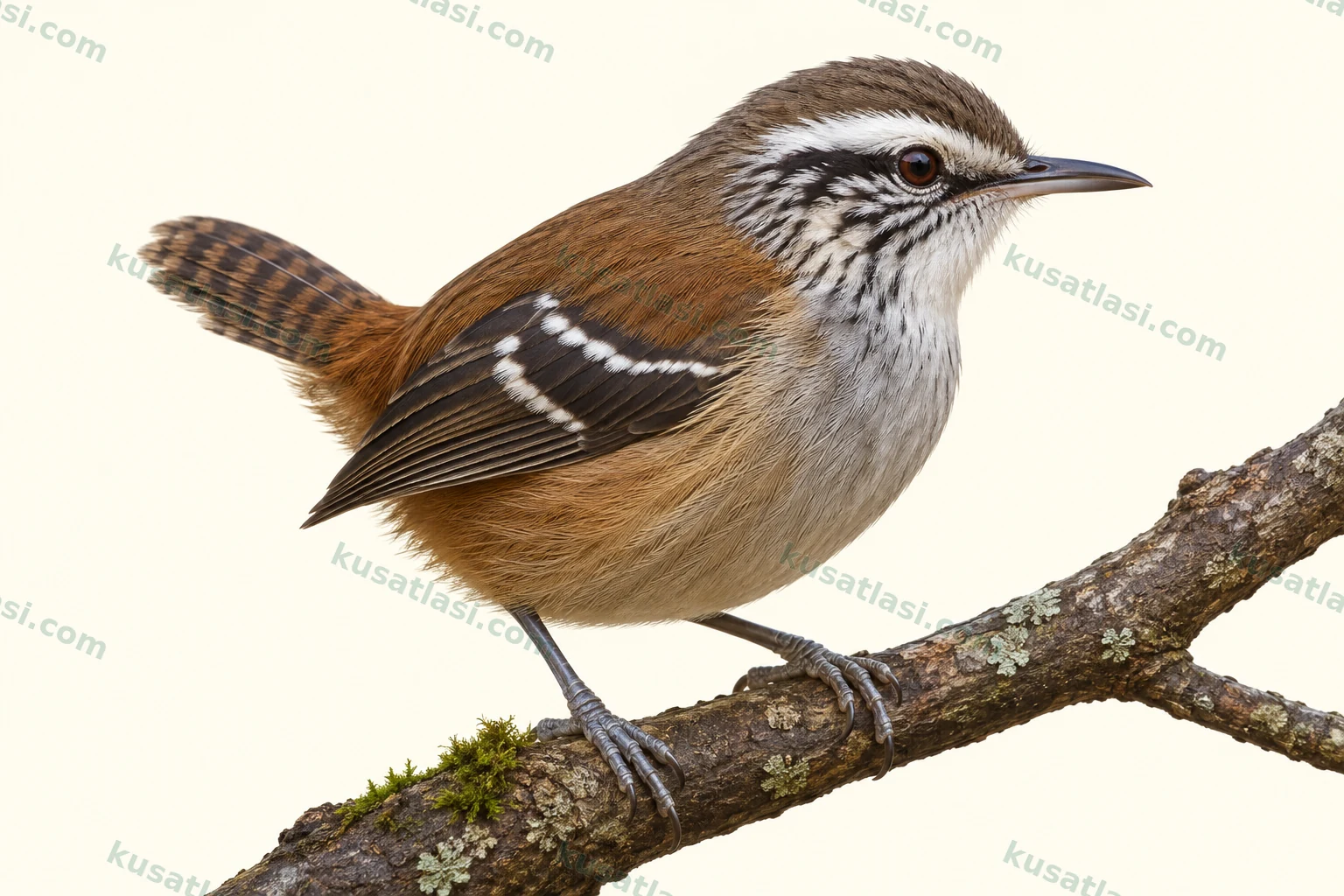
Swipe between the two adult plates.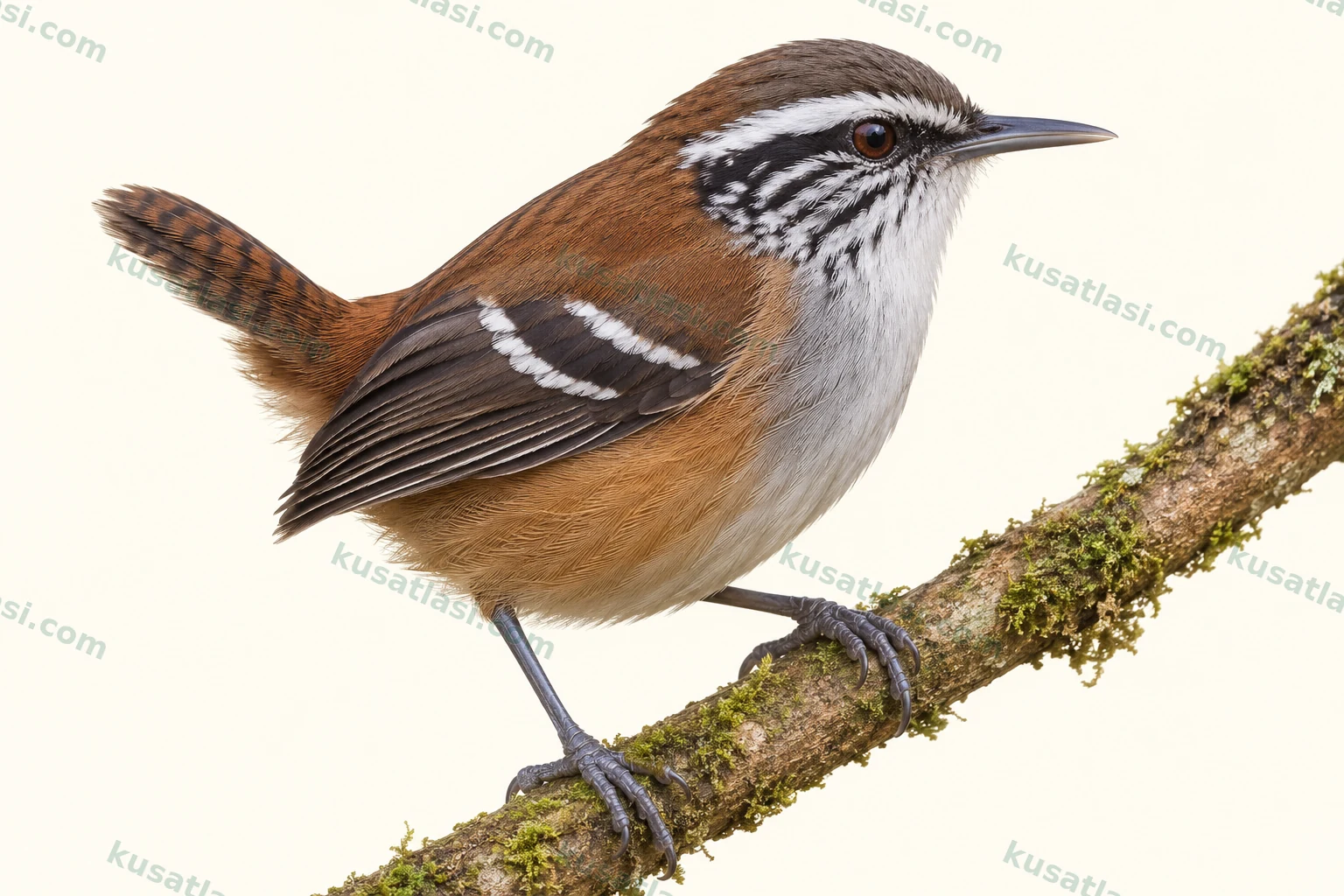
Troglodytidae · Passeriformes
Bar-winged Wood Wren
Henicorhina leucoptera
Ak Kanatlı Çıtkuşu
Look for two conspicuous white wingbars, a broad pale eyebrow and a very short tail together.
- Order
- Passeriformes
- IUCN Status
- LCLeast Concern
Biometrics
Length
- Male
- 11 cm
- Female
- 11 cm
Wing length
- Male
- 5.4 cm
- Female
- 5.4 cm
Weight
- Male
- 12–16.5 g
- Female
- 12–14.5 g
Detailed explanations of these measurements are available on our website, on the same species page.
At a Glance
- Two white bars
Contrast with the dark wing.
- Broad pale eyebrow
Assess with the striped face.
- Very short tail
Watch dense low cover.
A brief view does not establish sex; young may have less distinct face markings.
Calendar
Described as resident; a complete verified monthly breeding schedule was not found.
Species Information
Quick Identification
A very short-tailed wood wren of northern Peru and adjacent southern Ecuador. Two conspicuous white bars on the dark wing, a broad white eyebrow and a striped face are the key combination. The entire wing is not white.
General Appearance and Posture
The upperparts are rufous brown, underparts grayish, and flanks rufous. Pale and dark stripes mark the head sides. White bars contrast with blackish wing coverts. Its stubby tail and dense-understorey setting give a different silhouette from more exposed, long-tailed songbirds.
Males, Females and Young Birds
The adult pattern alone is not a certain sexing key; this review did not verify a reliable separate visual male–female key. Juveniles are described with less distinct facial markings and less clear white below. Expecting every young bird to show the adult’s sharp face pattern is misleading.
Appearance in Flight
Flights through dense undergrowth are short and low. When the wing is visible, assess its white bars with the head pattern rather than identifying a fast-moving brown bird from flight alone.
Voice and Behaviour
Alarm calls are described as rapid, high-pitched chatter. Song includes lively, fast phrases and trilled notes, with paired duetting also reported. In dense cover, the voice may be noticed before the bird.
Similar Species
Gray-breasted Wood-Wren (Henicorhina leucophrys) is an important comparison. The two conspicuous white wingbars of Bar-winged Wood Wren are particularly useful. Suitable locality alone is insufficient if vegetation hides them. The species can overlap at contact sites, so elevation alone cannot establish identity.
World Distribution
The natural range is fragmented among isolated mountain ranges in northern Peru and southeastern Ecuador. Cordillera del Cóndor and Abra Patricia are among the localities cited by the expert account. It is not endemic to Peru alone: Ecuador is also part of its natural range.
Status Within Its Natural Range
Regular occurrence at suitable sites does not imply continuous occupancy of every intervening valley and mountain. Published research emphasises isolated ridges and ranges east of the main Andes. This account concerns those verified natural areas.
Movements and Migration
Described as resident. Separated range localities are not joined into a migration route, and this review did not verify a regular long-distance migration schedule.
Breeding Habitat
It inhabits dense, mossy cloudforest undergrowth and stunted montane forest. Low scrub growing on nutrient-poor ridge soils is also important habitat. Habitat occupancy is not itself direct evidence that nests were found at every locality.
Nest Site
Verified nest structure, typical clutch size, incubation duration and nestling period were not found for this species in the reviewed sources. Published clutch sizes and developmental periods for Gray-breasted Wood-Wren are not transferred to it. Do not enter dense cover or flush adults to search for a nest.
Daily Habitat Use
Birds forage singly or in pairs in dense scrub. Association with stunted cover can help focus a search where Gray-breasted Wood-Wren uses humid forest understorey. Habitat differences nevertheless do not replace visual identification.
What It Eats
It feeds on insects. The reviewed specialist sources do not supply a detailed prey-species list or year-round proportions of food groups. Diet lists from other wood wrens are not treated as verified data for this species.
How It Forages
Foraging takes place in dense low undergrowth and scrub. Reports of single birds and pairs do not establish that every encounter represents a mixed-species flock or a family group.
Elevation Is Not a Family Tree
Caroline Dingle and colleagues’ 2006 study compared mitochondrial DNA from Henicorhina populations in Central and South America. The affinity of Bar-winged Wood Wren with the leucosticta group contradicted older placement closest to leucophrys based on appearance and behaviour.
It illustrates why birds replacing one another uphill need not have diverged in place along that same gradient. The conclusion concerns the sampled data and populations; one genetic study does not settle every aspect of the group’s evolution.
A Clue in the Species Name
John W. Fitzpatrick, John W. Terborgh and David E. Willard published the scientific description in 1977. Its title announced a new wood wren from Peru. Subsequent records including Ecuador show why the country of description is not the same as the species’ complete natural range.