
World Birds
Field Guide Plates
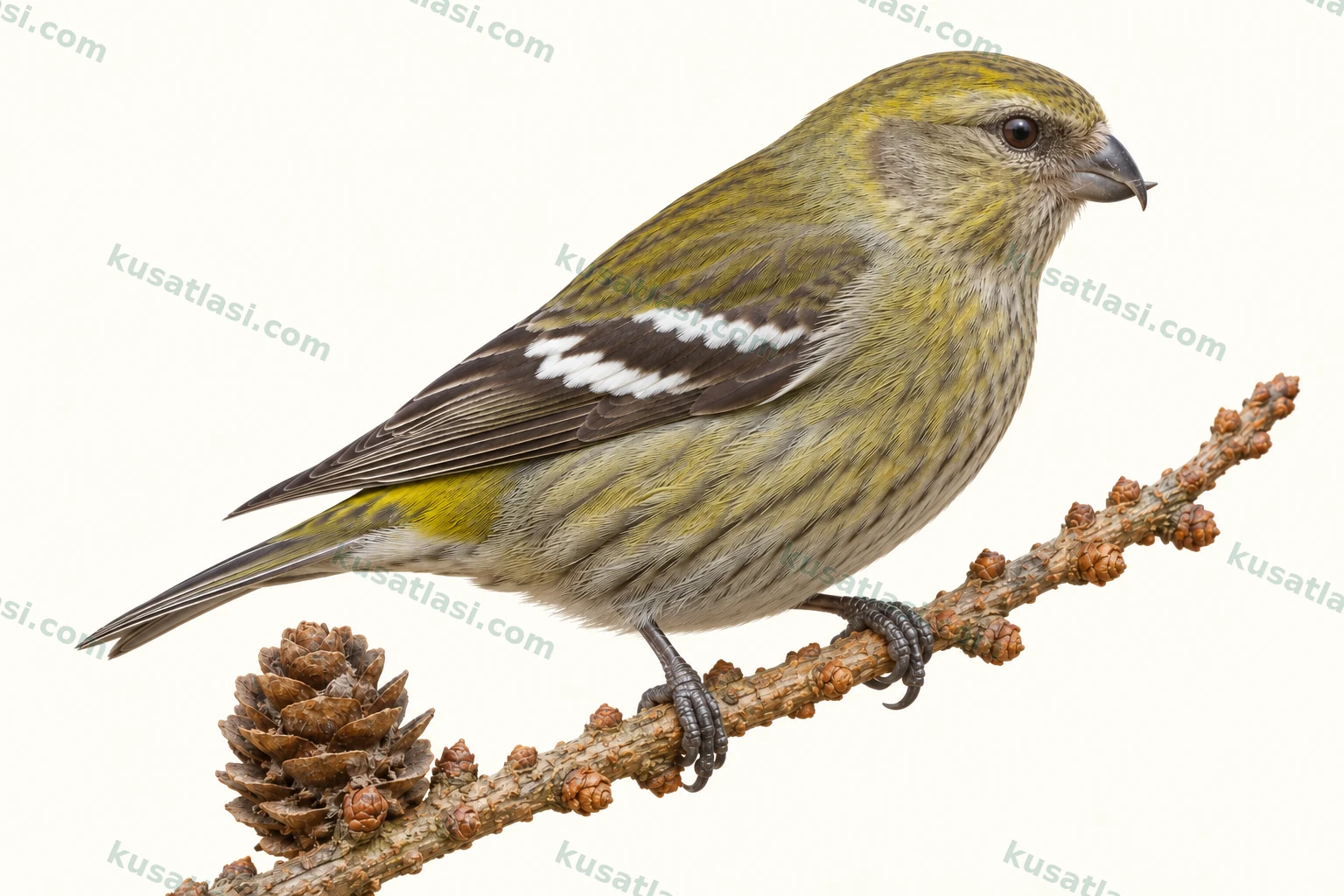
Swipe between the two adult plates.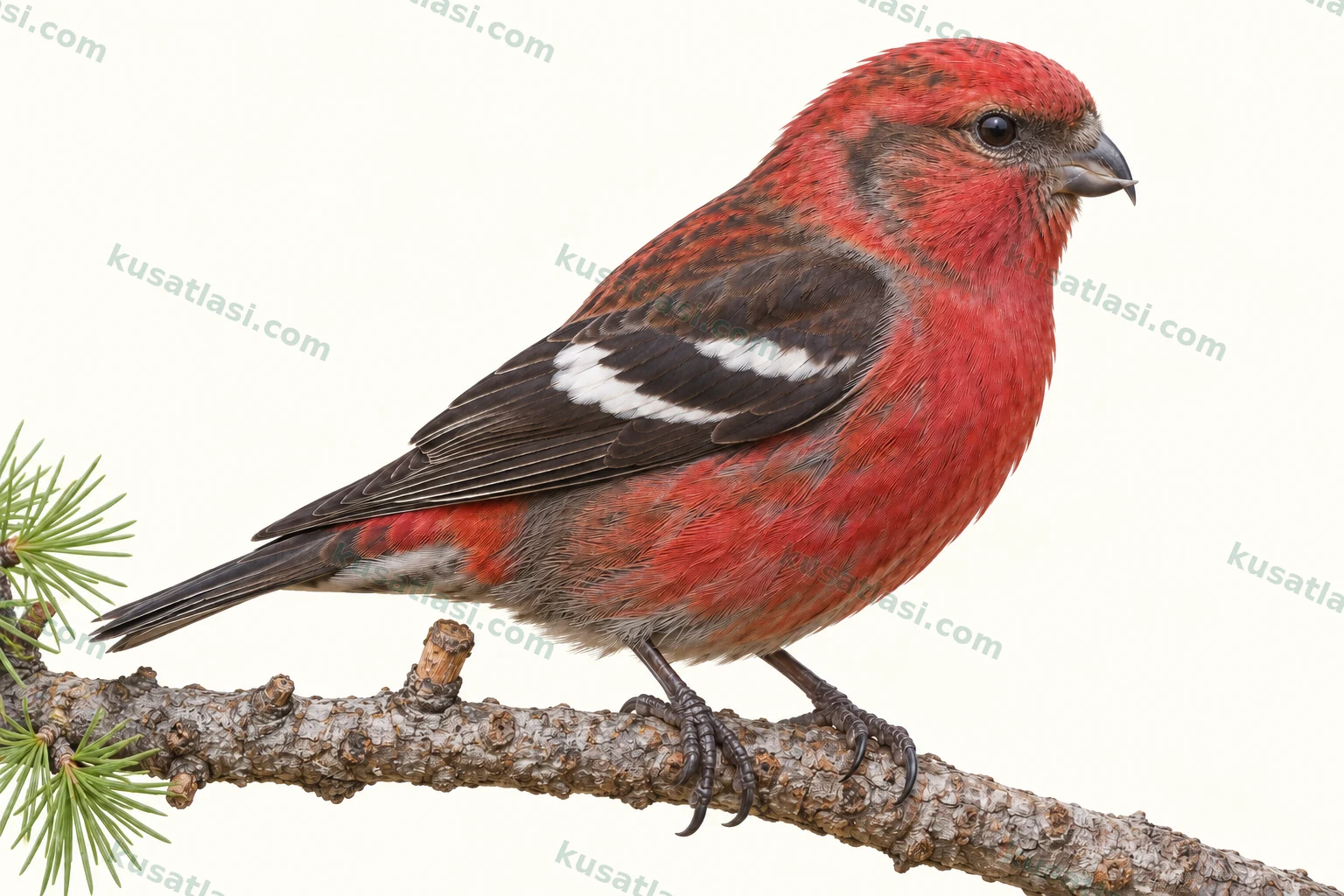
Fringillidae · Passeriformes
Two-barred Crossbill
Loxia leucoptera
Ak Kanatlı Çaprazgaga
Assess crossed bill tips together with two broad pale bars on the dark wing.
- Order
- Passeriformes
- IUCN Status
- LCLeast Concern
Biometrics
Length
- Male
- 14–17 cm
- Female
- 14–17 cm
Wingspan
- Male
- 26–29 cm
- Female
- 26–29 cm
Weight
- Male
- 26–34.4 g
- Female
- 24.4–37.9 g
Detailed explanations of these measurements are available on our website, on the same species page.
At a Glance
- Crossed tips
Check the bill tip.
- Two pale bars
Conspicuous on dark wings.
- Conifer cover
Search cone-bearing trees.
Males are pink-red, females yellowish, and juveniles distinctly streaked.
Calendar
Breeding follows suitable food supplies; there is no fixed monthly schedule shared by every region.
Species Information
Quick Identification
The crossed bill tips and two conspicuous white bars on a dark wing identify this finch. North American sources also call it White-winged Crossbill, referring here to the same scientific species.
General Appearance and Posture
It has a compact body and slightly forked tail. Eurasian bifasciata is larger and larger-billed than North American birds, with less black in the plumage. These geographical differences should not be confused with sex differences.
Males, Females and Young Birds
Adult males are pink-red; females are yellowish and streaked. Both show pale bars on dark wings. Juveniles are strongly streaked above and below, while developing males can combine red and yellow patches. Wing position may conceal one bar.
Appearance in Flight
Flight is undulating. White wingbars help in a passing flock, but a brief pale flash alone is insufficient; check the bill when birds settle.
Voice and Behaviour
Calls are described as soft chiff notes, and songs as musical warbles and trills. North American and Eurasian birds have different songs; a single written imitation does not cover all regional vocalisations.
Similar Species
When comparing Red Crossbill (Loxia curvirostra), look for two broad white wingbars. Red Crossbill can occasionally show thin pale bars, so the mere presence of white is insufficient. Assess conspicuous bars together with the crossed bill.
World Distribution
It inhabits the northern hemisphere’s boreal conifer belt. Nominate leucoptera ranges from Alaska to Newfoundland, south into the Washington Cascades, central Rocky Mountains and northeastern United States. Bifasciata occurs from northern Scandinavia to Siberia.
Status Within Its Natural Range
This account includes two subspecies within Loxia leucoptera. Hispaniolan Crossbill, Loxia megaplaga, is separate; information about island birds in older broadly defined accounts is not transferred here.
Movements and Migration
Movements do not follow a simple north–south calendar: flocks track suitable cone crops and can leave the usual range. In Britain and Ireland it is a scarce, irregular visitor from northeastern Europe. A large flock does not imply predictable annual occupancy.
Breeding Habitat
Conifer forests supplying spruce and larch seeds are important. Larch refers to trees of the genus Larix. North American birds wandering during food shortages may also use ornamental spruces in parks and cemeteries.
Nest Site
A North American expert summary describes a female-built cup, usually near a spruce trunk, made of twigs and plant fibres with softer lining. It gives 2–4 eggs and incubation of 14–16 days. This is not a shared result measured across every Eurasian population.
A single nest studied in northeastern Finland in 1978 occupied a branch near a spruce trunk beside a small marsh. Dry spruce twigs and beard lichens formed the exterior, with many feathers inside. Three eggs were observed in early June. Laying onset was unobserved, so intervals between visits do not establish incubation duration.
Daily Habitat Use
Flocks search treetops for cones and may descend to fallen cones. Site use changes with seed availability. Observe nests from a distance rather than climbing or repeatedly approaching adults.
What It Eats
Conifer seeds form the dietary core. Spruce and larch predominate in North America; insects and spiders are also eaten in summer. The 1978 Finnish nest study found spruce seeds in two nestlings’ crops, with fresh spruce buds in one. This small sample does not establish year-round dietary proportions.
How It Forages
Crossed bill tips help prise cone scales apart, allowing the tongue to lift out seeds. Foraging movements reflect both the presence of seeds and how readily they can be extracted.
Moving Uphill After an Irruption
Studying the Norwegian irruption from summer 2019 to summer 2020, Svein Dale found breeding-season records shifted towards higher elevations. Surveys in southeastern Norway located birds mainly in open spruce forest towards hilltops.
This does not mean birds breed at the same elevation everywhere each year. Reduced predation at higher elevations is discussed as a possible explanation, rather than a directly tested result.
Different Feeding Schedules in the Same Forest
Craig Benkman’s 1987 study examined two and a half years of field observations in the northeastern United States and adjacent Canada. Both crossbill species changed seed use seasonally. Two-barred Crossbills used white spruce in late summer, continuing with white spruce or tamarack before switching to black spruce in late autumn or winter.
Red Crossbills in that study instead moved towards different pine seeds in autumn and winter. Diets could overlap strongly in late summer while diverging at other times. This regional example shows that sharing a forest in one season does not establish identical year-round feeding patterns.