
World Birds
Field Guide Plates
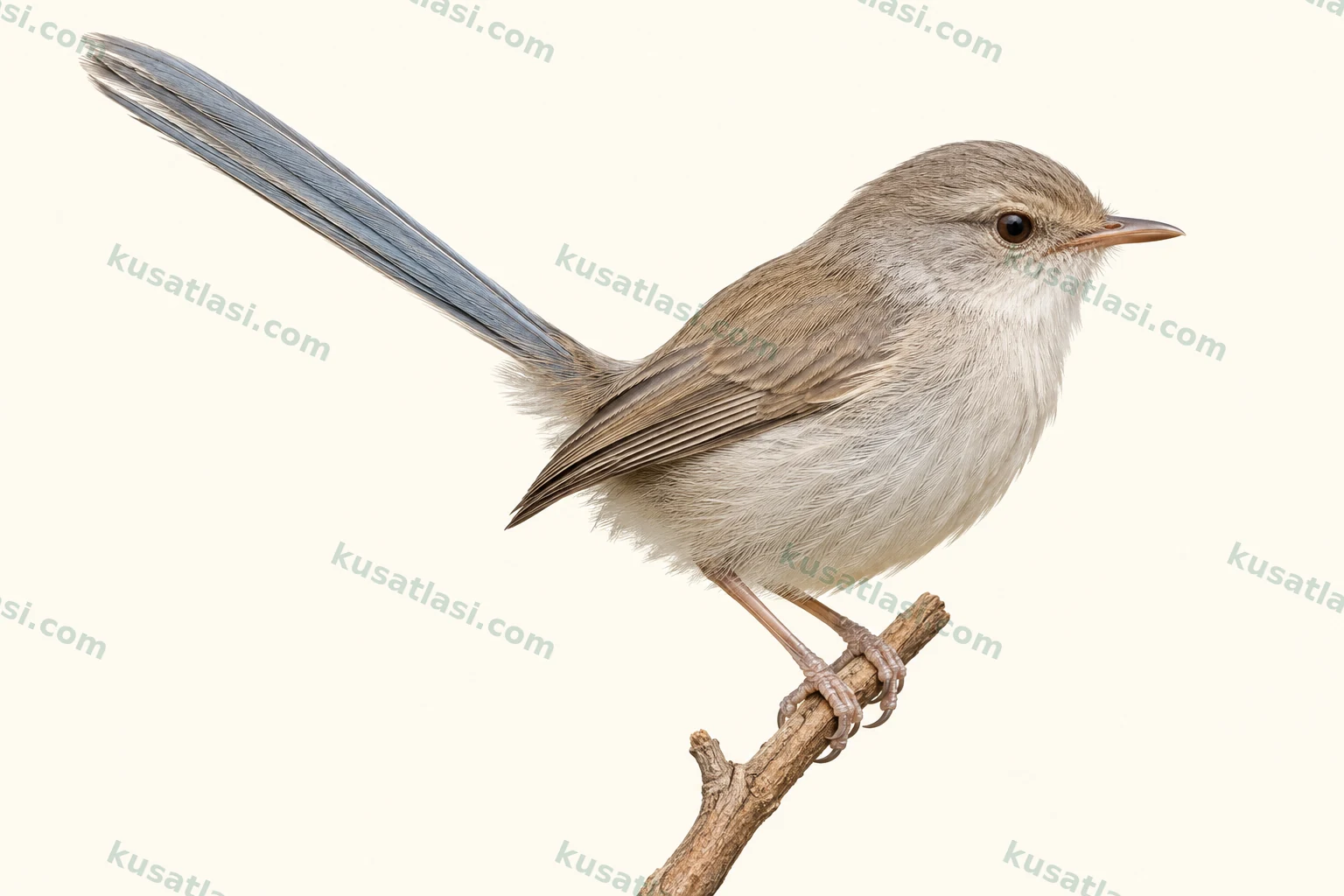
Swipe between the two adult plates.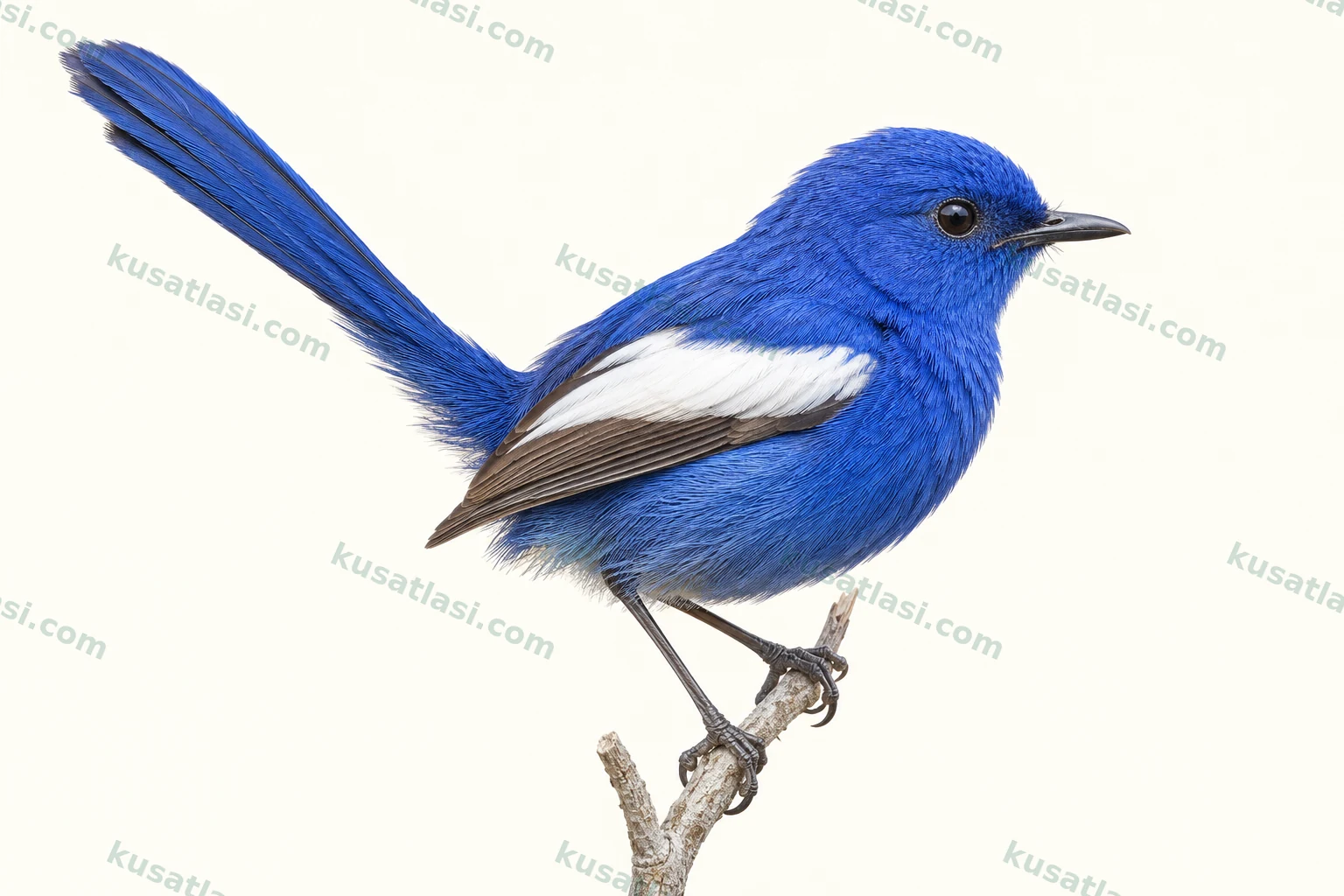
Maluridae · Passeriformes
White-winged Fairywren
Malurus leucopterus
Ak Kanatlı Peribülbülü
Ornamented males are blue and white on the mainland, black and white in two island subspecies.
- Order
- Passeriformes
- IUCN Status
- LCLeast Concern
Biometrics
Length
- Male
- 11–14 cm
- Female
- 11–14 cm
Wing length
- Male
- 4.68 cm
- Female
- 4.68 cm
Weight
- Male
- 7 g
- Female
- 6.1 g
Detailed explanations of these measurements are available on our website, on the same species page.
At a Glance
- White shoulder area
Contrasts with the male’s blue or black body.
- Bluish tail
Can be subtle in females.
- Fine bill
Assess with facial pattern and geography.
Not every brown bird is female.
Calendar
A monthly calendar covering the whole range was not verified.
Species Information
Quick Identification
The ornamented mainland male is cobalt blue and white. Males on Dirk Hartog and Barrow islands are black and white in the corresponding plumage. These are different subspecies of the same species.
General Appearance and Posture
Fine-billed, with white extending from shoulder to inner wing.
Males, Females and Young Birds
Females have gray-brown upperparts, whitish underparts and a bluish tail. Males outside ornamented plumage can resemble females. Young males may develop patchy colour; a brown appearance alone does not establish a female or a non-breeding individual. Plumage development does not provide an exact daily age.
Appearance in Flight
The male’s white wing area contrasts with blue mainland plumage or black plumage in the two island subspecies. Failure to see this white, especially in a brown bird, does not by itself exclude the species.
Voice and Behaviour
It associates in groups. The rapid songs and high contact calls of fairywrens can resemble one another; assess voice together with face and tail patterns. A reliable species-specific phonetic transcription was not verified in this review.
Similar Species
Female Red-backed Fairywren (Malurus melanocephalus) also has a plain face, but its tail is brown; a female White-winged Fairywren has bluish tones in the tail. Check lighting, facial pattern and habitat together. White-shouldered Fairywren (Malurus alboscapulatus) of New Guinea is a different species, whose breeding data cannot be transferred here.
World Distribution
It is endemic to Australia. Malurus leucopterus leuconotus occupies much of the mainland; Malurus leucopterus leucopterus occurs on Dirk Hartog Island and Malurus leucopterus edouardi on Barrow Island off Western Australia. A broad mainland range does not imply occurrence in every Australian habitat.
Status Within Its Natural Range
Black island and blue mainland ornamented plumages represent geographic variation within one species. The 2024 genomic study sampled these populations separately. Its genetic differentiation results should not be read as designation of the island birds as separate species or as current population censuses.
Movements
A tracked monthly migration route covering the entire range was not verified in this review. The distribution of island and mainland subspecies does not demonstrate regular migration between those areas. Historical population divergence inferred from genomes is not a documented present-day seasonal journey.
Breeding Habitat
It uses shrublands and grasslands in arid, semi-arid and coastal regions. Low scrub and heath are important on Dirk Hartog Island.
Nest Site
On Dirk Hartog Island, the domed nest is concealed in low shrubbery. In Western Australian research in 2000–2001, modal clutch size was three on the island and four at mainland Lancelin; median incubation was 13 and 12 days respectively, and median nestling duration was 12 days at both sites. These are regional findings. Observe from a distance without opening nests or blocking access.
Daily Habitat Use
It also uses floodplains and periodically flooded lake beds.
What It Eats
It eats insects, particularly beetles. The expert fact sheet for Dirk Hartog Island also reports seeds and fruits. These local records do not establish fixed dietary percentages throughout the range.
How It Forages
It hop-searches on the ground and in low vegetation. Island accounts describe insects being snapped up in low scrub; this should not be interpreted as an exclusively plant-based diet or dependence on a single insect group.
How Do Blue and Black Feathers Differ?
The mainland male’s blue is not simply a blue pigment: interactions between light and microscopic feather structures matter. Black feathers of island males also retain an internal structure potentially capable of producing blue, while melanin distribution and structural differences alter the visible colour. Black appearance therefore does not imply complete absence of structures capable of generating blue.
Genetic Evidence and an Evolutionary Hypothesis
Sin and colleagues’ 2024 study compared genomes of males from mainland Australia, Dirk Hartog Island and Barrow Island. It identified candidate genomic regions associated with colour differences; signals around ASIP and SCUBE2 supported possible re-evolution of blue from a black ancestor in the mainland lineage. This is not direct observation of ancestral plumage or experimental confirmation of every candidate gene’s function. A role for female preference is a proposed explanation, not a result established by a direct mate-choice experiment in that paper.
An Object Carried in the Bill
Near Kalgoorlie–Boulder, Western Australia, a male was photographed on 31 January 2017 carrying a white object in a manner resembling a petal display. Published in 2026, the observation interpreted the object as likely soft plastic from its appearance and nearby material. This single record does not establish improved mating success or widespread population-level adoption. The Queensland observation in the same paper concerned a different species.