
World Birds
Field Guide Plates
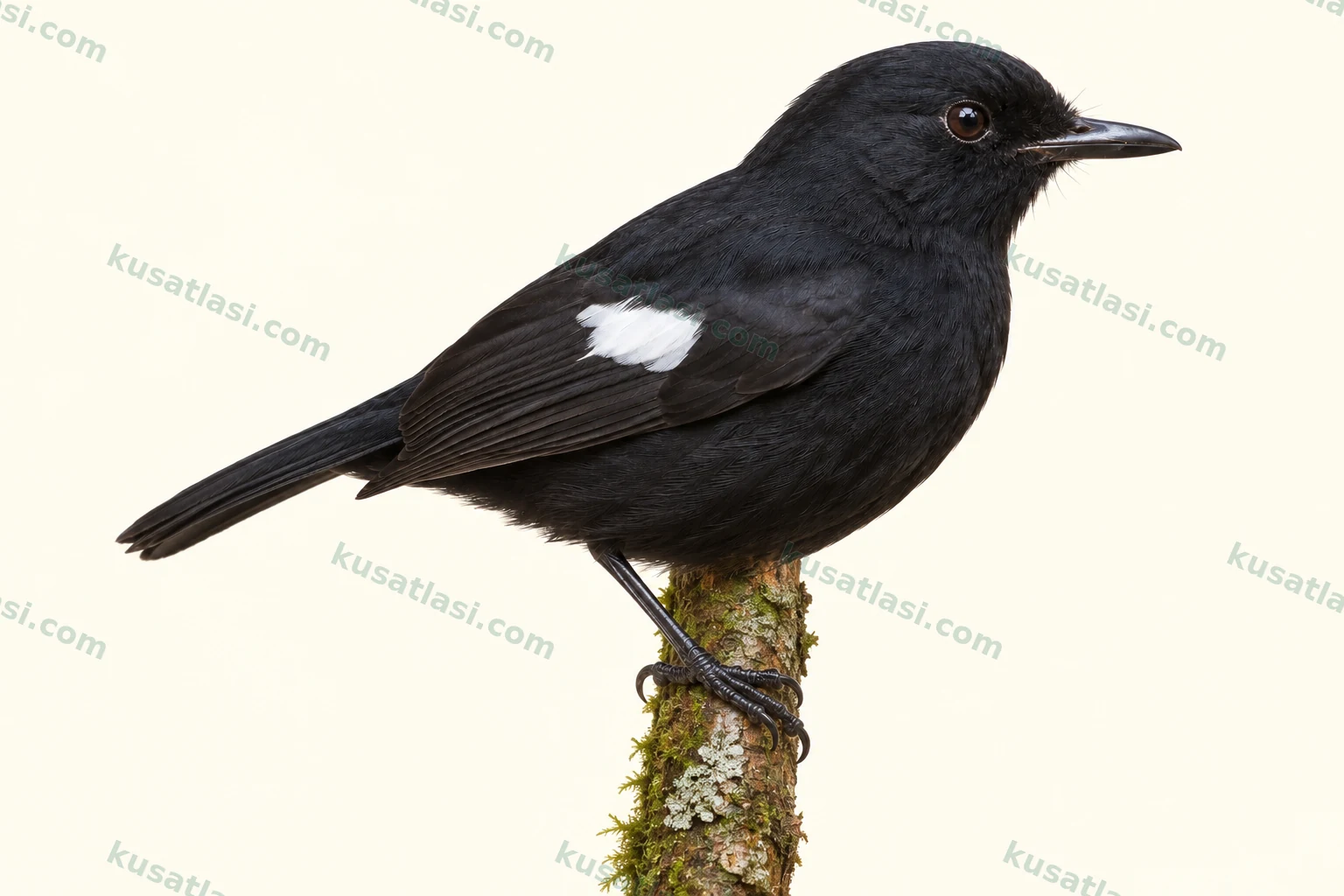
Swipe between the two adult plates.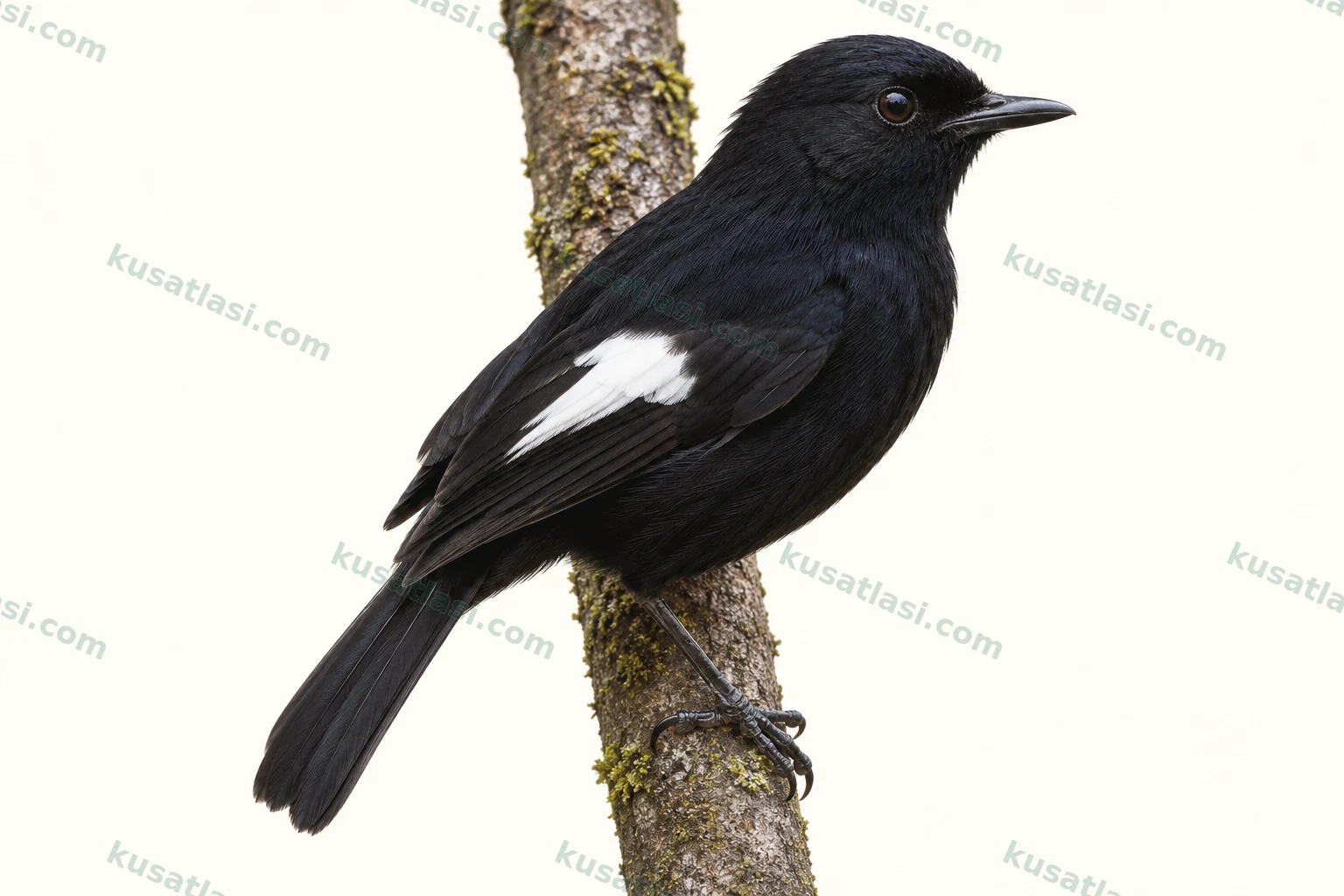
Petroicidae · Passeriformes
White-winged Robin
Melanodryas sigillata
Ak Kanatlı Bülbül
Look for the white inner-wing patch on the velvety-black adult; white breast sides can be a regional trait.
- Order
- Passeriformes
- IUCN Status
- LCLeast Concern
Biometrics
Length
- Male
- 14–15 cm
- Female
- 14–15 cm
Wing length
- Male
- 9.35 cm
- Female
- 9.35 cm
Weight
- Male
- Data unavailable
- Female
- 22.2 g
Detailed explanations of these measurements are available on our website, on the same species page.
At a Glance
- White inner wing
The entire wing is not white.
- Black adult body
Young are browner and patterned.
- Mossy montane forest
Watch understorey and ground-directed prey attacks.
Males and females are similar. Young are browner and patterned; regional wing or breast marks do not provide certain sexing.
Calendar
Presumed resident. Nest and dependent-young dates from different regions are not merged into one annual schedule.
Species Information
Quick Identification
White-winged Robin is a Petroicidae species of New Guinea’s high montane forests. Adults have a velvety-black body and conspicuous white wing patch, concentrated on the elongated inner flight feathers rather than the whole wing. Some regional forms also have white patches at the sides of the breast; these are not sex differences.
General Appearance and Posture
The adult head, body and tail are black, while the remaining flight feathers can look brownish black. The eye is dark brown and the bill and legs black. Waiting on an understorey perch before a short attack on prey is characteristic foraging behaviour.
In nominate sigillata, the white inner wing feathers have black tips. Hagenensis lacks those black tips. Western quadrimaculata also lacks them and additionally has a white patch on each side of the breast. Saruwagedi of the Huon Peninsula has more extensive black tips. The white area therefore need not have identical size and boundaries in every bird.
Wing position can change how much of the patch is exposed. Failure to see its full extent in a brief shaded view does not by itself establish another species. Assess head, body, wing and any breast-side patches together.
Males, Females and Young Birds
Adult males and females have similar plumage. Neither wing-patch width nor white breast sides reliably determine sex, since regional variation affects these areas. Sex in the nesting study was assessed using care behaviour; this does not imply equivalent certainty from a photograph alone.
Juveniles are dark brown, paler below, with pale buff, olive-brown or rufous shaft streaks on body feathers and upperwing coverts. Some juvenile coverts persist in immature plumage. This patterned appearance differs from the adult’s more uniform black.
Nestlings watched in Papua New Guinea developed rufous feather tips on the back and wing coverts. Eye opening and flight-feather development were gradual. One photograph of one age should not be used as the appearance of the entire nestling stage.
Appearance in Flight
Short foraging flights can reveal the white inner wing against the black body. A nearby prey attack from a perch is not evidence of long-distance migration. After a brief white flash, reassess regional plumage and juvenile markings when the bird lands.
Voice and Behaviour
Song is described as a slow trill of piping notes, sometimes gradually rising or falling in pitch. Calls include a rapid, high, descending trill and sharp alarm notes; thin metallic notes can accompany chases.
Occurs in the understorey and around food on the ground. At nests, females were observed quivering their wings while soliciting food and males delivering food to them. This is a care-related observation, not grounds for assigning the same function to every wing quiver.
Similar Species
Among dark montane forest birds of New Guinea, the adult’s white inner-wing patch is an important starting point. White breast sides are normal in quadrimaculata, so white in the wing and at the breast sides can occur together in one bird.
Altitudinal replacement by the blue-gray relative in lower forest is reported, but elevation alone cannot establish identification. Check the black body, wing patch and local range together, allowing for the less uniformly black plumage of young birds.
World Distribution
Endemic to New Guinea, spanning central and eastern high mountain ranges and the highlands of the Huon Peninsula in the northeast. This includes west-central mountains on the Indonesian side and high forests in Papua New Guinea; it is not endemic to just one country.
The expert account distinguishes quadrimaculata in the Nassau and Oranje mountains, hagenensis from the Antares region east towards Hagen, sigillata in central-eastern and southeastern ranges, and saruwagedi on the Huon Peninsula. Some publications include hagenensis within sigillata. That taxonomic treatment does not make the Hagen birds in an older study another species.
Movements and Migration
Presumed sedentary in the expert account. The reviewed publications do not establish a regular long-distance migration route or a shared year-round monthly movement schedule. Nesting observations are not evidence that the same individuals were tracked at the same site in every month.
Breeding Habitat
Uses the understorey of mossy high montane forest and adjacent shrubbery. Ferns, moss, saplings and dense lower vegetation matter for both foraging and nest placement. Suitable montane forest cannot be identified from elevation alone.
The detailed 2011 study took place around Kumul Lodge on the southern slope of Mount Hagen, Papua New Guinea. A nest found on the Huon Peninsula in 2017 was reported separately in the same paper. These sites and years are not merged or presented as equally intensive coverage of all New Guinea.
Nest Site
The bulky deep cup is covered externally with green moss and lined with fern pieces and fine roots. It can occupy a vertical sapling fork. One Kumul nest was in a tree-fern crown, while the Huon nest rested on a thin horizontal branch supported by upright branches. Nest placement is therefore not restricted to one type of fork.
Each of the three Kumul nests in which eggs were laid held one egg; another completed nest received none during observation. The female incubates and the male brings her food. One egg was already present when its nest was found, so the time followed until hatching established only a minimum of 16 days, not a precisely measured complete incubation period.
Nestling periods were recorded as 21 days at one nest and about 17 at another. The author noted possible premature departure at the latter because of the observation hide, without establishing that as a proven cause. Both parents fed the young and removed faecal sacs; only females were observed brooding.
October–November Kumul records and January reports of dependent young concern different places and breeding stages. They do not create one complete annual schedule for all regions. Avoid positioning close to nests or obstructing parental access.
Daily Habitat Use
Forages in the understorey and on the ground, waiting on a perch before pouncing down or taking prey from nearby foliage. Use of different levels within dense lower vegetation does not imply equal suitability of every opening or high treetop on the mountain.
What Does It Eat?
Insects and other small invertebrates form the main diet. The expert account also reports occasional fruit and seeds, without an established annual dietary share.
Recognisable food carried to Kumul nests included earthworms, spiders, cicadas, caterpillars, beetle larvae and pupae and other insects. A treefrog was also recorded as nestling food. A male delivered a small lizard to the incubating female on one occasion and a frog on another. These deliveries to chicks or a mate do not establish the same year-round proportions in every adult’s diet.
How Does It Forage?
A principal method is watching from a perch before a short attack, pouncing to the ground or snatching prey from understorey vegetation. Direct gleaning from nearby surfaces also occurs. Published proportions of observed attack types are not percentages of prey species or food mass.
A Third Attendant at One Nest
At one Kumul nest, a brown immature bird fed the nestling and the brooding adult and removed a faecal sac: direct evidence of an attendant beyond the breeding pair. The author inferred it was male from its behaviour, but did not establish its kinship. This single case does not mean that every pair has a helper.
Success in a Small Sample Does Not Mean No Risk
Hatching occurred at all three egg-containing Kumul nests, and departure of young was confirmed at two. This does not establish universal nest success; the third chick’s eventual outcome was unknown. Proposed roles of food limitation and nest predation in shaping breeding behaviour are not treated as definitive causal proof from this small observational sample.