
World Birds
Field Guide Plates
Swipe between the two adult plates.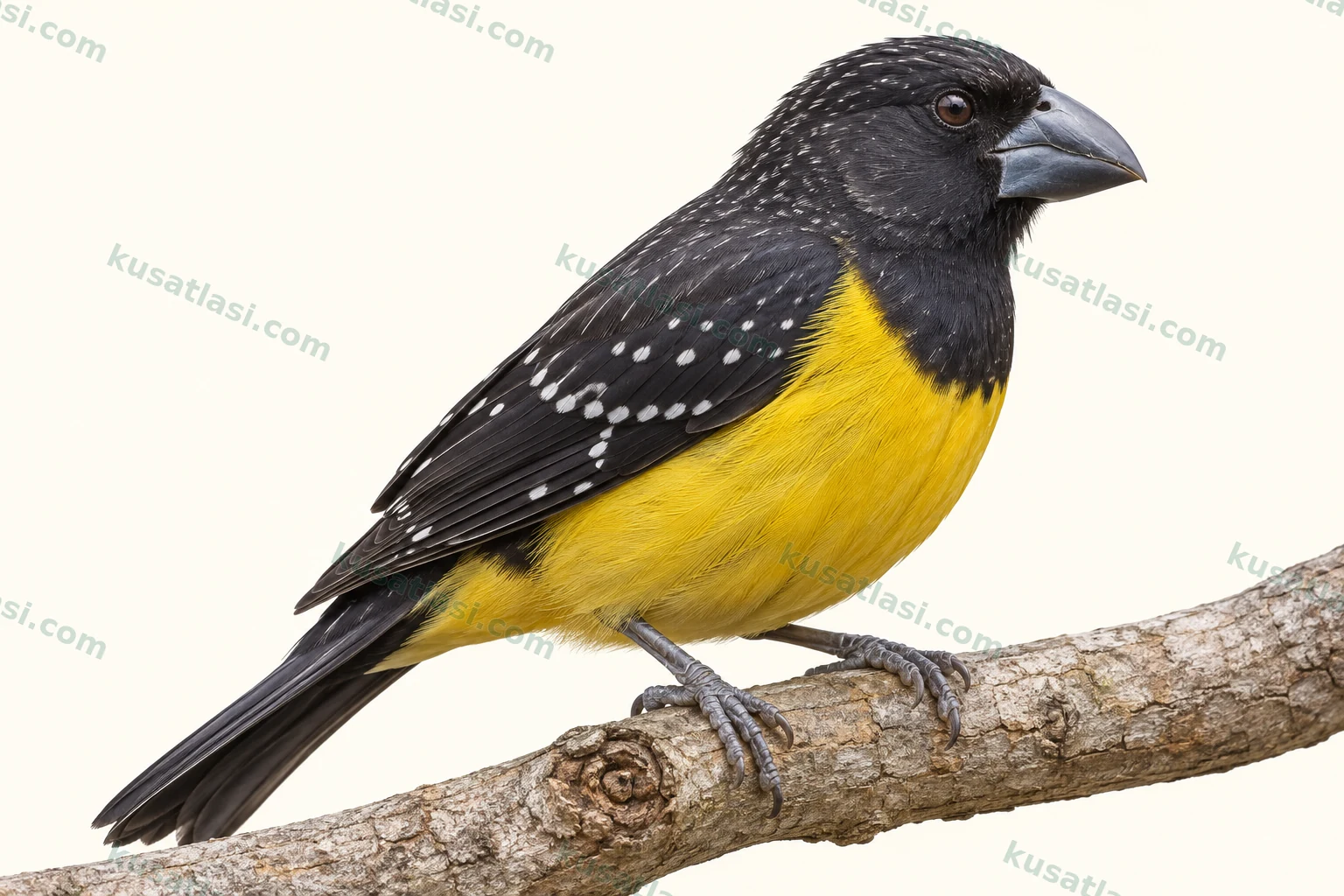
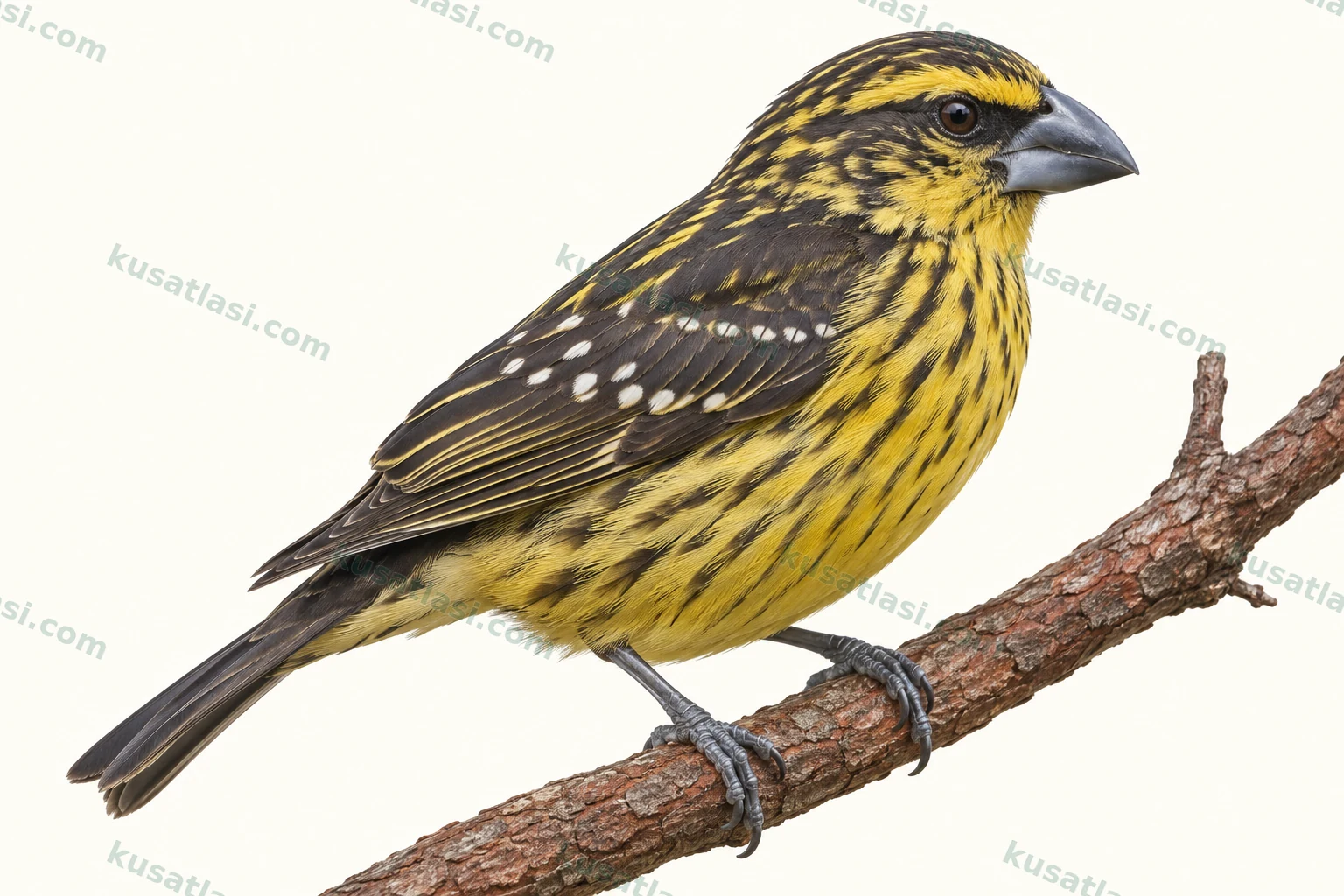
Fringillidae · Passeriformes
Spot-winged Grosbeak
Mycerobas melanozanthos
Ak Kanatlı Sarı Kocabaş
Check the thick bill, white wing spots and yellow body areas together.
- Order
- Passeriformes
- IUCN Status
- LCLeast Concern
Biometrics
Length
- Male
- 22–23 cm
- Female
- 22–23 cm
Wing length
- Male
- 12.06 cm
- Female
- 12.06 cm
Weight
- Male
- 50–74 g
- Female
- 50–74 g
Detailed explanations of these measurements are available on our website, on the same species page.
At a Glance
- White wing spots
The entire wing is not white.
- Dark rump
Useful against Mycerobas carnipes.
- Yellow belly
Contrasts with the male’s dark breast.
Females have dark-streaked yellow underparts; juveniles can look duller.
Calendar
Elevational movements are known; a monthly route for the whole range was not verified.
Species Information
Quick Identification
Check the thick bill, dark head, yellow belly and white wing spots together.
General Appearance and Posture
Males have a dark head and breast, a bright yellow belly and a dark rump.
Males, Females and Young Birds
Females have yellow-streaked upperparts, dark longitudinal streaks below and a conspicuous yellow eyebrow. Juveniles resemble females but can be paler and duller; this does not establish an exact daily age.
Appearance in Flight
The Nepal assessment describes strong, undulating flight. This is not established as a diagnostic rhythm on its own; check wing spots and body pattern when the bird lands.
Voice and Behaviour
Calls can resemble a rough “krrr”. Flocks observed near Maneri, India, were vocal while feeding and flying. A quietly perched bird can nevertheless be easily overlooked in foliage.
Similar Species
Against White-winged Grosbeak (Mycerobas carnipes), check this species’ dark rump, brighter yellow belly and less extensive black breast.
World Distribution
It inhabits Himalayan and neighbouring mountain regions of Asia, from Pakistan through Nepal, Bhutan and India towards southern China and northern Southeast Asia. Laos, Myanmar, Thailand and Vietnam are among the reported countries. This broad country list does not imply occurrence throughout every country. It is treated as monotypic.
Status Within Its Natural Range
Nepal’s 2016 assessment reported sparse but widespread records from Api Nampa in the west to Makalu Barun in the east. Observations in Langtang in 2013–2015 indicated more frequent encounters, not equivalent abundance throughout Nepal. Numerical lower and upper bounds for the national population were unknown in that assessment. These are dated findings, not a current national census.
Movements
It makes seasonal elevational movements and can descend into lower forest in winter. The Nepal assessment explicitly notes that the details are poorly known. Winter and spring flocks near Maneri in India’s Bhagirathi Valley are local records, not tracked journeys of identified birds. A monthly route or departure date for the entire range is therefore not supplied.
Breeding Habitat
In Nepal, mixed broadleaf–conifer forest is reported as breeding habitat and lower broadleaf forest as winter habitat. Forests containing fir, hemlock and maple are also used. Summer occurrence does not make every sighting evidence of an active nest.
Nest Site
The expert species account reports a tree cup nest made of twigs, grass and moss, lined with fine rootlets, and two or three eggs. Verified incubation and nestling durations were not found in this review. Durations from other Mycerobas species are not transferred here; avoid approaching nests in ways that obstruct adults.
Daily Habitat Use
It can feed in trees, bushes and on the ground. Nepalese sources report pairs in spring and close flocks in winter; habitat use is not restricted to the highest tree layer.
What It Eats
The Nepal expert assessment lists kernels of wild Prunus cherries and plants such as Myrica, together with Viburnum berries. These examples do not establish the same dietary proportions throughout the range or exclusive reliance on those plants.
How It Forages
The Bhagirathi Valley study in India reported Maneri flocks feeding together in one tree at a time. This does not imply using only one tree all day or depending on a single plant. A species-wide daily feeding duration cannot be calculated from this local observation.
More Records Do Not Necessarily Mean Population Growth
Nepal’s 2016 expert assessment attributes much of the increase in recorded distribution after 1990 to improved coverage. This does not mean that the species newly colonised all those places. The same source reports a marked scarcity of later records at the former regular wintering site of Phulchoki in the Kathmandu Valley. One later record dates from November 2007; this does not establish definite present-day absence.
One Flock Size Is Not a Fixed Species Rule
Fieldwork in Uttarakhand, India, in April 2013–May 2018 reported winter and spring flocks of 10–13 birds, with more males, around Maneri. They were vocal while feeding and flying. These are local observations from that study, not evidence of a fixed flock size, a shortage of females in the population or the same sex ratio throughout the range.
The Importance of Winter Forest
Nepal’s 2016 assessment highlights loss of lower temperate and subtropical broadleaf winter forest as a threat. Protection of breeding habitat does not automatically replace forests used in another season. This national assessment has a different scope from the global IUCN category.