
World Birds
Field Guide Plates
Swipe between the two adult plates.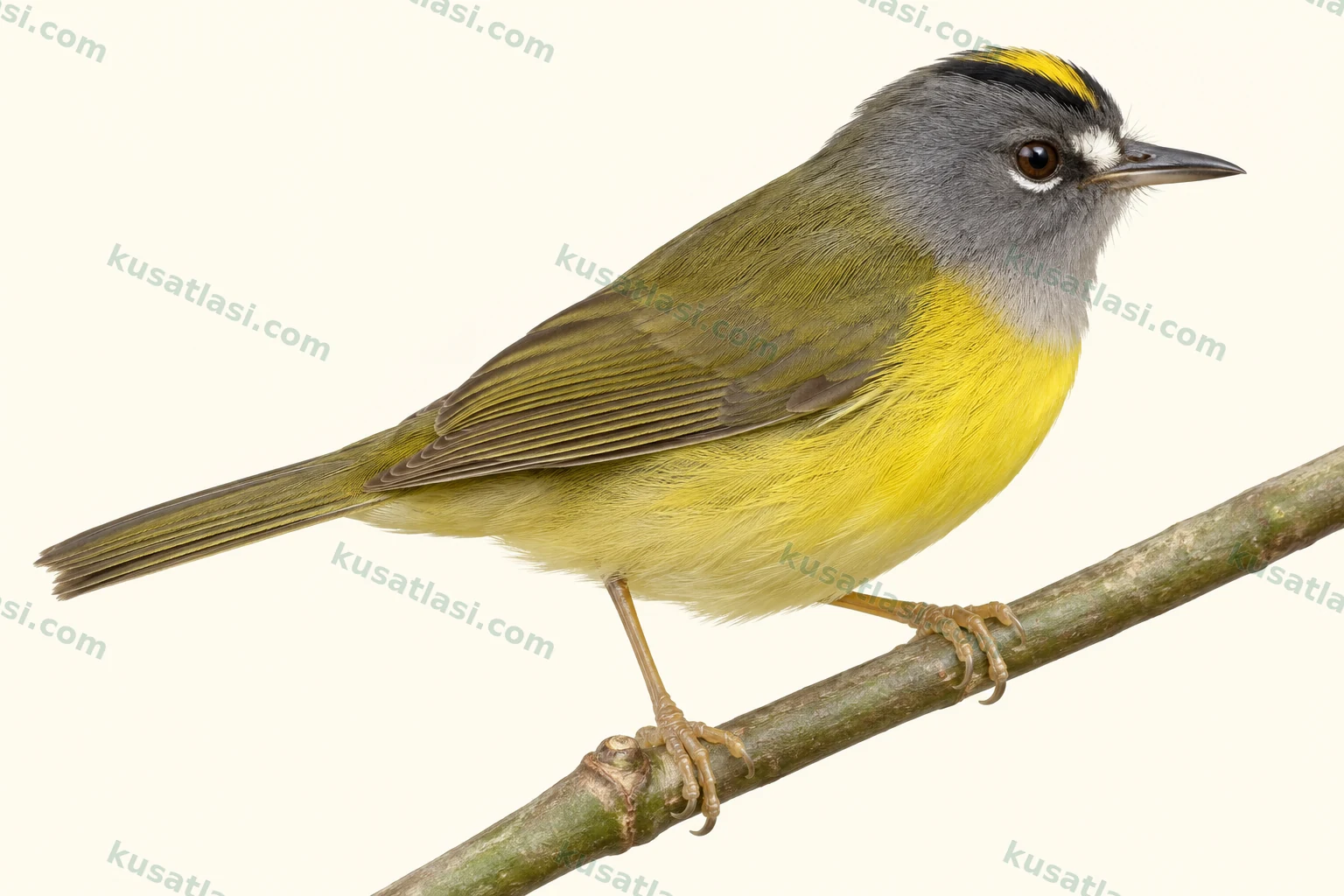
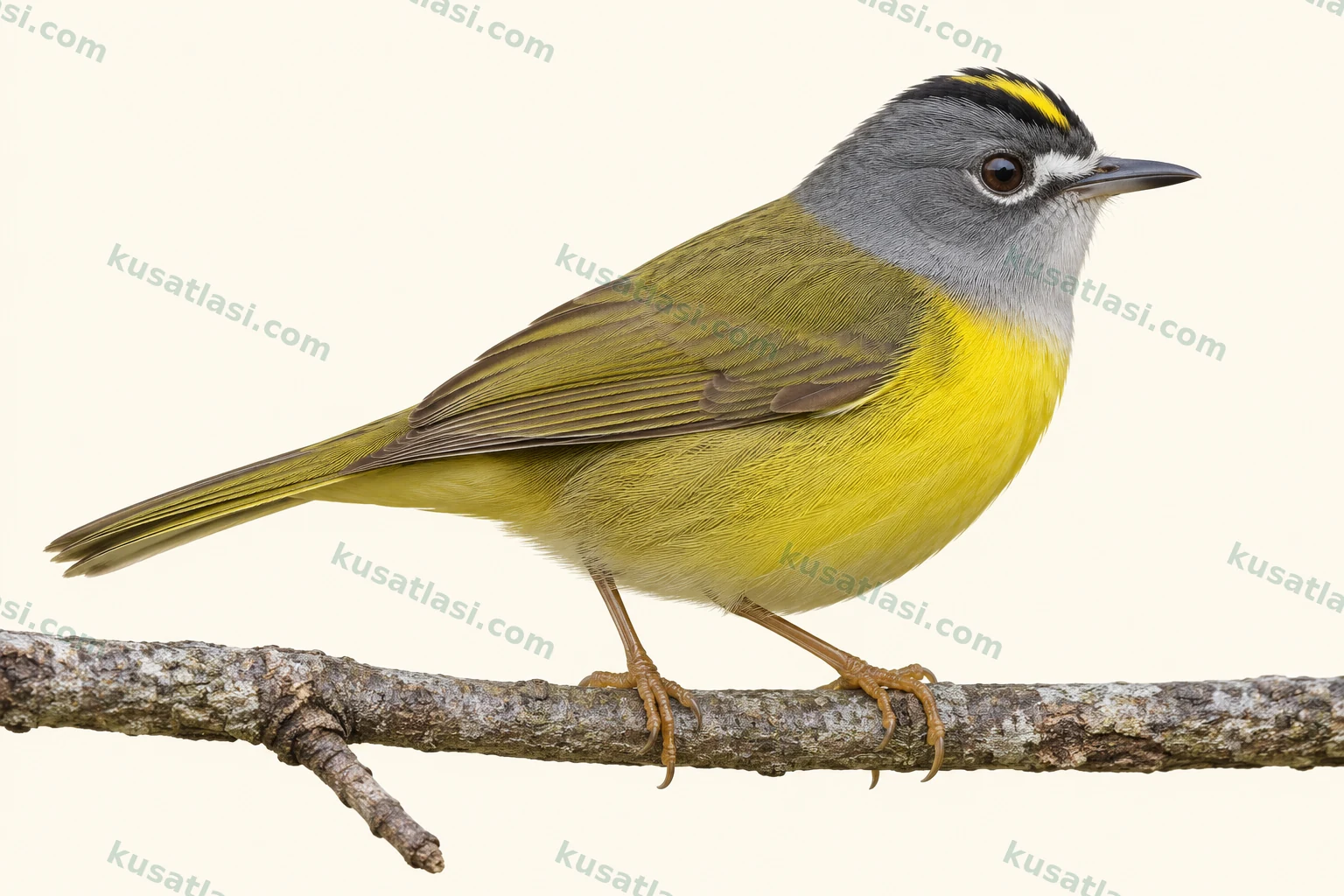
Parulidae · Passeriformes
White-lored Warbler
Myiothlypis conspicillata
Ak Gözlüklü Ötleğen
Combine the grey head and throat, broken white eye surround and yellow underparts.
- Order
- Passeriformes
- IUCN Status
- NTNear Threatened
Biometrics
Length
- Male
- 13 cm
- Female
- 13 cm
Wing length
- Male
- 6.46 cm
- Female
- 6.46 cm
Weight
- Male
- 12.8–14.6 g
- Female
- 12.8–14.6 g
Detailed explanations of these measurements are available on our website, on the same species page.
At a Glance
- Broken white spectacles
The iris is brown.
- Grey head and throat
Olive-green back and yellow underparts.
- Santa Marta endemic
Humid vegetation in this Colombian massif.
Sexes look alike. Yellow–orange crown variation does not reliably sex birds; juveniles initially lack the grey head.
Calendar
Resident. Regional breeding evidence spans late March–July; a fully verified monthly nesting calendar is unavailable.
Species Information
Quick Identification
White-lored Warbler is a New World warbler endemic to the Sierra Nevada de Santa Marta in northern Colombia. Look for the olive-green back, yellow underparts and contrasting grey head. A white stripe above the dark area between bill and eye connects with the broken white eye-ring. White feathers produce the spectacles; the iris is brown.
Appearance and Posture
The head looks relatively large. Two dark lateral stripes border a bright yellow central crown stripe and extend towards the nape. The central stripe approaches orange in some individuals. Throat is pale grey; lower breast, belly and undertail are yellow, with a yellow-olive wash possible on the flanks.
Back, rump, wings and tail are broadly uniform olive-green. The bill is dark grey and the legs pale orange. Relatively long legs and tail with short wings give the understory bird characteristic proportions, which should not be used alone for identification.
Males, Females and Young Birds
Males and females look similar. A yellow versus more orange crown stripe is not a verified stand-alone sexing key. Evidence is insufficient to assign this colour difference directly to age or sex.
Juveniles are duller and initially lack the adult’s distinctive grey head. A partial replacement of juvenile plumage produces the grey-headed appearance, while the wing can retain feathers from different generations. Assessing subtle feather boundaries requires experience. A slightly more olive appearance in one photograph does not establish an exact age in months.
Appearance in Flight
A separately verified diagnostic flight-pattern key is unavailable. Yellow underparts glimpsed briefly in flight do not alone separate it from other small forest birds. On landing, assess grey throat, crown pattern and broken white eye surround together.
Voice and Behaviour
While foraging in undergrowth, it can repeat thin squeaky “triit”-like calls. Song is a short rapid series of very high notes. The expert account reports more frequent singing in March; association with the onset of breeding is a possible explanation, rather than proof that every singing bird has a nest.
Forages actively alone or in groups of two or three and may temporarily join mixed-species flocks passing through its territory. Local resightings of colour-banded birds in the same areas throughout the year have been reported; this does not establish lifelong immobility in every individual.
Similar Species
Golden-crowned Warbler, Basileuterus culicivorus, can occur in the same local mixed flocks. Local birds have a yellow throat; seek White-lored Warbler’s grey throat, marked grey-head/green-back contrast and broken white eye surround. Both have a pale central crown stripe, so a yellow crown alone is insufficient. Golden-crowned Warbler varies geographically; this comparison concerns birds occurring together in Santa Marta.
World Distribution
Its natural range is restricted to the Sierra Nevada de Santa Marta massif near Colombia’s Caribbean coast. It is not merely Colombian endemic: it is associated with one mountain system within the country. Known areas such as San Lorenzo and Río Frío form parts of that restricted range, rather than evidence of occurrence throughout the Colombian Andes.
Status within Its Range
Can be locally common in suitable areas. The 2000–2001 study of the Río Frío Valley, Colombia, recorded it in forest, edges, older secondary growth and shade-coffee habitats. Local abundance does not make a restricted-range bird immune to habitat loss.
A 2024 study projected a total of 16,741–17,627 individuals across the range from data collected in San Lorenzo, Colombia. This is a model estimate, not an individual-by-individual census or a 2026 population count. Differences from older estimates can substantially reflect methods and do not alone establish a decline rate.
Seasonal Movements
Resident, with no clearly demonstrated seasonal or elevational migration. Records at different elevations do not themselves prove regular movements up and down the mountain. A long-distance migration route is not established.
Breeding Habitat
Inhabits humid premontane and montane forest, especially where the understory is dense. It also uses edges, regenerating vegetation and some shade-coffee plantations. In the Río Frío Valley, Colombia, the 2000–2001 study recorded it at 650–2,200 metres; that local interval is not an immutable range-wide limit.
The 2024 analysis of San Lorenzo data in Colombia modeled abundance against elevation and land cover together. Occurrence in regenerating cover and transformed mosaics does not establish equivalence between all farmland and native forest. Transformed sites in that study were mainly shade-grown coffee mixed with native vegetation; bare pasture should not be presented as the same habitat.
Nest Site
An older description relayed by the expert species account places a domed nest on the ground among tree roots. The same historical source is reported to give three to four white eggs with chestnut speckling. These details should not be presented as the results of a modern large-sample nest-monitoring study.
Expert observations in Colombia suggest reproductive activity from late March through July, while a 2016 regional synthesis reports breeding-condition birds particularly during April–June. These records are not a fixed calendar in which all nests start together. Incubation and nestling durations and parental division of labour remain unverified. Observe ground nests without approaching or opening the cover.
Daily Habitat Use
Usually forages actively in low understory near the ground. It can ascend to mid-levels and occasionally higher with mixed-species flocks. Brief openings may reveal the grey head and white eye surround; searching only in the canopy would miss much of its activity.
What Does It Eat?
Considered primarily insectivorous, taking small invertebrates. A detailed quantitative diet study was not verified, however. Specific insect families, caterpillar proportions or fruit percentages should not be supplied from other warblers’ diets.
How Does It Forage?
Searches actively through dense low vegetation, usually alone or in small groups, and may ascend when joining mixed flocks. At El Congo reserve in Colombia it has been observed with other warblers in the same feeding flocks. Association does not establish identical prey or feeding techniques.
A Grey Head Does Not Mean Every Feather Is New
A molt study conducted in the Sierra Nevada de Santa Marta, Colombia, and published in 2012 lists this species among birds with a partial first molt followed by complete adult-cycle molts. Developing an adult-like head does not mean that every juvenile wing feather has been replaced at the same time. Boundaries between feather generations can help experienced researchers assign age classes, without establishing an exact age in months from a distant view.
Why Is a Population Estimate More Than One Count?
The 2024 San Lorenzo study in Colombia used April–May counts from 2009–2016 and additional surveys in June 2022. Researchers modeled local density using elevation, habitat and the probability of detecting birds, then projected abundance across the range. Different observers worked in the two periods, preventing complete separation of observer and period effects.
This approach aims to account for birds missed in the field; results still depend on assumptions and how well San Lorenzo data apply to other slopes. The 599 detections used for this species do not mean that only 599 birds remain worldwide. A lower new estimate also cannot simply be divided by an older estimate made with different methods to calculate a population decline.