
World Birds
Field Guide Plates
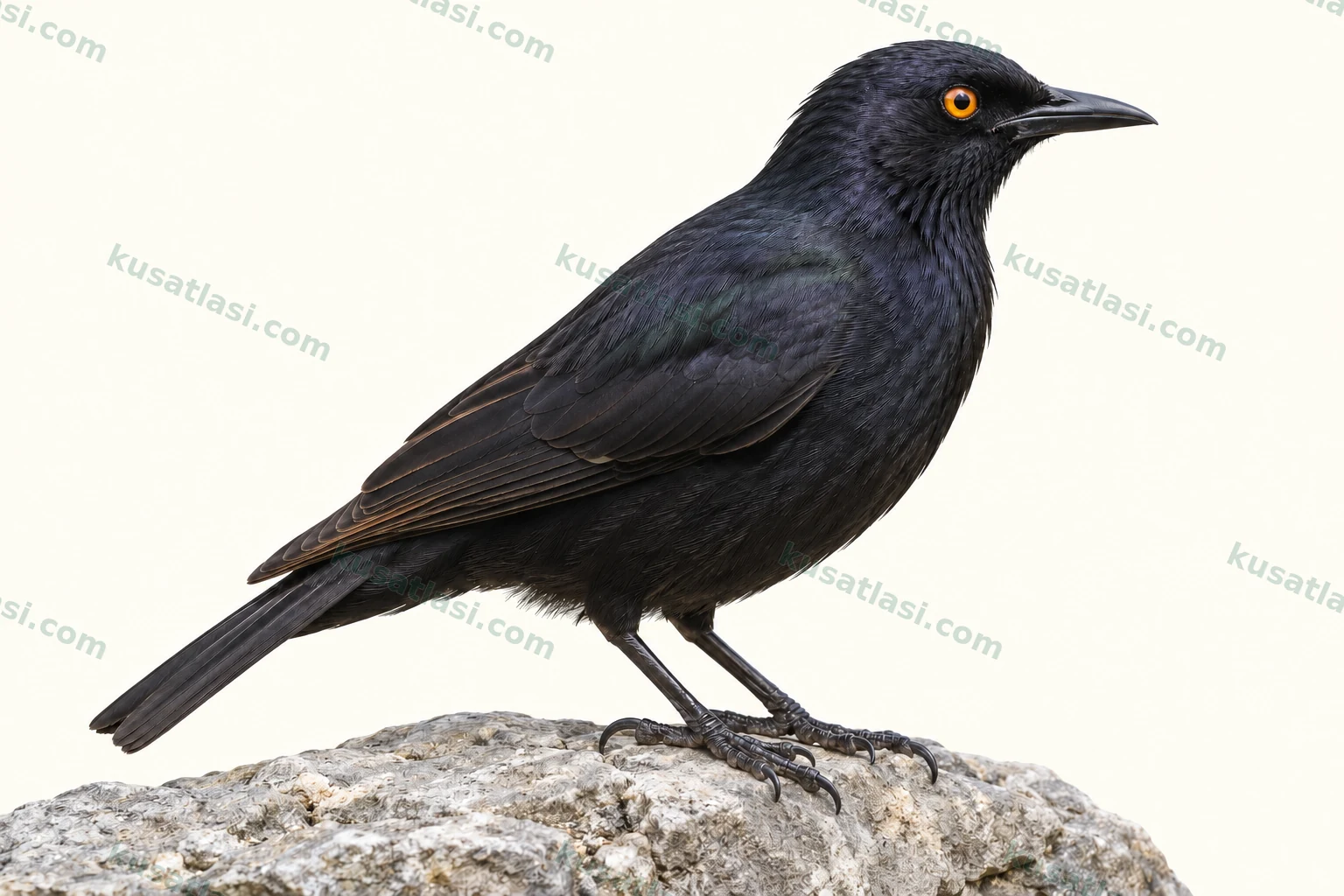
Swipe between the two adult plates.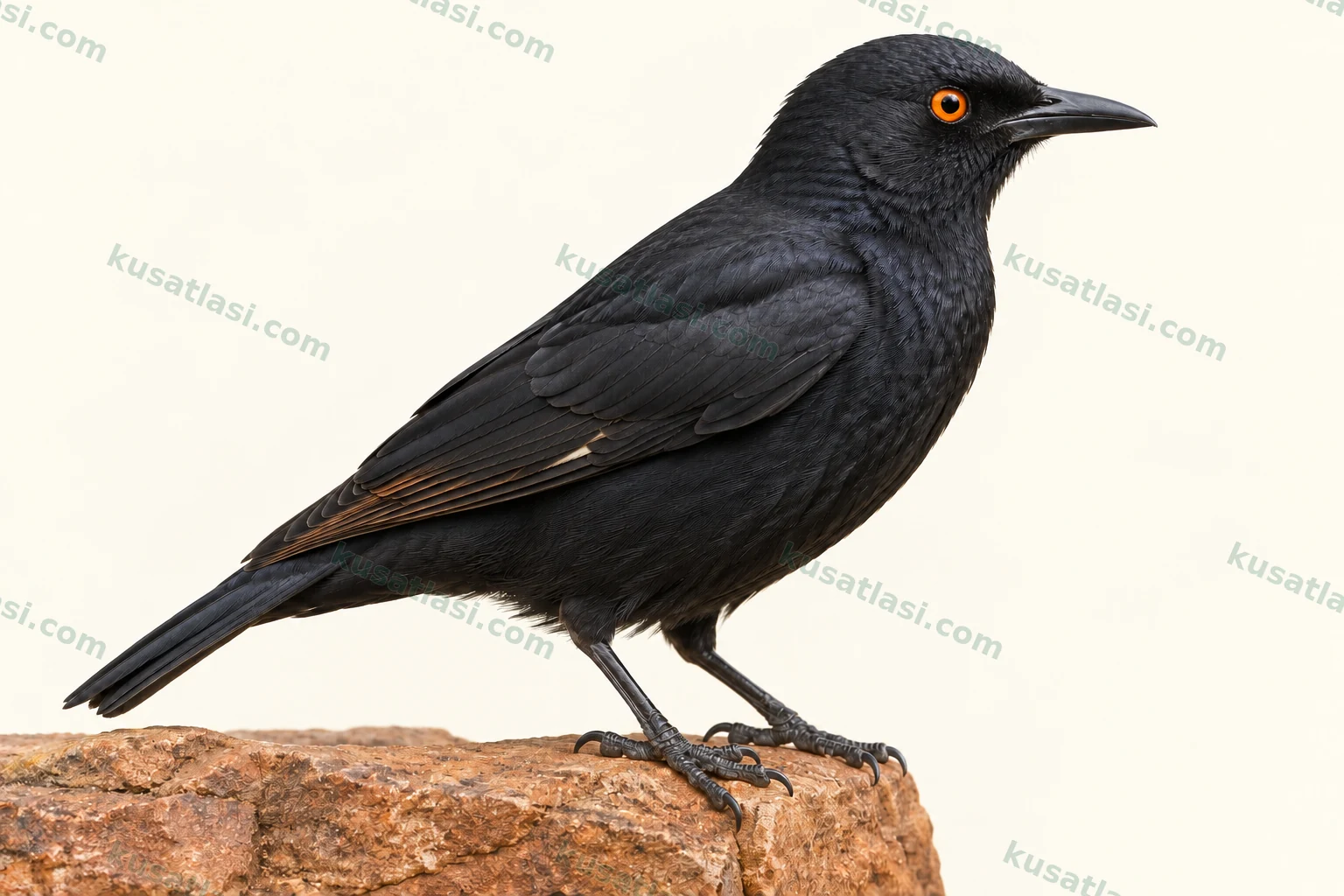
Sturnidae · Passeriformes
Pale-winged Starling
Onychognathus nabouroup
Ak Kanatlı Kızılkanat
Check the glossy dark body, yellow-orange adult eye and creamy-white open-wing patch together.
- Order
- Passeriformes
- IUCN Status
- LCLeast Concern
Biometrics
Length
- Male
- 27 cm
- Female
- 27 cm
Wing length
- Male
- 14.23 cm
- Female
- 14.23 cm
Weight
- Male
- 94–122 g
- Female
- 80–120 g
Detailed explanations of these measurements are available on our website, on the same species page.
At a Glance
- Bright adult eye
Yellow-orange.
- Creamy-white open wing
Rufous-brown edges can show when folded.
- Arid rocky country
Important for nesting and roosting.
Adult sexes share the same plumage; young are duller and darker-eyed.
Calendar
Breeding timing in South Africa and Namibia varies with region and rainfall; no precise whole-range monthly calendar is supplied.
Species Information
Quick Identification
Glossy black plumage, a yellow-orange adult eye and a creamy-white panel in the open wing form a useful combination. Despite its relationship to red-winged starlings, the conspicuous open-wing patch is pale.
General Appearance and Posture
The tail is approximately square-ended; bill and legs are black. Gloss and wing position affect the appearance of a perched bird, so black body color alone is insufficient.
Males, Females and Young Birds
Adult males and females share the same plumage. A gray head is not a female character in this species, although it occurs in some relatives. Young birds are duller, with less brightly colored eyes. Research methods using measurements do not make visual sexing at a distance reliable.
Appearance in Flight
Opening the wing exposes creamy-white inner webs of the outer flight feathers, contrasting with black tips. On the folded wing, rufous-brown outer edges can show instead. These are different views of the same feathers.
Voice and Behaviour
Its song is characteristically warbling, rather than the clear musical whistles typical of some other Onychognathus. Pairs can remain associated year-round. Nomadic flocks also occur when dry-season food is scattered; a flock is not necessarily a fixed assemblage of breeding pairs.
Similar Species
Compare Red-winged Starling (Onychognathus morio) by its rusty rather than creamy-white wing panel and dark reddish-brown rather than bright yellow-orange eye. Female O. morio has a gray head; female Pale-winged Starling does not. The two can share cliffs locally, so locality alone is insufficient.
World Distribution
Its range extends from the arid coastal belt of southwestern Angola through Namibia into the western interior of South Africa. It is not widespread throughout Africa. Broad plains between rocky areas can produce a patchy distribution even within its range.
Status Within Its Natural Range
In South Africa it ranges from the Northern Cape and inland Western Cape toward the southern Free State and adjoining Eastern Cape uplands. Records in southwestern Botswana are very infrequent and do not imply regular occurrence across that country.
Movements and Migration
Resident birds coexist with seasonally wandering flocks. The current expert account links this wandering to scarce, dispersed dry-season food. No fixed long-distance migration route followed by every population is supplied.
Breeding Habitat
It uses cliffs, gorges and rocky slopes in arid and semi-arid country. Rock faces supply both roosting and nesting sites. Living in dry country does not imply independence from water: it drinks and bathes regularly.
Nest Site
The nest is usually deep in a vertical rock crevice, with a grass cup supported by dry stems. Unlike Red-winged Starling, it does not use mud in the base. The expert synthesis gives 2–5 eggs, about 20 days of incubation and about 25 days in the nest. The female incubates and both parents feed young. These durations are approximate, not invariant thresholds; avoid disturbing birds at their nest.
Daily Habitat Use
Birds leave their cliff roosts to forage in surrounding areas. They may visit farms, gardens and towns for fruit; feeding in a settlement does not demonstrate nesting there. Breeding on human structures is uncommon.
What It Eats
It eats fruit, berries and invertebrates rather than depending on a single food group. Expert observations from the Karoo also include aloe nectar and pollen. This regional food list does not establish identical seasonal proportions throughout its range.
How It Forages
It searches the ground and vegetation and can catch insects in flight. Records from Namibia and South Africa document birds taking external parasites while perched on klipspringers. This does not mean that mammals supply its entire diet.
Identical Plumage Does Not Mean Identical Structure
A 2015 study genetically sexed 65 birds caught at Augrabies Falls National Park, South Africa, in 2011–2012. A measurement-based model achieved 81.1% accuracy on live-bird data from different observers and 77.9% on museum specimens. This establishes average structural differences, not error-free assignment of every bird or reliable sexing from a photograph. Observer effects on measurements were also significant.
Molt Timing Can Vary
Another 2015 study of this arid-western southern African species found different molt starting dates in two successive years. A tendency for females to be further advanced early in wing molt was not statistically significant. That small-sample result cannot support a rule that females always molt first.
Continuous and Discontinuous Song Together
Recordings of nine birds at Graaff-Reinet, South Africa, in 2005 were examined in a 2015 comparative study. This sample included both discontinuous elements and continuous sequences. The authors related vocal timing to social organization; that association is not proof of human language or identical human conversational rules.