
World Birds
Field Guide Plates
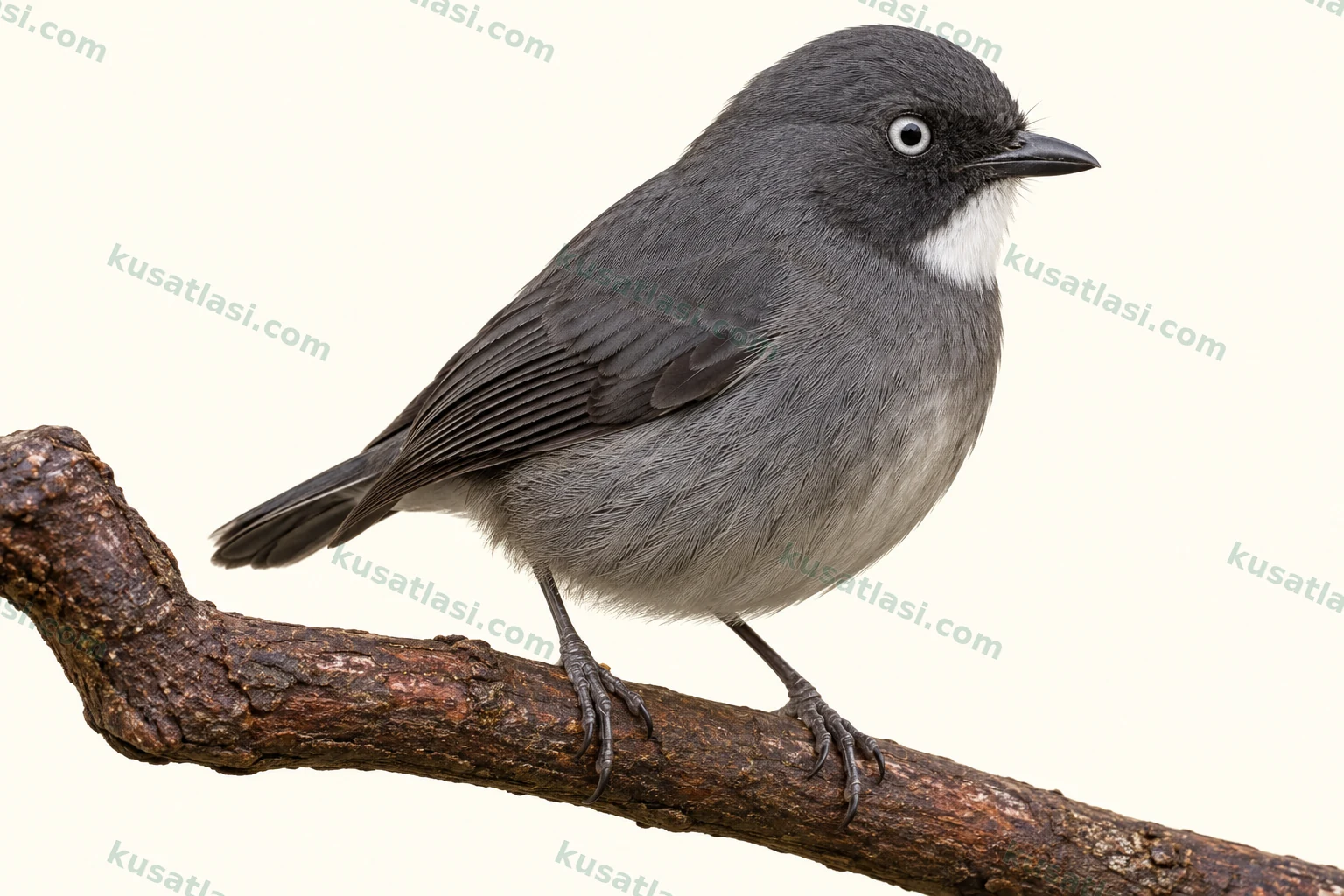
Swipe between the two adult plates.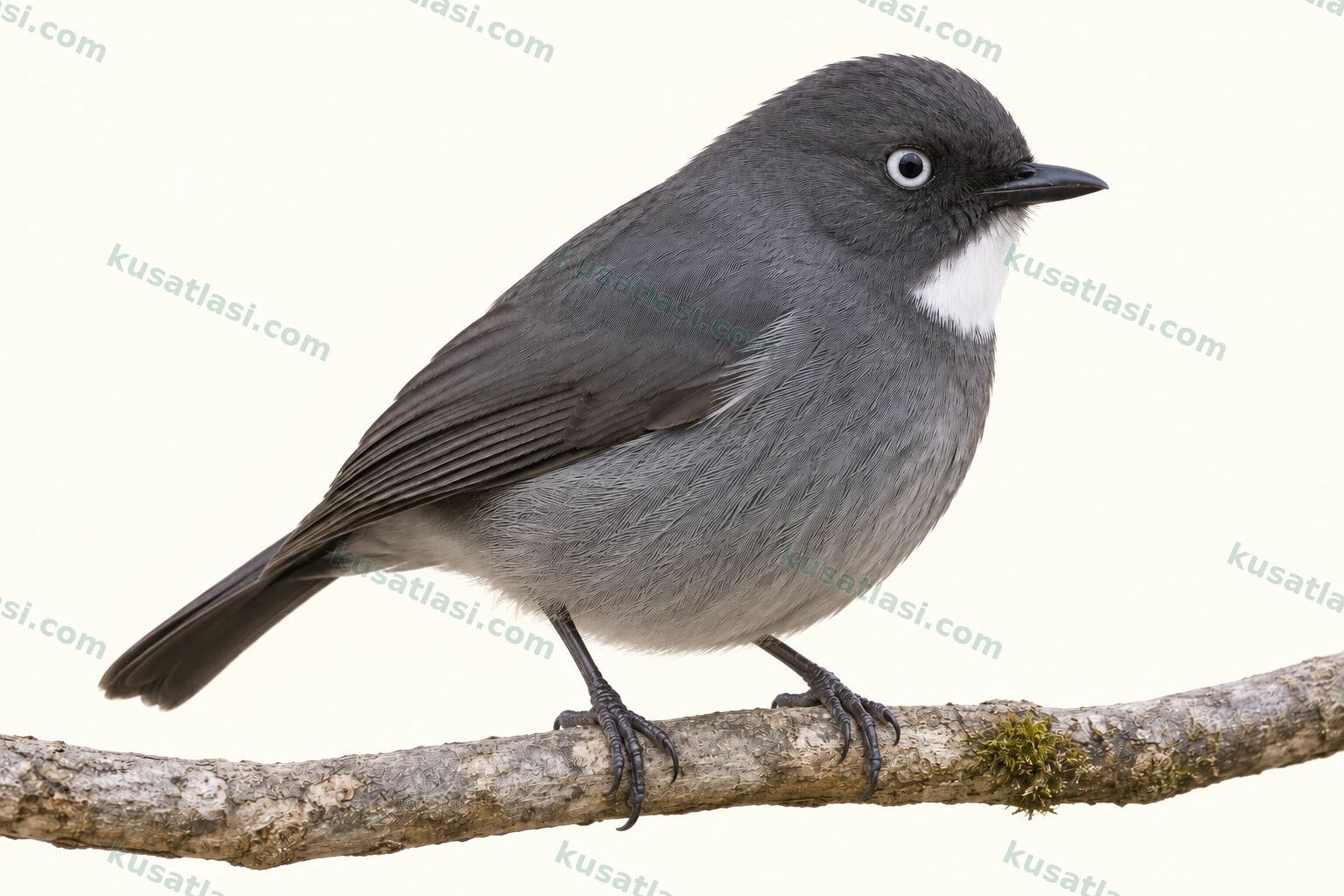
Petroicidae · Passeriformes
White-eyed Robin
Pachycephalopsis poliosoma
Ak Gözlü Bülbül
Assess the grey body, pale iris, black bill and geographically variable throat white together.
- Order
- Passeriformes
- IUCN Status
- LCLeast Concern
Biometrics
Length
- Male
- 15–17 cm
- Female
- 15–17 cm
Wing length
- Male
- 9.93 cm
- Female
- 9.93 cm
Weight
- Male
- 35–42 g
- Female
- 32–40 g
Detailed explanations of these measurements are available on our website, on the same species page.
At a Glance
- Generally grey plumage
Darker above; younger birds show more brown.
- Pale iris and black bill
The iris may be pale grey or buffy.
- Variable throat white
A broad clean white patch is not present in every population.
Adult sexes look alike; younger birds are browner and mottled.
Calendar
New Guinean records include a newly hatched chick in mid-August and a juvenile in early November. They do not establish a calendar covering every month and region, so no fixed monthly breeding window is shown.
Species Information
Quick Identification
White-eyed Robin is a mainly grey passerine of New Guinean hill and foothill forests. In adults, assess the pale iris, black bill and variable white on the throat together. The upperparts are darker than the grey underparts. Neither a pure-white iris nor a wholly white throat should be expected in every bird; colour and pattern vary among geographic populations.
Appearance and Posture
In the nominate subspecies poliosoma, the back is dark grey, the wing and tail sooty grey, and the area from the gape to the ear coverts also sooty. The upper tail coverts are slightly darker than the back. White mottling marks chin and throat; the throat sides are whiter and less marked, while breast and belly are medium grey.
The iris may be pale grey or buffy. The bill is black, and legs range from pinkish grey to slate blue. Assess these colours together. Green-backed Robin, a member of the same genus, also has a pale iris, making eye colour alone insufficient for identification.
The geographic forms recognised in the Cornell account differ in the extent of white on chin and throat, crown darkness and underpart tone. Some show a cleaner white chin and upper throat; in others the white is reduced and crown or breast can be tinged brown. Belly and undertail may also have whitish or buff tones. The overall grey appearance therefore does not imply identical pattern in every population.
Males, Females and Young Birds
Adult males and females share the same plumage. Juveniles are dark olive-brown above with very dark brown between eye and bill. The chin is white, but throat, breast and flanks are brown. Brown tips on white belly feathers produce mottling, and the undertail is tan.
Immatures can retain browner or chestnut-tinged crown, wings and tail, with faint brown mottling on breast and abdomen. Those younger-bird colours should not be interpreted as adult sexual differences. The reviewed sources do not establish iris colour alone as a reliable sexing or precise ageing key.
Appearance in Flight
Dark grey wings and tail continue the adult’s generally grey appearance. A brief flight view can conceal the pale iris and narrow throat markings. The reviewed expert account does not establish a flight rhythm diagnostic on its own, so identification should be supported by views of the perched bird’s head and underparts.
Voice and Behaviour
The song is a distinctive sequence of 4–10 loud, carrying, buzzing or churring notes. The first notes are upslurred and the sequence gradually rises. A clearer, bell-like ascending “periwee” whistle is described as a call, distinct from the more vibrating song sequence.
The bird can be highly secretive, with presence often first revealed by voice. Difficulty seeing it within dense undergrowth is not necessarily evidence of low local abundance. Watch the layer from which it calls without opening the vegetation or approaching closely.
Similar Species
1. Green-backed Robin (Pachycephalopsis hattamensis): Also pale-eyed, but with an olive-green back and yellowish-olive underparts; the lower belly can be yellower and undertail orange. Reddish-brown edging occurs on wing and tail feathers. White-eyed Robin’s generally grey upperparts and underparts differ from this green-and-yellow pattern. In some western and central New Guinean mountains where they overlap, the species replace one another with elevation; a local elevation record is not sufficient identification by itself.
World Distribution
Endemic to New Guinea, occurring in suitable foothill and mountain forests in both the Indonesian and Papua New Guinean parts of the island. The range includes western and central mountain slopes, some northern outlying ranges, the Adelbert and Huon regions and southeastern mountains. Geographic forms are not identical across this broad area; throat and head patterns can vary regionally.
Status within Its Range
The expert synthesis describes it as locally common or abundant despite being difficult to see. Research on Mount Karimui likewise treats it as a common understorey bird within particular elevational zones. These local descriptions do not establish uniform density throughout New Guinea. Forest structure and encounters with neighbouring species are relevant to understanding regional occurrence.
Seasonal Movements
Presumed to be sedentary, a qualification retained from the Cornell account. The reviewed sources do not establish regular long-distance migration or a seasonal route shared by all populations. A mountain population’s elevational boundary changing over time is not equivalent to an individual making the same seasonal migration each year.
Breeding Habitat
Hill forest and lower montane forest are characteristic habitats. The synthesis gives a usual elevational range of 400–1700 metres, with higher records in the Snow Mountains. That interval is not an absolute island-wide lower and upper boundary. Local replacement by Green-backed Robin in overlapping western and central areas should not be assigned the same threshold on every mountain.
Nest Site
The nest is a cup made of rootlets and green moss. One reported example was in a sapling about 1.3 metres above ground. The recorded single egg was buff-white, densely blotched brown and light purplish grey, with more conspicuous purplish-grey markings at the broad end. A more recent breeding synthesis also reports a clutch of one.
Records for New Guinea include a newly hatched chick in mid-August and a juvenile in early November. These limited records do not establish the same beginning and ending months for breeding in every region. Incubation and nestling durations could not be verified in the reliable sources reviewed. Preserve the nest’s surrounding cover and keep the adults’ access unobstructed.
Daily Habitat Use
It generally occupies low forest layers. Dense cover allows concealed movement even near an observer. Retaining that understorey is relevant alongside the presence of the overhead canopy.
Diet
Insects are the documented food group. The Cornell synthesis also mentions circumstantial evidence that larger prey, such as eggs or nestlings, may be taken. This is retained as indirect evidence rather than presented as a directly demonstrated regular habit. The reviewed sources do not provide a detailed prey list or dietary percentages.
Foraging
Prey is gleaned from low vegetation or the ground. Short sallies can also be directed at prey on vegetation or the forest floor. Foraging therefore includes surface-directed attacks in the understorey rather than only aerial pursuit in open space. No separate capture-success rate is assigned to each method.
Responding to a Neighbouring Species
Playback experiments on Mount Karimui, Papua New Guinea, found that White-eyed Robins could respond aggressively to Peneothello cyanus, which occupies a higher elevational zone. The response occurred near the upper range boundary where the species approach one another, but not in lower-elevation individuals. Research author Benjamin Freeman discusses a potentially learned response to encounters with the neighbour; learning itself was not experimentally established.
More Than One Influence on Elevational Limits
The Karimui research in Papua New Guinea found interspecific aggression in three of the five bird species-pairs studied, with the lower-elevation species responding more strongly. This supports behavioural interactions as a possible influence on some elevational boundaries; it does not establish competition as the sole cause of every New Guinean bird’s range limit.
Museum Evidence from the Bewani Mountains
Carter and Engilis’s 2025 Bishop Museum paper examines specimens from Agpo Creek in the Bewani Mountains of Papua New Guinea. A narrow grey-white band across the chin and backwards along the sides contrasts with a black central throat. This regional pattern illustrates why a broad white throat should not be imposed on every population.
The same specimen records list white, pale-grey or tan irides. These observations on particular specimens do not establish a universal sexing rule. Publication in 2025 also does not mean collection in that year: the study evaluates regional collections from 1972–1986.