
World Birds
Field Guide Plates
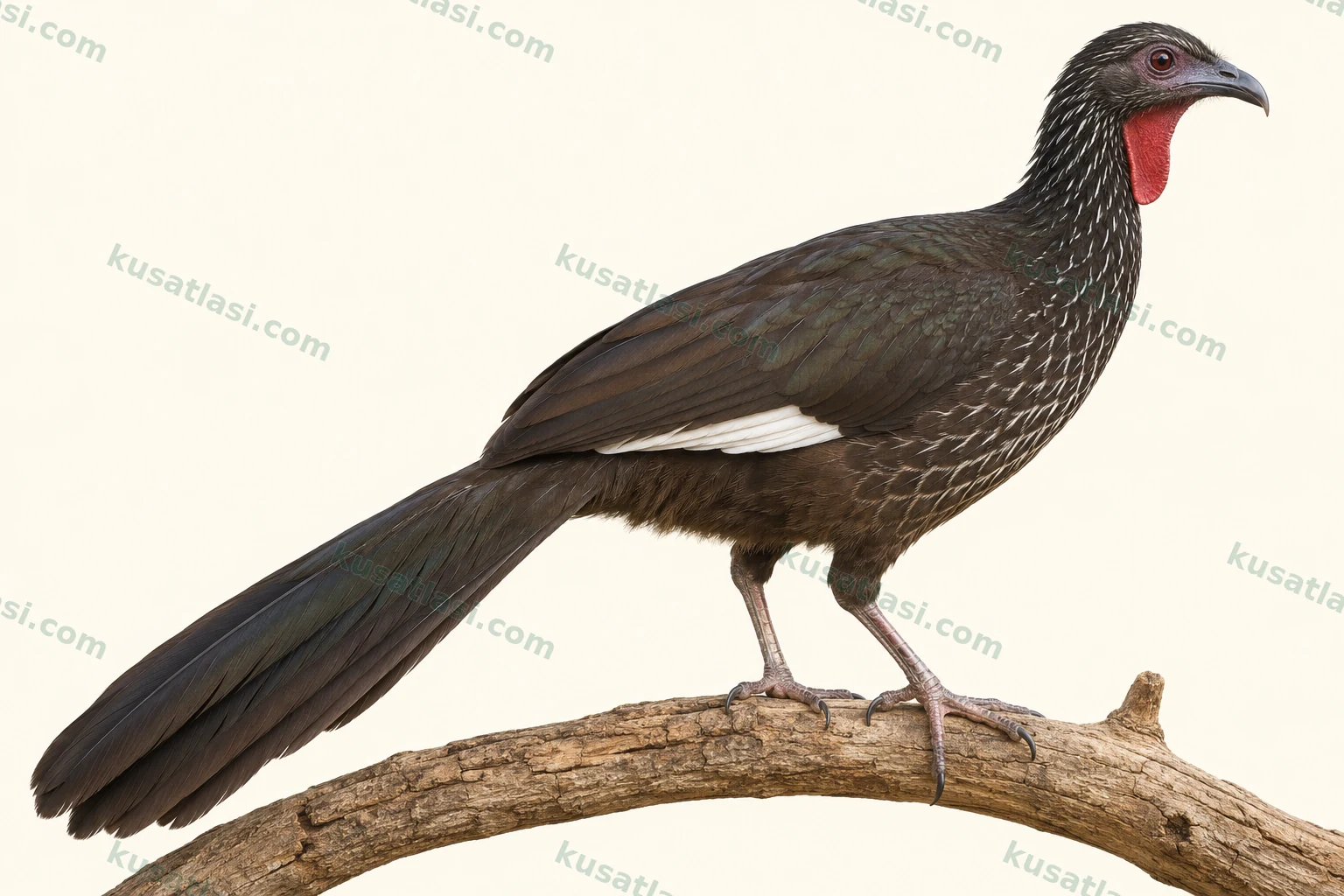
Swipe between the two adult plates.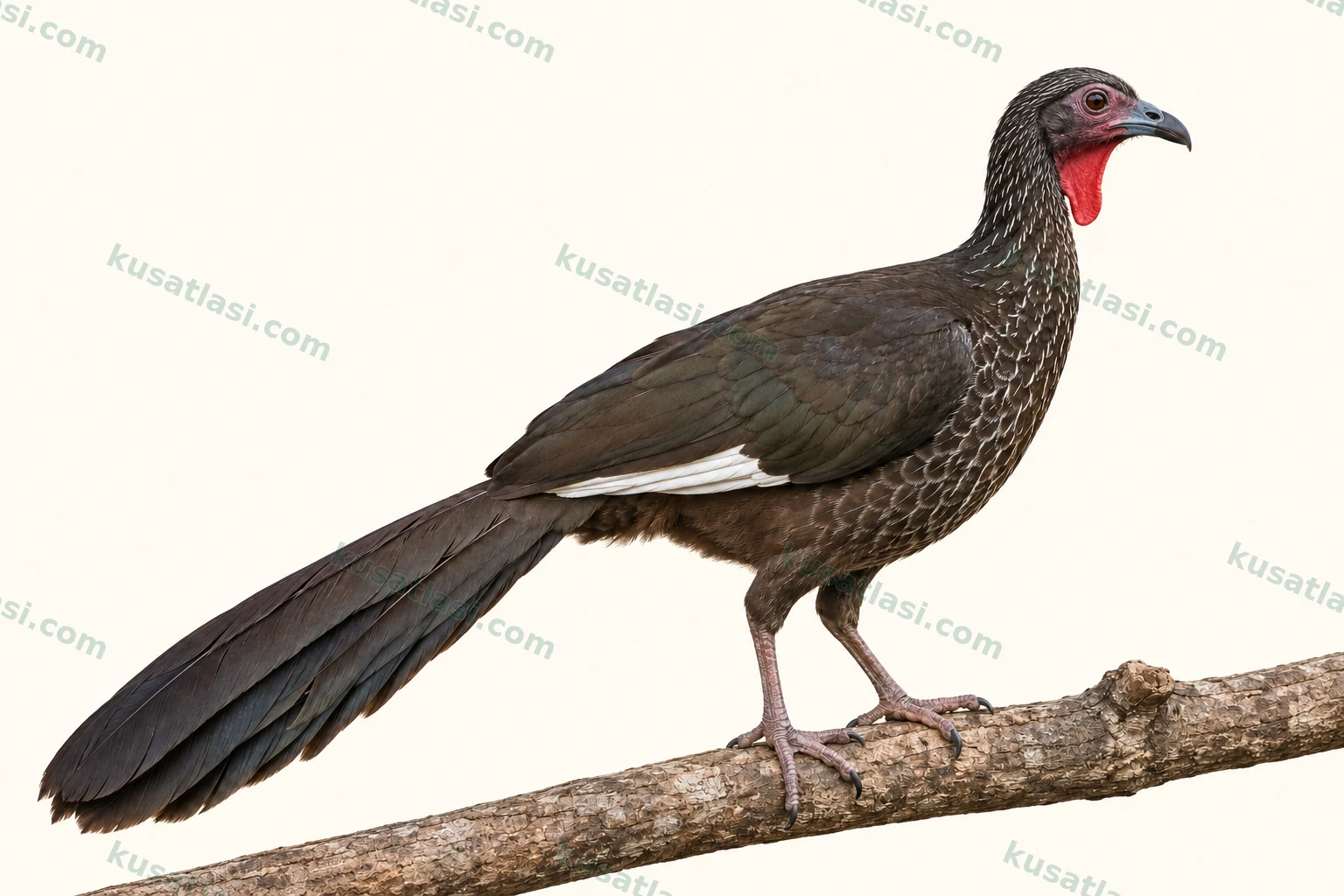
Cracidae · Galliformes
White-winged Guan
Penelope albipennis
Ak Kanatlı Guan
Look for a dark body, red bare throat and white outer flight feathers together.
- Order
- Galliformes
- IUCN Status
- ENEndangered
Biometrics
Length
- Male
- 70–85 cm
- Female
- 70–85 cm
Wing length
- Male
- 31.75 cm
- Female
- 31.75 cm
Weight
- Male
- 1.6–1.75 kg
- Female
- 1.6–1.75 kg
Detailed explanations of these measurements are available on our website, on the same species page.
At a Glance
- White outer flight feathers
Create strong contrast on an open wing.
- Red throat skin
A prominent bare, hanging throat patch.
- Long neck and tail
Accompany the dark, finely pale-streaked body.
Adult males and females look alike.
Calendar
Breeding relates to rainfall and resources; a fixed calendar for all populations was not verified.
Species Information
Quick Identification
White outer flight feathers contrast strongly with the dark body. Assess them together with the long neck and tail, fine pale body streaks and bare red throat skin.
General Appearance and Posture
Plumage appears dark brown to blackish, sometimes with a greenish sheen on the back. The bill has a blue-grey base and dark tip; bare facial skin is greyish with pink-purple tones. Its long tail and conspicuous neck stand out among branches.
Males, Females and Young Birds
Adult males and females look alike; plumage colour is not a reliable sexing method. DNA-based sex determination has also been investigated for Peruvian conservation breeding. A detailed juvenile moult and ageing key was not verified in this review.
Appearance in Flight
The white outer flight feathers become conspicuous when the wing opens and can also be visible at rest. If the amount of white appears different between views, consider posture and wing position before interpreting it as a sex difference.
Voice and Behaviour
Eley’s 1982 comparison describes rapid, plaintive calls that may begin with low growling and rise in pitch. They can resemble those of Crested Guan. Greater activity around dawn and dusk makes quiet listening useful during observation.
Similar Species
Crested Guan (Penelope purpurascens) and Spix’s Guan (P. jacquacu) invite comparison because of their dark appearance; white outer flight feathers strongly favour White-winged Guan. A Laquipampa field account also records overlap with Bearded Guan (P. barbata) in a narrow elevational band of the same ravine. Check locality, head and neck appearance and wing pattern together.
World Distribution
It is endemic to the Tumbesian region of northwestern Peru, occupying seasonal dry forest and wooded valleys along the western Andean foothills. Piura and Lambayeque are core areas; the specialist account treats it as a Peruvian endemic.
Status Within Its Natural Range
Hunting, forest loss and fragmentation are major threats. Conservation and reintroduction have taken place at Chaparrí and Laquipampa. Records of released birds and surviving wild populations require separate interpretation; an old study total is not a current population estimate.
Movements and Migration
Long-distance seasonal migration was not verified. Peru’s 2016 plan describes small seasonal movements as possible but poorly understood. Dispersal by released Chaparrí birds belongs to a reintroduction study and does not establish an annual migration route.
Breeding Habitat
Covered ravines and slopes within dry forest are important. The 2001 and 2004 El Angolo site assessment considered food trees, year-round water, resting and nesting cover, and undisturbed forest together. A site judged suitable did not necessarily hold breeding birds when surveyed.
Nest Site
A nest examined in Lambayeque, Peru, in 1978 consisted of twigs and leaves in a vine-covered tree and held three eggs. That direct record does not establish a fixed clutch size. Peru’s 2016 conservation plan reports 31 days of incubation and chicks leaving soon after hatching to climb among branches. Do not uncover nests or flush birds to obtain views.
Daily Habitat Use
Fruiting trees are useful observation focal points. A Laquipampa field account records birds visiting a fruiting fig in the village. Such use does not remove the need for forest cover or safe nesting habitat.
What It Eats
Fruit is important, with flowers, leaves, buds and seeds also taken. Cordia lutea was prominent among seeds examined in droppings at Chaparrí during May–December 2010. This dry-season sample does not establish fixed dietary proportions for all sites and seasons.
How It Forages
It uses plant foods in trees and shrubs. Supplementary foods such as banana, grapes and tomato supplied during the Chaparrí reintroduction programme are not treated as a list of natural forest foods. Observe feeding trees without placing food to draw birds closer.
A Long Gap in Confirmed Records
After the first specimens in the 1870s it was feared extinct for almost a century. Its rediscovery in 1977 prompted field research and conservation breeding. This was the closing of a knowledge and observation gap, rather than a species returning after actual extinction.
Its Relationship with Seeds Is Not One-sided
In the 2010 Chaparrí dry-season study, Cordia lutea seeds collected from droppings were sown under nursery conditions and germinated better than control seeds from trees. Digested seeds and flower remains were also found: the bird can disperse some seeds while consuming others. The result does not apply automatically to every plant or every seedling in the wild.
Release Alone Is Not Enough
The 2011 assessment of the Lambayeque programme describes how food trees and habitat quality contributed to different outcomes at two release sites. Producing chicks at Chaparrí did not mean all intended links between wild populations had formed. Long-term monitoring and suitable forest cover mattered alongside the number released.