
World Birds
Field Guide Plates
Swipe between the two adult plates.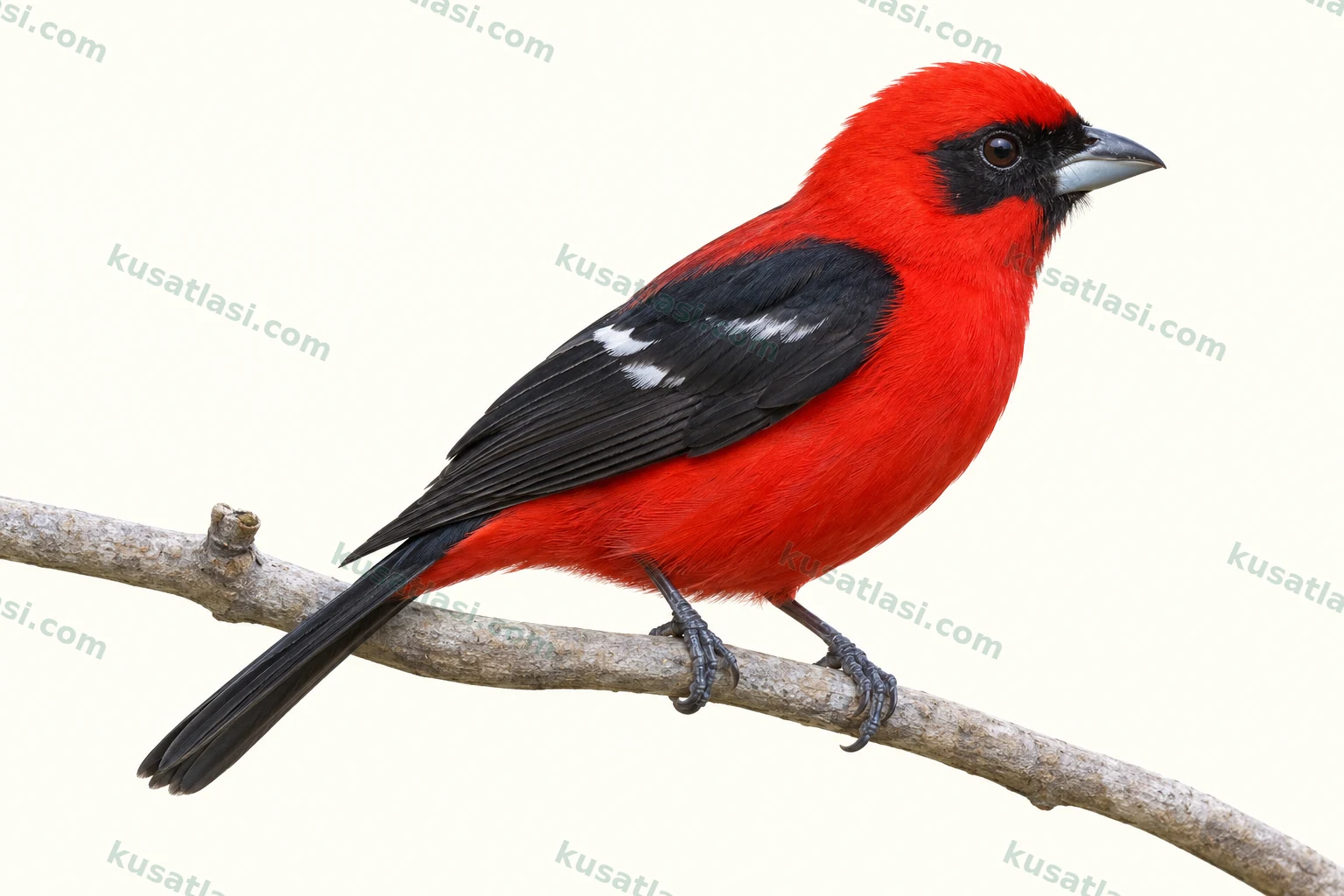
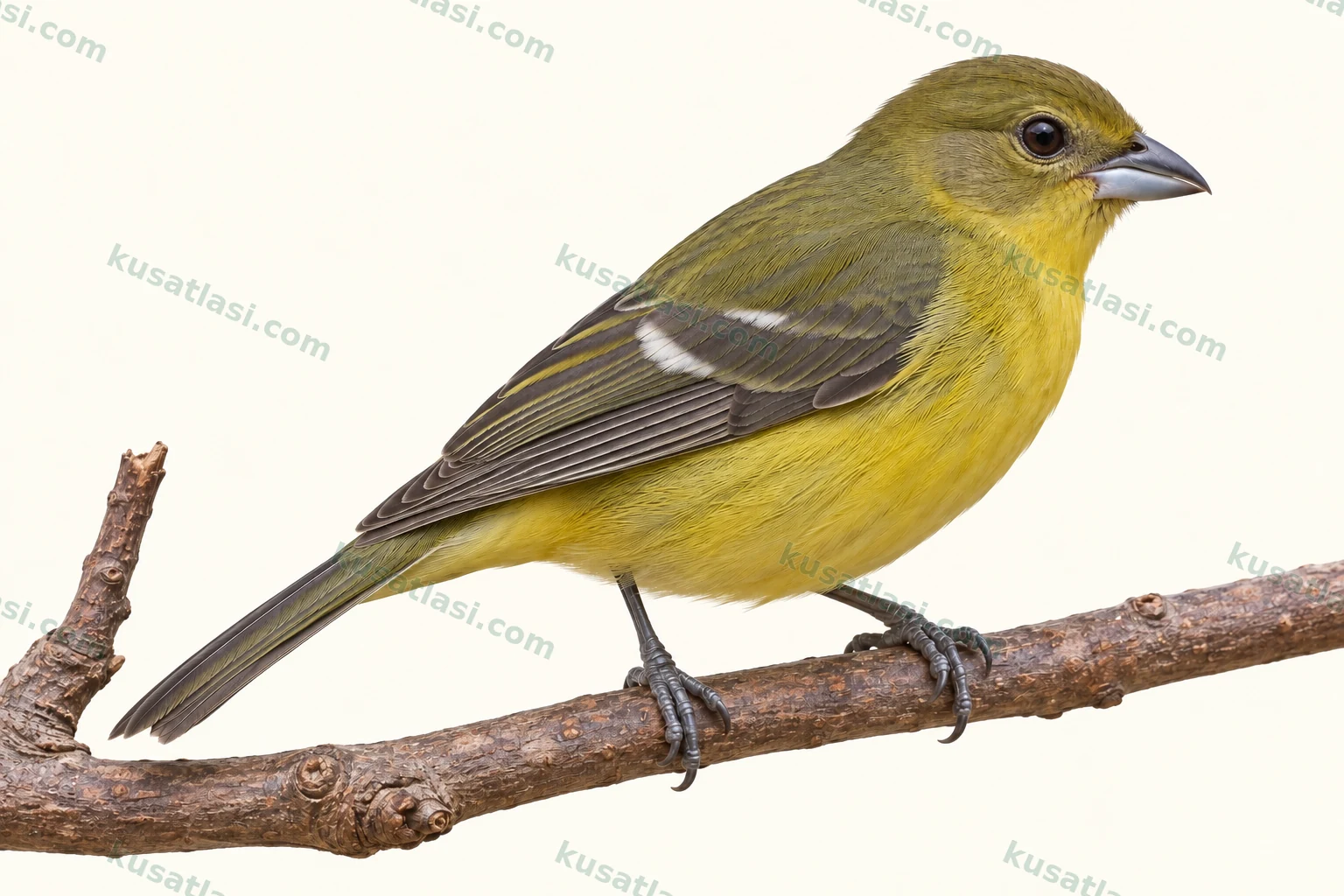
Cardinalidae · Passeriformes
White-winged Tanager
Piranga leucoptera
Ak Kanatlı Piranga
Red body and dark face in males; white bars on dark wings in both sexes.
- Order
- Passeriformes
- IUCN Status
- LCLeast Concern
Biometrics
Length
- Male
- 13 cm
- Female
- 13 cm
Wing length
- Male
- 7.25 cm
- Female
- 7.25 cm
Weight
- Male
- 13–20 g
- Female
- 13–20 g
Detailed explanations of these measurements are available on our website, on the same species page.
At a Glance
- Two white wingbars
The entire wing should not be white.
- Dark facial area
Assess together with the male’s red head.
- Dark tail
Check alongside body and wing pattern.
Females have yellow or yellow-green body plumage; a detailed juvenile age key was not verified.
Calendar
A monthly breeding calendar covering the entire range was not verified.
Species Information
Quick Identification
The male combines a red head and body, a black facial area, dark wings and two white wingbars. The white in its name does not cover the entire wing.
General Appearance and Posture
The tail is dark. Try to see the head, back and wing together through foliage; a patch of red alone is insufficient for identification. It forages in the middle and upper parts of trees.
Males, Females and Young Birds
Females have yellow or yellow-green body plumage, retaining dark wings and tail and white wingbars. The red male appearance therefore should not be expected in every bird. A detailed, reliable juvenile ageing key was not verified in this review; body colour alone should not determine an exact age in a yellowish bird.
Appearance in Flight
Dark wings and tail contrast with the male’s red or female’s yellowish body. The wingbars visible on a folded wing are not a substitute for an unverified underwing pattern. A diagnostic species-specific flight rhythm was not verified in this review.
Voice and Behaviour
It can forage in pairs or small groups and join mixed-species bird flocks. A reliable phonetic transcription or voice-only identification key was not verified in this review. Not every call in a mixed flock should be assigned to this species without confirming the bird.
Similar Species
Flame-colored Tanager (Piranga bidentata) also has two pale bars on dark wings, but its heavily streaked upperparts provide an important comparison. In White-winged Tanager, check the male’s facial pattern and head and body colour, or the female’s yellowish body together with the wingbars. A wingbar alone does not separate all Piranga species.
World Distribution
Its range consists of discontinuous areas from eastern Mexico through Central America, northern South America and the Andes south to Bolivia. Four subspecies are recognised. Costa Rica and western Panama, Venezuela and neighbouring highlands, and the Andean range should not be treated as one continuous population.
Status Within Its Natural Range
It was included in 2001–2003 research in coffee-growing landscapes of Soconusco, southwestern Chiapas, Mexico, within its native range. This was not a continent-wide population census and does not establish the same present-day abundance in every region.
Movements
The Chiapas study classified it as a year-round resident. This regional classification does not mean that every subspecies is entirely immobile at every elevation. A tracked monthly migration route covering the entire range was not found in this review.
Breeding Habitat
It uses humid forest, forest edges and wooded second growth. The Guatemalan university account also reports pine–oak woodland and its edges. Capture in a coffee-growing area does not itself demonstrate nesting at that location.
Nest Site
A small open cup nest in a tree has been reported. A reliable species-specific typical clutch size, incubation period and nestling duration were not verified in this review. Durations from other members of the genus should not fill that gap. Observe any nest from a distance without pulling branches aside or obstructing adults.
Daily Habitat Use
Leafy middle and upper tree layers are important during foraging. In the Chiapas study it was classified as a canopy forager and sampled in three different shade-coffee production types. That classification does not imply remaining at one branch height throughout the day.
What It Eats
It eats insects and fruit. Research in Chiapas, Mexico, classified it among generalist insectivores that also consume fruit. This does not establish dependence on one insect group or a fixed dietary percentage throughout its range.
How It Forages
It can search for food in trees in pairs or small groups. The Chiapas study included 28 stomach-content samples from this species. This is distinct from the paper’s total sample across all birds and does not provide an exhaustive list of every food available to White-winged Tanager.
What Did the Coffee-Farm Study Show?
Jedlicka and colleagues examined bird diets in different coffee-production systems in Chiapas, Mexico, in 2001–2003; the paper appeared in 2021. White-winged Tanager was one of four species with sufficient samples from all three production types during the 2001 wet season. The study did not detect a significant dietary difference among these systems for this tanager; the detected difference concerned Yellow-green Vireo (Vireo flavoviridis). Failure to detect a difference is not proof that all conditions are biologically equivalent.
Eating Insects Does Not Prove Control of a Particular Pest
No insects identified as coffee pests were found in the stomach contents examined in the Chiapas study. The paper therefore cannot serve as species-specific evidence of how much White-winged Tanager reduces a particular coffee pest. The researchers discuss limits involving sampling methods, timing and recognition of prey remains. Presence in an agricultural landscape and quantified provision of a particular crop-protection service are different findings.
The Amount of White Can Vary
The amount of white in the wing varies among the four recognised subspecies. The size of the white area in one illustration should therefore not be treated as an invariant criterion throughout the range.