
World Birds
Field Guide Plates
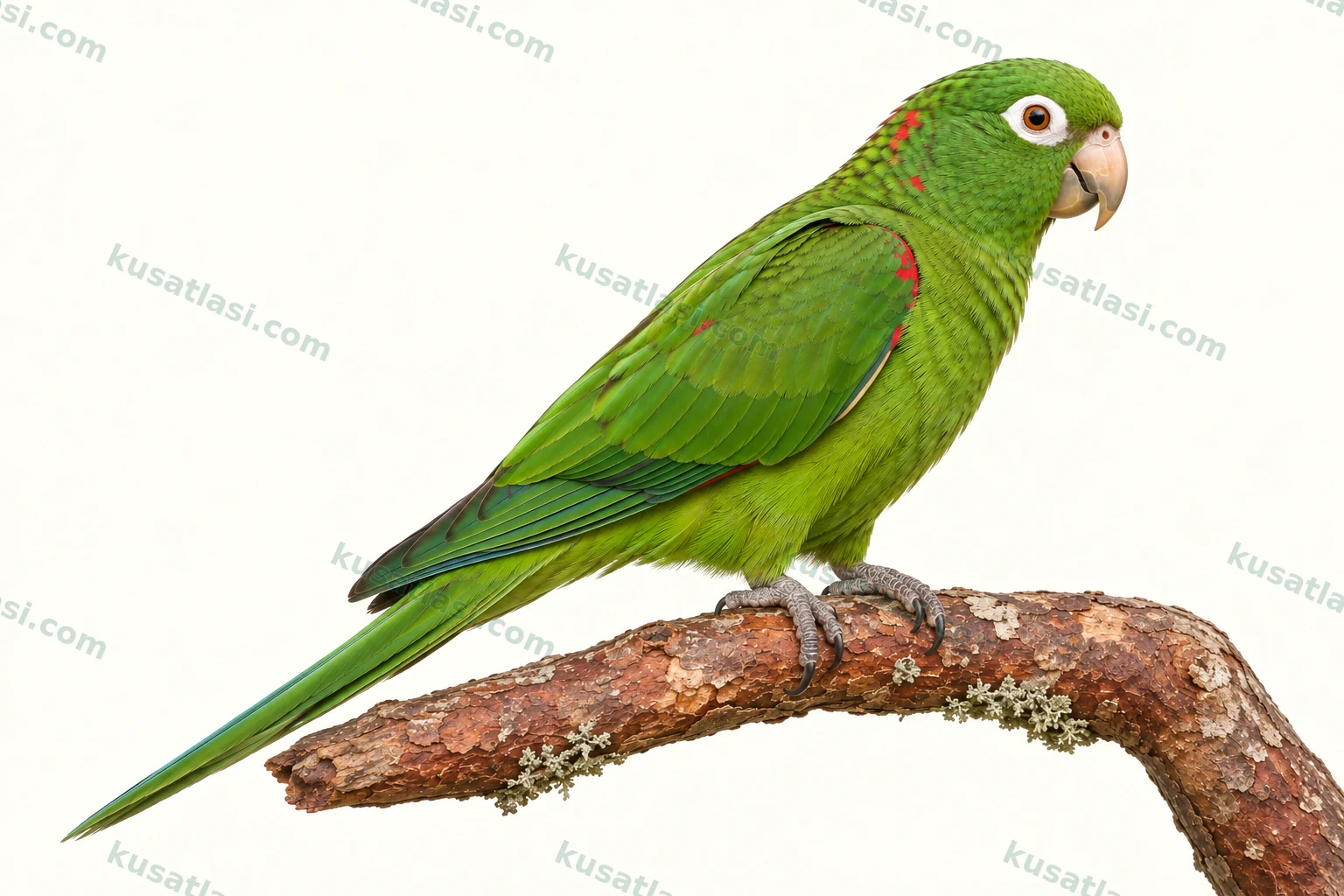
Swipe between the two adult plates.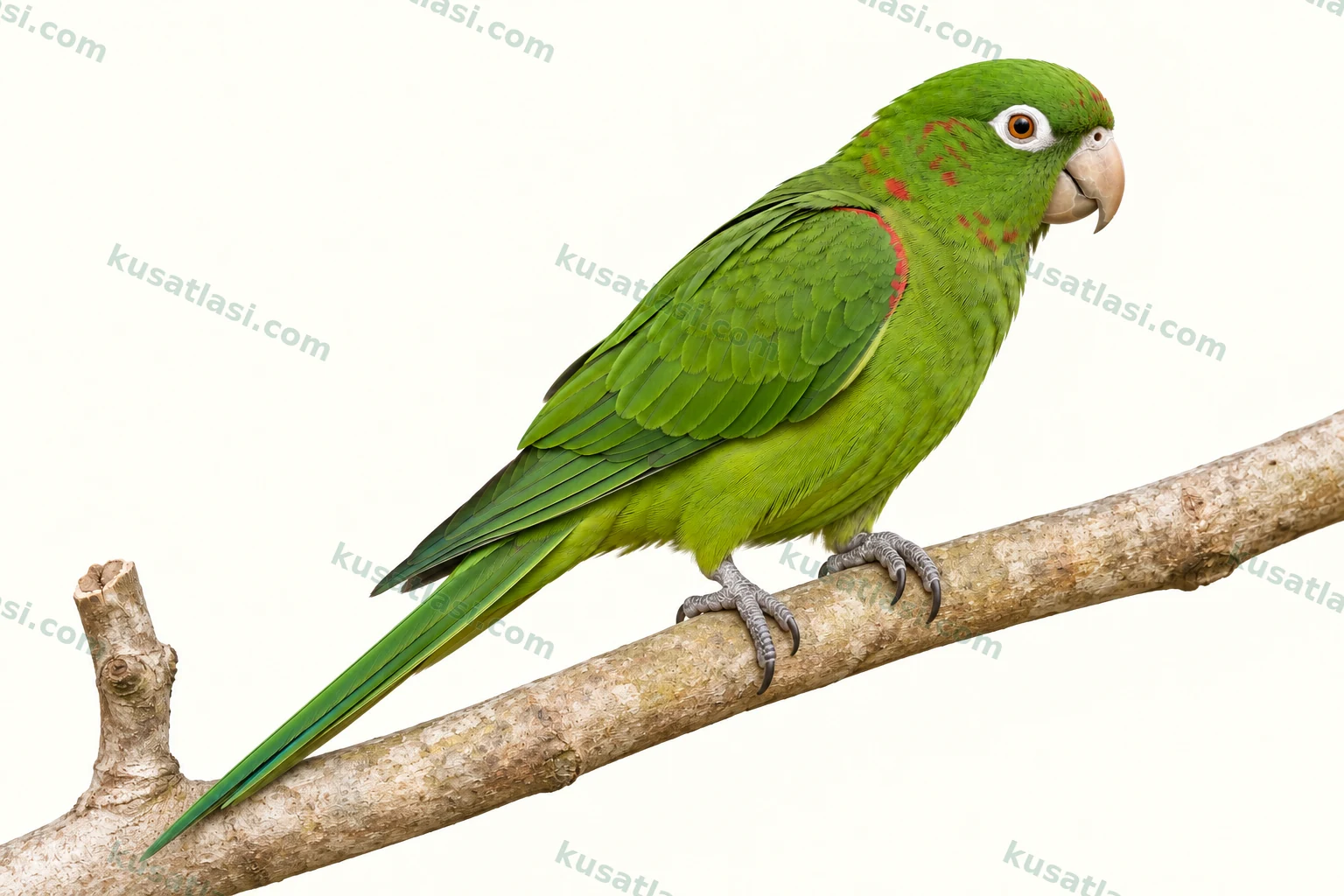
Psittacidae · Psittaciformes
White-eyed Parakeet
Psittacara leucophthalmus
Ak Gözlü Papağan
Check the bare pale eye ring, scattered red head feathers and red-and-yellow underwing areas together.
- Order
- Psittaciformes
- IUCN Status
- LCLeast Concern
Biometrics
Length
- Male
- 32–35 cm
- Female
- 32–35 cm
Wing length
- Male
- 17.23 cm
- Female
- 17.23 cm
Weight
- Male
- 100–218 g
- Female
- 100–218 g
Detailed explanations of these measurements are available on our website, on the same species page.
At a Glance
- Pale eye area
The bare ring is greyish-white; the iris need not be white.
- Scattered red on the head
Extent varies; do not expect a continuous facial mask.
- Red and yellow beneath the wing
Check wing angle and the other identification characters.
Adult sexes look alike; young can have less red. Distinguish the pale surrounding skin from the iris itself.
Calendar
Regional breeding records include February in the Guianas, January–March in southwestern Brazil and around November in Argentina; July–August is possible in Peru. These are not combined into a single monthly calendar.
Species Information
Quick Identification
White-eyed Parakeet is a widespread South American parrot with a long tail and predominantly green plumage. Assess the bare pale eye ring, scattered red feathers on head and neck, and the red and yellow areas visible beneath the wing together. “White-eyed” does not mean that the iris must be white: the conspicuous pale area surrounds the eye.
Appearance and Posture
The body is green, often paler below. The number and distribution of red feathers on head and neck vary, generally forming scattered flecks rather than an identical continuous red facial mask in every adult. A light-coloured bill and greyish-white bare eye ring contribute to the head pattern.
The bend and leading edge of the wing are red. Outermost lesser underwing coverts are red and outermost greater coverts yellow, with greener or olive inner areas. Undersides of flight feathers and tail are olive. A folded wing may conceal much of this pattern; failure to see a hidden colour does not establish its absence.
Green plumage can be inconspicuous among leaves while feeding, whereas flocks crossing open sky attract attention through their long tails and voices. Identification should combine face, wing and tail characters rather than relying on the general green colour.
Males, Females and Young Birds
Adult males and females share similar plumage. More red on the head alone does not indicate one sex, and colour differences between illustrations should not be used to determine sex.
Young birds may have few or no red feathers on head and neck and reduced red in the wing. The tail can be shorter and the iris browner; adults can have orange-toned irides. Evaluate these characters together rather than assigning an exact year of age from the number of red feathers.
The form callogenys is generally described as darker green and thicker-billed. A red forehead band has been reported for nicefori, known from a single type specimen in Colombia; interpretations of that form remain debated. A forehead mark alone should not prompt a certain subspecies assignment.
Appearance in Flight
Look for the long tail and mainly green body together with red and yellow covert areas beneath the wings. Their visibility depends on lighting, wing angle and distance. Calls from passing flocks can help locate the birds, but hearing them does not replace checking an individual’s diagnostic wing pattern.
Voice and Behaviour
Gives sharp squeaky notes and loud harsh screeches. Flying flocks may maintain rough chattering interspersed with higher-pitched shrieks. Its varied repertoire should not be reduced to one syllable; consider the perched or flying context.
Highly social, forming flocks that feed in fruiting trees, travel between feeding and roosting areas, and visit clay licks in some regions. Other parrot species can join these groups, so all members of one flock should not automatically be assigned to the same species.
Similar Species
1. Mitred Parakeet (Psittacara mitratus): Adults generally have more extensive red on forehead and face, but appearance is variable and young can have very little red. In White-eyed, assess scattered head flecks with the red-and-yellow underwing pattern and locality. It would be incorrect to claim that Mitred can never show red at the wing bend: the expert account explicitly allows occasional red there. One head or wing patch is insufficient on its own.
World Distribution
Native to South America, from eastern Venezuela and the Guianas through much of Brazil to northern and eastern Bolivia, Paraguay, northern Argentina and Uruguay. It also occupies western Amazonia through southeastern Colombia, eastern Ecuador and northwestern Peru. It is not widespread along all Pacific coasts west of the Andes.
Callogenys is associated mainly with northwestern and central Amazonia, while the widespread nominate form occupies extensive areas farther east and south. The single Colombian specimen underlying nicefori does not justify drawing a broad, certain range for that form.
Status within Its Range
Can be common across much of its extensive range, without occurring at the same abundance in every country or habitat. The expert account describes it as scarce in Uruguay and more local in Suriname and French Guiana. A large flock at a fruiting tree does not demonstrate a regional population increase. Loss of forest and nest trees, together with trapping, can affect local populations.
Seasonal Movements
Can make local and regional movements in response to food. Concentrations at one French Guianan locality in June–August have been associated with palm fruiting. That local resource response should not be presented as a fixed long-distance route followed throughout South America in the same months.
Breeding Habitat
Uses forest edges and adjacent savanna, scrub woodland, secondary vegetation, deciduous woodland and gallery forest. Also occurs in Mauritia palm wetlands, seasonally flooded forest, rainforest openings and mangroves. Predominantly a lowland bird, without being restricted to a single forest type.
Nest Site
Usually nests in a tree cavity, sometimes high in a branch or trunk, and also in palms. The expert synthesis reports clutches of three or four eggs. Its approximately four-week incubation and nine-week nestling periods refer to captivity and must not be generalised as precise measurements from wild nests.
Breeding timing varies geographically: February is reported for the Guianas, January–March for southwestern Brazil and around November for Argentina. July–August in Peru is presented as possible in the expert source. These regions should not be combined into a calendar implying identical year-round activity everywhere. Do not open cavities or block adult access while observing.
Daily Habitat Use
Flocks move between roosts and trees offering fruit or flowers. Communal roosting has been reported in trees, canefields and caves. Roosting and nesting are different uses: a bird spending the night in a cavity does not by itself demonstrate eggs or young. When a feeding flock is found, scan adjacent foliage carefully as well.
What Does It Eat?
Feeds primarily on fruit, with seeds, flowers and occasional insects also taken. Expert sources list fruits of Goupia, Tetragastris and palms, Erythrina blossoms and some grass seeds. Plant species eaten vary with locally available resources.
Research in Uberlândia, Brazil, during May–December 2011 recorded 37 feeding events for this species. Observations support consumption of pulp, seeds, flowers, nectar and young leaves, including pulp, flowers and leaves of Terminalia catappa and nectar from Handroanthus flowers. These are findings from the urban study area, not dietary proportions for the entire native range.
How Does It Forage?
Obtains most food from plants. In the Uberlândia study, birds pulled off and crushed food, bit at it while attached to the plant, or held it with a foot during handling. A foot could also help hold flowers during nectar feeding. Both feet were observed in use, without demonstrating the same foot preference in all individuals.
Later Breeding in One Regional Community
In a 2006–2015 nest study in Misiones, Argentina, White-eyed Parakeets began laying in late November or December, after many other cavity-nesting birds studied. The authors also report use of cavities recently vacated by other birds. Food timing and avoidance of cavity competition are possible explanations, rather than demonstrated causes of the later breeding.
An Alternative Nest Site in Palms
A field study published in 2023 documented pairs enlarging spaces between palm bracts for nesting in Beni, Bolivia, in 2014 and 2017. Its table includes four pairs of this species in Attalea speciosa and Attalea totai. These limited records do not demonstrate a species-wide change in usual nest preference or greater success in the alternative sites.