
World Birds
Field Guide Plates
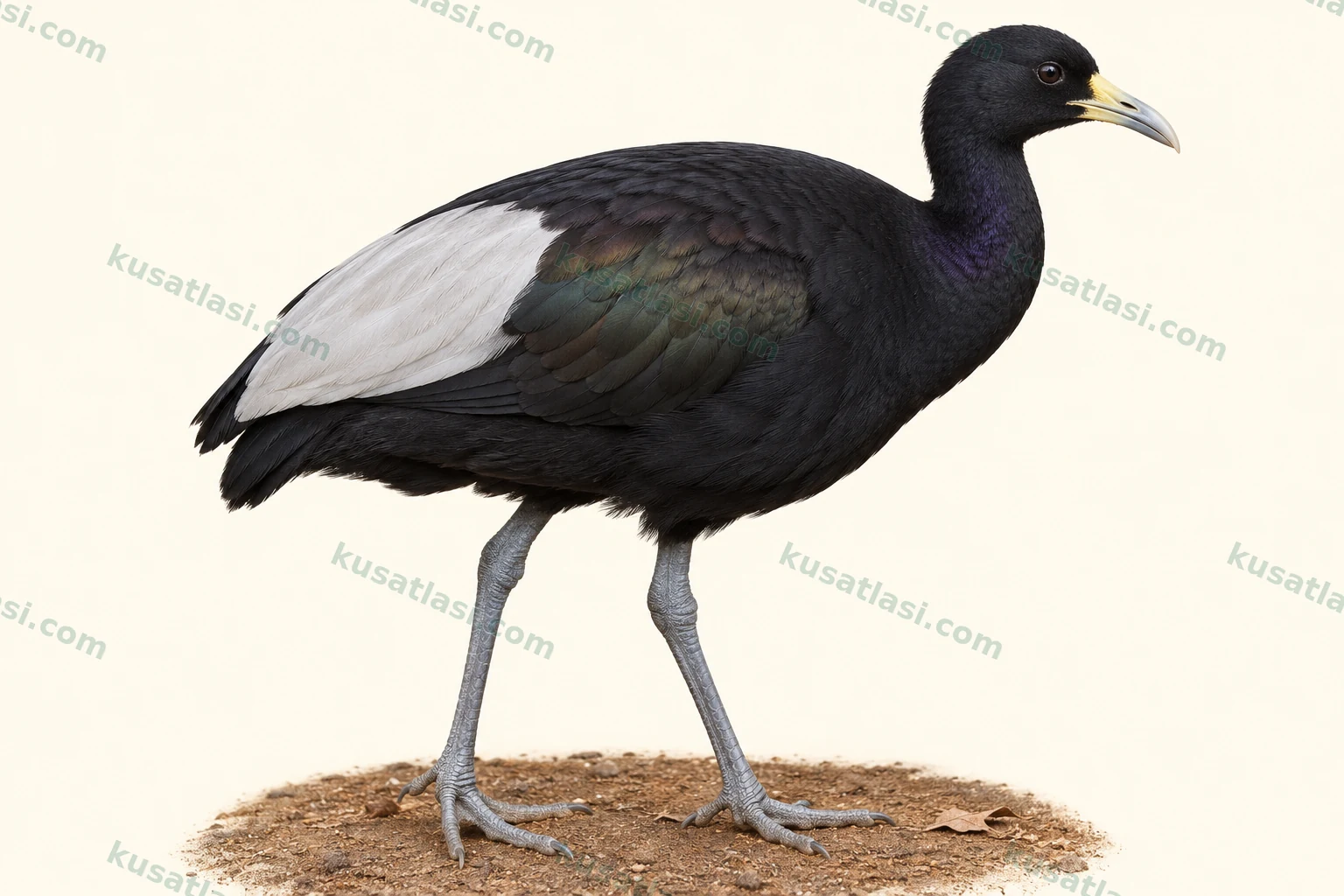
Swipe between the two adult plates.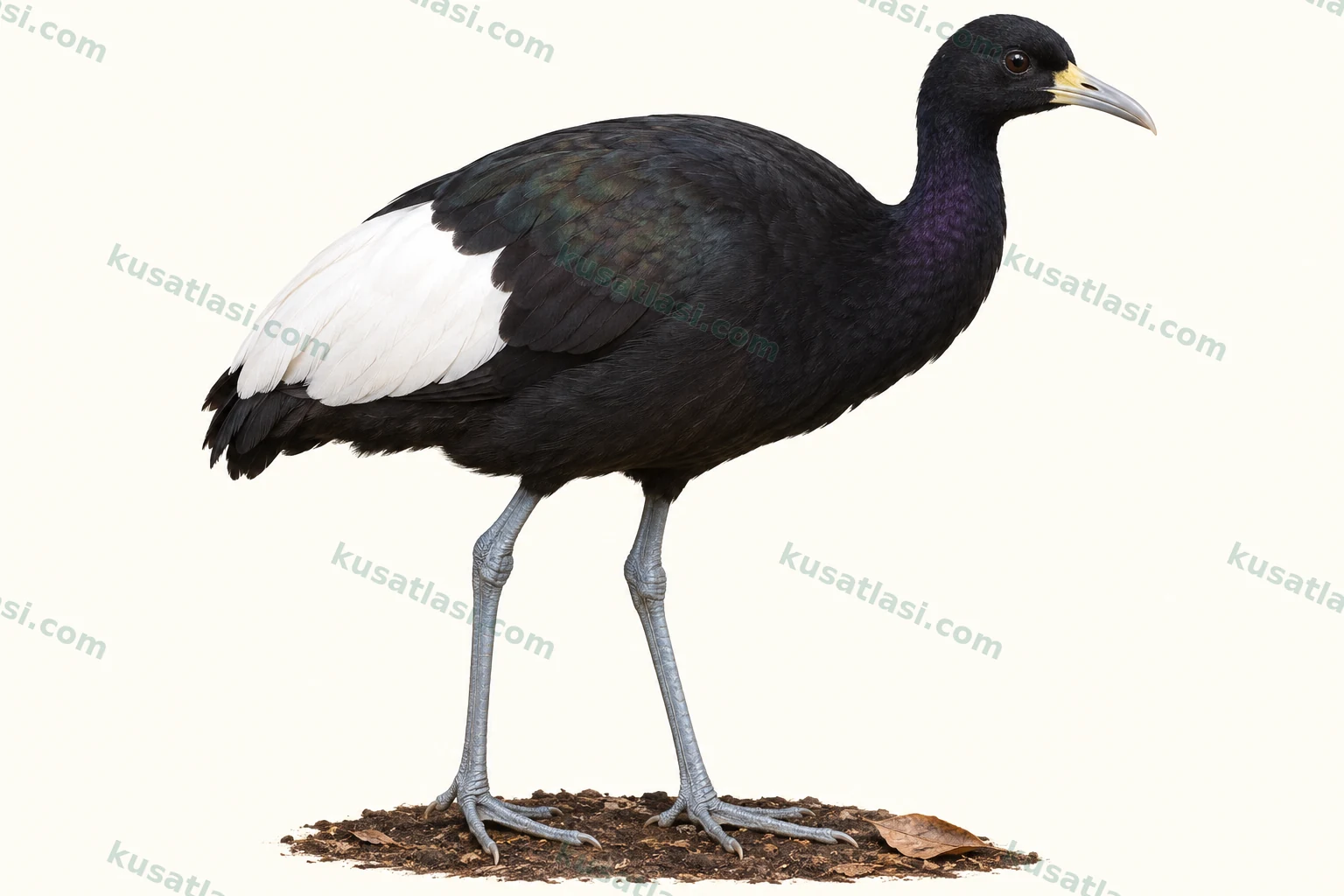
Psophiidae · Gruiformes
Pale-winged Trumpeter
Psophia leucoptera
Ak Kanatlı Borazankuşu
Look for the broad white rear-wing area against a black body and terrestrial group behaviour.
- Order
- Gruiformes
- IUCN Status
- LCLeast Concern
Biometrics
Length
- Male
- 45–52 cm
- Female
- 45–52 cm
Wing length
- Male
- 27.05 cm
- Female
- 27.05 cm
Weight
- Male
- 1.28–1.44 kg
- Female
- 1.18–1.32 kg
Detailed explanations of these measurements are available on our website, on the same species page.
At a Glance
- White rear wing
The whole wing is not white.
- Pale bill and legs
Grayish, with a yellowish bill base.
- Terrestrial groups
Walks and runs, but can also fly into trees.
Males and females share the plumage pattern; appearance alone does not reliably sex them. Newly hatched chicks differ in their striped russet down.
Calendar
Resident groups defend territories year-round. Regional Peruvian breeding observations are not made into one calendar for all Amazonia.
Species Information
Quick Identification
Pale-winged Trumpeter is a long-legged, mainly black bird that travels in groups on the Amazonian forest floor. A large white area on the rear of the folded wing is its most conspicuous mark, not evidence of an entirely white wing. Assess plumage, legs, bill and terrestrial group behaviour together.
General Appearance and Posture
Most of the body is black. White feathers on the rear wing contrast strongly with the dark forewing and body. Outer wing coverts can show purple, green or bronze iridescence in suitable light. The lower throat lacks the green iridescence of the Gray-winged Trumpeter group, though the visibility of gloss depends on angle.
Bill and legs are pale grayish, with a yellowish bill base. Long legs carry it walking and running through leaf litter. Birds following one another along the forest floor can reveal different wing and body angles; the exposed size of the white patch changes with posture.
Males, Females and Young Birds
Adult males and females share the general plumage pattern. A black body and white wing patch do not provide reliable sexing. The Peruvian study established many birds’ sex by methods beyond external appearance; a brief field view does not offer equivalent certainty.
Older young resemble adults but have dark brown edging at the tips of body feathers. Newly hatched chicks are very different: russet down, pale underparts, a dark throat-and-upper-breast bib and contrasting pale and dark stripes along the back.
The ability to walk shortly after hatching does not mean that adult wings and plumage are already developed. Newly hatched chicks, more advanced young and adults need separate assessment.
Appearance in Flight
Travels and forages mainly on the ground but is not flightless. It can fly into trees to roost, nest or escape terrestrial danger. The pale rear wing can help in a short flight, but one white flash alone is insufficient for certain identification.
Voice and Behaviour
Song includes low, vibrating, far-carrying notes, with short notes leading into a longer resonant tremolo. Other group members may join in. The repertoire also includes short harsh or softer close-range calls. Related trumpeters sound similar, so sound alone is not always sufficient.
Groups defend territories used throughout the year. At Cocha Cashu, Peru, researchers followed groups in which several adult males mated with the breeding female and helped rear young. Such a group is more complex than a simple pair with offspring. Observed mating alone does not establish each chick’s genetic father.
Similar Species
The white rear-wing patch is important when comparing Psophia crepitans. Other trumpeters can have grayer, ochre-toned or darker patches, so local taxon and geography matter. In Pale-winged Trumpeter, assess the broad white patch, lack of green lower-throat gloss and pale grayish legs and bill together.
Pale feathers can appear darker in forest shade, while iridescent feathers may not shine at an unsuitable angle. Reassess the complete pattern when the bird reappears rather than deciding from sound or one glossy area alone.
World Distribution
Occurs in moist forests of western and southwestern Amazonia, principally eastern Peru, central-western Brazil and northern and east-central Bolivia. Brazilian limits broadly relate to forests south of the Amazon/Solimões and west of the Madeira. Geography around these large rivers also matters when distinguishing neighbouring trumpeter taxa.
The older expert account questions the natural origin of a record from Leticia in southeastern Colombia. That record is therefore not treated here as proof of a continuous, confirmed native Colombian population. A broad range outline does not guarantee present occurrence in deforested or heavily hunted areas.
Movements and Migration
Sedentary. Studied Peruvian groups occupied territories with relatively stable year-round boundaries and defended them against neighbours. This differs from seasonal long-distance migration.
Young leaving their natal group and attempting to join others are dispersing locally, not following a demonstrated intercontinental migration route. Departure around sexual maturity at about two years belongs to the context of the Peruvian research.
Breeding Habitat
Mature, dense, moist tropical forest is the principal habitat, especially continuous lowland forest floor. Large old trees provide elevated cavities and roosts as well as shade. Terrestrial travel does not mean that the entire life cycle depends only on ground vegetation.
Forest fragmentation and hunting pressure matter. Occurrence in large remote forest blocks shows why tree-cover percentage alone is insufficient to describe habitat suitability. The detailed Peruvian breeding study took place in undisturbed Cocha Cashu forest; its conditions should not be assumed for every heavily modified site.
Nest Site
Eggs are laid on the floor of a pre-existing elevated tree cavity, without a separately built woven nest. In Peru, the dominant male or female cleared debris from the cavity floor. Not every cavity inspected by the birds became an active nest.
The expert account summarises clutches as usually three, with a stated range of two to four. In the studied Peruvian groups, the dominant female laid the eggs. Incubation was mainly by the dominant male and female, with some participation by other adult males. The reported 23–29 days covers four clutches: two were followed directly from onset to hatching at 29 days, while two were estimated at 23–26 days from encounters after hatching.
Chicks jump from the cavity to join the group on the morning after hatching. This departure is neither the acquisition of flight nor feeding independence. In the Peruvian study they received all food from older birds for over three weeks, progressively fed themselves more, and were almost independent by about three months.
At Cocha Cashu, first incubation began in the second half of September or October, with hatching near the onset of the rains. This is not an invariant annual calendar for all Amazonia. Avoid climbing to inspect active cavities, crowding following birds or separating a group from its chicks.
Daily Habitat Use
Travels over the forest floor by day, foraging around fallen fruit and leaf litter, and ascends trees to roost. Elevated roosts and ground feeding areas serve different functions. Chicks’ movement and roosting abilities develop gradually; a group walking on the ground does not imply that its chicks can negotiate every obstacle independently.
What Does It Eat?
Ripe fruit pulp makes up most of the diet. Arthropods, occasional annelids and small vertebrates are also eaten, including reported small snakes. A predominantly fruit-based diet does not imply avoidance of every animal encountered.
The group watched at Cocha Cashu in 2001 gathered around snakes and a large frog; most encountered snakes were killed and eaten. These direct observations show that small-vertebrate consumption is more than an assumption. The study covered one group and does not establish these prey items’ annual share in every population.
How Does It Forage?
Picks fruit mainly from the forest floor, occasionally taking it from low plants, and searches leaf litter for small animals. Foraging accompanies the group’s daily terrestrial travel. Tree roosting should not be confused with spending most of the day plucking fruit in the canopy.
Not Every Leap Is Courtship
Older general descriptions attributed noisy, leaping “courtship dances” to trumpeters. The detailed Peruvian study did not observe them in that context, instead finding similar movements during play and intergroup fights. This does not prove an absence of courtship everywhere; behaviour before and after a movement matters to its interpretation.
A Call Associated with Separation
A 2001 Cocha Cashu vocal study of one six-bird group associated a mew-like contact call with separation. Controlled separations increased this call, while other members answered with a different call. The result supports a particular contact function, not a human-like language system or identical results in every trumpeter population.