
World Birds
Field Guide Plates
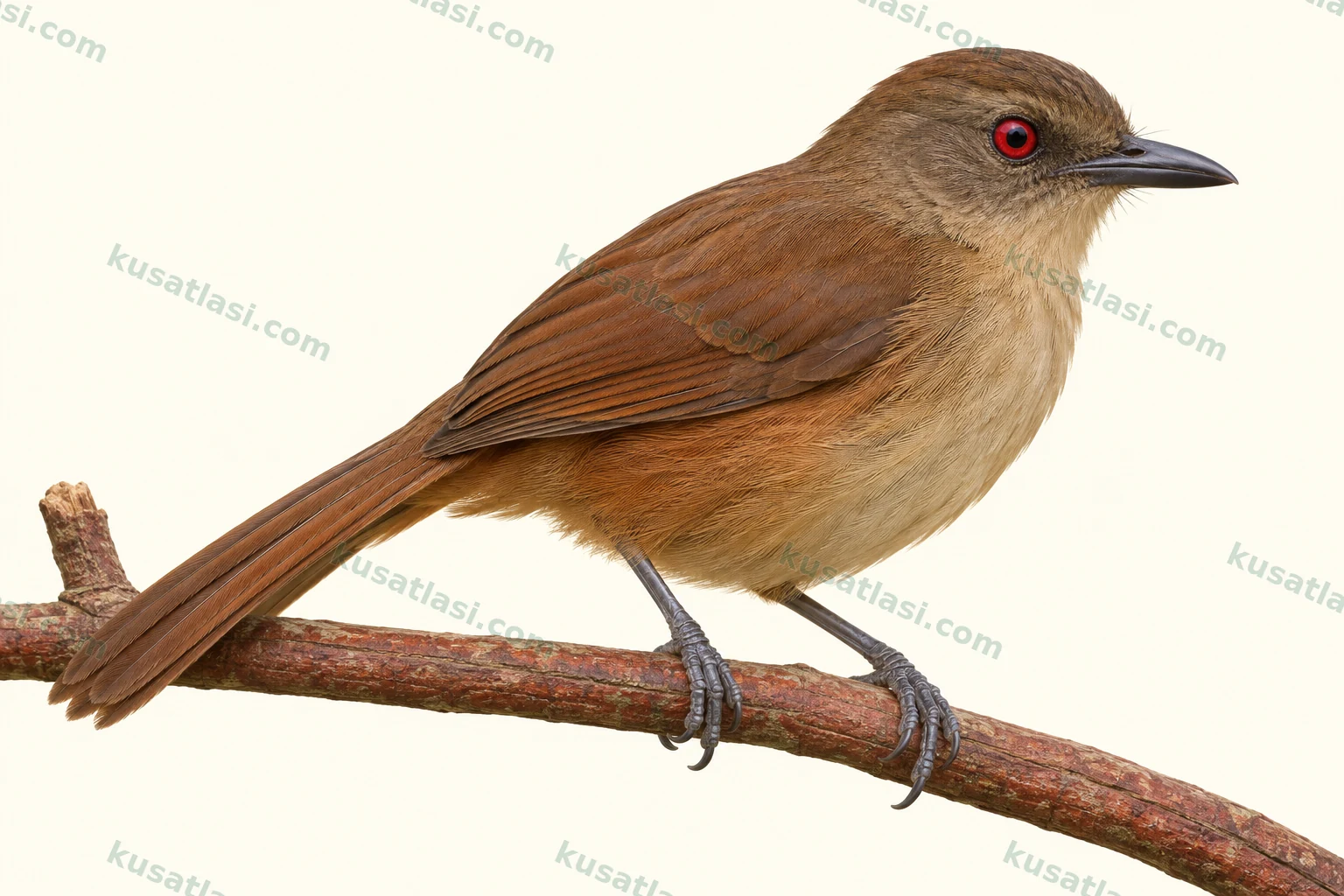
Swipe between the two adult plates.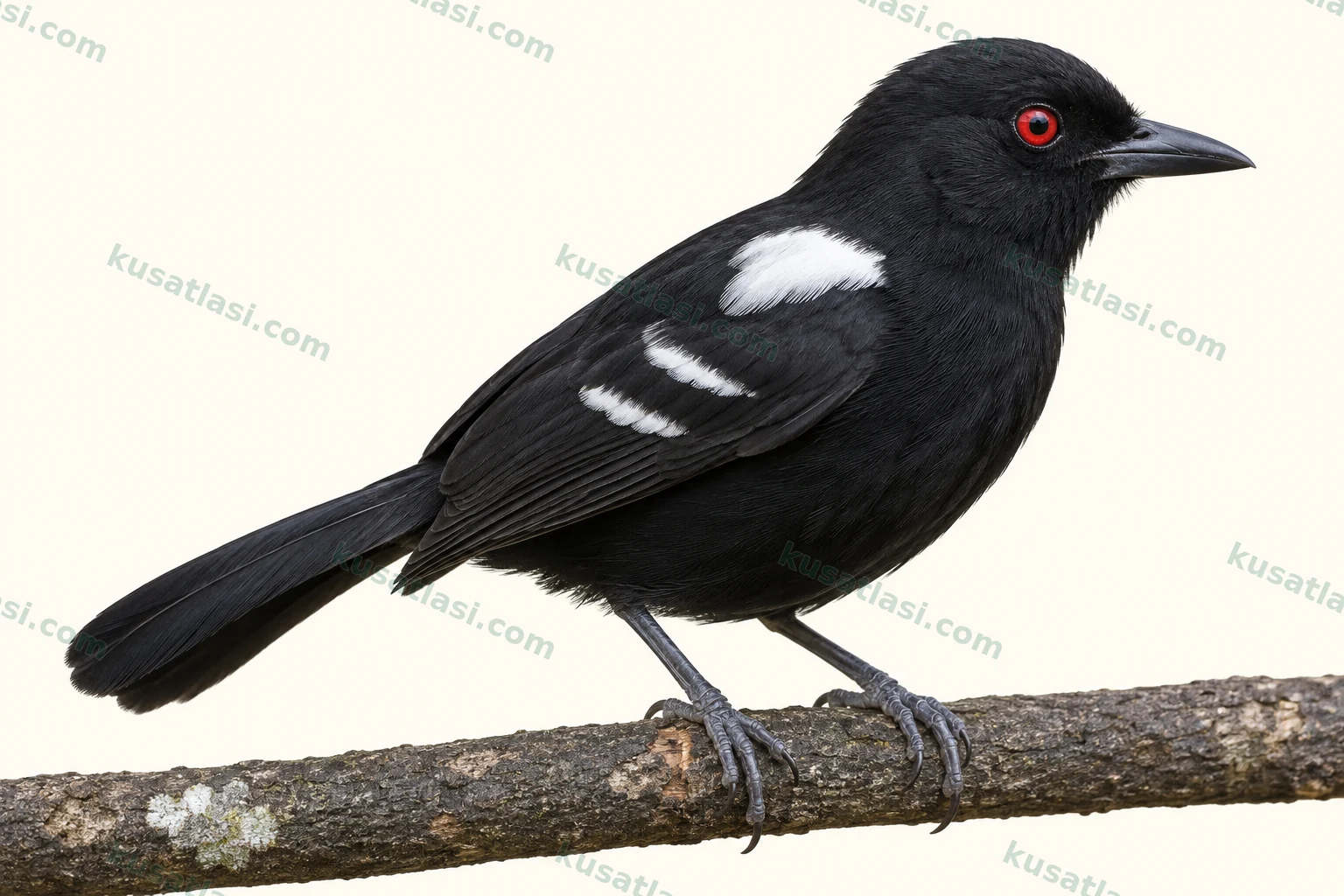
Thamnophilidae · Passeriformes
White-shouldered Fire-eye
Pyriglena leucoptera
Ak Kanatlı Alev Karıncakuşu
Males show a black body, white wing markings and red eyes; females are warm brown and also red-eyed.
- Order
- Passeriformes
- IUCN Status
- LCLeast Concern
Biometrics
Length
- Male
- 16–18 cm
- Female
- 16–18 cm
Wing length
- Male
- 7.8 cm
- Female
- 7.8 cm
Weight
- Male
- 25–34 g
- Female
- Data unavailable
Detailed explanations of these measurements are available on our website, on the same species page.
At a Glance
- White wing markings
Conspicuous against the adult male’s black body.
- Brown female
Gray-olive face and white central throat.
- Dense forest understorey
Low branches, vines and leaf litter.
Adult sexes differ clearly in plumage. Both have red eyes, so eye colour alone does not identify a male.
Calendar
Generally regarded as resident. Misiones nest records are from September–October; the broader expert account gives September–December. One fixed monthly calendar is not applied across countries.
Species Information
Quick Identification
White-shouldered Fire-eye inhabits the understorey of South America’s Atlantic Forest region. Adult males combine glossy black plumage, bold white wing markings and a red eye. Females are warm brown and also have red eyes. Eye colour alone therefore does not identify a male.
General Appearance and Posture
The male’s lesser wing coverts are white, while white tips to the median and greater coverts produce distinct markings on the closed wing. A white patch lies between the shoulders and can become particularly apparent during singing; its visible extent varies with posture. The underwing coverts are blackish gray.
Females have warm yellowish-brown crown, back and wings and a brownish-black tail. The area between bill and eye is dark; the sides of the face are gray with an olive tone. The chin and central throat are white, the breast pale olive-brown, and the belly centre paler than the darker olive-brown flanks and undertail. Females lack the male’s white back patch.
Watches its surroundings from low branches and sloping stems. At an ant swarm it may hold the body slightly raised and repeatedly pound the tail down before lifting it again. It sometimes clings sideways to upright stems. These behaviours complement the plumage clues.
Males, Females and Young Birds
Adult males and females differ clearly in their black and brown plumage. Age and lighting still need to be considered. Failure to glimpse a back patch briefly does not turn a black bird into a female.
One closely monitored chick in Misiones, Argentina, hatched naked with closed eyes. Later it resembled an adult male in its black plumage and red eye; after nest departure, a pale yellow remnant at the gape and duller eye colour than an adult were recorded. Development of that single chick is not a complete identification key for young of both sexes at every stage.
Appearance in Flight
The male’s white upperwing markings contrast with its black body, while the female’s wing appears browner. Details can disappear during brief, obstructed movements through the understorey. Reassess wing markings, back patch, face pattern and eye colour when the bird perches. Flight style alone should not determine species or sex.
Voice and Behaviour
The male’s prominent song is a regularly paced series of notes that stay at a similar pitch or fall slightly. The female’s similar series may descend more noticeably. Calls include a low “chup”, a higher “cheep” and a bubbling rattle that decreases in pitch. Written sound descriptions do not replace listening to a verified recording.
Pairs and family groups may forage close together, sometimes briefly joining mixed groups of other insectivores. Several pairs or families can gather at an army-ant swarm. Such a gathering is not necessarily a fixed flock maintained by the same birds throughout the year.
Similar Species
When considering close relatives such as Pyriglena atra, do not rely solely on a black body and red eye. Male White-shouldered Fire-eyes have conspicuous white wing markings. In male P. atra, the interscapular patch contains feathers with white bases and edges and a black band near the tip. Assess the positions and shapes of wing and back markings together.
Geography also helps: P. atra has a restricted range associated with Sergipe and coastal northeastern Bahia in Brazil, while White-shouldered Fire-eye extends much farther south through the Atlantic Forest region. Locality alone is not decisive, especially near range boundaries. In females, assess the face, throat and complete body pattern as well.
World Distribution
Endemic to the Atlantic Forest biogeographic region, rather than to Brazil alone. Its range extends from eastern and southeastern Brazil into eastern Paraguay and northeastern Argentina. In Brazil it reaches from eastern Bahia and southwestern Minas Gerais south to southern Mato Grosso do Sul and northernmost Rio Grande do Sul.
Eastern Paraguay from Canindeyú towards Itapúa and Argentina’s Misiones are important parts of the range. Authors of the Misiones breeding study also report a 2016 observation along the Uruguay River in extreme northeastern Corrientes; that isolated record does not establish equivalent occupation throughout Corrientes.
Status within Its Range
Can be locally frequent in suitable understorey, but forest loss and fragmentation weaken connections between habitats. Use of some secondary forests and plantations retaining undergrowth does not make open cropland or pasture equivalent habitat. Local frequency should not be extrapolated across the whole range.
Movements and Migration
Generally regarded as resident. Dispersal between forest fragments and local foraging movements are distinct from regular seasonal migration. A Brazilian radio-tracking experiment investigated movement across open habitat; it does not establish a continental or annual migration route.
Breeding Habitat
Uses dense understorey in evergreen forest, forest edges, growth around treefall gaps and mature secondary woodland. Tangled vines, shrubs and bamboo provide important cover. Frequent occurrence in bamboo does not establish dependence on bamboo alone.
Also uses selectively logged forest and some plantations with native plants in the understorey. Trees overhead are only part of the habitat: the low branches, vine network and near-ground cover used in foraging also matter. Open, sparse parts of the forest floor are not equivalent habitat.
Nest Site
The nest is an enclosed rounded or oval structure of leaves and fine plant material, with an opening towards its upper part. Four nests examined in Misiones, Argentina, in 2009, 2010, 2014 and 2015 rested on ferns slightly above the ground. The nest described in detail used bamboo leaves, fine sticks and petioles. Materials need not be identical throughout the range.
The usual clutch is reported as two eggs, and all four Misiones nests contained two. Eggs are white with brown and darker markings, sometimes concentrated towards the broad end. Active nests in that study were recorded in September and October. The broader expert account gives September–December, rather than a separately verified fixed calendar for every country.
In one intensively monitored Misiones nest, incubation may already have begun before discovery. At least thirteen to fourteen days elapsed between discovery of the eggs and hatching of one; the authors state that this does not establish the complete incubation period. The single chick’s nestling period was reported as thirteen to fourteen days; the moment of departure was not directly witnessed.
Both parents were observed incubating and brooding the chick. Researchers’ approaches altered care behaviour, so avoid prolonged close watches at a nest.
Daily Habitat Use
Usually forages in near-ground cover but can climb higher through hanging vines. Leaf litter and the surfaces of low vegetation form parts of the same foraging environment. Space used while following an ant swarm should not be assumed to be confined to a small area immediately around the nest.
What Does It Eat?
Feeds mainly on insects and other small arthropods. The expert species account records crickets, other orthopterans, cockroaches, beetles, ants and spiders. This list does not establish equal dietary proportions throughout the range.
At an army-ant swarm, an important opportunity is the small animals fleeing the advancing ants. The behaviour should not be described simply as eating ants. Regular foraging away from swarms is also reported, so the species should not be portrayed as dependent exclusively on army ants everywhere and at all times.
How Does It Forage?
May pounce from a low perch to seize escaping prey and then jump back onto a branch. Sometimes stays briefly on the ground and tosses leaves. Away from ant swarms it gleans from leaf, branch and vine surfaces, using short reaches, jumps and brief sallies to nearby prey. These movements provide access to food both in litter and on understorey vegetation.
Reaching Forest Is Not the Same as Settling
On the Atlantic Plateau of São Paulo, Brazil, thirty-one adult birds were translocated and radio-tracked during 2008–2009. Birds were moved from continuous forest to small fragments, and researchers followed their departure and movement through surrounding open areas. This experiment is not a study of every young bird voluntarily leaving its natal area.
Females were more successful than males at reaching another forest patch in the experiment. The researchers could not establish permanent settlement after arrival. Reaching woodland therefore does not prove subsequent breeding or long-term residence there. The results retain their regional, adult-sample and experimental limits.
Hopping Does Not Mean Flightlessness
In the same Brazilian experiment, some birds crossed open ground by hopping rather than flying, while flight was also recorded. This is not evidence of flightlessness. With few direct observations of locomotion, the study did not establish a fixed maximum flying distance. Behaviour needs to retain its observed conditions before drawing conclusions about ability.
Nest Visits Do Not Measure the Entire Care Budget
At the one intensively monitored nest in Misiones, Argentina, the female was encountered caring more often than the male. Intermittent checks are not continuous monitoring, and the authors call for a larger sample. These observations do not establish a fixed division of duties for all pairs or prove a survival advantage from the female’s brown plumage.