
World Birds
Field Guide Plates
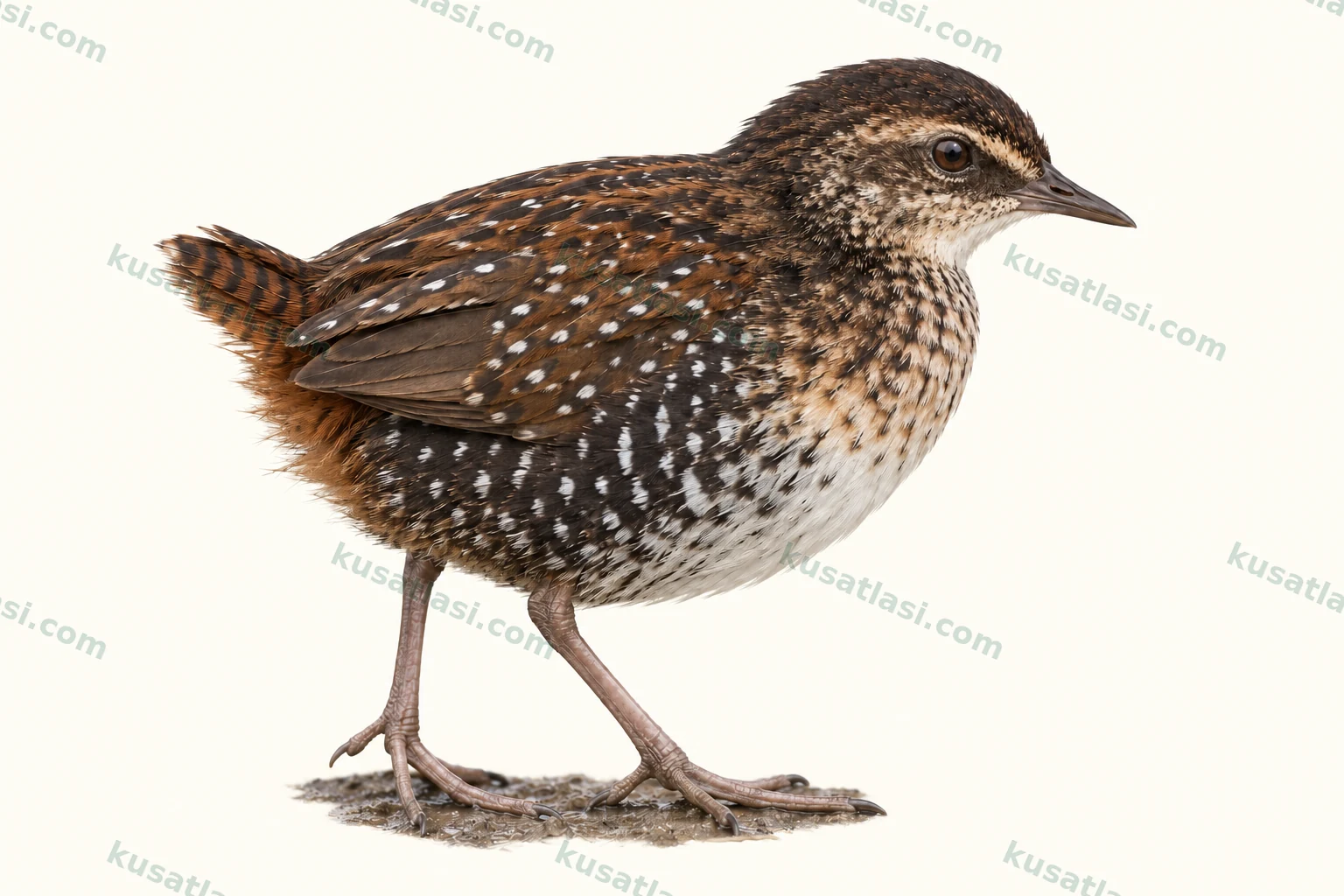
Swipe between the two adult plates.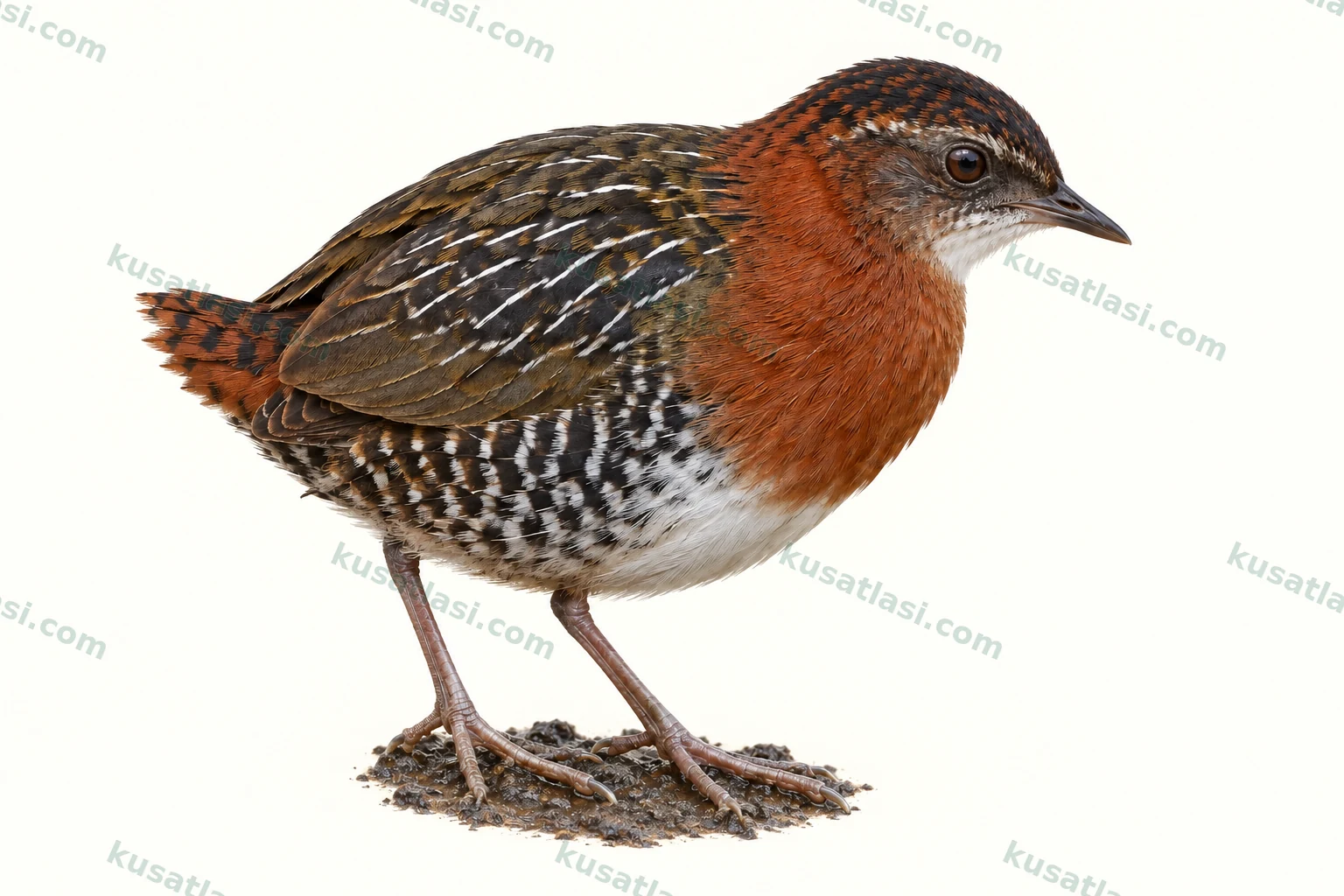
Sarothruridae · Gruiformes
White-winged Flufftail
Sarothrura ayresi
Ak Kanatlı Alacayelve
Assess the white inner flight feathers together with the chestnut-and-black tail and head and neck pattern.
- Order
- Gruiformes
- IUCN Status
- CRCritically Endangered
Biometrics
Length
- Male
- 14–16 cm
- Female
- 14–16 cm
Wing length
- Male
- 7.3 cm
- Female
- 7.3 cm
Weight
- Male
- 31.8 g
- Female
- Data unavailable
Detailed explanations of these measurements are available on our website, on the same species page.
At a Glance
- White inner flight feathers
Visible in both sexes when the wing opens.
- Chestnut-and-black tail
Not a unique identification feature on its own.
- Dense wetland vegetation
Do not part cover or flush birds to obtain a view.
Adult females have less chestnut and buffier spotting. Young males can also have spotted wings; do not force a sex identification from a brief view.
Calendar
Breeding and occurrence seasons differ between Ethiopia and South Africa. With wintering areas and routes unresolved, no single monthly calendar is supplied.
Species Information
Quick Identification
White-winged Flufftail is an elusive bird of densely vegetated African wetlands. Both sexes show conspicuous white inner flight feathers when the wing opens. A chestnut-and-black barred tail and white throat and belly help complete the identification. A brief flash of white alone is insufficient for certainty.
General Appearance and Posture
The body is compact, with a short tail and a dark pointed bill. Adult males have a dark brown crown and conspicuous chestnut on the neck and breast. The dark back and closed wings carry fine pale markings. White down the centre of the underparts should not be mistaken for an entirely plain white breast.
The eyes are dark brown to brownish black. The bill is dark brown or blackish; the legs gray, brownish or purplish flesh-coloured. Most of a walking bird can remain concealed among dense stems. An isolated glimpse of feathers without the full pattern should be treated cautiously.
Males, Females and Young Birds
Adult females show less chestnut and buffier pale mottling above. Male upperwing coverts tend to be streaked and female coverts spotted. Sexual differences are nevertheless less marked than in some other flufftails. Leave sex unassigned when a rapid, obstructed view does not show dependable detail.
Newly hatched chicks have black down and pale creamy-white areas at the bill base and tip. Pale spotting above and white on the throat and belly become apparent as they develop. Young birds can be darker gray-brown and less chestnut than adults. Young males may also have spotted wing coverts, so the adult distinction between spots and streaks does not apply at every age.
Appearance in Flight
White inner flight feathers form a large contrasting patch on an open wing. Flight can be strong and direct. Camera records from South Africa also show the white patch being exposed during wing-flapping and display. There is no need to flush a bird to look for it; entering dense wetland vegetation disturbs both birds and habitat.
Voice and Behaviour
A study matching camera and sound records in South Africa, followed by comparison with Ethiopian recordings, confirmed short metallic “chit” notes. They are commonly grouped into three-, four- or five-note phrases. A rapid trill following one note was suggested to have a warning function; that interpretation is not an experimentally established fact.
At Middelpunt, South Africa, the 2017–2018 summer study found movement and calling particularly prominent around dawn and again towards dusk. Calls can be masked by other birds and environmental noise. These local findings do not establish identical activity schedules throughout the range, nor does silence establish absence.
Similar Species
When comparing wetland flufftails, assess the white inner flight feathers together with tail pattern, head and neck colour and age. Chestnut-and-black tail barring alone is not unique: female Sarothrura affinis can show a similar pattern.
Vocal confusion with Sarothrura rufa is particularly important. Some low “oop”-like calls formerly attributed to White-winged Flufftail had not been verified with a bird in view. Later research identified one as a variation of the S. rufa duet. An old sound label should therefore not be accepted as a current, confirmed identification.
World Distribution
The main known areas are the Ethiopian highlands and wetlands in eastern South Africa, with historical records from Zimbabwe. The large gaps between these countries should not be drawn as continuous occupied range or a proven migration corridor.
Recent South African work has confirmed occurrence in suitable wetlands along the eastern escarpment region from Mpumalanga to KwaZulu-Natal. Precise locations of many sites are withheld to protect the bird and its sensitive habitat. The known localities should not be treated as a complete map of every population.
Status within Its Range
Confirmed breeding in South Africa adds a southern breeding population to the previously known Ethiopian records. Wetland drainage, altered hydrology, excessive grazing and degradation of vegetation are major pressures. The change in the 2025 South African regional assessment does not show that these threats have disappeared.
Movements and Migration
Seasonal movements remain poorly understood, including wintering areas and routes. Occurrence during different rainy seasons in Ethiopia and South Africa does not prove that the same individuals travel annually between the two. In particular, confirmed South African breeding supersedes the older explanation of that country as solely a nonbreeding destination for Ethiopian birds.
Breeding Habitat
Breeding habitat consists of upland wetlands with dense herbaceous cover. Ethiopian sites contain mixtures of sedges, grasses and other flowering plants. Peat wetlands are important in South Africa, where wet ground and vegetation providing cover down to its base are key features.
A vegetation study in Mpumalanga, South Africa, sampled recorded-use areas at Middelpunt and Verloren Valei in March 2020. Carex austro-africana and Cyperus denudatus were prominent sedges, with grasses including Leersia hexandra and Arundinella nepalensis. The study describes plants in used habitat; it does not prove that the bird requires precisely these plant species everywhere in Africa.
Shallow water, wet ground and dense mixed cover should be considered together. Birds may sometimes retreat into tall reeds, but a uniform stand of Phragmites or Typha is not equivalent to mixed sedge-and-grass habitat.
Nest Site
In the Berga study in Ethiopia, nests were placed close to wet ground within dense plant clumps. Live stems brought together overhead form a domed, ball-like structure with a side entrance. Surrounding vegetation conceals it.
Of seven nests reported at Berga, Ethiopia, in 2003, one contained four unmarked ivory-white eggs; the others were empty and apparently under construction. The authors also relay an earlier account of a complete six-egg clutch from another nest examined in the same wetland in 1999. The four-egg set may therefore have been incomplete. These records should not be reduced to one fixed clutch size.
Chicks hatch downy and mobile; expert accounts report care by both adults. Detailed division of incubation duties and development periods applicable across the range remain insufficiently documented. Observe without disturbance rather than walking through the marsh to search for nests, parting vegetation or using playback.
Daily Habitat Use
Moves beneath dense cover around wet ground and shallow water. Nest sites and wetter areas accessible to chicks need not have identical conditions. Changes in water level, grazing or fire can alter which parts of a small wetland remain usable. Conserving its mapped boundary alone is insufficient; hydrology and vegetation structure also matter.
What Does It Eat?
Diet is poorly documented. The expert species account relays observations of adults taking earthworms, small freshwater crustaceans, insects and insect larvae. These reports do not provide a detailed annual food budget or establish the dominant prey group in every region.
The expert synthesis of Ethiopian chick observations reports water beetles, some fly larvae and small crustaceans being fed to young. These are chick-feeding records, not adult dietary proportions or a menu for every season. The South African vegetation study discusses sedge seeds as a potential food source; that suggestion is not a direct observation of seed consumption in that study.
How Does It Forage?
Picks up small food items from damp ground, shallow water and low or flattened vegetation. Dense cover makes feeding difficult to watch. Observe without altering that cover or attempting to drive a bird into the open.
Breeding Confirmed on Camera
The 2017–2018 study at Middelpunt Wetland in South Africa recorded adults with very young chicks and young birds at different stages of development. These observations changed the idea that breeding was restricted to Ethiopia. Unlike an isolated adult sighting elsewhere, local records of small chicks provide direct evidence supporting breeding.
The many photographs in the study include repeated images of the same birds. Neither the image total nor encounters separated by a chosen time interval should therefore be treated directly as a count of different individuals.
Regional and Global Categories Differ
BirdLife South Africa changed the 2025 regional category to Endangered because knowledge had improved, rather than because a complete census had demonstrated population growth. The global IUCN category remains Critically Endangered. The two geographic scales should not be used interchangeably.
Population calculations in the newer regional assessment draw on suitable habitat and estimates of space use. A modelled number that habitat could support is a different kind of evidence from individually counted wild birds.
The Value of Passive Monitoring
Combining cameras with passive sound recording helped establish the correct call and document breeding without repeatedly flushing birds. For this sensitive species, the researchers recommend passive monitoring rather than playback, walked transects or flushing. Responsible observation does not require exposing a nest or disclosing a precise location.