
World Birds
Field Guide Plates
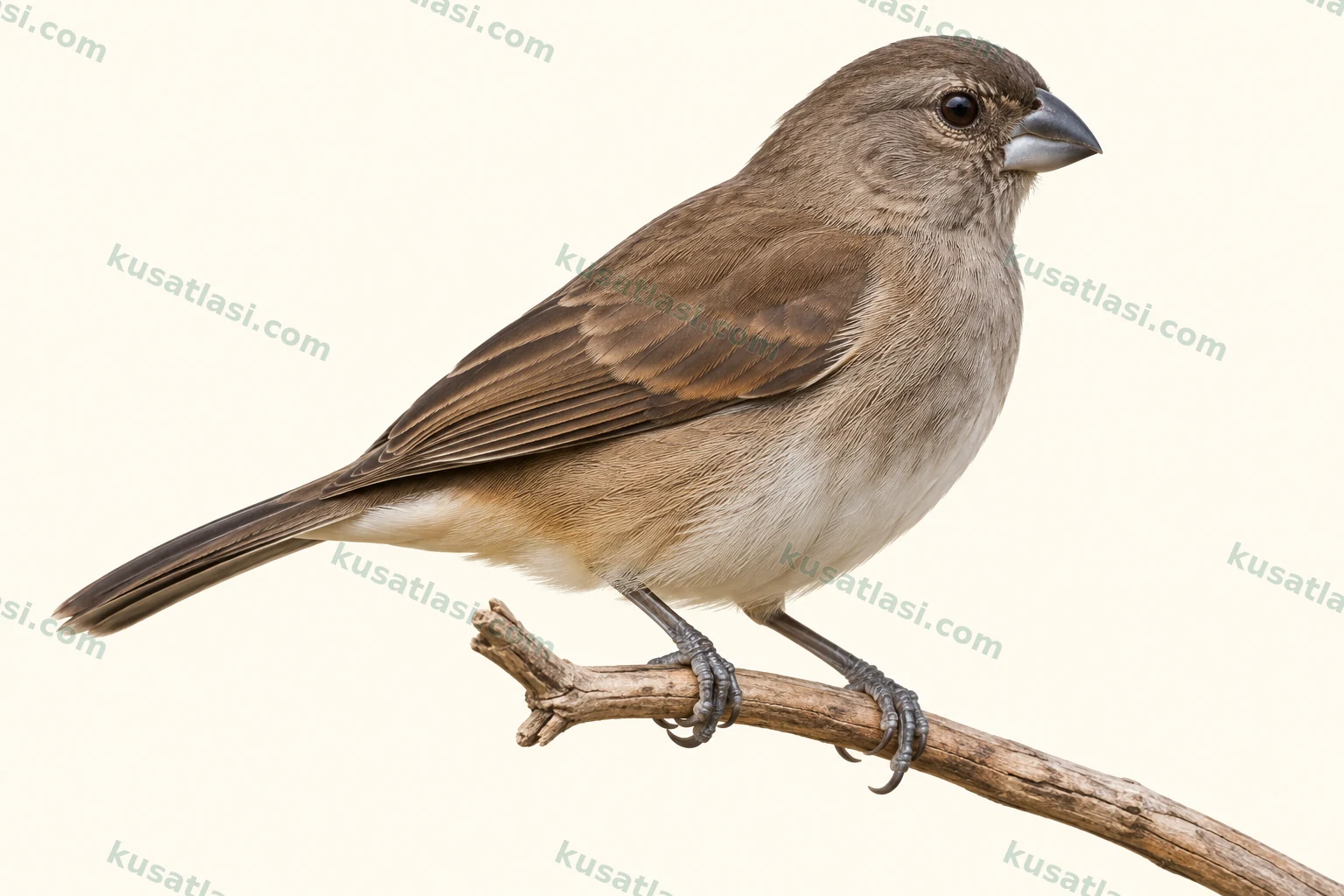
Swipe between the two adult plates.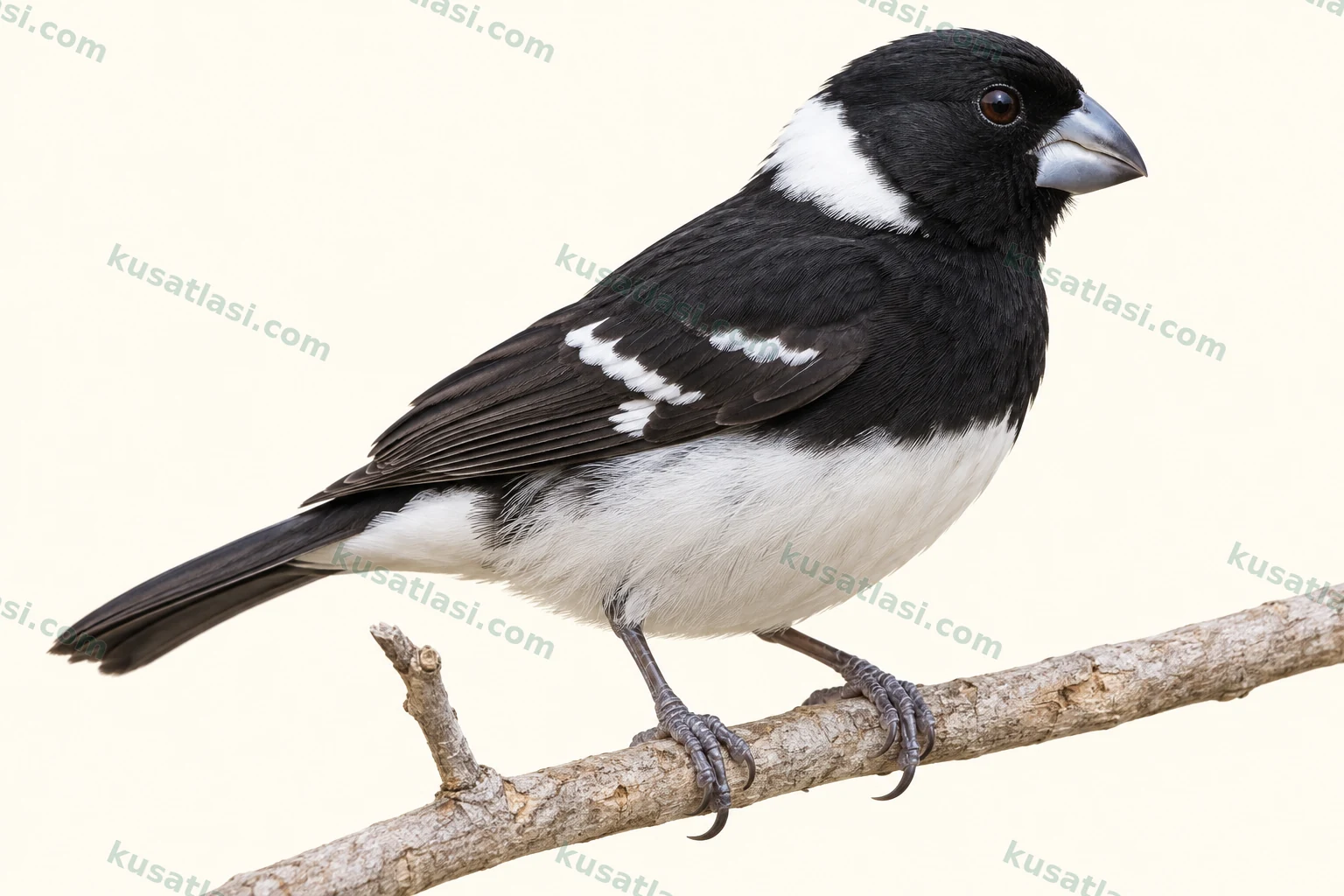
Thraupidae · Passeriformes
White-naped Seedeater
Sporophila fringilloides
Ak Halkalı Tohumcul
Check the pale elongated conical bill, black hood and two white wingbars together.
- Order
- Passeriformes
- IUCN Status
- LCLeast Concern
Biometrics
Length
- Male
- 13–14 cm
- Female
- 13–14 cm
Wing length
- Male
- 6.13 cm
- Female
- 6.13 cm
Weight
- Male
- 12.4–13.8 g
- Female
- 12.1–12.5 g
Detailed explanations of these measurements are available on our website, on the same species page.
At a Glance
- Elongated conical bill
Pale in males, sometimes blue-gray tinged.
- Two white wingbars
The upper is broader; the nape collar may be hidden.
- White-sand scrub
Check dense cover and exposed singing perches.
Adult females are brown, but immature males may look very similar. Brown coloration alone does not establish sex.
Calendar
Presumed generally resident. Guyana breeding-condition records in August and February–March do not establish a fixed calendar for every month and region.
Species Information
Quick Identification
White-naped Seedeater inhabits scrub associated with white-sand landscapes in northern South America. The adult male combines a black head and upperparts, white underparts, a pale elongated conical bill and white wingbars. Its narrow white nape collar is not visible in every posture, so identification should use the full combination.
General Appearance and Posture
The body is slim and elongated, with a relatively long tail. The bill is deep at its base and tapers to a distinctly pointed triangle. In males it can look ivory-white in the field, while closer views reveal blue-gray tones and a dark tip. These appearances do not by themselves indicate different morphs or species.
The black hood extends over much of the throat. The white underparts continue into a partial nape collar. The back is black, the rump whitish and the tail and its upper coverts dark. Two white wingbars include a broader upper bar and a potentially broken-looking lower bar. Another white area at the bases of the flight feathers may be concealed on a closed wing. A small dark wedge at the breast sides and sometimes grayish flanks complete the pattern.
The iris is brown, rather than conspicuously pale. Legs can appear gray or dark gray in males and darker gray-brown in females. Assess bare-part tones alongside plumage and bill shape, allowing for lighting.
Males, Females and Young Birds
The adult female is warm brown rather than sharply black and white. Its head, back, wings and tail are comparatively uniform; the throat, breast and flanks are brownish and the central belly whitish. The undertail coverts may be buffier. The bill can appear dark gray or brownish.
Young birds can closely resemble females. One immature male examined in southern Guyana in late February–early March 1999 was virtually indistinguishable in plumage from an adult female. Other transitional males showed a darker brown body, black mottling on the head and face and white wingbars. Brown coloration alone does not establish female sex, and transitional markings do not provide an exact age in months.
Appearance in Flight
A change of perch may expose the pale rump and white wing pattern. A brief flight view is insufficient on its own; check the elongated conical bill, hood and two wingbars again after landing. A detailed diagnostic wingbeat rhythm has not been verified here, so no particular flight style is offered as a decisive identification feature.
Voice and Behaviour
Male song is loud, rapid and musical, with changing notes often delivered in pairs or triplets. A short sharp call is also described. Singing males may use an exposed branch or snag. In Guyana they sometimes sang from one perch for several minutes before changing position or chasing another bird; these chases were interpreted as territorial.
Occurs singly and in pairs. During work in Guainía, Colombia, in 1992, some males were conspicuous in the open while females fed quietly within dense cover. That local difference does not establish identical wariness in every setting.
Similar Species
Male Sporophila americana can also show conspicuous white wingbars, but has a shorter-looking black bill. The pale, more elongated conical bill is important in White-naped Seedeater. Definite natural range overlap between the two should not be assumed.
When comparing females with Sporophila angolensis, examine the relatively elongated body and bill shape. Female angolensis has a darker belly and usually conspicuous white underwing coverts. One distant view of a brown bird may be insufficient for secure species or sex identification.
World Distribution
Its natural range includes suitable sites in Guainía and Vaupés in southeastern Colombia, Amazonas in southern Venezuela, northwestern Brazil and southern Guyana. Brazilian records extend from northern Amazonas to the Presidente Figueiredo area north of Manaus, and include Roraima. It should not be treated as a continuously distributed open-country bird throughout those countries.
Status within Its Range
Distribution is patchy, with suitable white-sand scrub isolated within much taller forest. Local abundance at a small studied site does not establish abundance across the range. The first southern Guyana record was obtained at Gunn’s Strip on 17 August 1998; a singing male was also observed in the southern Rupununi in April 2000. Newly documented localities can reflect improved coverage rather than recent expansion.
Movements and Migration
Presumed generally resident, although movements remain poorly known. Birds feeding on a small river island in Guyana prompted the suggestion that rivers and islands might help dispersal between suitable scrub patches. This is not a tracked migration route. Failure to encounter the species in partially flooded Gunn’s Strip in April 2001 likewise does not by itself demonstrate seasonal migration.
Breeding Habitat
Typical habitat includes low scrub on white sand, damp or wet clearings, grassy savanna–forest interfaces and stunted vegetation on some rocky ridges. Song and birds in reproductive condition have been recorded in this vegetation, without establishing that nests occur throughout all such habitats.
Nest Site
Adult males in southern Guyana showed reproductive condition in August 1998 and again in late February–early March 1999. A female examined on 4 March was recorded as laying. The researchers suggested a possible breeding period extending between August and April, while explicitly calling for confirmation.
Those records do not describe a nest site or structure. The sources examined did not establish nest architecture, typical clutch size, incubation or nestling duration, or division of parental care. These details are not transferred from other Sporophila species. Observe suspected breeding birds from a distance without pursuing them or opening their cover.
Daily Habitat Use
Dense vegetation provides foraging cover, while more exposed elevated points can be used for song. During July–September 1992 work in the Serranía de Naquén, Guainía, Colombia, the species was recorded at only two small sites despite wider searches. Males were conspicuous in low open ridge scrub but less visible at a second site with taller, more closed forest.
Recently burned patches occurred at those Colombian sites, and singing males also occupied burned forest edge in Guyana. Occurrence after fire does not establish a benefit from burning or justify burning its habitat.
What Does It Eat?
Seed consumption is directly documented. Stomachs from five males and one female in southern Guyana contained seeds. This small sample does not determine annual dietary proportions or every plant species eaten.
On 17 November 1999 in Guyana, one male and three females were observed and filmed eating mistletoe fruit on a small rocky island near the mouth of the Kassikaityu River. This establishes consumption beyond dry seeds, without making that fruit the principal food everywhere or in every season.
How Does It Forage?
Forages within dense vegetation, sometimes several metres above the ground. Birds occur alone or with a partner, with associations with other seed-eating species reported infrequently. A female feeding quietly in cover can be much harder to notice than a male singing in the open.
Two Sexes and Two Historical Names
The female was described as fringilloides in 1870, while an adult male was published the following year as a different species, Dolospingus nuchalis. Comparison of additional specimens established that the two appearances belonged to one species. Their history illustrates how strong differences between the sexes can complicate classification. The former name Dolospingus fringilloides also refers to the bird now called Sporophila fringilloides.
From Bill Shape to DNA
Its unusual bill long helped maintain it as the sole member of Dolospingus. A molecular study published in 2013 compared a broad selection of seedeaters, including a White-naped Seedeater specimen from Guyana. Two mitochondrial gene regions were analysed for thirty-three of the thirty-nine species then recognised; these were not thirty-three individuals of the focal species.
The results supported placement of Dolospingus and Oryzoborus within a broader Sporophila assemblage, and the authors recommended merging the genera. This was a study of genetic relationships, rather than a nesting or feeding experiment. The species is now classified in Thraupidae, without implying identical life histories in all its relatives.