
World Birds
Field Guide Plates
Swipe between the two adult plates.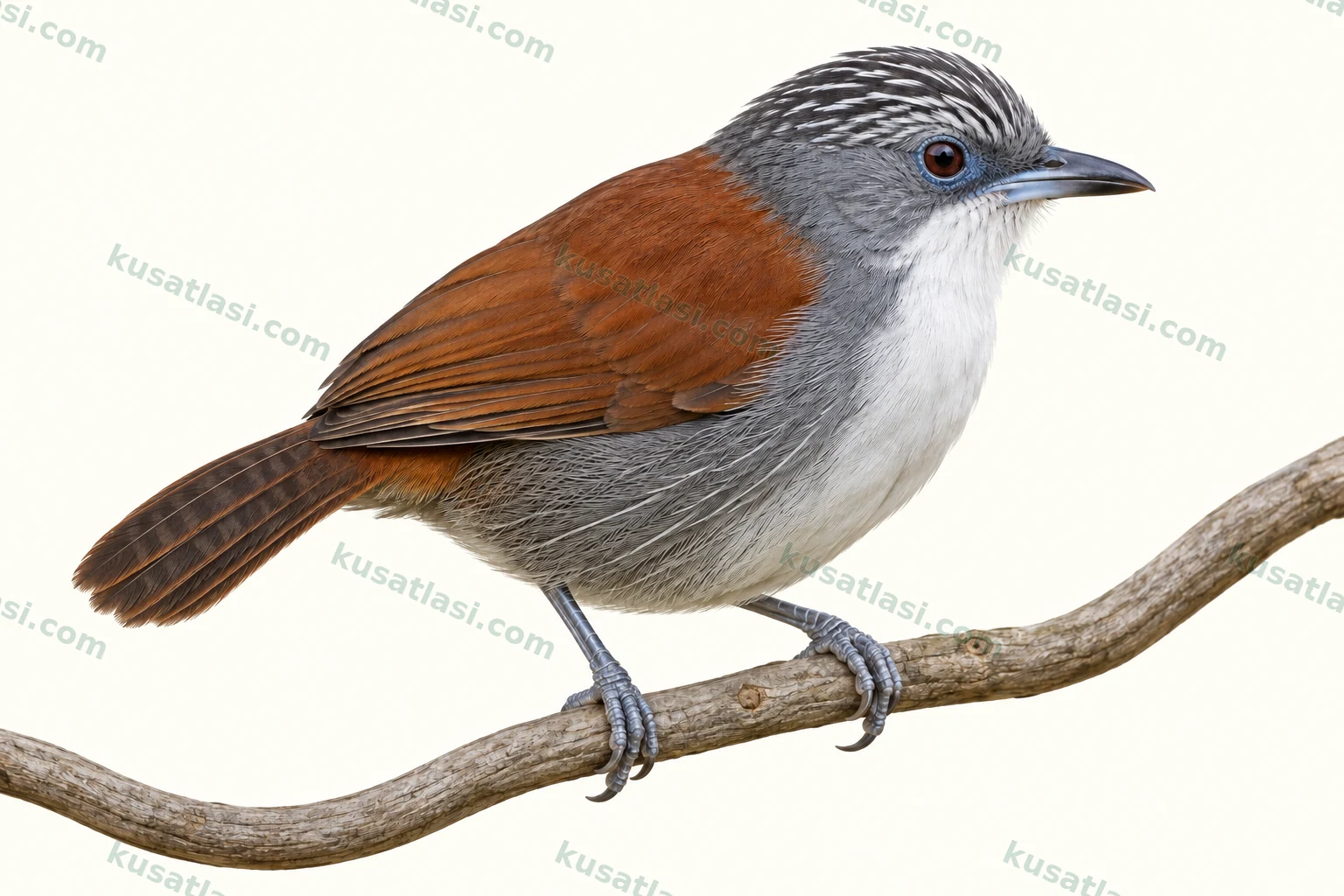
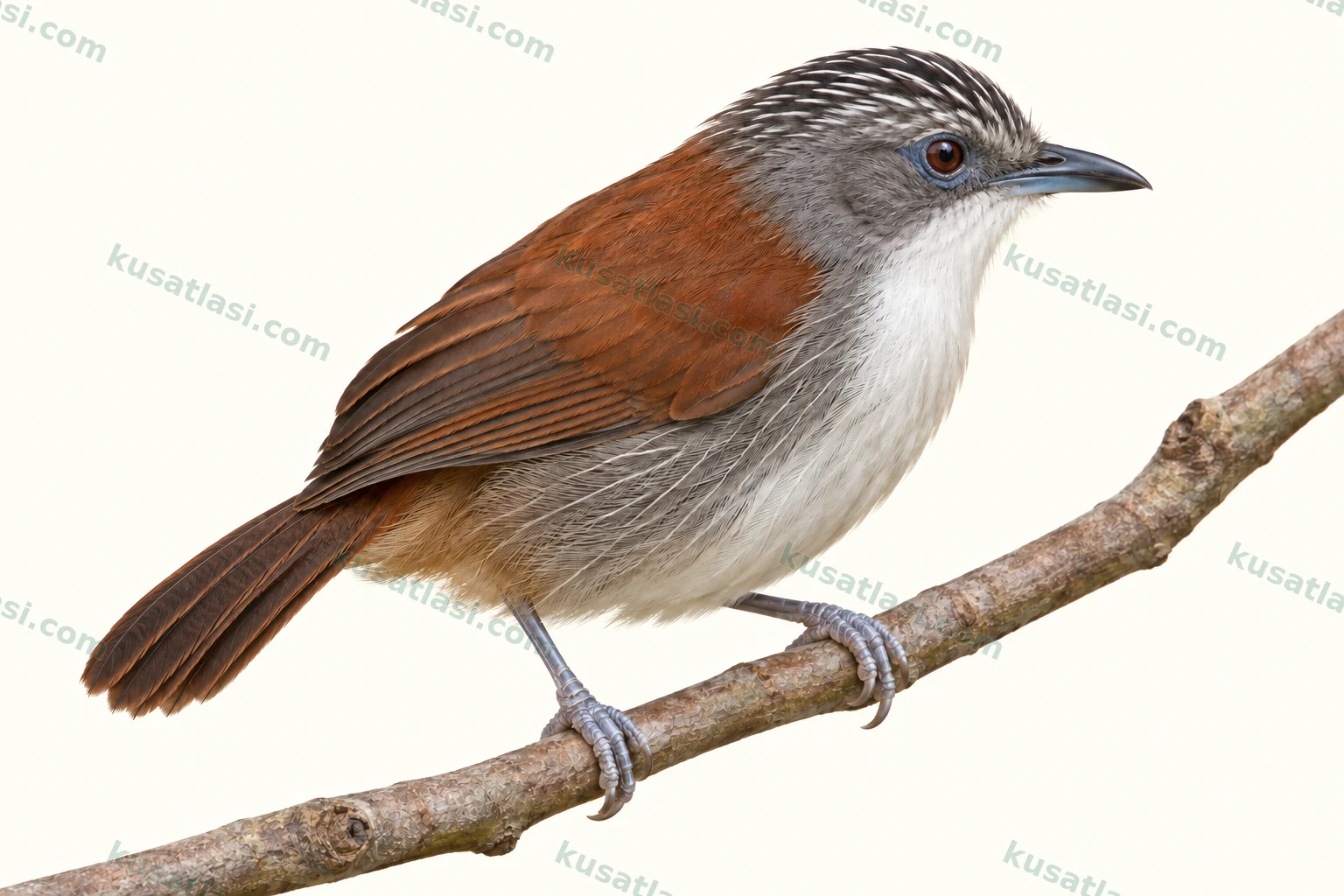
Timaliidae · Passeriformes
White-breasted Babbler
Stachyris grammiceps
Ak Karınlı Çalı Timalyası
Grey head, white underparts, rufous wings and tail.
- Order
- Passeriformes
- IUCN Status
- NTNear Threatened
Biometrics
Length
- Male
- 12 cm
- Female
- 12 cm
Wing length
- Male
- 5.68 cm
- Female
- 5.68 cm
Weight
- Male
- 11–15 g
- Female
- 11–15 g
Detailed explanations of these measurements are available on our website, on the same species page.
At a Glance
- Head
Grey.
- Underparts
White.
- Wings and tail
Rufous.
An age/sex key was not verified.
Calendar
Laying calendar not verified.
Species Information
Quick Identification
Look for the combination of a grey head, white underparts, and rufous wings and tail.
General Appearance and Posture
A rather chunky babbler, it forages at lower and middle forest levels in small or mixed-species groups.
Males, Females and Young Birds
The reviewed Javan records do not establish a definitive distant age-and-sex key.
Appearance in Flight
Short “chup chup” calls have been recorded in flight on Java.
Voice and Behaviour
Its song is a high-pitched, insect-like trill.
Similar Species
Its trill can resemble Stachyris nigriceps; the 2005 review notes that the latter does not occur on Java.
World Distribution
It is endemic to Java, Indonesia. AviList 2026 describes a local distribution in forests of the western part of the island.
Status Within Its Natural Range
BirdLife’s 2025 assessment highlights increasing demand for the cagebird trade alongside the historical importance of forest loss. Decline in the wild population is presented as suspected from available evidence, rather than established by a complete census.
Movements
BirdLife classifies it as non-migratory and resident in Indonesia.
Breeding Habitat
It inhabits moist lowland and hill forest. BirdLife notes that small gaps and edges can support luxuriant lower growth in some places; this does not mean that wholesale forest clearance benefits the species.
Nest Site
The extensive 2005 review from Java reported no nest record.
Daily Habitat Use
In the observational study at Sokokembang, Petungkriyono, Central Java, in August 2015, birds were encountered along two stream-following routes. The observation sites contained vegetation layers ranging from trees to shrubs. This describes use of one forest in one month; it does not show that the species can live only beside streams everywhere.
What It Eats
Recorded prey include bush-crickets.
How It Forages
At Sokokembang, Central Java, in August 2015, birds picked food from nearby leaves and twigs. Some hung beneath liana leaves or dry leaves caught in branches to reach food. These are direct records of feeding behaviour, not evidence that the birds ate the leaves themselves.
The Breeding Season Is an Inference
The extended breeding season in the 2005 Java review is an inference from young-bird and moult records.
Limits of a One-Month Study
The 3–30 August 2015 study at Sokokembang, Central Java, visited 70 points on seven routes twice. Four encounters produced 14 bird records. Because distinct individuals were assumed rather than individually marked, this is not equivalent to 14 confirmed different birds or a census of the whole forest.
Different Feeding Movements
The behavioural table in the same Java study lists 12 gleaning records and two hanging records. The suggestion that association with other species caused differences in movement was an interpretation, not experimentally tested.