
World Birds
Field Guide Plates
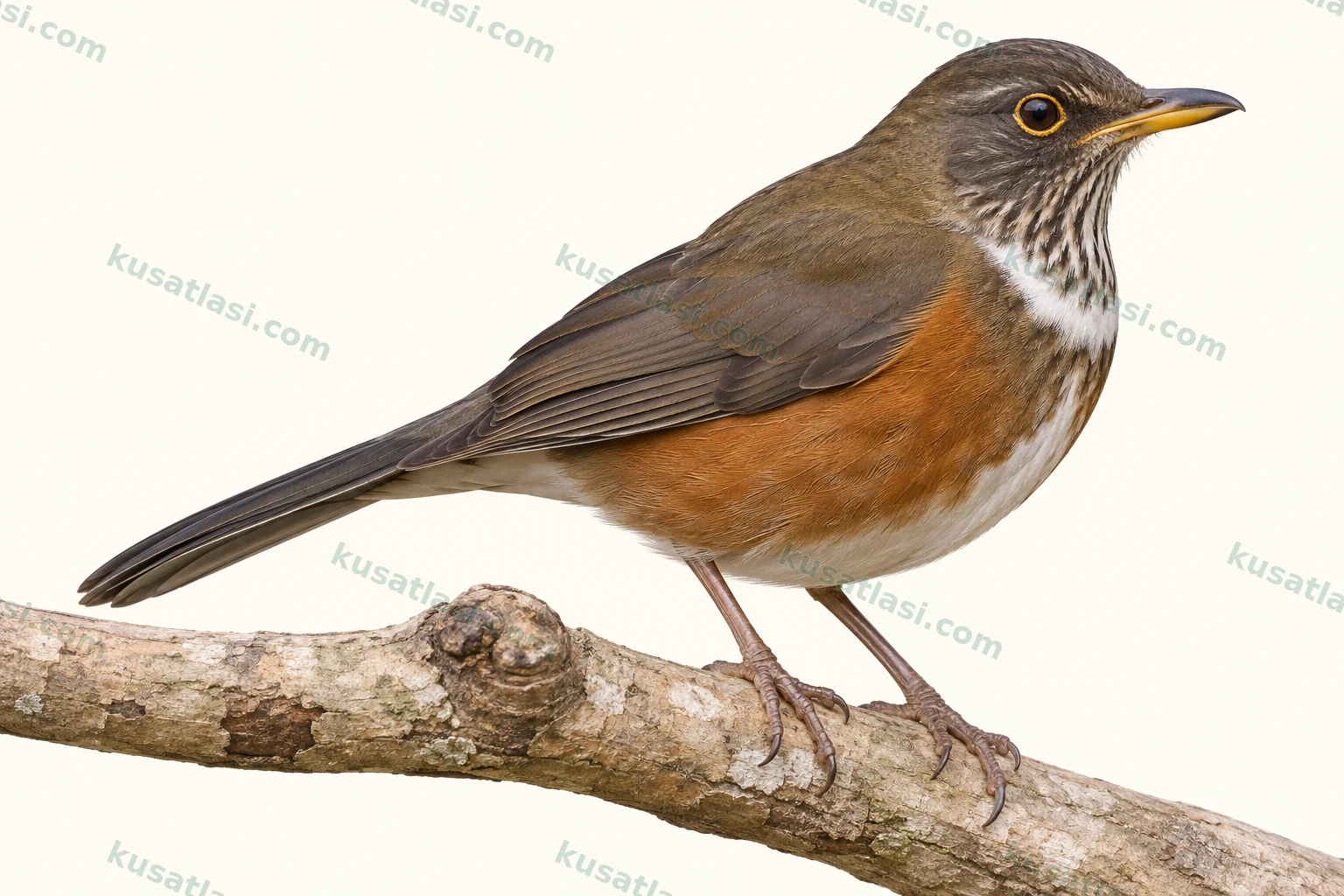
Swipe between the two adult plates.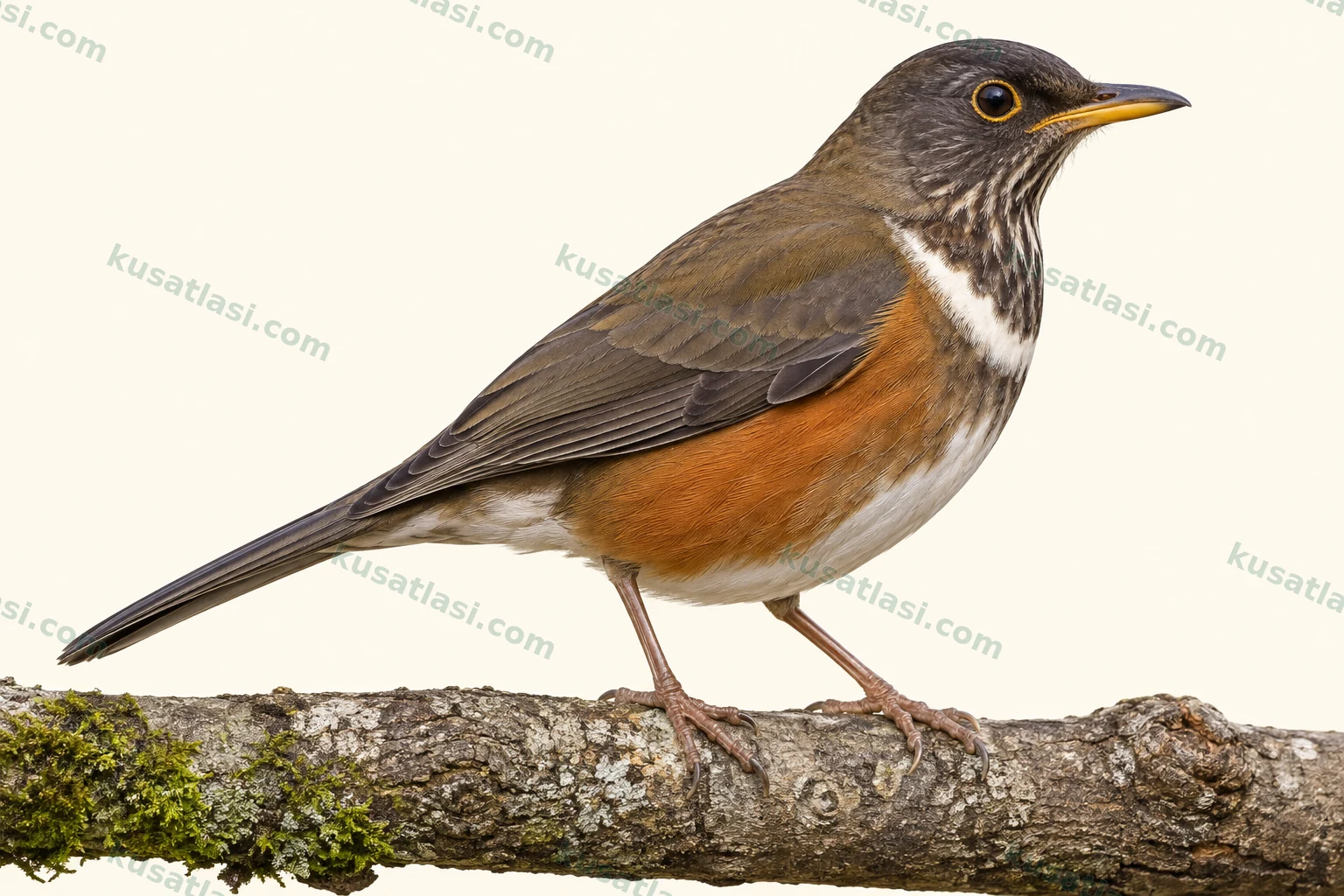
Turdidae · Passeriformes
Rufous-flanked Thrush
Turdus albicollis
Ak Halkalı Ardıç
Check the streaked white throat, white upper-breast crescent and warm rufous flanks together.
- Order
- Passeriformes
- IUCN Status
- Source-taxon assessment
Biometrics
Length
- Male
- 20–26 cm
- Female
- 20–26 cm
Wingspan
- Male
- Data unavailable
- Female
- Data unavailable
Weight
- Male
- 40–84.5 g
- Female
- 40–84.5 g
Detailed explanations of these measurements are available on our website, on the same species page.
At a Glance
- White upper-breast crescent
Immediately below the streaked white throat.
- Warm rufous flanks
Allow for geographic variation.
- Humid forest interior
Search leaf litter and fruiting trees.
Sexes look alike. Young may show pale head and wing spots and stronger brown patterning below.
Calendar
Generally resident, with regional seasonal movements reported. Brazilian breeding records do not establish one monthly calendar across the range.
Species Information
Quick Identification
Rufous-flanked Thrush is a brown thrush of humid forests in southern and eastern South America. A short white crescent across the upper breast lies below a dark-streaked white throat. Assess the warm rufous or orange-brown flanks, pale belly and throat–breast pattern together.
Older literature often used White-necked Thrush for a broader species. This account follows the current southern Turdus albicollis concept, rather than combining all Amazonian and Trinidadian populations under the same heading.
Appearance and Posture
In the nominate form, the forehead and face are blackish-brown, grading into dark brown upperparts. Dark streaks on the white throat contrast with the white crescent immediately below. The middle breast and upper belly are buff-grey, becoming white farther down. Warm flanks can look browner in shade.
The bill is yellow with a dark upper ridge. The iris is brown and the thin bare eye-ring yellow or yellow-orange; this is not a broad white feather ring. Legs are pinkish-brown. Seek a combined view of head, eye surround, throat and flanks.
Four subspecies differ mainly in colour tones. Eastern Brazilian crotopezus is described with duller grey from breast to belly and tawny flanks. Paraguayensis of Paraguay and neighbouring areas has heavier throat streaking and orange-brown flanks. Bolivian contemptus has brighter upperparts and browner flanks. These differences should not be used to identify sex.
Males, Females and Young Birds
Males and females share similar plumage. Apparent size or posture in one free-living bird does not reliably identify sex.
Young can show buff flecks on the head, two vague rows of orange wing spots and buffier underparts. Brown spotting or barring, strongest on the breast, differs from the cleaner adult underparts. This appearance does not establish an exact age in months, and geographic colour differences also matter.
Appearance in Flight
Brown upperparts glimpsed in a short flight do not identify the species alone. After it perches, check the streaked white throat, upper-breast crescent and warm flanks. A separately verified diagnostic flight-pattern key is unavailable, so wing colour is not presented as a definitive rule.
Voice and Behaviour
Song is a leisurely sequence of throaty whistles, with several note types repeated in changing order. Short “whuh” and more nasal “wheer?”-like calls are also described. Written syllables are approximate memory aids, rather than a definitive identification from one note.
Singing may begin at dawn, continue through the morning and resume in late afternoon. It is often delivered from an inconspicuous low or mid-level perch inside forest; even a loud bird can be hard to locate. Males can defend areas during breeding. Breeding records remain geographically specific.
Similar Species
Grey-flanked Thrush, Turdus phaeopygus, was formerly included in the same species and shares the white throat–breast pattern. Warm rufous flanks and a buff-grey breast help distinguish the current southern species from the greyer sides of the northern bird. First check locality and current species limits; a single impression of colour is insufficient in Bolivian boundary areas.
Their whistled songs are similar. The expert account distinguishes short “kuk” and rough chattering calls of the northern species from this bird’s “whuh” and nasal calls, while noting that detailed comparisons of call repertoires remain incomplete. One recording should not be generalized across every population.
World Distribution
Under current limits it occurs in suitable forested areas of eastern and southeastern Brazil, eastern Paraguay, northeastern Argentina and Uruguay. Disjunct populations in northeastern Brazilian Atlantic Forest and the Bolivian Yungas also belong here. The Yungas distribution reaches southeastern Peru in Puno and the extreme north of Argentina.
Nominate albicollis extends from Rio de Janeiro to Rio Grande do Sul and central/eastern Uruguay; paraguayensis occurs in southwestern Brazil, eastern Paraguay, Misiones and northern Corrientes. Crotopezus occupies eastern Brazil and contemptus principally Bolivia. Northern Amazonian, Guianan and Trinidadian records under the former broad species name are not combined with this distribution.
Status within Its Range
Abundance varies geographically. It can be locally common in suitable southeastern and southern Brazilian forest, while encounter rates differ in Paraguay and Uruguay. A total for the newly delimited species cannot simply be extracted from older broad-species population numbers. Presence in a small forest fragment does not establish equivalent performance in every fragmented habitat.
Seasonal Movements
Generally resident, although not every population is stationary; seasonal and elevational movements are reported. Movement information from historical Colombian or Trinidadian accounts should not be transferred here.
Mist-net sampling at Guarapuava, Paraná, Brazil, from December 2008 to November 2009 caught the species more often in winter and not in spring. This local pattern is consistent with possible movement, but does not establish a tracked migration route or universal spring departure. Behaviour and sampling methods also influence capture probability.
Breeding Habitat
Uses humid Atlantic Forest and Yungas forest. Leaf-littered ground and wooded cover inside forest provide important foraging habitat. It also occurs in developed secondary forest and some fragments; this flexibility does not make treeless farmland equivalent to humid forest.
Nest Site
The nest is an open cup placed on a supporting structure in a tree. A nest monitored in Minas Gerais, Brazil, in 1995 was made of roots and moss in the forked trunk of a Cariniana tree and contained two eggs in early September. Young were seen in mid-September, with one still in the nest at the end of the month. Monitoring did not continue after that date.
This record establishes neither an exact incubation period nor fledging at fourteen days. Verified wild incubation and nestling durations for the current narrow species were not found in this research. Detailed division of parental duties also remains incomplete, although the genetic study in São Paulo, Brazil, directly confirmed both social parents feeding young at some nests.
Breeding evidence in Minas Gerais includes September, November and December. Another study in São Paulo monitored nests during the 2013–2014 and 2014–2015 seasons. Regional records should not become one fixed continent-wide breeding calendar. Observe without approaching nests or flushing birds.
Daily Habitat Use
Can be seen searching ground litter and ascending into fruiting trees at mid-levels. It may join other birds, while solitary feeding is also normal. Fruit visits and ground feeding represent different foraging opportunities for the same species.
What Does It Eat?
An omnivore consuming both fruit and small invertebrates. Earthworms and other invertebrates can be taken on the ground, with fruit gathered in trees and shrubs. Brazilian studies report consumption of several plant fruits, without establishing obligatory dependence on one.
Research near Belo Horizonte, Minas Gerais, Brazil, during the 1999–2000 wet season classified it as omnivorous. Its food-importance index combines abundance and frequency of occurrence. A high fruit contribution to that index is not the same as a year-round percentage of food mass.
How Does It Forage?
Searches among leaf litter and ascends into fruiting branches. A visit to fruit does not establish an exclusively fruit-based diet. Seeds swallowed with fruit can document plant-food consumption in diet studies, without demonstrating identical dispersal distances or germination of every seed.
Social Pairing and Genetic Parentage Are Different
A study at Carlos Botelho State Park, São Paulo, Brazil, published in 2016 genetically examined twenty-two young and twenty-two attending adults from eleven nests. Four broods contained at least one extra-pair young. This does not mean that 36.4 percent of all nestlings were extra-pair: the percentage describes broods.
Researchers also confirmed the social parents feeding offspring at three of those four nests. Seeing a pair share care therefore does not reveal every young bird’s genetic parentage. This local study does not demonstrate an inevitable genetic-adaptation benefit of extra-pair mating or identical rates in all populations.
An Observation Interval Is Not Always a Fledging Period
At the 1995 nest in Minas Gerais, Brazil, fourteen days separated two visits, but a young bird remained in the nest on the final visit. Neither the exact hatch time nor departure was observed. The interval therefore cannot establish a precise developmental duration. Detailed dates reveal both the value and the limits of a record.