
World Birds
Field Guide Plates
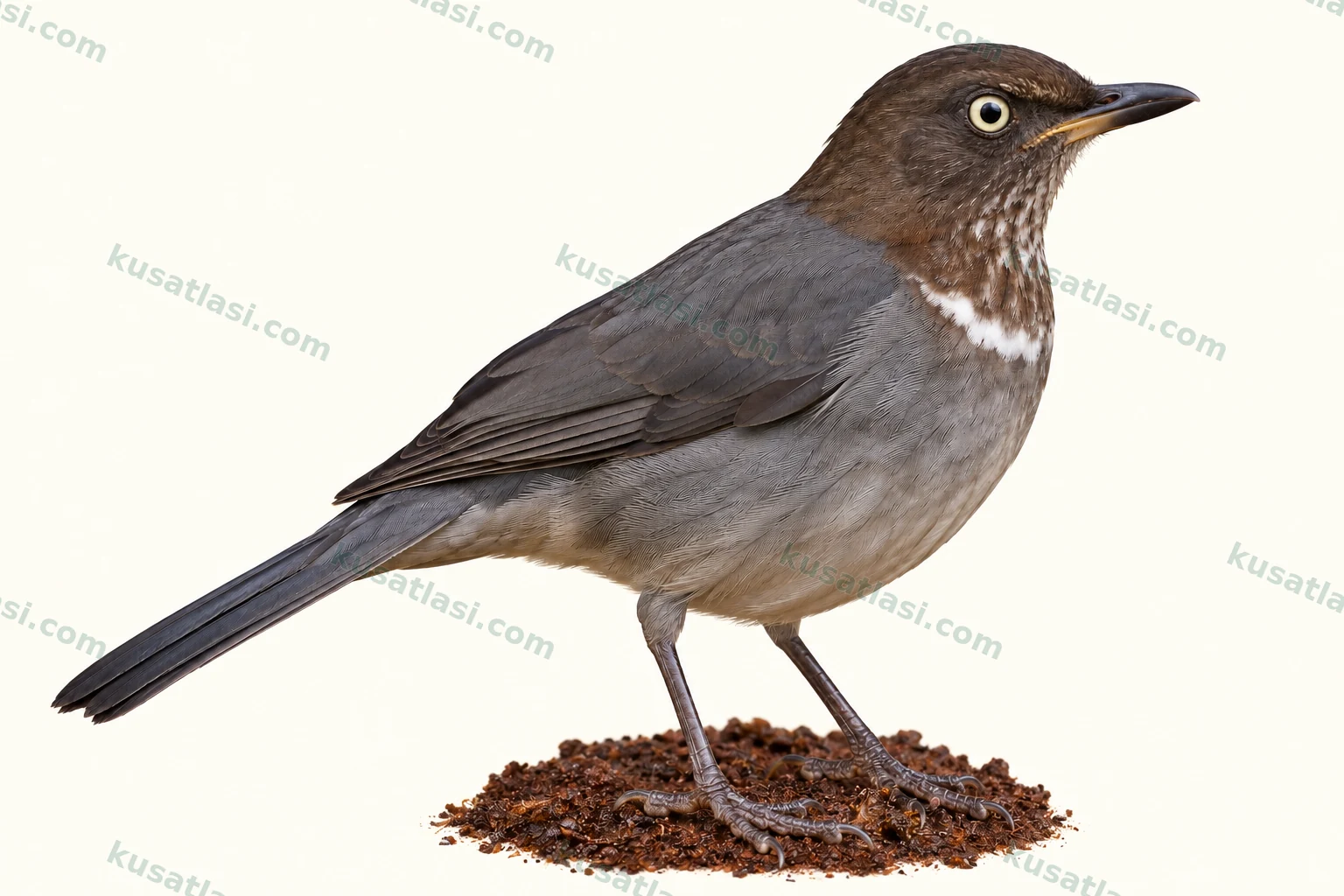
Swipe between the two adult plates.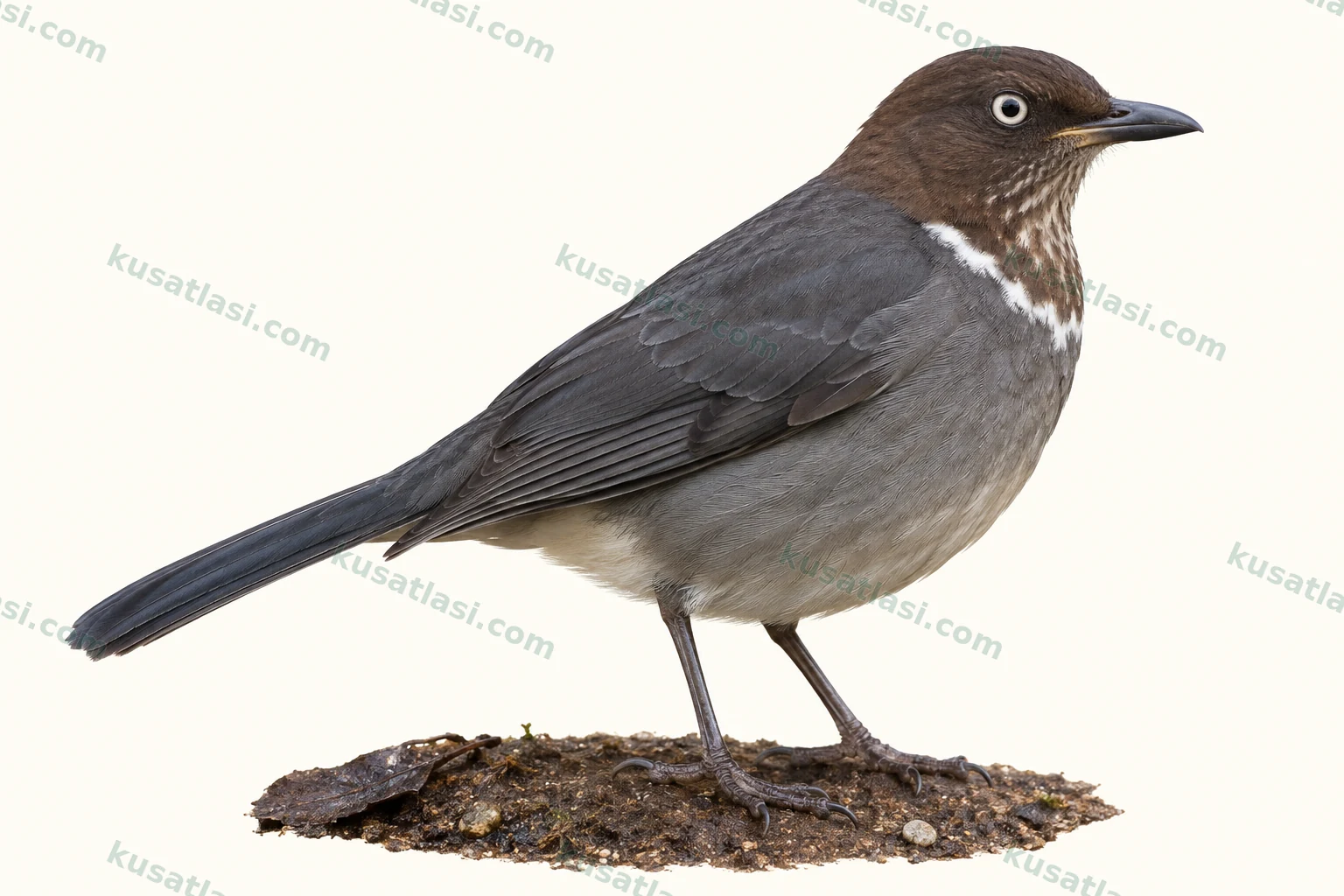
Turdidae · Passeriformes
White-eyed Thrush
Turdus jamaicensis
Ak Gözlü Ardıç
Look for the brown head, grey body, pale eye and dark bill and legs together.
- Order
- Passeriformes
- IUCN Status
- LCLeast Concern
Biometrics
Length
- Male
- 23–24 cm
- Female
- 23–24 cm
Wing length
- Male
- 11.51 cm
- Female
- 11.51 cm
Weight
- Male
- 59 g
- Female
- 59 g
Detailed explanations of these measurements are available on our website, on the same species page.
At a Glance
- Brown head, grey body
Check the warm head against the cooler grey upperparts.
- Pale iris
Conspicuous in the dark head; use it with the other marks.
- Dark bill and legs
Important when comparing the orange-billed White-chinned Thrush.
Adult sexes look alike; juveniles have heavier breast streaking.
Calendar
The calendar shows the April–June Jamaican breeding period in the expert synthesis. No precise monthly route is assigned to elevational movements.
January
Outside the stated window
February
Outside the stated window
March
Outside the stated window
April
Reported breeding period
May
Reported breeding period
June
Reported breeding period
July
Outside the stated window
August
Outside the stated window
September
Outside the stated window
October
Outside the stated window
November
Outside the stated window
December
Outside the stated window
Species Information
Quick Identification
White-eyed Thrush is native only to Jamaica. The adult’s dark chestnut-brown head contrasts with the grey back and body, and the pale eye stands out conspicuously. A small white crescent below the brown-streaked white throat, together with dark bill and legs, provides supporting characters. Assess head, breast and bill colours together rather than identifying the bird solely by its pale eye.
Appearance and Posture
The upperparts from mantle to tail are dark slate grey. Below, the bird is paler grey-brown, with white at the vent. The contrast between a warmer brown head and cooler grey body is useful even in a more distant adult. Calling the bird uniformly brown or black would obscure that pattern.
The white chin and throat carry chestnut-brown streaks. A small white crescent lies below the throat at the upper breast. These are different elements: the streaked area beneath the head and the pale boundary below it can be checked separately. The remainder of the adult breast is plainer.
The whitish iris appears as a sharp pale point within the dark head. Bill and legs are blackish. When comparing it with Jamaica’s other resident Turdus, these areas are useful checks after the eye. Secretive feeding in dense vegetation can prevent all the marks from being seen in one brief view.
Males, Females and Young Birds
Males and females look alike, with no reliably distinct sex-specific plumage pattern described in the source. Juveniles generally resemble adults but have much heavier breast streaking. This extensive juvenile marking should be distinguished from the brown streaks concentrated on an adult’s throat. One plumage area alone does not establish a precise age or sex.
Appearance in Flight
Grey on the back, wings and tail contrasts with the brown head. The pale eye and throat pattern may be missed in a fleeting or rear view. The reviewed expert account does not establish a uniquely diagnostic wingbeat pattern, so identification should be supported by views of the perched bird’s head, body and bill colour.
Voice and Behaviour
The song consists of repeated musical phrases, including “hee-haw”-like whistles. The Cornell account compares it with Northern Mockingbird, Mimus polyglottos, but describes it as louder and less variable. That is a comparison of song structure, not proof of direct imitation of other birds. Calls can be harsher and more shrill.
It can feed unobtrusively within dense cover, using levels from leaf litter to the canopy. Observation should therefore not be limited to the path surface. Watch the layer from which the sound comes rather than approaching closely to drive the bird from cover.
Similar Species
1. White-chinned Thrush (Turdus aurantius): This co-occurring Jamaican species has an orange bill and legs, a small white chin patch and a conspicuous white wing patch. White-eyed Thrush has dark bill and legs and a distinctly browner head than body. Seeing white on the chin alone therefore does not separate the two. White-chinned is more tolerant of disturbed vegetation, but habitat is not a sufficient identification character by itself.
World Distribution
Endemic to Jamaica, with its native distribution confined to that island. The Cornell account recognises no subspecies. Its use of suitable forest at both higher and lower elevations does not imply equal abundance everywhere. The geographic boundary of the range and encounter frequency in a particular forest patch are different kinds of information.
Status within Its Range
The expert account describes it as fairly common in mountain forest and records its presence in the Blue and John Crow Mountains National Park. These are regional descriptions of a forest bird’s occurrence, not a current island-wide population census. Damp gullies and retained tree cover are important to understanding its local distribution.
Seasonal Movements
Resident, with no regular seasonal migration route outside Jamaica described. Some birds breeding at higher elevations range into lowland valleys outside breeding. This regional elevational movement does not mean every individual travels the same distance on synchronised dates. No fixed route or common monthly descent-and-return schedule is assigned without supporting evidence.
Breeding Habitat
Wet forest and densely vegetated gullies are characteristic habitats. Shade-coffee plantations and other wooded areas are also used. Occurrence in coffee does not establish equivalent use of open agriculture after tree removal: the source specifically identifies shaded, wooded conditions.
Nest Site
The Cornell synthesis gives an April–June breeding season. The bulky cup nest is made of plant material and placed in a tree. Clutches contain 2–3 eggs, pale bluish green with heavy speckling. Incubation and nestling durations could not be verified in the reliable sources reviewed. The division of incubation between the sexes is not established here, and neither duration nor care pattern is transferred from a close relative.
Daily Habitat Use
Daily activity can involve dense undergrowth and higher tree layers. In a damp gully, a bird may remain concealed while calling nearby. At a nest, leave surrounding foliage intact and keep the adults’ approach unobstructed.
Diet
The diet includes fruits and invertebrates, among them earthworms and insects. Reported fruit plants include Trophis racemosa, Nectandra antillana, Cupania glabra and Dunalia arborescens. These records show that feeding is not restricted to one fruit. They do not establish equal use of each plant throughout the island or a constant year-round proportion of fruit and animal food.
Foraging
It searches leaf litter on the forest floor, but feeding is not confined to the ground. Dense vegetation and the canopy are also used, so a bird feeding high in a fruiting tree fits its known foraging range. The account does not describe all prey being chased in the air or every food item being obtained by one method.
Names Inspired by a Glassy Eye
In The Birds of Jamaica, published in1847 by Philip Henry Gosse with Richard Hill’s assistance, this bird appears under Glass-eye. Shine-eye and Fish-eye are also recorded, referring to the pale, glassy appearance of the iris. The book explicitly equates Merula jamaicensis with Turdus jamaicensis in the same entry, confirming the identity of the historical account.
The Limits of Historical Food Samples
Gosse reported fruit but no animal remains in Jamaican stomach samples, without specifying their number. The modern expert synthesis includes worms and insects alongside fruit. Failure to find an item in those historical samples is not proof that the species never eats it. The accounts illustrate the distinction between a limited sample and the full species diet.
Feeding on an Introduced Plant
The Cornell account reports feeding on introduced Pittosporum undulatum along Jamaican mountain trails. A native island bird can therefore use a plant brought from elsewhere; its food associations are not restricted to native plants. Fruit consumption alone does not measure dispersal distance or the proportion of seeds that germinate.