
World Birds
Field Guide Plates
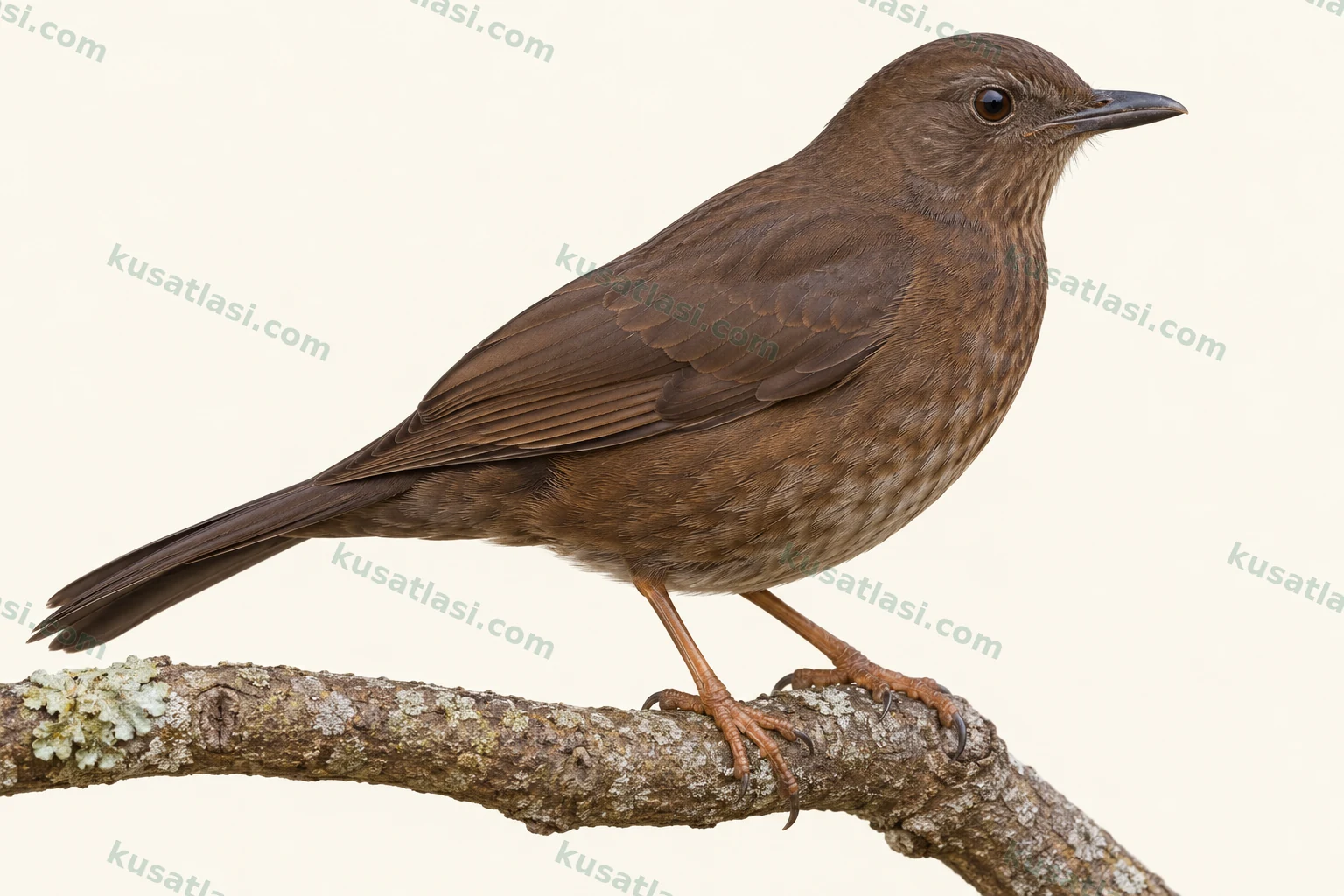
Swipe between the two adult plates.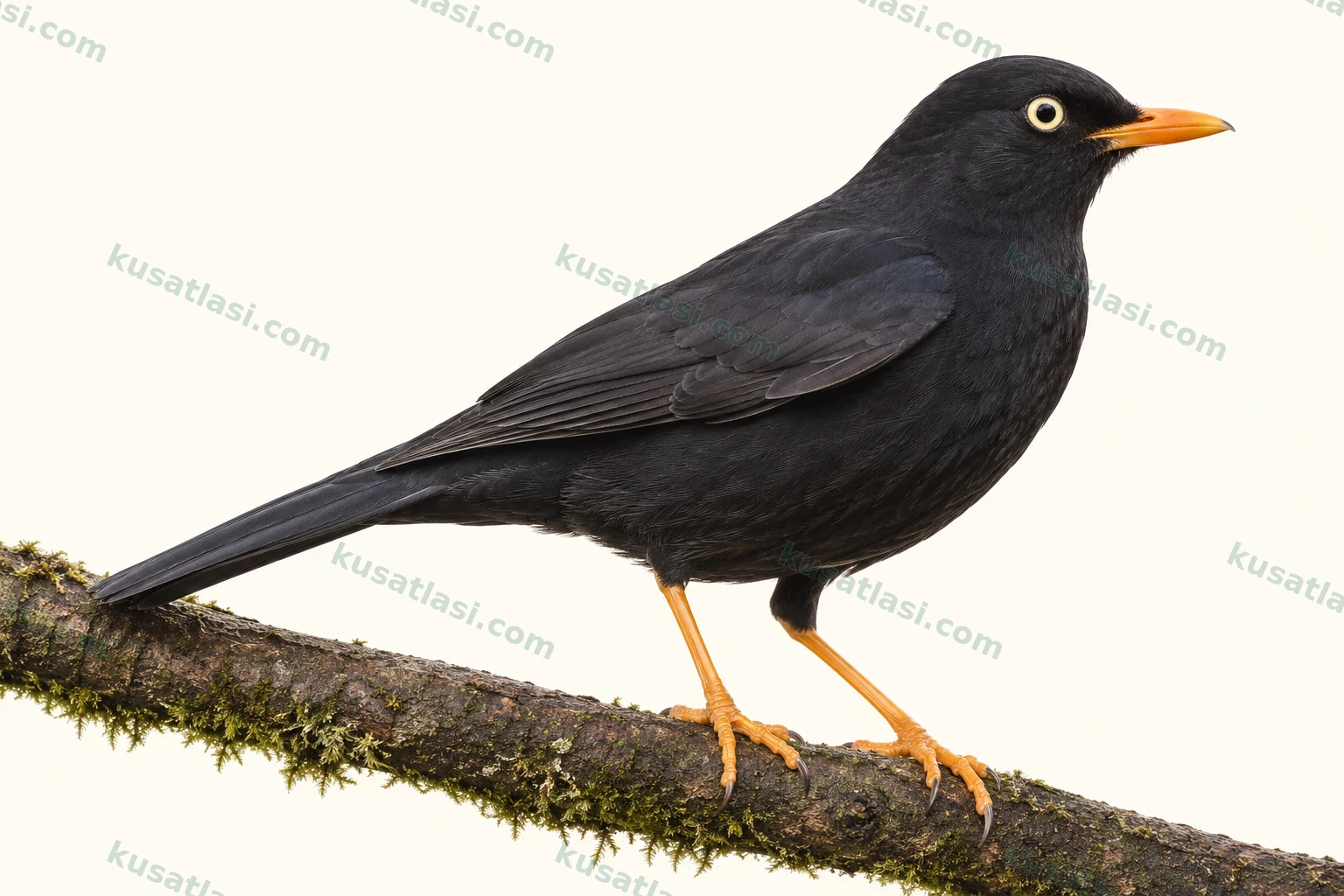
Turdidae · Passeriformes
Pale-eyed Thrush
Turdus leucops
Ak Gözlü Karatavuk
Assess the male’s black plumage,pale iris and yellow-orange bill together;females are brown.
- Order
- Passeriformes
- IUCN Status
- LCLeast Concern
Biometrics
Length
- Male
- 18–21 cm
- Female
- 18–21 cm
Wing length
- Male
- 11.71 cm
- Female
- 11.71 cm
Weight
- Male
- 54–80 g
- Female
- 54–80 g
Detailed explanations of these measurements are available on our website, on the same species page.
At a Glance
- Glossy black male
Bluish reflections can appear in good light.
- Pale iris in males
Iris and surrounding orbital ring are distinct structures.
- Olive-brown female
Do not apply the adult-male key unchanged to females.
Sexes differ strongly;juveniles are brown and mottled.
Calendar
This calendar shows the December–June breeding-attempt window of the San Isidro–Yanayacu study in northeastern Ecuador. It is not a shared season throughout the range;see Interesting Facts for regional differences.
January
Local study window
February
Local study window
March
Local study window
April
Local study window
May
Local study window
June
Local study window
July
Outside this study window
August
Outside this study window
September
Outside this study window
October
Outside this study window
November
Outside this study window
December
Local study window
Species Information
Quick Identification
Pale-eyed Thrush inhabits humid South American mountain forests. The adult male combines glossy blue-black plumage, a conspicuously pale iris and a yellow to orange bill. Females are olive-brown and look quite different. The pale eye suggested by the name should therefore not be treated as equally conspicuous in every sex and age.
Appearance and Posture
Head, back, wings and underparts of the male look generally black, with blue or greenish metallic reflections in favourable light. The iris is bluish white, sometimes almost pure white. Legs and feet usually match the bill’s yellow or orange tones. The pale iris is distinct from the surrounding orbital skin; a fine pale ring need not look identical in every individual.
This is an unobtrusive bird within the trees, encountered alone, in pairs or in small family groups. Several birds visiting one fruiting tree do not necessarily constitute a permanent flock. For a male, check the generally black body together with iris and bill colour.
Males, Females and Young Birds
Females are dark olive-brown above and somewhat paler below. The lighter throat can carry faint streaks or spots. The iris is pale brown or grey-brown, and the usually dark bill may become yellower in breeding condition, making bill colour alone insufficient for sexing. Legs are duller yellowish than in males.
Juveniles resemble females but show buff streaking and flecking on the head and back, with darker mottling from breast to flanks. Young males approaching adult appearance can retain brown flight feathers and cream-tipped wing coverts. Their browner iris and darker bill differ from the conspicuous pale-eyed appearance of an adult male.
Appearance in Flight
Within forest it makes short flights between trees and vegetation layers, including through tangled growth beside streams. Wings and tail continue the male’s dark or female’s brown appearance. A fleeting flight view can conceal the eye and facial details, so a passing black or brown silhouette is insufficient for identification.
Voice and Behaviour
The male’s song proceeds in short phrases separated by conspicuous pauses, combining thin high notes with more musical whistles. Expert accounts report imitation of other birds, insects and frogs within the song. Such variability makes a single short phrase an unreliable universal key. Short contact calls are also exchanged among adults and young.
Song often comes from a perch in or just below the canopy. Voice can locate a bird without making visual confirmation easy in dense foliage. Watch the calling branch from a distance rather than approaching to flush its occupant.
Similar Species
1. Yellow-legged Thrush (Turdus flavipes): It also has black males and brown females. The conspicuous bluish-white iris is an important character of male Pale-eyed. When comparing females, assess Yellow-legged’s yellow orbital ring and more evident chin-and-throat streaking; yellow legs alone are insufficient.
2. Glossy-black Thrush (Turdus serranus): Black males can look similar at a distance, making Pale-eyed’s light iris particularly useful. Female Glossy-black is generally larger, with a narrow yellowish orbital ring and more uniformly brown underparts. The glossy-black adult-male key should not be applied to females or juveniles.
3. Black-hooded Thrush (Turdus olivater): Females can be compared using their paler buff-brown underparts and fine yellowish orbital ring. In mountain forests where the species can co-occur, examine iris colour, orbital skin, throat and body tones together.
World Distribution
Its native range is discontinuous across mountain regions of northern and western South America. It occurs in northern Venezuelan ranges and Andean forests from Venezuela through Colombia, Ecuador and Peru to Bolivia. Tepuis of southern Venezuela, adjacent northern Brazil and the Roraima region of western Guyana also support populations. This is not a continuous distribution across all intervening lowlands.
Status within Its Range
Regional accounts often describe it as rare or uncommon, although it can be more frequent at suitable sites. Concealment and use of tree layers affect encounter rates. Few captures in nets sampling only the understorey do not measure every bird in the canopy. The Cornell account identifies gaps in global population size and trend information.
Seasonal Movements
Considered resident across most of its range. Some records may reflect local elevational or post-breeding movements, rather than migration on synchronised dates in every population. The reviewed sources do not establish a species-wide route, shared distance or monthly departure-and-return schedule.
Breeding Habitat
Very humid, mossy montane and cloud forest is characteristic habitat. Older secondary woodland, shaded forest margins and some shade-coffee areas are also used. Humid stream valleys connected to forest are important. This does not establish equivalent use of open treeless agriculture. Direct nest research in Ecuador took place in cloud forest around San Isidro and Yanayacu in the northeastern Andes.
Nest Site
The nest is an open cup with a mossy exterior and a lining of fine dark rootlets. A trunk side, branch junction or shallow cavity can provide support; roadside banks are also used. Ecuadorian nests studied were 0.8–3.2 metres above ground. Usually two eggs, rarely one, have greenish or pale blue ground colour with brown to reddish markings.
In the Ecuador study, incubation lasted 14 days at the sole nest with a known onset; natural departure averaged 18.6 days at five nests. Females incubate and both parents feed young. These durations belong to a particular local sample. Observer approach caused some premature departures, so watch remotely and leave the adults’ access unobstructed.
Daily Habitat Use
It frequently uses middle and upper tree layers but also descends to the ground and dense undergrowth. Search more than the path surface: activity can shift between forest levels. A bird disappearing from view need not have left the forest patch.
What Does It Eat?
Fruit is important, supplemented by arthropods such as insects and spiders. Plants reported in the Cornell synthesis include Myrsine coriacea and Bactris setulosa. No quantitative study there establishes an invariant fruit percentage throughout the range. Fruit-dominated feeding should therefore not be understood as exclusive frugivory.
At a nest monitored in 2003 in Otún-Quimbaya, in Colombia’s Central Andes, both parents brought Dendropanax macrophyllum fruit. Its seeds and insect remains occurred together in nestling droppings. This directly documents plant and animal components in nestling food, without establishing a fixed proportion for every brood.
How Does It Forage?
Fruit can be picked from a perch or during a brief hover and swallowed whole. Food is sought in trees, leaf litter and dense vegetation. Following army ants to take disturbed insects has been reported, without establishing obligatory or continuous ant-following. It also explores moss and plants growing on trees; this does not justify adding unverified vertebrate prey to its diet.
Different Local Breeding Calendars
A broad mountain distribution does not imply identical breeding months everywhere. The expert synthesis particularly reports April–June in northern Venezuela, whereas the northeastern Ecuador study followed attempts from December through young leaving in June. April–June breeding records also exist for Colombia. These regional patterns should not be collapsed into one worldwide calendar.
During the 2003–2005 Ecuador study, few nests were found in some years and none in one year despite comparable search effort. The authors discuss this variation. It does not by itself establish regular skipped breeding throughout the species or prove that a particular food shortage caused it.
The Nest’s Microclimate
Measurements at two Colombian nests in 2003 showed that the cups did not cool at the same rate after the female left. Cooling was much greater at one nest. Placement and local microclimate are possible explanations, but the researcher explicitly noted that all potentially influential variables had not been measured. This is a comparison of two nests, not an invariant temperature rule for every forest.
A Different Genus Name in Older Literature
Older studies may use Platycichla leucops. The current Cornell account treats the same species as Turdus leucops and recognises no subspecies. The former genus name alone does not mean that a different bird was studied. Nevertheless, information about the similar Yellow-legged Thrush cannot be transferred to this species: historical name matching and biological species identity require separate checks.