
World Birds
Field Guide Plates
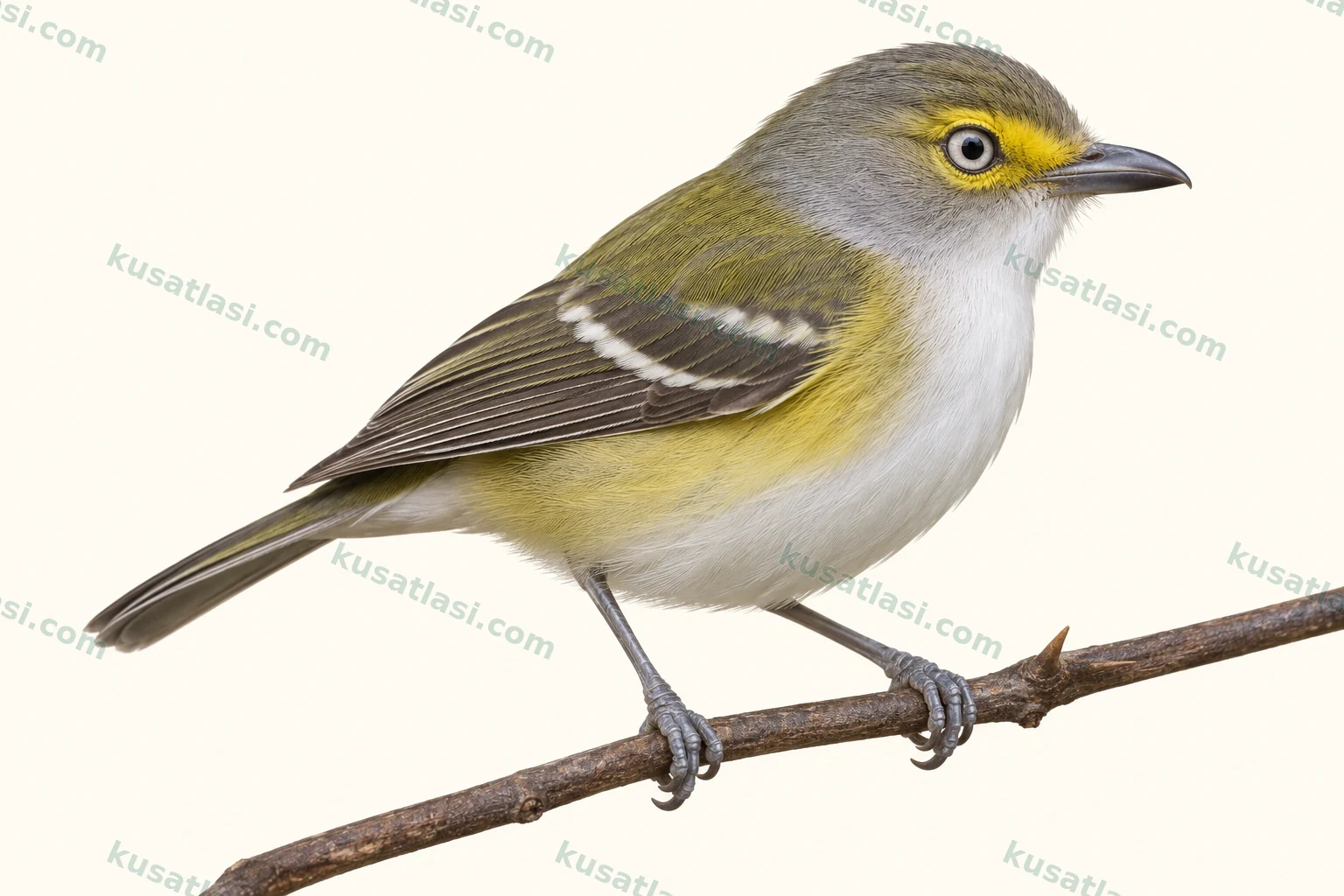
Swipe between the two adult plates.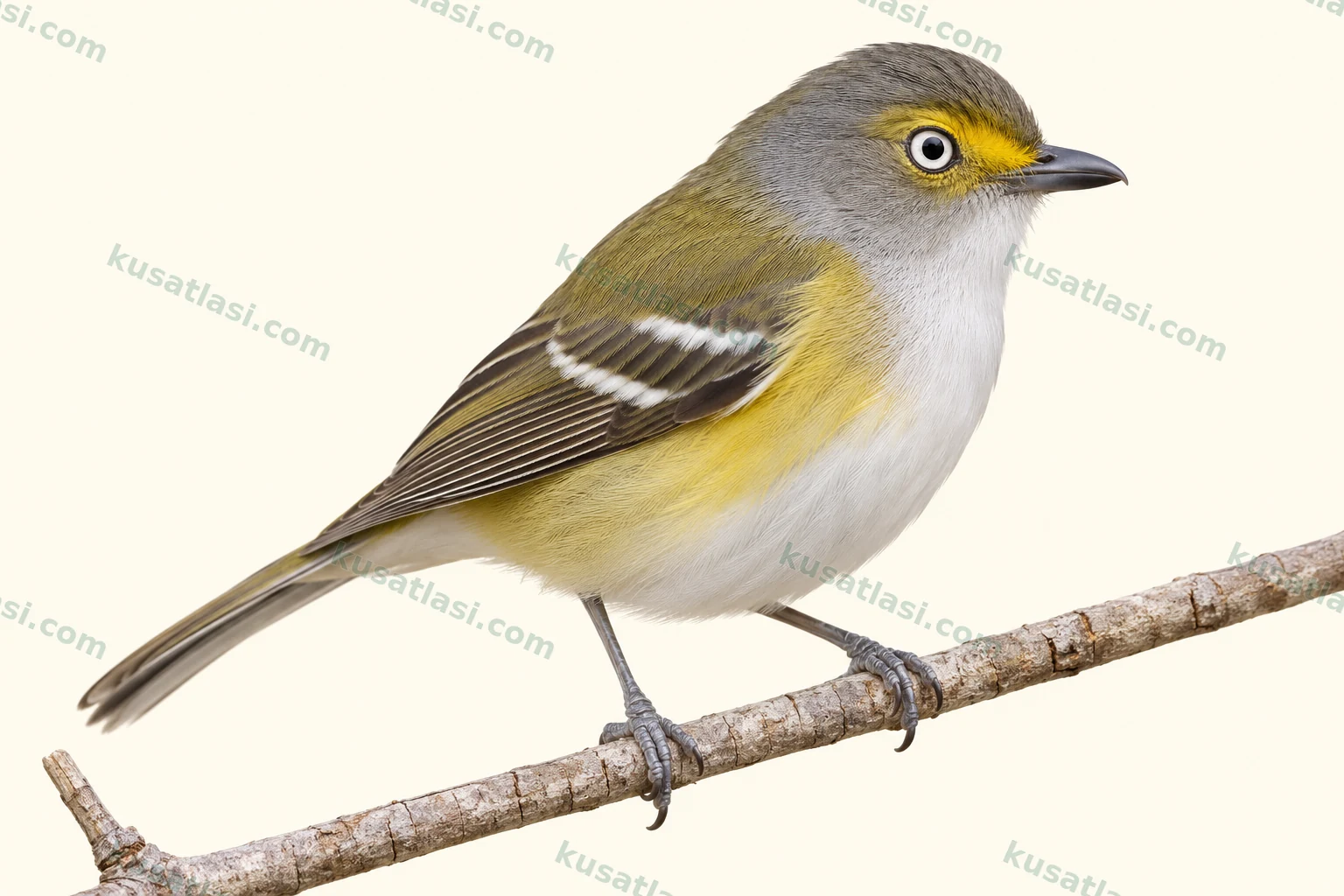
Vireonidae · Passeriformes
White-eyed Vireo
Vireo griseus
Ak Gözlü Vireo
In adults, look for a white iris, yellow spectacles, two pale wingbars and yellow sides together.
- Order
- Passeriformes
- IUCN Status
- LCLeast Concern
Biometrics
Length
- Male
- 10–14 cm
- Female
- 10–14 cm
Wing length
- Male
- 6.16 cm
- Female
- 6.16 cm
Weight
- Male
- 8.28–13.9 g
- Female
- 7.56–13 g
Detailed explanations of these measurements are available on our website, on the same species page.
At a Glance
- Yellow spectacles
Yellow in front of and around the eye.
- Two pale wingbars
Useful even in duller young birds.
- Whitish centre, yellow sides
Intensity varies geographically and with wear.
Sexes look alike. Juvenile eyes are brown; a grey iris alone does not give a precise age.
Calendar
Northern populations migrate, some southern ones remain resident. Bermuda breeding and care records extend from late February into August; one monthly chart cannot represent the entire range.
Species Information
Quick Identification
White-eyed Vireo is a small bird of dense scrub in eastern North America, Mexico and nearby regions. Adults combine a white iris, yellow line in front of and around the eye, two pale wingbars and yellow sides. The throat and central underparts are generally whitish. Dense vegetation may allow only brief views of these features; song is often the easiest way to locate the bird.
The head and neck look thick, and the sturdy bill has a slightly downturned tip. Young birds have dark eyes, so insisting on the adult white iris can cause misidentification, particularly in autumn. Wingbars and yellow in front of the eye remain useful at that age.
Appearance and Posture
Upperparts range from greenish-grey to olive-green, with a greyer neck. The forehead may be more yellowish-green and crown and nape greyer. Wings and tail are greyish-brown with yellowish or olive feather edges. Pale tips to the wing coverts form two distinct bars, varying from whitish to yellowish-white.
The yellow line above the eye and narrower orbital ring form a spectacle-like pattern. A dark line between eye and bill may interrupt the ring, and the thickness and continuity of yellow above the eye vary. Central breast and belly are not equally bright in every bird: some show clean white, others a duller greyish centre. Yellow is most obvious along the sides.
The bill is usually dark, although the lower mandible may be paler and the edges yellowish. Legs are bluish-grey in life. Feather wear in late spring and summer can reduce colour richness. Birds from southern Florida and Bermuda can be greyer with weaker yellow on the flanks, so vivid yellow should not be expected on every individual.
Males, Females and Young Birds
Males and females cannot reliably be separated by plumage. Song or territorial behaviour may identify sex in particular contexts, but an apparent difference in colour brightness in an image is not a dependable male–female distinction.
Fresh juveniles can have duller brownish olive-green upperparts, beige cheeks and pale yellow around the eye. Wingbars may look buffier than the adult’s whitish bars. Underparts are dull greyish-white, with buff or yellow tones on throat and sides. Later plumage approaches adult appearance.
Brown juvenile irides begin to lighten on the wintering grounds, and most birds look adult-like by spring. The transition does not finish on the same date in every bird, and greyish irides have also been documented in older individuals. Detailed ageing from contrasts between feather generations requires expertise; a distant grey eye should not establish a precise year of age.
Appearance in Flight
Usually makes short flights between shrubs with rapid wingbeats, using the tail to manoeuvre. Hops along branches alternate with these brief flights. Fluttering flight is also reported in courtship and confrontations. None of these behaviours identifies the species alone; seek the face pattern and wingbars when it lands again.
Voice and Behaviour
Song is a crisp, emphatic sequence combining contrasting short notes in rapid succession. A male may use several distinct song types, so one memorized phrase will not represent every individual. It also gives softer, more continuous, hurried-sounding rambling sequences. Males are the principal singers on breeding grounds, making birds detectable even while concealed.
Territorial displays can include fluffing and sleeking feathers, wing flicks and a forward head posture, escalating to chasing. Behaviour on wintering grounds is not identical to breeding behaviour. Year-round territoriality is documented in resident Bermuda birds; it should not be assumed to describe the annual cycle of every continental migrant.
Similar Species
Vireo bellii can occur alongside it in the central United States. It is generally greyer, dark-eyed and lacks the bright yellow in front of the eye. A dark-eyed first-autumn White-eyed Vireo has stronger wingbars and at least some yellow above the lores; iris colour alone cannot separate them at that age.
Vireo crassirostris is an important comparison in the Bahamas and nearby islands, and occasionally southern Florida. It has a larger-looking bill and lacks the white iris; assess bill with eye and face pattern. Vireo pallens matters along the Mexican coast and in the Yucatán, being duller overall with less conspicuous yellow. Some southern White-eyed Vireos are also duller, making a decision from one colour unreliable.
The Jamaican Vireo, Vireo modestus, may also have a white iris. A pale eye in the Caribbean therefore does not automatically identify White-eyed Vireo. Yellow in front of the eye, pale throat, bill and island locality should be considered together; geography supports rather than replaces plumage identification.
World Distribution
The main breeding range covers the eastern, southeastern and central United States. Resident populations also occur in southern Texas and eastern Mexico. Southern Florida and Bermuda support geographically distinct forms. It is the subspecies bermudianus, rather than the entire species, that is endemic to Bermuda.
Northern migrants winter along the southeastern United States and Gulf coasts, in eastern Mexico, the northern Caribbean and northern Central America. Occasional records extend south to Costa Rica. Regular wintering areas and more distant irregular records should not be portrayed as equally frequent occurrence.
Status within Its Range
Widespread in many areas with suitable dense scrub, but habitat use and local trends vary regionally. An increase at continental scale does not establish the same outcome on every island or for every subspecies. In Bermuda, local studies describe space use and breeding outcomes rather than a definitive island-wide census; these should not be presented as the current total population.
Seasonal Movements
Northern populations migrate, while some southern populations remain year-round. The southeastern United States shows a mixed pattern involving both residents and migrants. Bermuda birds are sedentary and may occupy the same area throughout the year. These differences prevent one departure date, return date or universal route from representing every population.
Breeding Habitat
Uses dense thickets with brambles and vines, overgrown former farmland, forest edges and thick streamside vegetation. Regenerating deciduous growth is important in the inland United States. In southeastern coastal areas it can occupy dense understory beneath swamp forest or more closed woodland, and in southern Florida it uses mangroves. It is therefore not confined to dry scrub or young forest alone.
The shared feature is dense, varied low vegetation providing cover. The amount of taller tree cover varies geographically. An increase following a forestry treatment in one region does not establish that treatment as beneficial throughout the range.
Nest Site
The nest is usually an open cup suspended by its rim between horizontal forked twigs. Spider and caterpillar silk bind leaves, bark, fine roots and plant fibres. Lichen, moss and leaves may be added outside, with finer plant material lining the cup. Both partners contribute; continental records describe the female completing the lining.
Typical clutches contain three or four eggs. The detailed expert account explicitly states that it could not verify five-egg clutches reported in some older sources. In the 2016–2021 Bermuda study, twenty-one nests held one to four eggs; that island sample is not one universal continental range. Eggs are whitish with sparse brown or reddish speckling.
Virginia, United States, records give thirteen to fifteen days of incubation and nine to eleven days in the nest. In Bermuda, eleven fully observed incubation periods lasted twelve to sixteen days, and nestling periods at six nests nine to fourteen days. Both sexes incubate and feed young; continental observations place night incubation with the female. Nest departure is not the same as independence. Observe without exposing the nest or obstructing returning adults.
Daily Habitat Use
Usually moves under cover among branches and foliage. Winter habitats are more varied than breeding habitats: on Mexico’s Yucatán Peninsula it forages in both scrub and more developed forest. Fruiting trees can become important for feeding and territorial defence. Frequent concealment in thick scrub does not mean that it never uses higher branches.
What Does It Eat?
Arthropods form an important part of the diet, including caterpillars, moths and butterflies, flies, beetles, leafhoppers, grasshoppers and spiders. It also eats small fruits, which become more important outside the breeding season. This seasonal contrast does not mean that fruit is absent in summer or insects abandoned in winter.
Birds wintering on Mexico’s Yucatán Peninsula use Bursera simaruba fruit and may defend fruiting trees against other birds. During 2016–2021 nest observations in Bermuda, adults delivered insects, caterpillars, spiders and small Anolis lizards to young. That island observation does not establish lizards as a staple in every population.
How Does It Forage?
Moves with short hops and flights, pausing to tilt its head and inspect foliage. It may pick prey directly from leaves, reach, hover briefly, lunge or hang from a branch. Small items can be swallowed, while larger ones may be pinned to a branch with a foot and dismantled. Beating caterpillars against branches and removing wings from some prey are recorded; foraging is not limited to one manoeuvre.
Songs Built with Other Birds’ Calls
White-eyed Vireos can incorporate short call notes of other birds into their own songs. This differs from reproducing another species’ entire territorial song. The expert account describes this combination of contrasting sounds, but its function remains uncertain. A specific purpose such as deceiving enemies should not be asserted without direct evidence.
The Family after Nest Departure
In the 2016–2021 Bermuda study, fledgling care lasted twenty-six to fifty-seven days in five families followed throughout that stage. This small island sample does not establish the same duration for every continental family. Colour-banded pairs divided their young, with males caring within their territory and females inside it or occasionally beyond it. Separate provisioning trips did not necessarily indicate the end of the pair bond.
Territory Fidelity and the Limits of a Study
The 2025 study of Bermuda observations from 2016–2023 documented year-round territoriality and longer occupancy of particular territories by males than females. However, singing males generated far more location records, making limited female data an important constraint. Remaining in the same broad woodland patch was distinguished from holding one specific territory. The findings do not assign an invariant territory size to all White-eyed Vireo populations.
During the same Bermuda study, a male was observed taking over a neighbouring male’s territory on 26 April 2019. The previous owner was not subsequently seen there, which does not establish that it had died. This single event documents territorial defence escalating to physical confrontation.