
World Birds
Field Guide Plates
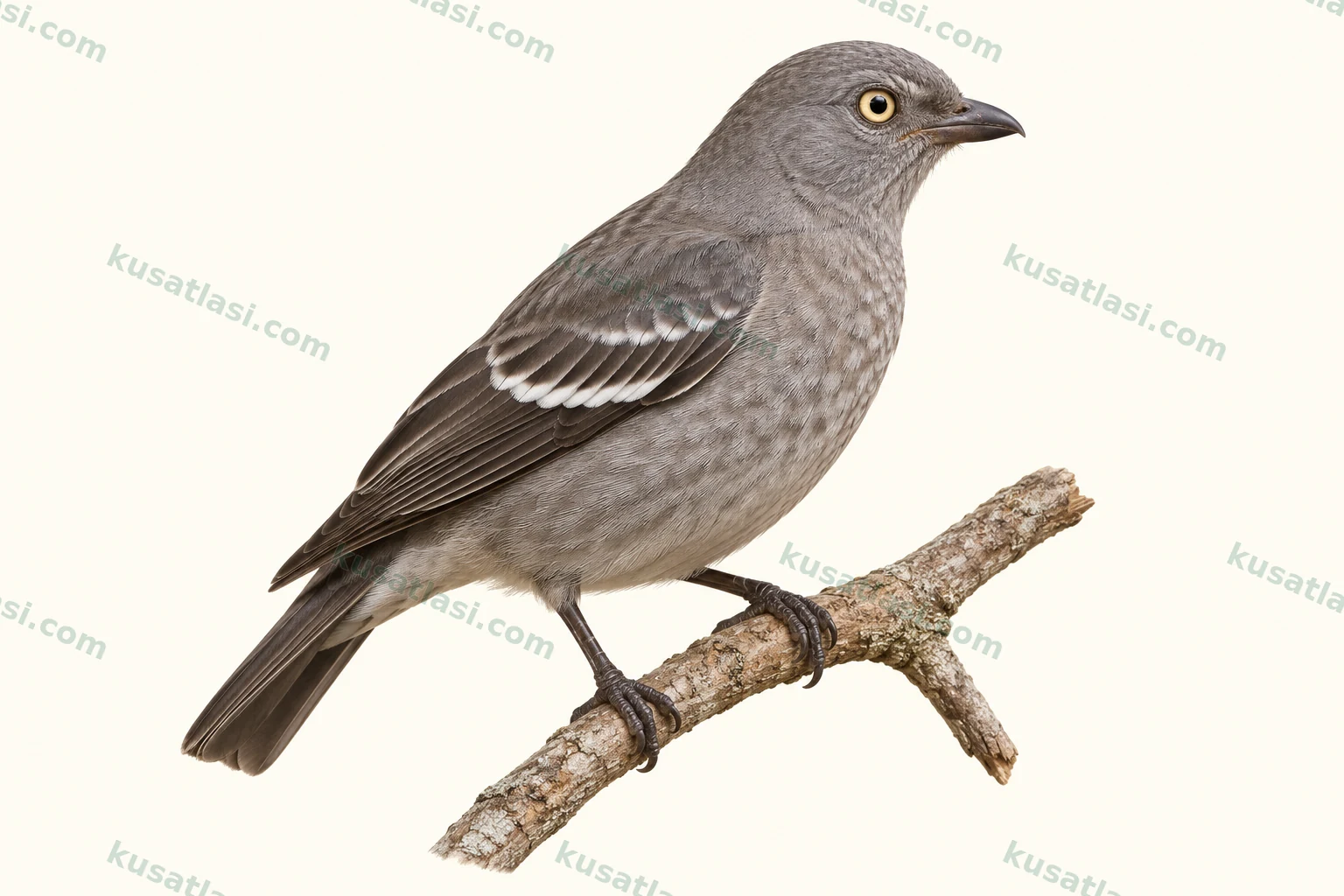
Swipe between the two adult plates.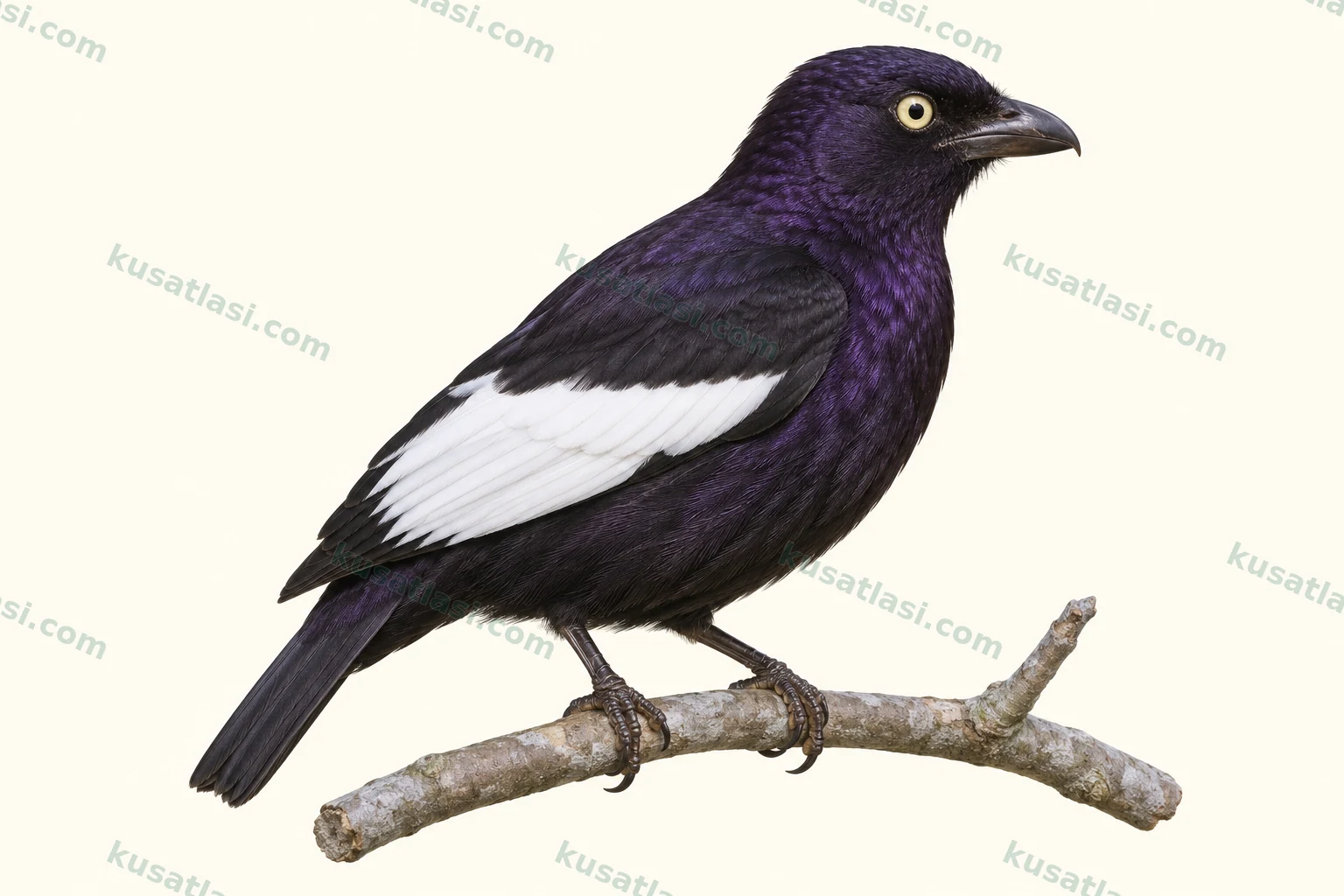
Cotingidae · Passeriformes
White-winged Cotinga
Xipholena atropurpurea
Ak Kanatlı Kotinga
Males have a dark purplish body and white wings; females are grey with white wing edges.
- Order
- Passeriformes
- IUCN Status
- VUVulnerable
Biometrics
Length
- Male
- 19 cm
- Female
- 19 cm
Wing length
- Male
- 11.02 cm
- Female
- 11.02 cm
Weight
- Male
- 58–65 g
- Female
- 56–67 g
Detailed explanations of these measurements are available on our website, on the same species page.
At a Glance
- Pale eye
The similar female Banded Cotinga has a dark eye.
- Short dark tail
Do not confuse wing white with a white tail.
- Forest canopy
Scan exposed branches and fruiting trees.
Adults differ, but a verified immature ageing and sexing schedule is unavailable.
Calendar
An expert account suggests breeding is concentrated in August–February; a precise whole-range monthly calendar was not verified.
Species Information
Quick Identification
An adult male combines a nearly black, purplish body with white wings and a pale eye. Females are grey, with diagnostically useful white wing edges.
General Appearance and Posture
The short tail is dark. In males, black primary tips border the white wings. Females have a pale throat and darker breast with whitish mottling, contrasting with the greyish-white remaining underparts.
Males, Females and Young Birds
Strong adult sexual differences do not make every immature bird reliably sexable by appearance. A dependable age and moult schedule for acquisition of adult male plumage was not verified for this guide.
Appearance in Flight
When the wings open, the adult male’s white wing area stands out against its dark body. A whir produced by wing movement should be distinguished from a vocal call.
Voice and Behaviour
Look on exposed canopy branches and in fruiting trees. It gives chirping calls. Males may remain still on a perch for long periods, making a brief scan of a quiet tree inadequate for detecting them.
Similar Species
When comparing females with Banded Cotinga (Cotinga maculata), check for this species’ white wing edges and pale eye. Female Banded Cotinga is more strongly scaled below, lacks the corresponding white wing edges and has a dark eye.
World Distribution
Endemic to eastern Brazil’s Atlantic Forest, its historical range extends from Paraíba to Rio de Janeiro. That broad geographical span does not imply continuous occupancy of all intervening forest.
Status Within Its Natural Range
A study published in 2026 compiled 87 occurrence records from 1957–2024 across 21 forest fragments in the Pernambuco Endemism Center. These are neither a census of 87 individual birds nor proof of 21 current populations. The authors explicitly note that concentrated observer effort can affect record density in protected areas.
Movements and Migration
AVONET classifies the species as sedentary, without excluding daily foraging movements. A male was recorded in Sucupira Torta Forest, Paraíba, in October 2023 and a female in May 2024. Those observations alone do not demonstrate a breeding pair or a permanently resident population.
Breeding Habitat
It chiefly inhabits lowland primary forest and advanced regenerating forest. This should not be interpreted as adaptation to extensive open, non-forest landscapes.
Nest Site
An expert account describes a small bowl nest placed high above ground among lianas. Clutch size, incubation duration and nestling duration were not adequately verified.
Daily Habitat Use
Northern records in the 2026 study include seasonal forest types as well as rainforest. A single record in coastal sandy vegetation does not establish regular migration corridors. The authors’ suggested refuge and connectivity functions are not routes demonstrated by tracking individual birds.
What It Eats
Fruit forms the main diet; expert sources also report flowers and insects. The 2026 study assessed fruit use only from photographs showing fruit held in the bill. Recorded food plants included Araliaceae, Malpighiaceae, Arecaceae and Moraceae. Perching in a fruiting tree alone was not accepted as evidence of eating its fruit.
How It Forages
Taking fruit from a nearby perch and swallowing it whole is among the behaviours summarized from earlier work in the 2026 paper. Photographic records can identify food plants, but do not measure seasonal proportions of the entire diet or an individual bird’s daily intake.
The Chemistry of Dark Plumage
In a study published in 2012, Prum and colleagues chemically examined back feathers from one male museum specimen of this species. They detected a mixture of carotenoids in these very dark feathers. The result concerns the sampled region of one male: it does not establish the same chemistry in females or white wing feathers. Nor did the study conclusively identify every component of the dark colour or directly link it to the bird’s health.
A Reserve Boundary Is Not a Species Boundary
A 2020 study reported new records of three threatened cotingas, including this species, in unprotected Atlantic Forest fragments in southeastern Bahia. Reserves remain important, while forest beyond their boundaries also merits consideration. Occurrence at a site does not by itself demonstrate long-term population security.