
World Birds
Field Guide Plates
Swipe between the two adult plates.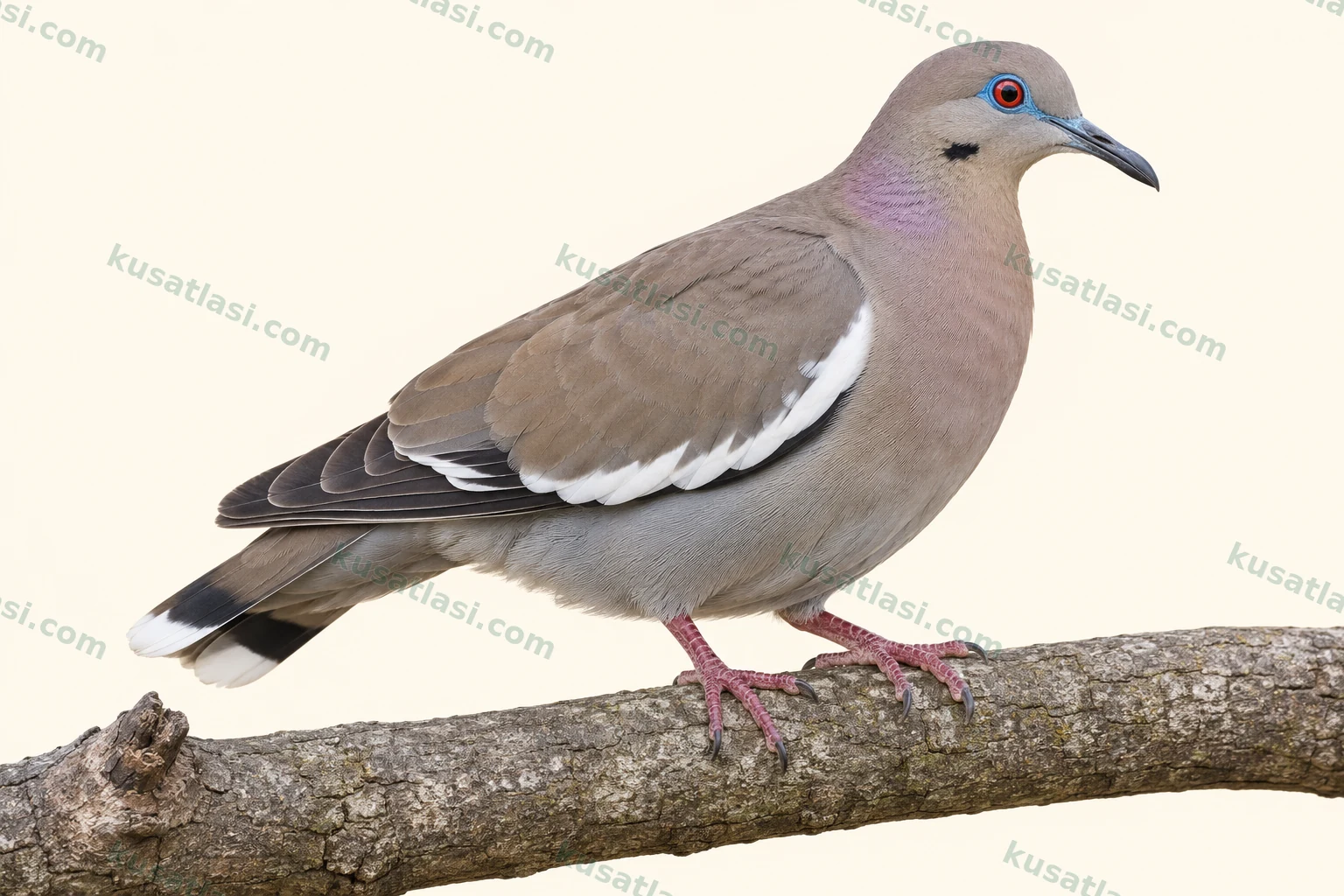
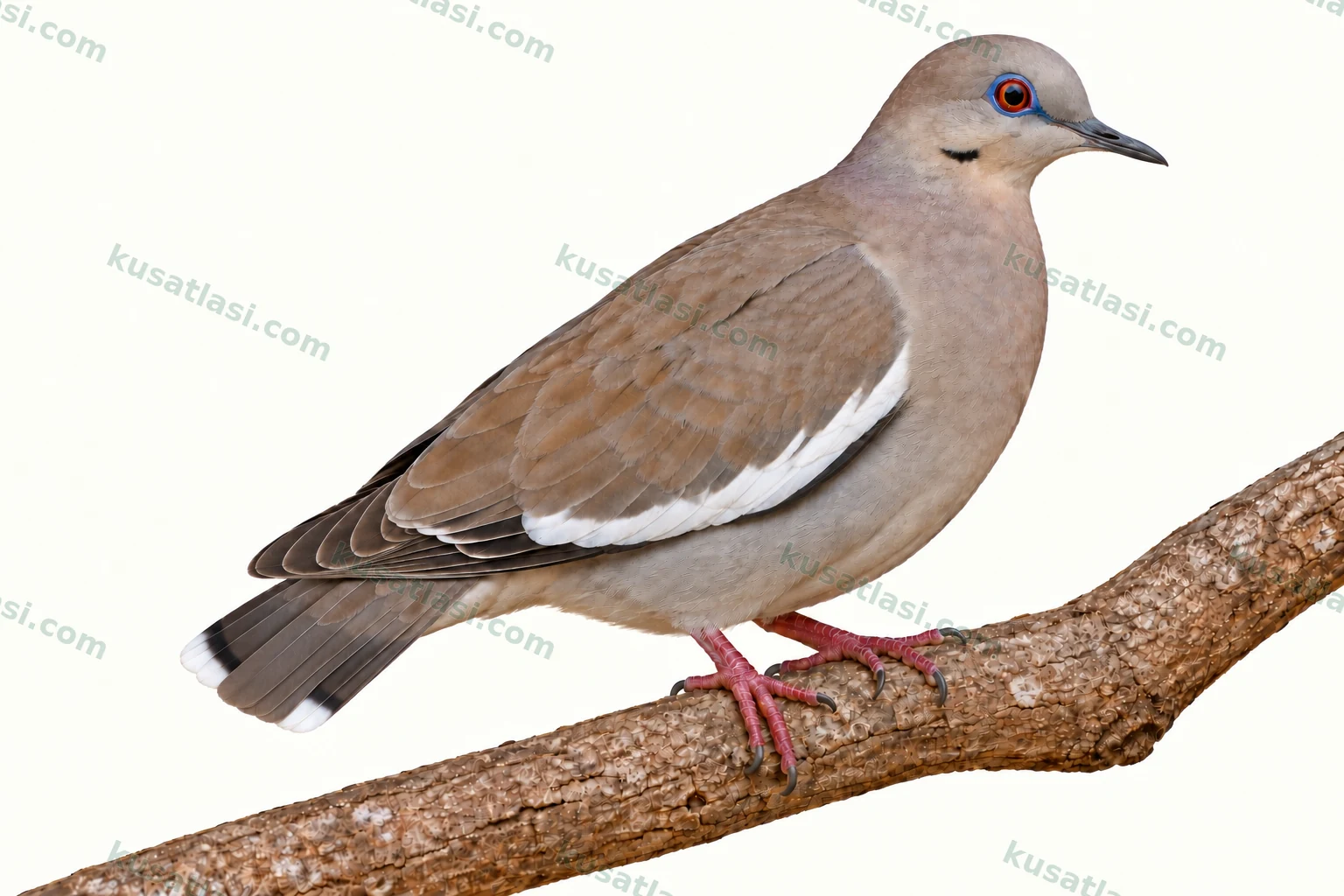
Columbidae · Columbiformes
White-winged Dove
Zenaida asiatica
Ak Kanatlı Kumru
Bulky body, white wing area and white tips on a short tail.
- Order
- Columbiformes
- IUCN Status
- LCLeast Concern
Biometrics
Length
- Male
- 27–31 cm
- Female
- 27–31 cm
Wingspan
- Male
- 43–46 cm
- Female
- 43–46 cm
Weight
- Male
- 125 g
- Female
- 153 g
Detailed explanations of these measurements are available on our website, on the same species page.
At a Glance
- White wing area
A narrow folded-wing line expands when the wing opens.
- Blue eye surround
Check together with the black cheek mark.
- Short tail
Mourning Dove is slimmer and longer-tailed.
Adult sexes resemble one another; juvenile feather marks do not provide an exact age calendar.
Calendar
Estimated Texas hatch dates or Arizona migration months do not describe the entire range.
Species Information
Quick Identification
A bulky greyish-brown dove with a conspicuous white line on its folded wing.
General Appearance and Posture
A black cheek mark accompanies bare blue skin around the eye. Adult eyes are conspicuously red to orange. The tail looks shorter and more square-ended than a Mourning Dove’s.
Males, Females and Young Birds
Adult sexes look similar; subtle colour differences in one photograph do not justify certain sexing. A Texas banding study used buff tips on primary coverts when ageing young birds. As moult advances, age classes can resemble one another, so a single feather character is not a definitive age test.
Appearance in Flight
One of the most useful flight marks is the white area contrasting with the dark wing. White tips on the outer tail feathers are also visible. Fast, direct flight alone is not diagnostic.
Voice and Behaviour
Its song is a prolonged, several-part coo. A displaying male may climb and then glide down in a broad circle; from a perch it opens and closes its tail to flash the black-and-white pattern.
Similar Species
Mourning Dove (Zenaida macroura) is slimmer and longer-tailed. Compared with Eurasian Collared-Dove (Streptopelia decaocto), look for stronger dark-and-light contrasts in the wings and tail. Confirming the white wing area is more useful than relying on a general dove silhouette.
World Distribution
It ranges from the southern United States through Mexico and Central America to Panama, and also occurs in the Caribbean. Zenaida meloda on South America’s Pacific coast is a separate species. That southern range in older, broadly defined asiatica accounts should not be assigned to the current species.
Status Within Its Natural Range
In Texas, northward expansion has accompanied increased urban nesting. Research using 2007–2016 banding data distinguishes historical migratory populations from birds now remaining resident. This regional change does not establish an identical trend across the Americas.
Movements and Migration
Most birds breeding in the southwestern United States move south in autumn. Some winter locally, especially around settlements, while Florida birds are largely resident. A single arrival month, departure month or obligatory route cannot describe the entire species.
Breeding Habitat
Breeding habitats include thorny woodland, streamside forest, cactus desert and urban tree cover in the southern United States. Nesting cover interspersed with feeding habitat is important; not every population depends on cactus desert.
Nest Site
The female selects the precise site, usually on a shaded branch or fork. The male brings twigs and the female builds the flimsy nest. Two eggs are usual. An expert synthesis reports incubation of about 14 days in southern Texas, usually 15–17 days and occasionally up to 20 in Arizona. Young usually leave the nest at 13–18 days. Both parents incubate and feed the young.
Daily Habitat Use
A California expert account associates resting and nesting with trees or dense shrubs, and feeding with fields and open scrub. Using these different habitats means the surroundings of a single perch should not be mistaken for the bird’s entire habitat use.
What It Eats
It eats grain, other plant seeds and fruit, with foods varying in seasonal availability. Resources include cactus fruit, berries and agricultural grain. Saguaro use in the Sonoran Desert should not be generalized into identical dietary proportions in cities or throughout Caribbean populations.
How It Forages
It forages on the ground and on vegetation. In southern Arizona in 1998, it was observed eating fruit atop saguaros, while Mourning Doves in the same study mainly gathered seeds on the ground.
A Cactus Supplies Water as Well as Food
Research in southern Arizona in 1998 combined crop contents with stable-isotope analysis. White-winged Doves’ saguaro use was associated with chemical signatures in tissue carbon and body water. This supports contributions of nutrients and water, without implying that the birds never drink. An equivalent water contribution was not demonstrated in Mourning Doves.
Pollination and Seed Dispersal Are Different Roles
The Arizona-Sonora Desert Museum’s scientific program identifies western birds as important saguaro pollinators. Eating fruit, however, does not automatically make a bird an effective seed disperser. Their powerful gizzards destroy most ingested seeds. Intact seeds beneath nests are noteworthy, but do not establish that these doves generate most new cactus recruits.
Hatch Dates Are Not Always Observed Directly
A Texas study published in 2023 estimated hatch dates by backdating young birds’ moult records. In its 2007–2016 data, 95% of estimated hatching fell between 22 March and 18 June. This was not a direct census of nests watched on those dates: estimates depend on modelling assumptions and the capture season. They do not establish a universal breeding calendar.