
Approved field-guide plates
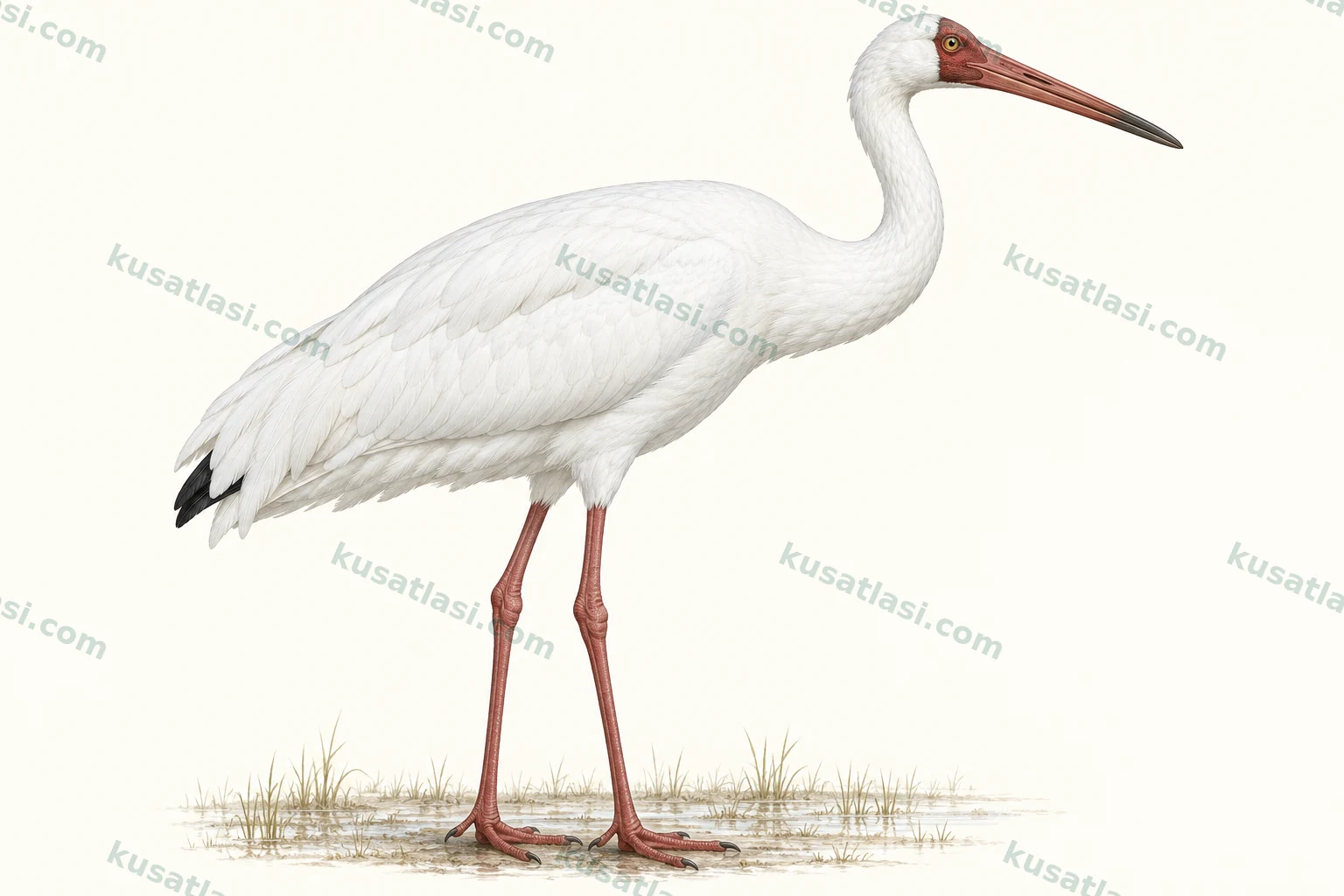
Siberian Crane identification views
Swipe left or right through all five plates.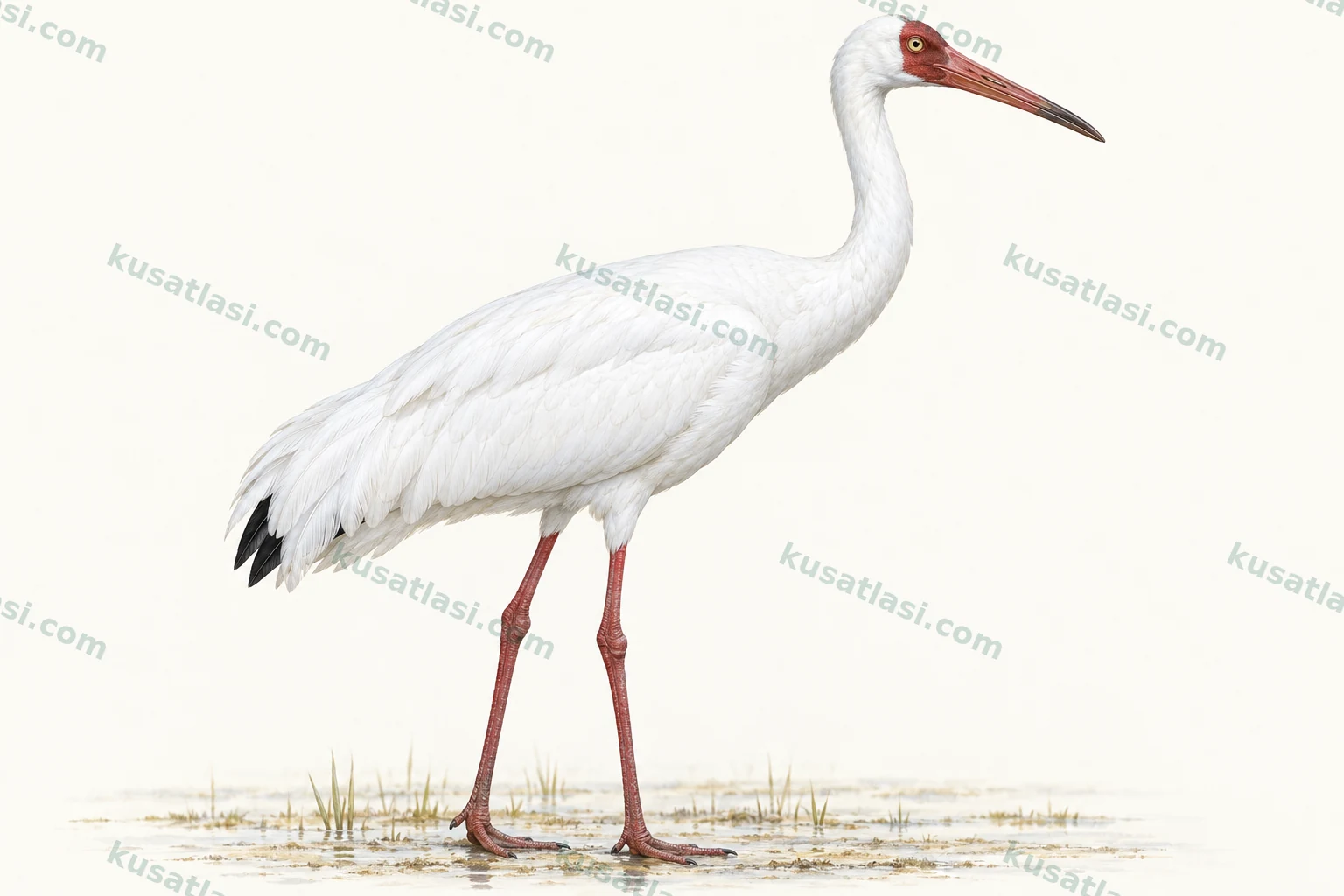
Cranes
Siberian Crane
Leucogeranus leucogeranus
Ak Turna
Combine the white body, bare red face and black outer flight feathers; Turkish observations require rare-record assessment.
- Order
- Neognathae
- Conservation status
- CR Critically Endangered
First look in the field
Quick identification
- White with black tips
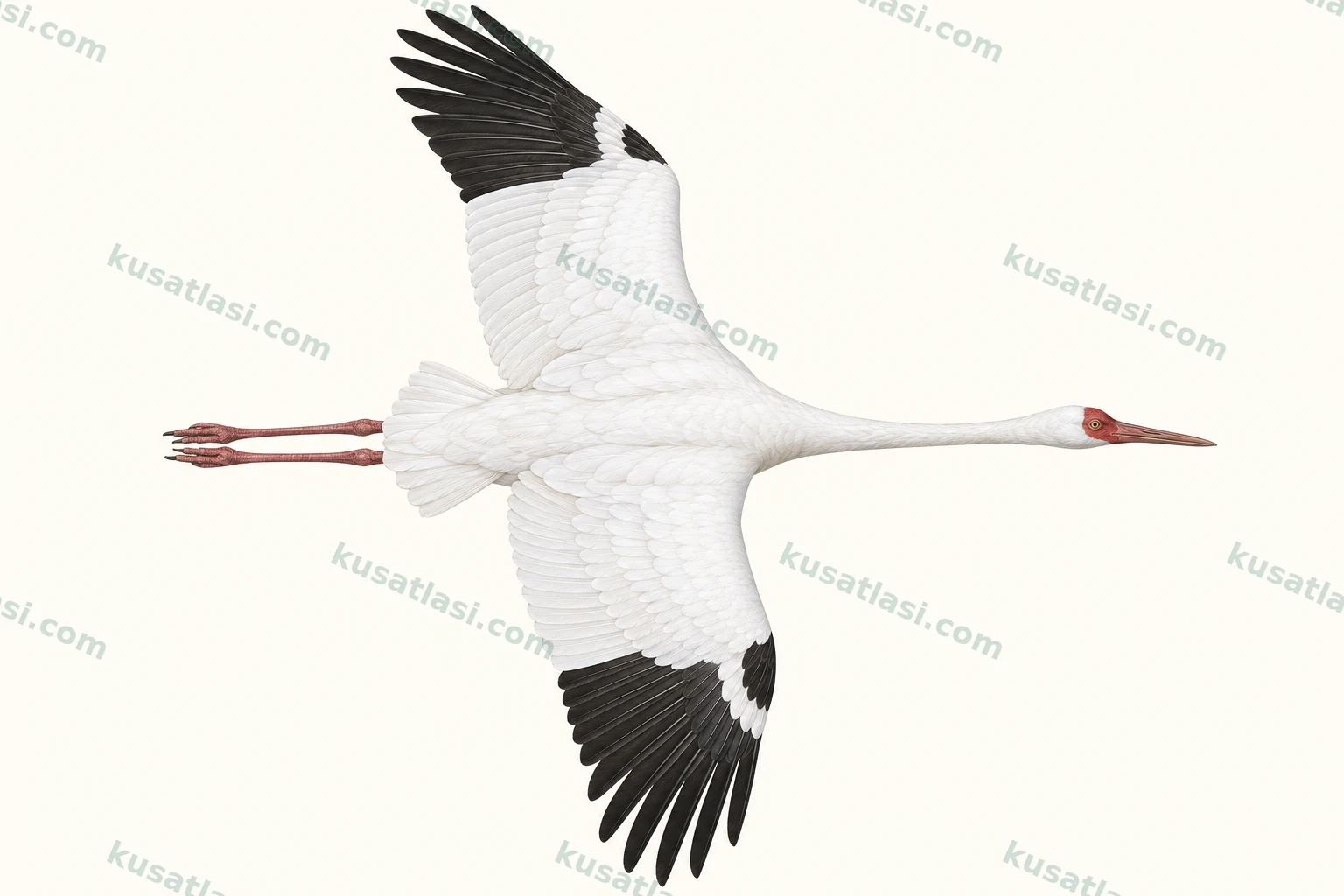
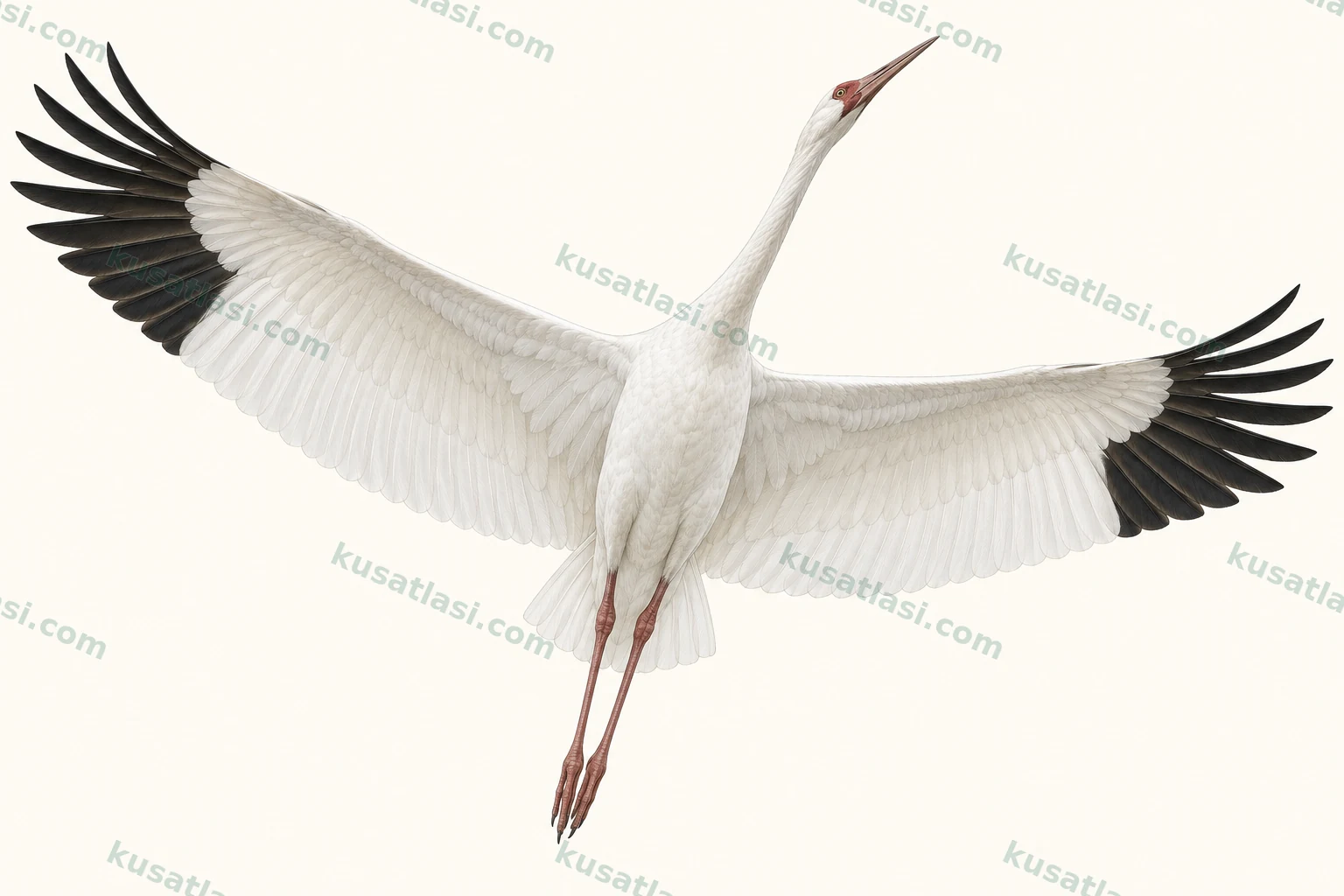
In adults, black primaries contrast with an otherwise white wing.
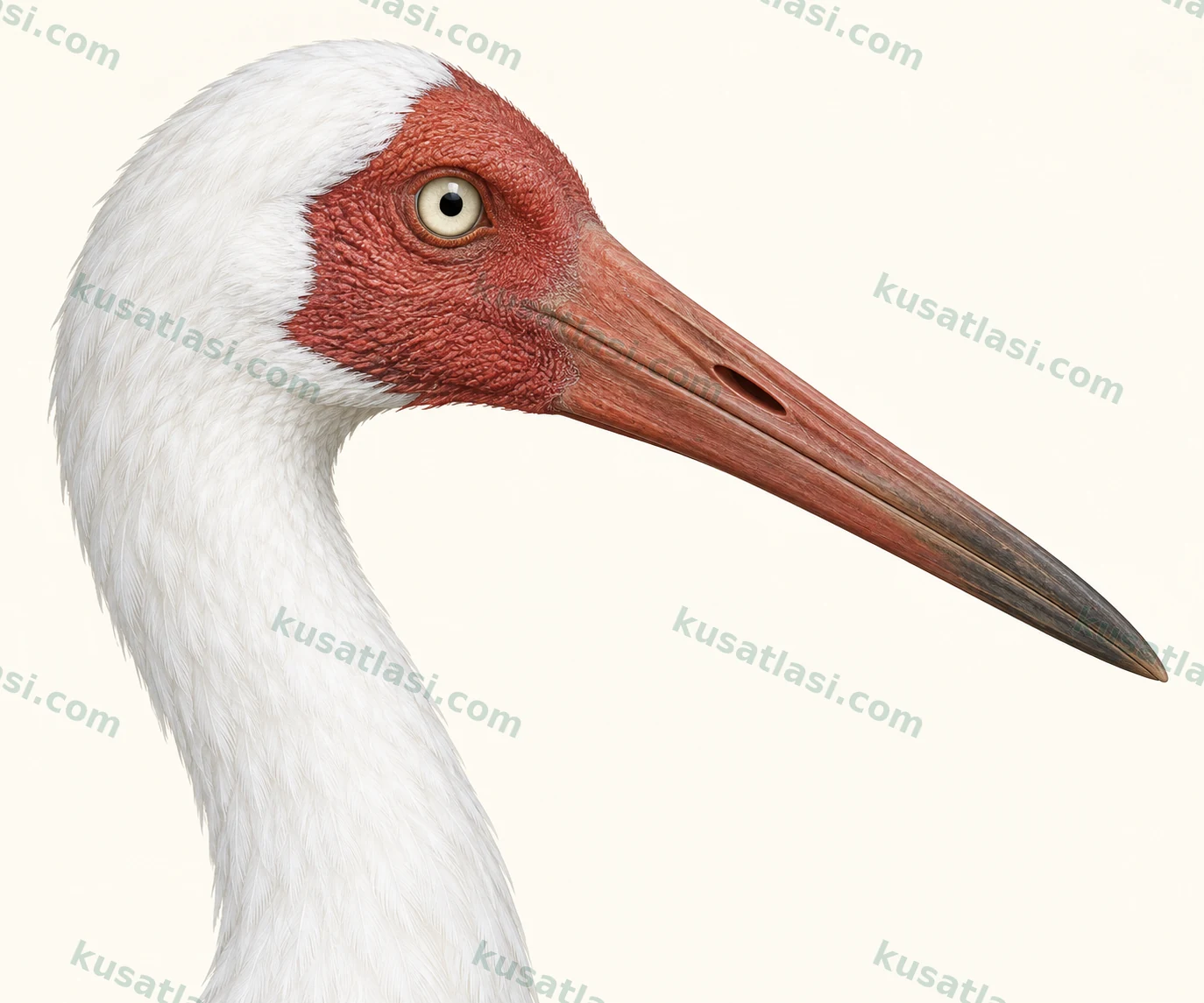
- Bare red face
Check the adult's bare red foreface; it is not expected in juveniles.
- Crane silhouette
A long neck extends forward and long legs trail in flight.
Biometrics
Length
- Male
- 108–122 cm
- Female
- 108–122 cm
Wingspan
- Male
- 210–230 cm
- Female
- 210–230 cm
Weight
- Male
- 4.9–8.6 kg
- Female
- 4.9–8.6 kg
Detailed explanations of these measurements are available on our website, on the same species page.
World distribution
Siberian Crane
Customize map layers
Observation Sites
Bird Atlas recordsLoading observations…
Monthly record intensity
12 monthsRecord intensity is affected by observation effort.
Rotate the globe and compare the supported layers. Colours show broad range areas, not exact sightings or nests.
- Jan
- Apr
- Jul
- Oct
- Dec
Generalised data and method
Basemap: Natural Earth (public domain).
Bibliography ↗Authentic bird sound and ethical use
Voice and listening
Soft, low contact calls may be heard; a silent bird is not thereby excluded.
Spoken guide
Narration has not been recorded; no audio file has been created.
Observe without approaching the nest
Breeding
A low plant platform in shallow Siberian wetlands.
Typically two; this does not mean both chicks survive.
About 27–29 days, with both parents participating.
These are species-level breeding facts, not proof of regular breeding in Turkey.
Never rely on one mark
Similar species
White Stork
Ciconia ciconiaHas more extensive black flight feathers; check the crane's bare red adult face.
Great Egret
Ardea albaRetracts its neck in flight and has wholly white wings.
Scientific species guide
Detailed account
Identification
Siberian Crane is a large, long-necked crane with a white adult body, bare red facial skin and black outer flight feathers. In Türkiye it is a rare or accidental visitor, not a routine seasonal bird. Document the face, open wing and overall structure together before accepting an identification based on a distant white shape.
Adult Male and Female
The sexes have very similar plumage; males are generally larger. Both have a red bare facial area and white rear crown. Neither apparent size in one photograph nor the intensity of red skin provides a reliable sex determination. The repeated biometric ranges in the male and female boxes are species-wide values, not separately established sex-specific ranges.
Young Birds
Immatures can show cinnamon tones, particularly on the head and neck, and lack the full adult facial appearance. This is an age difference, not a distinct brown female plumage. Assess several body regions and avoid assigning an exact age from one coloured patch.
Above and Below in Flight
1. Above: The back and inner wing are white; black is concentrated in the outer flight feathers. Do not expect a broad black band across all the flight feathers.
2. Below: White underparts and inner wings contrast with black tips. Determine the viewing angle from the body and leg attachment rather than assuming that black tips indicate only one surface.
3. Shape: The neck is extended forward and the long legs trail behind. Great Egret normally retracts its neck in flight and has wholly white wings.
4. Comparison: White Stork also extends its neck but has more extensive black flight feathers and no bare red facial mask. A single black-and-white flight image is insufficient.
Nesting Biology
On the natural breeding grounds, nests are low platforms of plant material in shallow wetland terrain. Two eggs are typical and both parents incubate for approximately 27–29 days. Both also care for the young; two eggs do not guarantee two surviving chicks. These are species-level breeding facts, not evidence of regular nesting in Türkiye.
Measurements
These are shared ranges. Body length is different from standing height, which is commonly given as about 140 cm. A taller-looking bird in a photograph is not thereby proven male.
Voice and Behaviour
Soft, low contact sounds may be heard, while a silent crane cannot be excluded. Coordinated calls between paired birds need behavioural context; they should not be assumed from an isolated sound. Document a natural call without playback or approaching the bird. In Turkey, another crane species' migration timing must not be borrowed for this very rare species. A rare observation, even of two birds together, is not evidence of a local nest. Record date, duration, age-related plumage and the observed behaviour without converting one record into a regular migration route.
Similar Species
An adult Common Crane is predominantly grey, and its red marking is on the crown rather than the Siberian Crane's bare red foreface. A White Stork extends the neck in flight but has much more extensive black in the wings and no equivalent bare facial mask. A Great Egret retracts its neck and has entirely white wings; an adult Siberian Crane shows black outer flight feathers. White body colour alone is inadequate in distant or warm light. Juveniles can have cinnamon tones, which are not a female character. Seek views that show face, wing tips, neck and legs before claiming an exceptional record.
Global Pattern
The natural breeding range is in Siberian wetlands. The eastern population is now the principal concentration, with major wintering areas in the lower Yangtze basin of China, especially around Poyang Lake. Its regular long-distance movements should not be transposed onto a Turkish seasonal calendar.
Status in Türkiye
The Turkish Bird Records Committee includes Siberian Crane among rare and accidental species. A previous observation at a site is not evidence of annual return, regular wintering or local nesting. This account therefore does not mark a routine Turkish arrival month or breeding season. New observations need careful documentation and assessment.
Historical and Current Range
Older accounts describe western and central populations linked to Iran and India. Those populations have suffered severe losses; an old distribution map must not be presented as a current functioning route. A line connecting a Turkish occurrence to Siberia is not a tracked journey of that bird.
Recording a Possible Visitor
Keep dates, duration, numbers and original photographs or video. Document the face, wings and any visible marks without approaching. Distinguish repeated sightings from additional individuals, and a preliminary identification from an assessed record. Consider the bird's safety before broadcasting a precise location.
Month-by-month field notes
1. January: Turkey has no established regular wintering month; document date and duration.
2. February: A historical winter sighting does not prove annual return; avoid repeat counts.
3. March: Do not use another crane's migration to assign this species a Turkish passage calendar.
4. April: Document red foreface, wing tip and extended neck together.
5. May: Siberian breeding season is not evidence of regular breeding in Turkey.
6. June: Two birds together do not by themselves prove a local nest.
7. July: Warm light makes distant white birds difficult; do not force an identification.
8. August: A juvenile may be cinnamon-toned; brown does not mean female.
9. September: Autumn movement elsewhere does not establish regular passage through Turkey.
10. October: Compare the extent of black wing feathers with a stork, not just body colour.
11. November: Chinese wintering does not guarantee a Turkish sighting; preserve rare-record evidence.
12. December: A neutral calendar cell means timing is unestablished, not confirmed absence.
Shallow Fresh Water
Siberian Crane is strongly associated with shallow wetlands and wet mud. Open marshes and lake margins provide access for walking and feeding. A deep lake with steep banks is not equivalent to a vegetated shallow margin, even if both appear as water on a map.
Breeding Terrain
On Siberian breeding grounds, low wet areas near lakes with short vegetation provide nesting habitat. Research combining nest observations and satellite data has linked extreme flooding to loss of suitable nesting terrain. Water is necessary, but levels that submerge eggs are not beneficial. This describes the natural breeding region, not verified nesting locations in Türkiye.
Winter Feeding Habitat
At Poyang, shallow water and exposed soft mud make aquatic plant tubers accessible. Deep water or hardened dry ground may prevent access. Habitat quality therefore involves depth, vegetation and seasonal water movement, not simply the total area of a lake.
Watching in Türkiye
There is no routine Turkish meeting place implied here. If a possible visitor occurs, watch from a fixed, distant position without driving across its path or walking it into flight. Record resting and feeding separately. A crowd can make a small stopover area unusable even when no one physically touches the bird.
Food
Aquatic plant roots and tubers are important foods. Insects, small fish and other small animal prey may also be taken, with diet varying by place and season. An isolated Turkish observation cannot establish a national feeding pattern or a fixed dietary percentage.
Feeding Method
The long bill can probe soft substrate while the crane moves through shallow water. A bill entering water does not necessarily mean fish capture: the bird may be extracting plant material. If the item is not visible, describe the action rather than inventing a prey identification.
Water and Access
On the Chinese wintering grounds, the availability of buried plant tubers depends on plant growth and the formation of accessible shallows. Turbidity affects underwater light, while excessive depth or hard dry mud can restrict feeding. Different parts of one wetland may therefore differ in value through time.
Responsible Observation
Record probing, walking and visible swallowing separately; not every bill movement is successful feeding. Do not use food to attract a bird for photographs. Feeding shallows and secure resting areas need to remain usable together, and flushing a rare visitor takes away time and energy it could otherwise spend feeding or resting.
Hidden Black Tips
Much of the black outer wing can be concealed when a crane is standing. It becomes conspicuous when the wings open, explaining why a nearly white resting bird shows dark tips in flight. The extent of black and the bare facial pattern still need comparison with White Stork.
Calls Within a Pair
Coordinated calling helps maintain pair bonds and territorial behaviour. A single image of two birds holding their heads differently is not a reliable sex test; a complete behavioural sequence provides more context. Quiet contact sounds also occur, and silence alone does not rule out the species.
Threatened and Rare Are Different
Siberian Crane is globally Critically Endangered. Its rarity in Türkiye is a separate distribution fact. A country recording few individuals and a species facing worldwide extinction risk are not the same measure. Historical population estimates should not be relabelled as current exact counts.
Connected Wetlands
Breeding marshes, stopover shallows and wintering lakes support different parts of one annual cycle. Protecting only one location cannot secure the entire journey. Water management and disturbance matter alongside the survival of habitat itself. Careful evidence collected without moving a bird is more useful than a close photograph obtained by forcing it to fly.
Species text and plates come from existing atlas records. Measurements were checked against reliable species sources.
Open bibliography