
Approved field-guide plates
Audouin's Gull identification views
Swipe left or right through all five plates.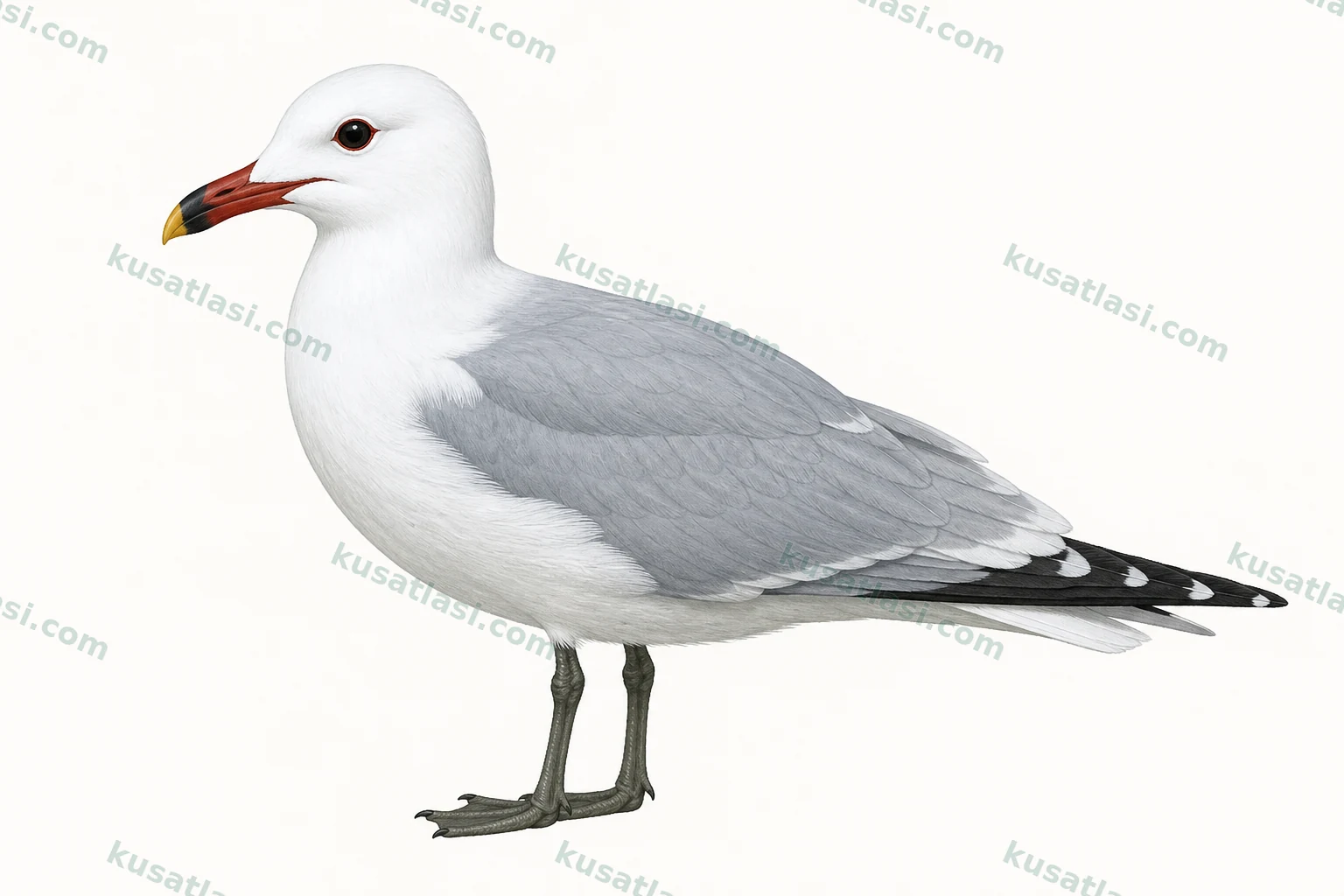
Gulls (Laridae)
Audouin's Gull
Ichthyaetus audouinii
Ada Martısı
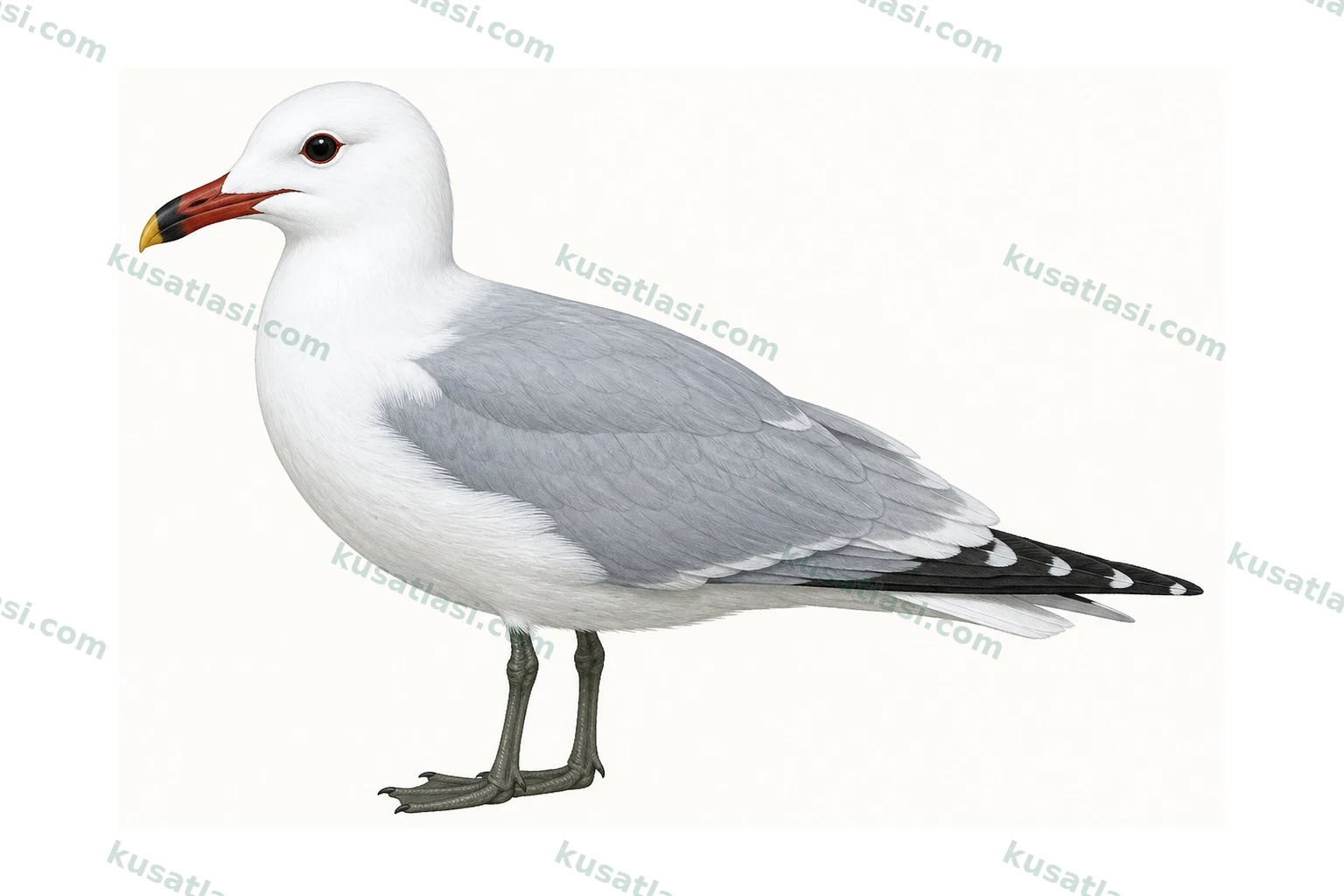
A slender Mediterranean gull; assess adult red bill, dark eye and grey-green legs together. Immatures need age-specific comparison.
- Order
- Charadriiformes
- Conservation status
- VU Vulnerable
First look in the field
Quick identification
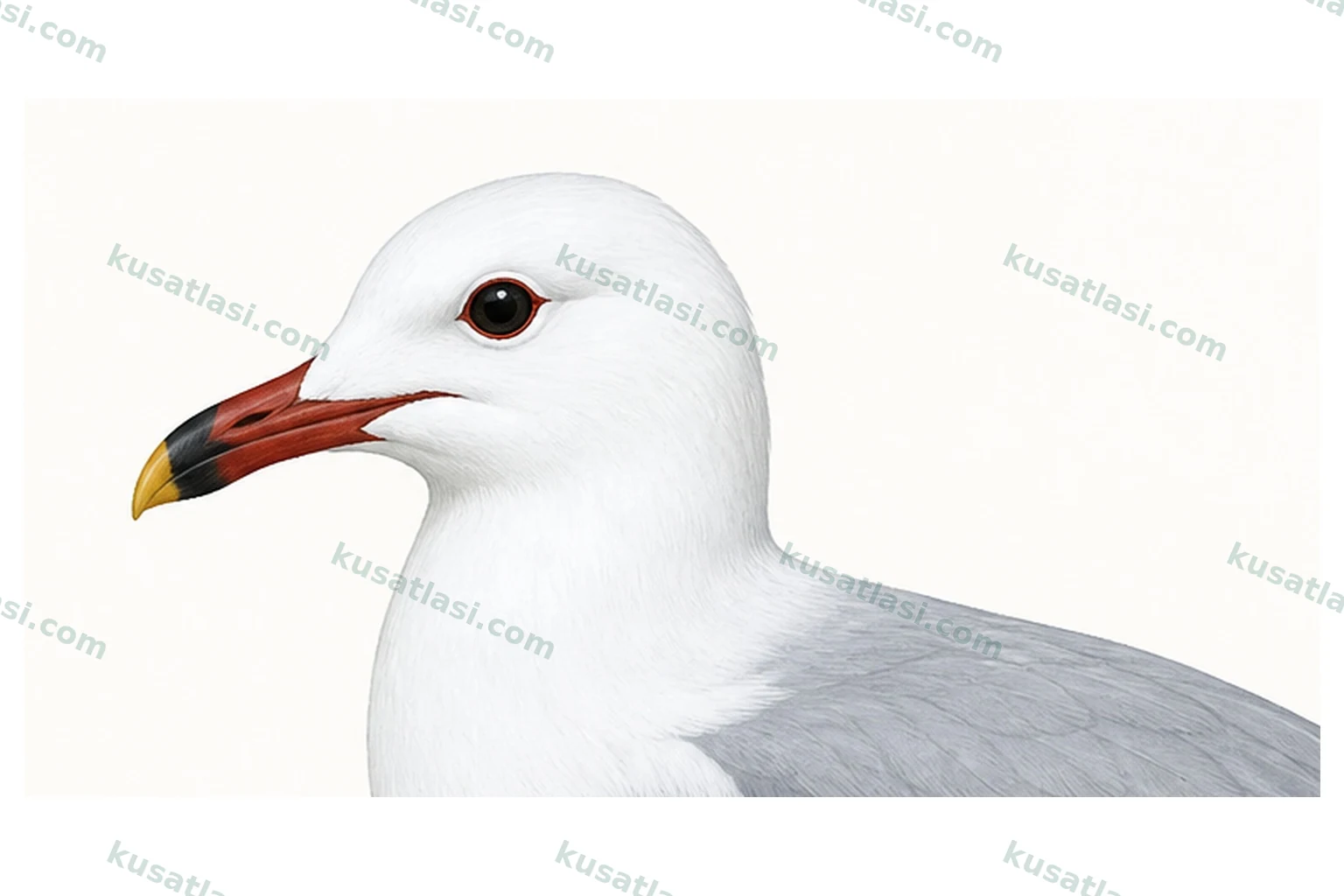
- Dark red bill
In adults, combine the dark red bill with the dark eye.
- Grey-green legs
The adult legs look grey-green rather than yellow.
- Slender build
Look for a pale grey mantle, long narrow wings and elegant proportions.
- Juvenile plumage
Young birds lack the adult red bill and clean white-and-grey plumage.
Biometrics
Length
- Male
- 50 cm
- Female
- 50 cm
Wingspan
- Male
- 130 cm
- Female
- 130 cm
Weight
- Male
- 610 g
- Female
- 610 g
Detailed explanations of these measurements are available on our website, on the same species page.
World distribution
Audouin's Gull
Customize map layers
Observation Sites
Bird Atlas recordsLoading observations…
Monthly record intensity
12 monthsRecord intensity is affected by observation effort.
Rotate the globe and compare the supported layers. Colours show broad range areas, not exact sightings or nests.
- Jan
- Apr
- Jul
- Oct
- Dec
Generalised data and method
Basemap: Natural Earth (public domain).
Bibliography ↗Authentic bird sound and ethical use
Voice and listening
Gull-like calls do not identify the species independently of plumage and structure.
In a mixed group, confirm which individual is calling.
Do not approach a colony or flush resting birds.
Spoken guide
Narration has not been recorded; no audio file has been created.
Observe without approaching the nest
Breeding
A shallow ground scrape on a rocky or sparsely vegetated coastal islet.
Usually 2–3.
About 28 days; timing varies between places and years.
Never rely on one mark
Similar species
European Herring Gull
Larus argentatusAdults have a yellow bill and a stronger head and bill.
Mediterranean Gull
Ichthyaetus melanocephalusBreeding adults have a dark hood and white wing tips.
Scientific species guide
Detailed account
Structure and Adult Identification
Audouin's Gull is a slender coastal gull. Identify adults by the combination of a red bill, dark eye, grey-green legs and pale grey upperparts. The bill has a dark band near its tip and a paler extreme tip. Do not apply these adult colours to a brown immature bird, or identify a distant gull from a black wingtip alone.
Male and Female
The sexes have similar plumage. Small colour differences between illustrations or photographs are not proof of sex. A lone bird often cannot be sexed confidently from appearance. The measurement pills use the same species-wide ranges for both sexes, not separately measured male and female samples. Leave sex unassigned when evidence is insufficient.
Immatures
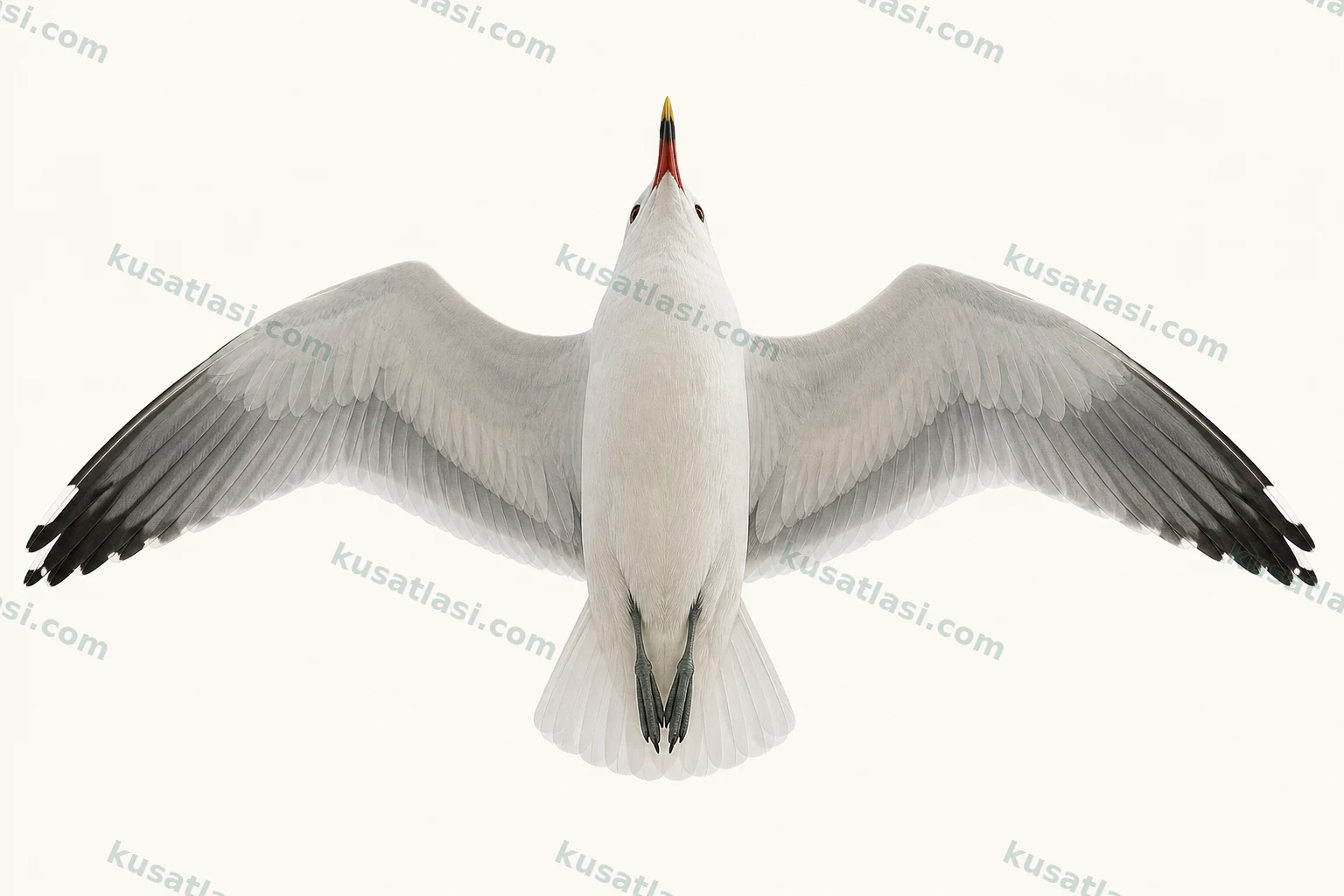
Young birds are brown-patterned and dark-billed rather than clean white and grey. Their patterned underwings and the relationship between the pale rump and dark tail should be documented together. Whitening of the head does not necessarily mean full adulthood; dark wing and tail markings may persist during the transition. Compare birds of similar age.
Flight: Keep the Viewing Angles Separate
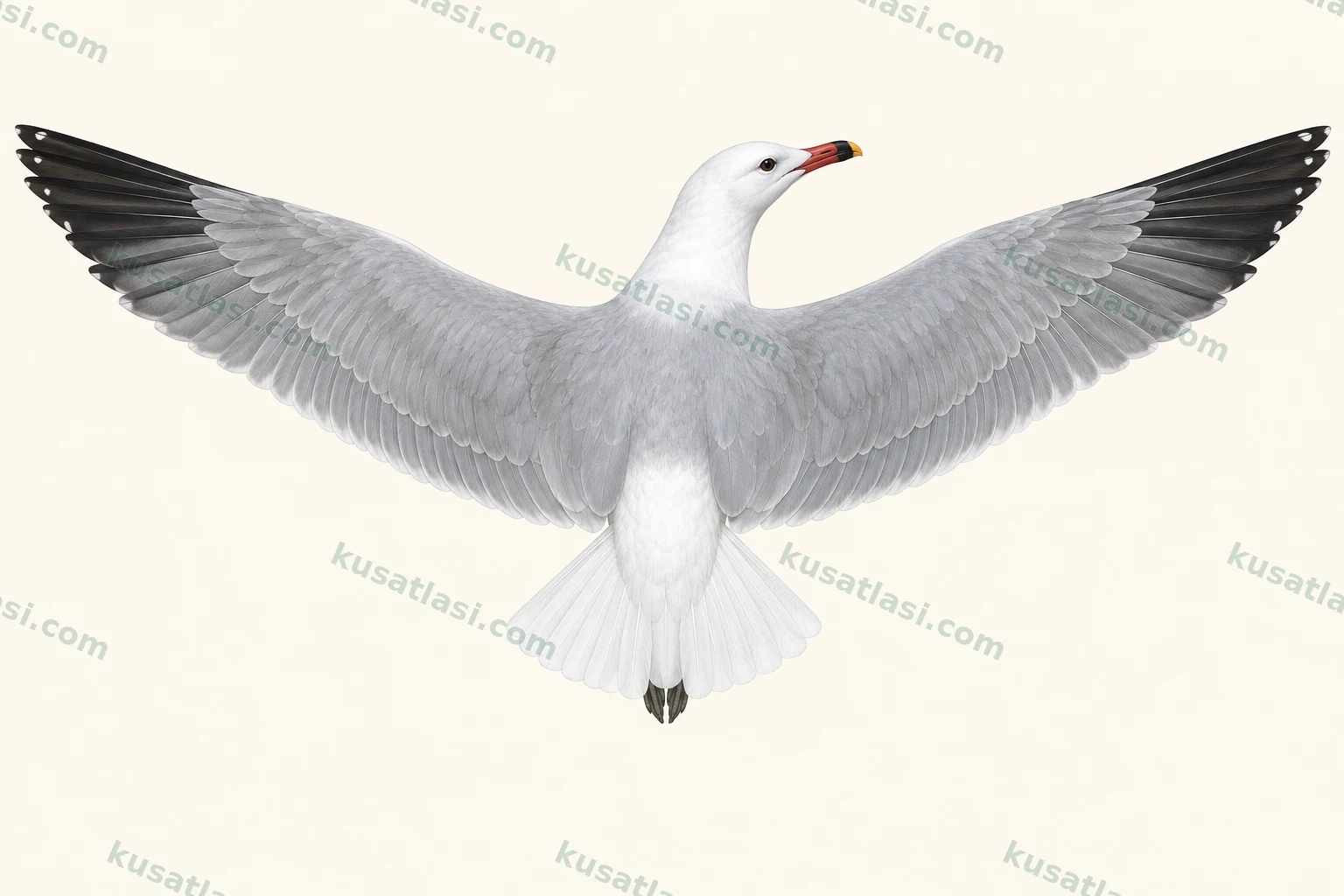
From above an adult shows pale grey inner wings and black outer wings. The underside is a different surface: never look for a juvenile's barred underwing in an adult dorsal plate. If possible, photograph the bird turning so both views are available. Record which view supports each identification character.
Confusion Species
1. Adult Yellow-legged Gull combines yellow bill and legs with a stronger head and bill. Young birds cannot be separated using these adult colours.
2. Adult Mediterranean Gull has white wingtips and, in breeding plumage, a dark head. Winter and immature plumages require more than head colour alone.
3. Immature large gulls require combined evidence from structure, upperwing, underwing, rump and tail. A single poorly lit photograph may not support a species-level identification.
Behaviour and Voice
Watch feeding birds and coastal roosts from a distance. In mixed flocks, establish which individual is calling before assigning a recording to a species. Gull-like calls are supporting evidence, not a substitute for age-appropriate visual characters. Do not flush birds to obtain flight photographs or alarm calls.
Nest, Eggs and Incubation
1. Nest: a shallow ground scrape on a quiet coastal island or islet, among rocks or sparse vegetation.
2. Eggs: usually 2–3; clutch size is not the number of young guaranteed to survive.
3. Incubation: approximately 28 days. Mediterranean timing varies between places and years.
4. Observation: remain offshore or at telescope distance, avoid precise public nest locations and retreat if adults alarm or rise together.
Biometrics
| Measure | Male | Female | |---|---|---| | Total length | approximately 50 cm | approximately 50 cm | | Wingspan | approximately 130 cm | approximately 130 cm | | Body mass | 610 g | 610 g |
No separate representative male and female measurements were verified for these three measures. Both pills show the same species-wide values. Fundación CRAM directly gives approximately 50 cm length and 130 cm wingspan; BTO BirdFacts lists body mass as 610 g. These are not sexing criteria, and individual birds vary.
Breeding Range
The Mediterranean is the core breeding region, with colonies also on Portugal's Atlantic coast. Distribution is discontinuous: suitable-looking islands do not all hold colonies, and this is not a gull to expect at every harbour.
Turkey
It is local and scarce around Aegean and Mediterranean coasts and islands. Separate breeding, feeding, passage and winter records. A summer bird does not establish a nearby nest, while winter occurrence is possible; it should not be excluded as an exclusively summer visitor.
Interpreting Research
Özkan and Yapan's 2024 study reports a small eastern Mediterranean Turkish colony varying between 6 and 10 pairs during 2016–2023 and changing between neighbouring islands. This local count is not the Turkish population total. Read every estimate with its study area, date and survey method.
Movement
Post-breeding dispersal occurs along coasts. Some western birds pass Gibraltar toward Atlantic Africa, while others remain in the Mediterranean. That western route should not be assigned automatically to a Turkish bird. The biological calendar and the monthly distribution of submitted records represent different information.
Nesting Habitat
Quiet coastal islands and islets offer open or sparsely vegetated ground for nests. A nesting patch must be considered together with accessible marine feeding habitat, not as an isolated rock.
Feeding and Resting
Scan coastal water, bays, wetlands and fishing-associated areas. Search resting groups from existing viewpoints, including birds standing apart. Walking to the end of a breakwater and flushing a flock is less useful than examining bill, eye and legs through a telescope.
Changing Sites
BirdLife's 2026 assessment notes that some populations now nest in ports and human-modified areas. Such flexibility does not remove disturbance or pollution risks, and protection of traditional quiet sites remains important.
Responsible Access
Share broad locations rather than precise nest coordinates. Do not land to search for nests. Persistent alarm, close attention to the observer or a collective take-off should prompt retreat, not another approach for a photograph.
Marine Food
Small schooling fish, including sardines and anchovies, are important prey. Accessibility near the surface matters, but the species does not have one unchanging menu everywhere. Local opportunities influence what birds take.
Time of Day
Nocturnal feeding is an important part of its ecology. Tracking studies in Spain link use of marine and terrestrial areas with food availability and fishing activity. Absence at midday does not establish that a site is unused at night, and a schedule measured at one colony is not universal.
Fishing and Flexibility
Discards can contribute food, alongside natural prey and other opportunistic items. An Ebro Delta study found that male and female area use did not respond identically on days without trawling. This illustrates flexibility, not a rule that males always feed on land and females always at sea.
Recording Behaviour
Following a boat does not itself prove feeding success. Note whether food is actually obtained and, if visible, what is carried. Do not feed birds to attract them or follow food-carrying adults to nests.
Names and History
The English and scientific names honour Victor Audouin. BTO attributes the original description to Payraudeau in 1826. Older references using Larus audouinii and current ones using Ichthyaetus audouinii refer to the same species, not two different gulls.
Similar Sexes
Many birds do not have strongly different male and female plumages. Differences in lighting or illustration tone should not be promoted into biological sex characters. Learning shared species features is more useful than assigning meaning to every small shade difference.
A Mobile Colony
Research on the Turkish coast documented breeding-site changes between neighbouring islands. A decline at one site cannot immediately be equated with mortality without checking its surroundings; equally, possible relocation does not explain away a sustained regional decline. Consistent repeated surveys are needed.
Conservation and Publication Dates
BirdLife's January 2026 statement lists the species as Vulnerable. Older online pages may show a lower category. The international action plan adopted in 2025 addresses food conditions, mammalian predators and human pressures together. Source date matters when apparently authoritative pages disagree.
Records Are Not Individuals
One bird may generate several records on different days. A well-visited harbour may produce more submissions than a remote island. A high monthly bar does not on its own demonstrate a larger population; effort and coverage also matter.
A Useful Observation
Include date, broad location, number, behaviour, tentative age and the characters actually seen. Label upperwing and underwing photographs correctly. Leaving unsupported age or sex blank is better than inventing precision.
Existing species account; references are in the central bibliography.
Open bibliography