
Approved field-guide plates
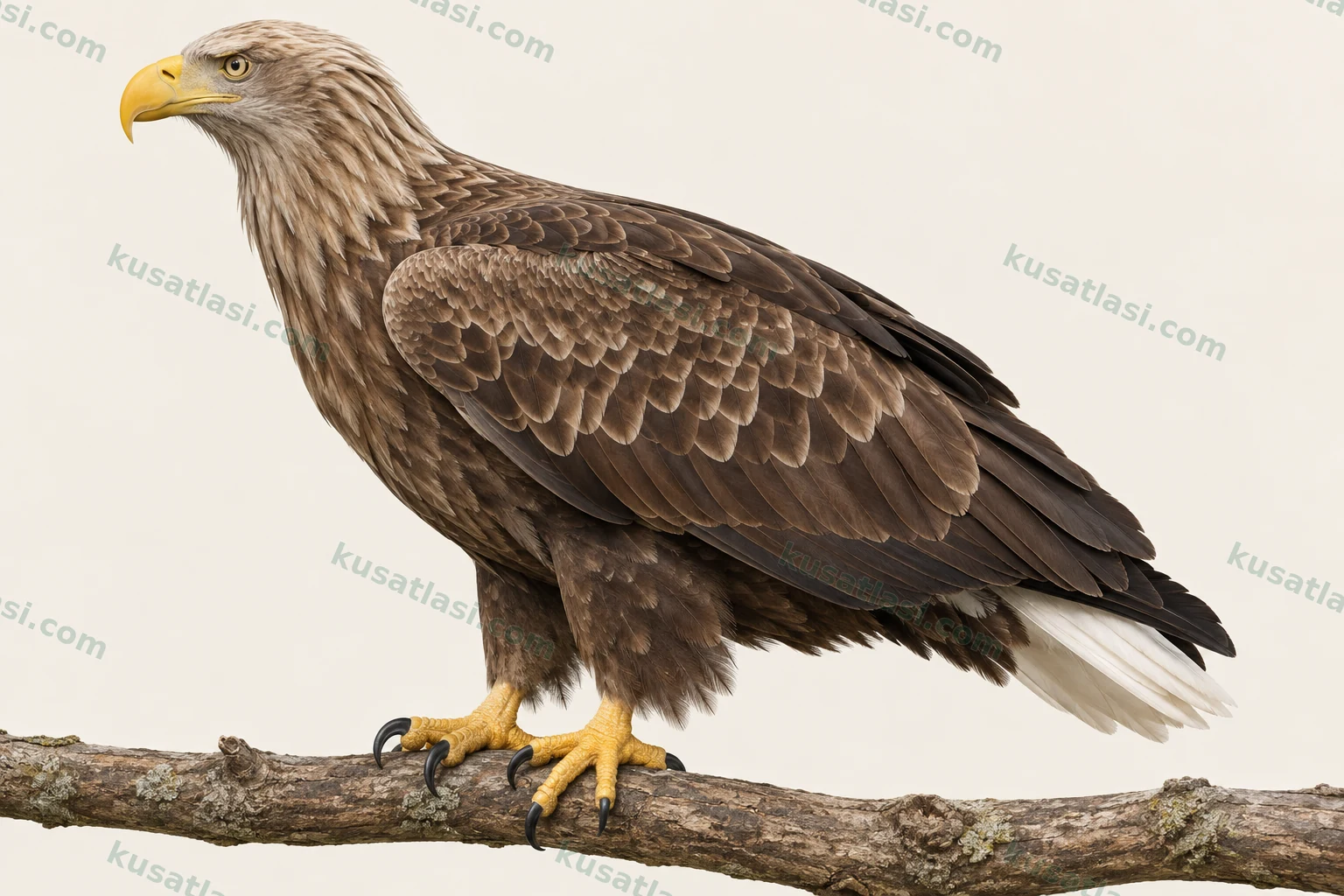
White-tailed Eagle identification views
Swipe left or right through all five plates.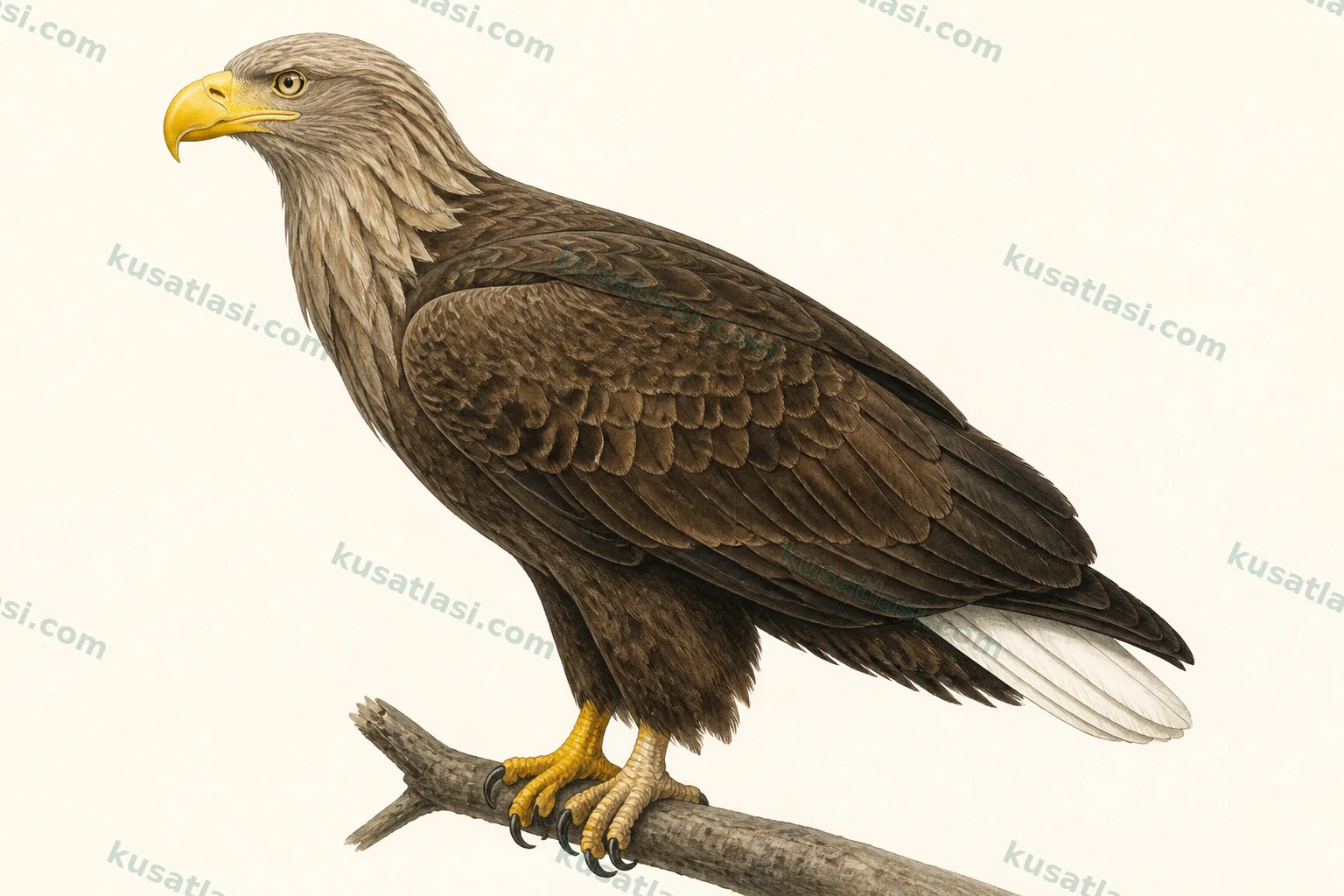
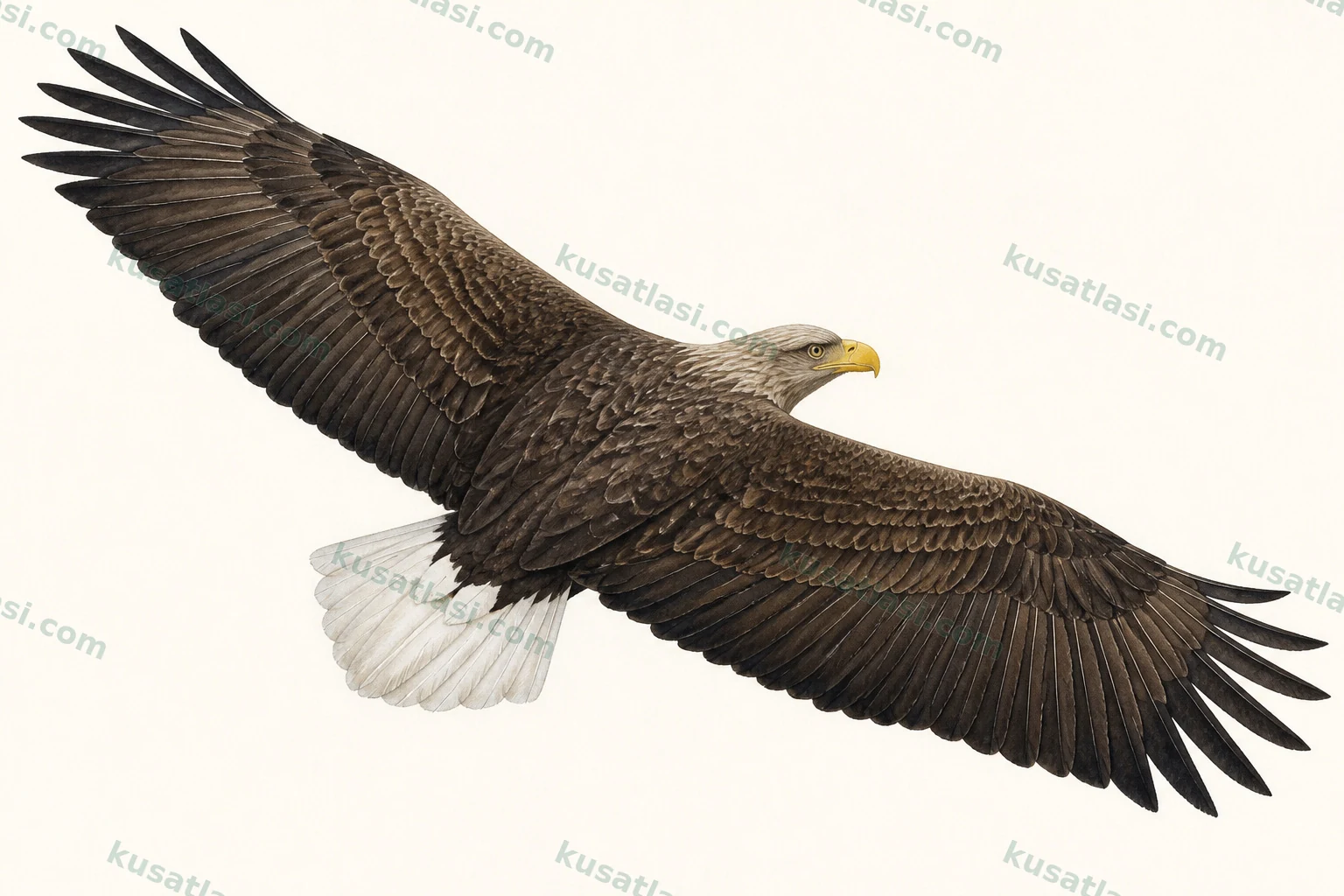
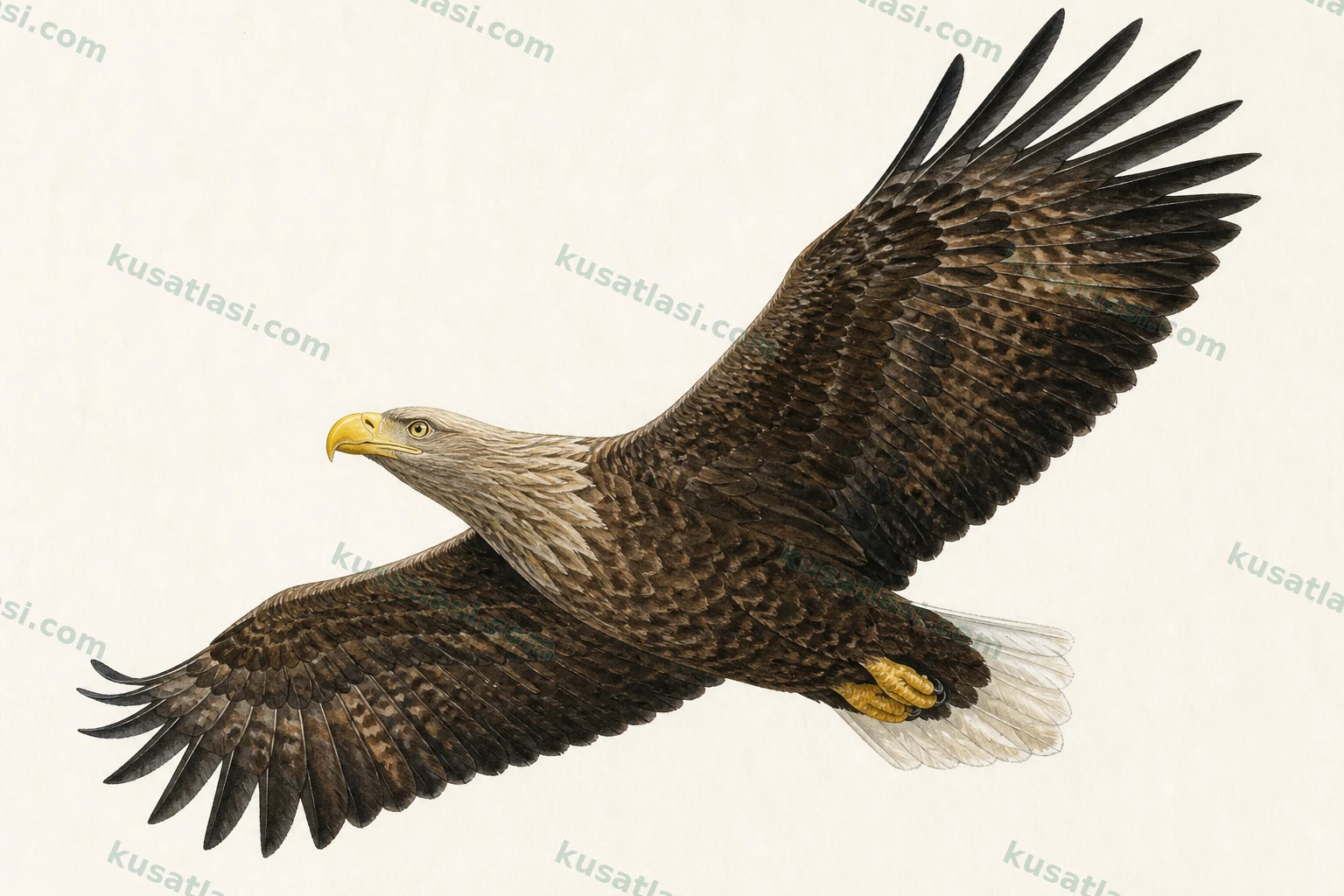
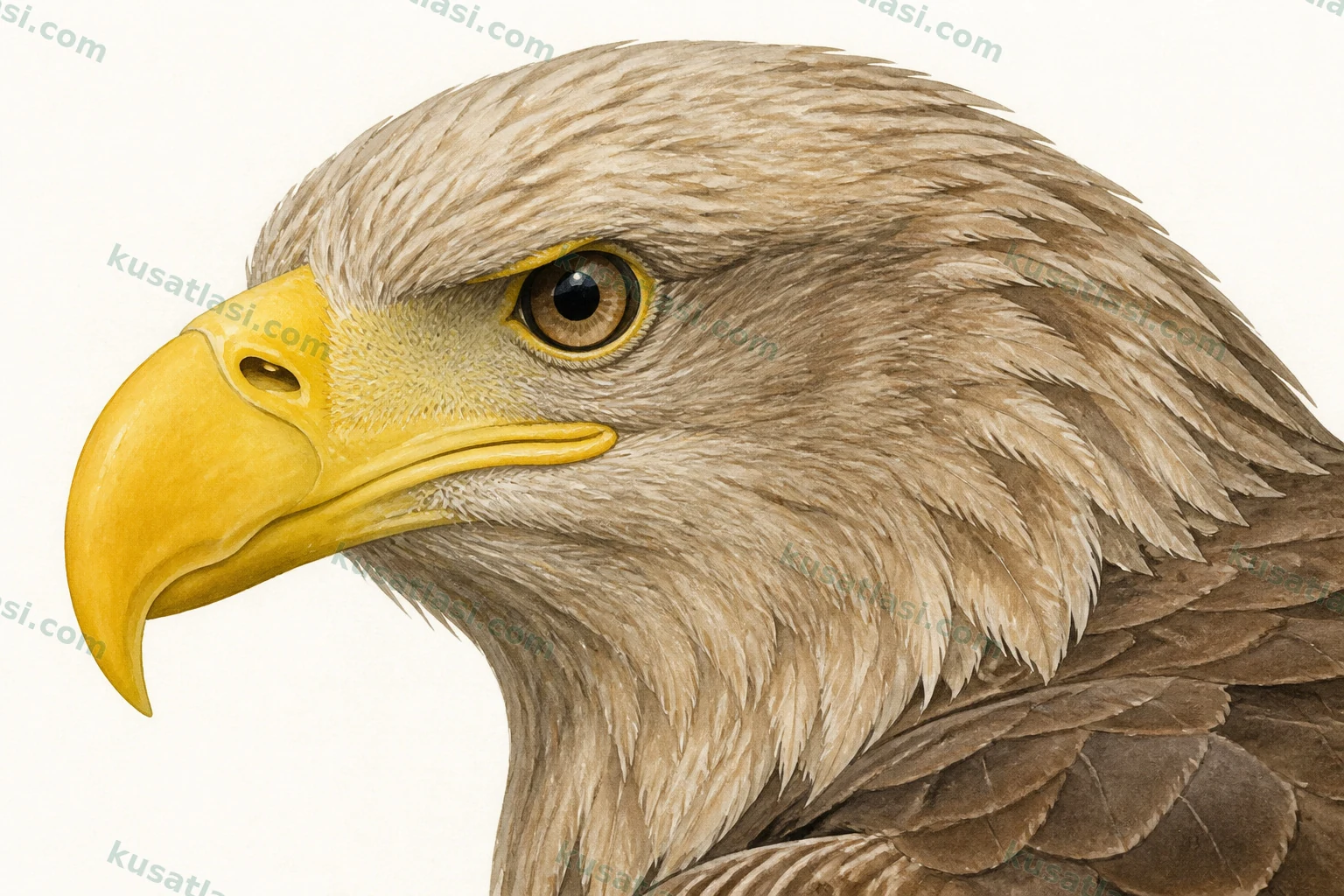
Hawks, Eagles, and Kites
White-tailed Eagle
Haliaeetus albicilla
Ak Kuyruklu Kartal
Combine broad level wings, projecting heavy head and short tail; a clean white tail is an adult feature.
- Order
- Accipitriformes
- Conservation status
- LC Least Concern
First look in the field
Quick identification
- Very broad wings
Often held nearly level in soaring flight, with fingered tips.
- Head and tail proportions
A heavy head and bill project forward; the tail is short relative to the body.
- Check age
The clean white tail belongs to adults; young birds may have a dark or mottled tail.
Biometrics
Length
- Male
- 70–90 cm
- Female
- 70–90 cm
Wingspan
- Male
- 200–240 cm
- Female
- 200–240 cm
Weight
- Male
- 3075–5430 g
- Female
- 4080–6920 g
Detailed explanations of these measurements are available on our website, on the same species page.
World distribution
White-tailed Eagle
Customize map layers
Observation Sites
Bird Atlas recordsLoading observations…
Monthly record intensity
12 monthsRecord intensity is affected by observation effort.
Rotate the globe and compare the supported layers. Colours show broad range areas, not exact sightings or nests.
- Jan
- Apr
- Jul
- Oct
- Dec
Generalised data and method
Basemap: Natural Earth (public domain).
Bibliography ↗Authentic bird sound and ethical use
Voice and listening
White-tailed Eagles produce several calls but may remain silent for long periods. Written sound imitations are approximate, and a distant call should not be assigned to the bird in a photograph unless that bird was seen calling.
Spoken guide
Narration has not been recorded; no audio file has been created.
Observe without approaching the nest
Breeding
A large, reusable stick nest in a substantial tree or on a suitable cliff ledge.
Typically two; BTO reports a range of one to three.
About 38 days according to BTO; both parents participate.
Fledging takes about 70–75 days; parental care may continue afterwards.
Do not approach a suspected nest or disclose its sensitive location.
Never rely on one mark
Similar species
Golden Eagle
Aquila chrysaetosCompare the projecting head, broad wings and short tail together; juveniles lack the adult white tail.
Large vultures
Gyps / AegypiusHead, neck, bill and tail proportions differ; size alone is unsafe at distance.
Scientific species guide
Detailed account
Quick Identification
White-tailed Eagle is a very large raptor with exceptionally broad, nearly rectangular wings, a heavy head projecting well forward and a relatively short tail. Adults have a clean white tail and yellow bill; the head and neck may be paler than the brown body. Young birds lack the adult white tail, so rejecting a bird solely because its tail is dark is a serious identification error. Start with wing breadth, head projection and tail proportions together.
Apparent size alone is unreliable at an unknown distance or altitude. Soaring wings are often held near level, with spread, finger-like primaries. Age changes both bill and tail colour. Use the plate depicting the surface and angle actually seen: an upperwing pattern should not be compared with an underwing illustration. Wait for natural changes of angle rather than trying to flush the bird into flight.
Appearance and Posture
The bird is heavy-bodied, with long, very broad wings. In an adult, the brown body, often paler head and neck, yellow bill and white tail form a useful set of characters. Head paleness varies; an all-white head is not required. When perched, the large bill and powerful feet are obvious. A bird may remain motionless for a long time on a shore rock, large tree or other vantage point overlooking water.
The short adult tail can look wedge-shaped when spread. Dark underparts vary with the lighting, and a bright wing patch should never be confused with the anatomically separate white tail. Immatures may show irregular pale patches, but these are not the adult's clean white tail. Moult takes several years, so different feather tracts can suggest different stages. Do not reconstruct unseen areas from a partial photograph.
Male, Female and Immature
The sexes share the broad brown-and-pale-head pattern, and females are generally larger and heavier. A single bird at a distance cannot be sexed reliably from head colour or perceived size. Even two birds side by side can seem differently sized if one is closer. Shared length or wingspan figures in the biometric cards are species ranges, not a claim that male and female individuals are identical. The source provides separate sex-specific mass ranges; it does not justify inventing separate values for the other measures.
Young birds can be darker overall, with a dark bill and a dark or mottled tail. Irregular pale areas may appear on the body and wing coverts. A paler head and whiter tail develop gradually, not overnight. A few pale feathers do not make an exact adult, just as a dark tail does not exclude White-tailed Eagle. Assess wing, tail, head and bill together, and avoid assigning a precise calendar age from one incomplete image. Adult male and female plates do not represent every immature transition.
A size comparison is most useful for a pair seen at similar distances and in similar posture, yet even then it is not proof of sex. Describe observed nest visits or food transfers directly instead of attaching a sex label by assumption. Keep well away from possible nests and protect sensitive location information; disturbance can change behaviour and breeding success.
In Flight
Broad wings make a heavy, powerful silhouette. During a glide they are often level or only slightly raised, with splayed tips. The large head projects in front and the short tail remains behind. Wingbeats are strong, and long glides may separate them. Wing angle changes with wind, turning and take-off, so one momentary pose is not a fixed diagnostic character.
The white adult tail may stand out well in flight. Against bright sky, however, brown wings can become almost black and the tail overexposed. An immature's dark tail shifts emphasis back to structure: wing breadth, head projection and tail length. Keep upperwing and underwing markings separate. The same tail may look broad from behind but almost disappear from a side view; recording the angle makes comparison more dependable.
Voice and Behaviour
White-tailed Eagles produce several calls but may remain silent for long periods. Written sound imitations are approximate, and a distant call should not be assigned to the bird in a photograph unless that bird was seen calling. Playback near a nest is unethical because it changes behaviour and makes the observation less natural.
The eagle catches fish, waterbirds and other available prey, and also scavenges. A bird seen over the sea does not eat only fish; one over an inland lake does not take only ducks. Food choice varies with season and local opportunity. It may search low over water or watch from a perch. Alarm among nearby birds can be a clue, not proof of the predator's identity. Never use bait to draw an eagle to a photographic position.
Similar Species
Golden Eagle can also appear huge, but compare wing and tail proportions with the projecting head. White-tailed Eagle has particularly broad wings and a shorter tail; in adults, the white tail and yellow bill add strong evidence. Immatures lack the clean white tail, so structural comparison is especially important. Wing posture changes in both species, making one frame with “level wings” inadequate by itself.
Large vultures can create a similarly broad distant silhouette. Their head, neck, bill and tail proportions differ, but these details may remain invisible until the bird approaches. Prefer visible characters to an initial impression of size. If the record is uncertain, state which features were seen and which were obscured. Sensitive possible nest coordinates do not need public disclosure.
Local in Turkey
The species is on the Turkish list, occurs around wetlands and has historical breeding records. The Kocaçay key biodiversity area account mentions breeding. This older record is not presented as proof that the same nest or pair count persists today. A current national breeding total was not verified for this account.
Coastal and Inland Water
Large lakes, rivers and reservoirs matter as well as coasts. EKODOSD's regional observations support occurrence in Aegean wetlands. A feeding or passing eagle does not by itself prove a nearby nest.
Different Movements
Many European adults are resident, whereas some northern populations migrate and young birds disperse widely. The EURING/CMS atlas describes an Israeli-marked juvenile seen the following summer on Turkey's Black Sea coast. This is one connection, not a universal route.
Reading the Calendar
Monthly cards provide observation cautions, not guaranteed presence in every region. Counts reflect observer effort and repeated records as well as birds. Keep observations of wandering young distinct from evidence of territorial breeding pairs.
Monthly field notes: January—scan quiet perches around wetlands. February—keep away from possible nest activity; timing varies by region. March—a flying pair alone does not prove an active nest. April—do not treat an old nest record as current. May—maintain distance and quiet near potential breeding areas. June—do not expect a clean white tail on a young bird. July—fledging is not immediate independence. August—distinguish dispersing juveniles from resident adults where possible. September—avoid counting repeated sightings of one bird as new individuals. October—northern migration timing is not a national Turkish calendar. November—watch waterbird concentrations and nearby perches. December—winter record density also reflects observer effort.
Large Waters
Coasts, lakes, broad rivers and other extensive wetlands provide feeding opportunities. Scan shallow margins and concentrations of waterbirds, but also consider nearby secure resting and nesting sites rather than treating the water surface as the entire habitat.
Quiet Perches
A large eagle can remain inconspicuous for long periods on a tree or rock. Search substantial branches and viewpoints patiently. Do not approach simply to force the bird into flight; perched views can reveal useful head and tail details.
Nest Support
A large stick nest needs a strong tree or suitable ledge and clear access. A historically occupied site may have changed. Sharing an old locality as a currently active nest can mislead observers and increase disturbance.
Keep Distance
If nesting is suspected, stop approaching and remain well back. Do not use food or playback to position the bird for a photograph. Quiet resting places, feeding water and safe connections between them all contribute to a functioning habitat.
Nesting Space and Daily Use
Foraging water alone does not define the habitat. Shallow margins, waterbird concentrations, quiet lookout perches and secure nesting places all matter. A large stick nest requires a sound tree or suitable ledge with open access. The presence of a large tree alone does not prove it can support a nest, and a historically occupied site must not be passed off as an active nest today.
Scan substantial branches, dead trees and high points overlooking water patiently: a stationary eagle can be easy to miss. Do not approach to make it fly. Feeding waters, quiet resting areas and safe connections between them need to function together. Repeated disturbance can make an otherwise intact place less usable. If breeding is suspected, maintain a wide distance and avoid publishing precise sensitive locations.
More Than Fish
Fish and waterbirds are important, alongside small mammals and carrion. Diet varies with local opportunities and season. A bird eating a dead animal did not necessarily kill it; distinguish predation from scavenging.
Surface Capture
Fish may be taken with the feet after a low approach over water. Waiting, attacking and returning to a perch can be parts of one feeding sequence. A glide over water does not prove a successful capture, so describe observed stages separately.
Age and Opportunity
Roy Dennis Wildlife Foundation observations of reintroduced birds documented the importance of carrion to young eagles and increasing fish use with maturity. This illustrates flexibility, not fixed proportions applicable to every Turkish individual.
Safe Food Sources
Scavenging is natural but can expose birds to poisoned remains. Do not bait an eagle for observation. If poisoning or injury is suspected, avoid handling and report the location to the relevant wildlife authority. Food safety matters as well as abundance.
Opportunity and Risk
Feeding can include a low approach over water, a brief strike with the feet, long periods of waiting and a return to a perch. An eagle gliding over water has not necessarily caught anything. Describe the approach, contact and departure separately when visible. Scavenging is natural, but poisoned remains present a risk. Do not place carrion as bait; report a suspected poisoned or injured bird to the appropriate wildlife authority without handling it. The age-related feeding observations from reintroduced British birds illustrate flexibility, not a universal numerical diet for Turkey.
A Name Is Not Every Age
The white tail is an adult character; young birds can lack it. Broad wings, a heavy bill and short-tail proportions remain useful. The absence of one mature feature does not automatically indicate another species.
An International Connection
The EURING/CMS atlas records an eagle marked young in Israel and seen the next summer on Turkey's Black Sea coast. A recovery links two places but does not reveal every point travelled between them or the route of an entire population.
Recovery After Loss
Scottish reintroduction began in 1975 and the southern English project in 2019. The latter recorded successful breeding in 2023. These are results of licensed specialist programmes, not encouragement for individuals to move wild chicks.
Long Periods Still
Spectacular flight is only part of the eagle's life. Tracking and field observations also show prolonged perching. A stationary bird may be resting or waiting for an opportunity. Patient watching reveals that behaviour; forcing flight replaces it with a response to disturbance.
Species text and plates come from existing atlas records. Measurements were checked against reliable species sources.
Open bibliography