
Existing atlas plates
White-eared Bulbul identification views
Swipe left or right through all five plates.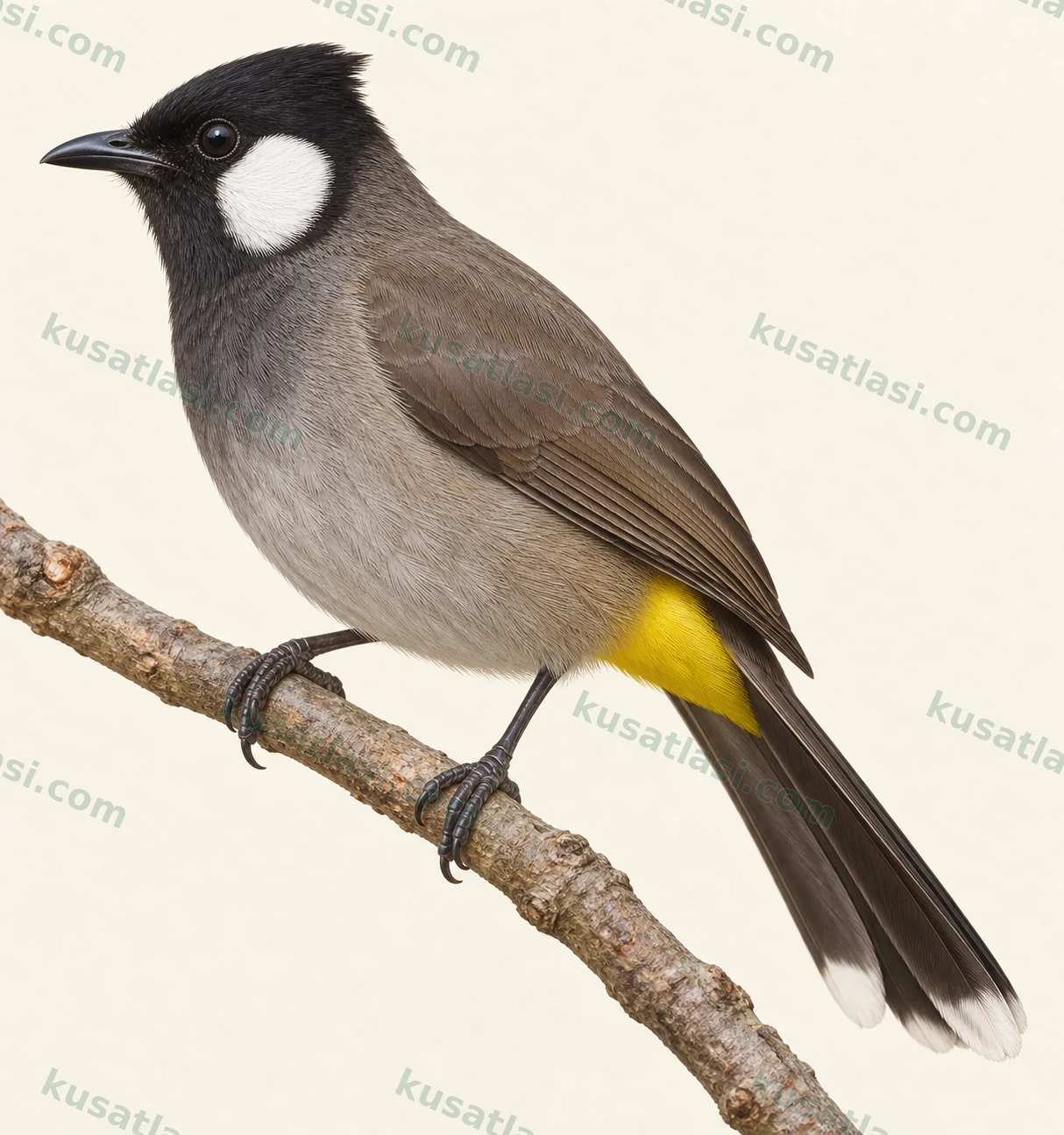
Bulbuls
White-eared Bulbul
Pycnonotus leucotis
Ak Yanaklı Arapbülbülü
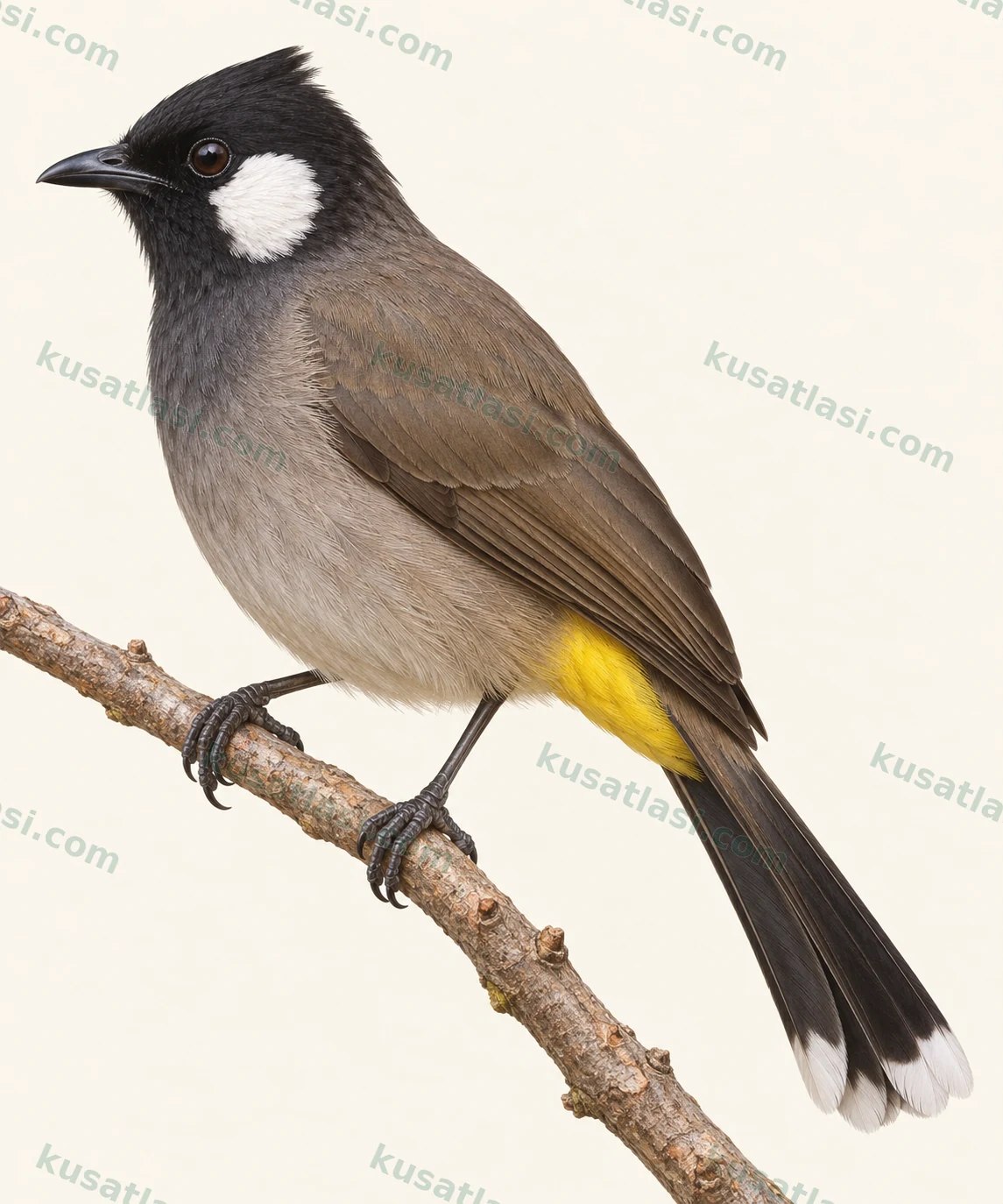
Black head with white cheek, plain grey-brown body, yellow vent and white tail tips together; adult sexes are similar.
- Order
- Passeriformes
- Conservation status
- LC Least Concern
First look in the field
Quick identification
- A White Cheek Within a Black Head
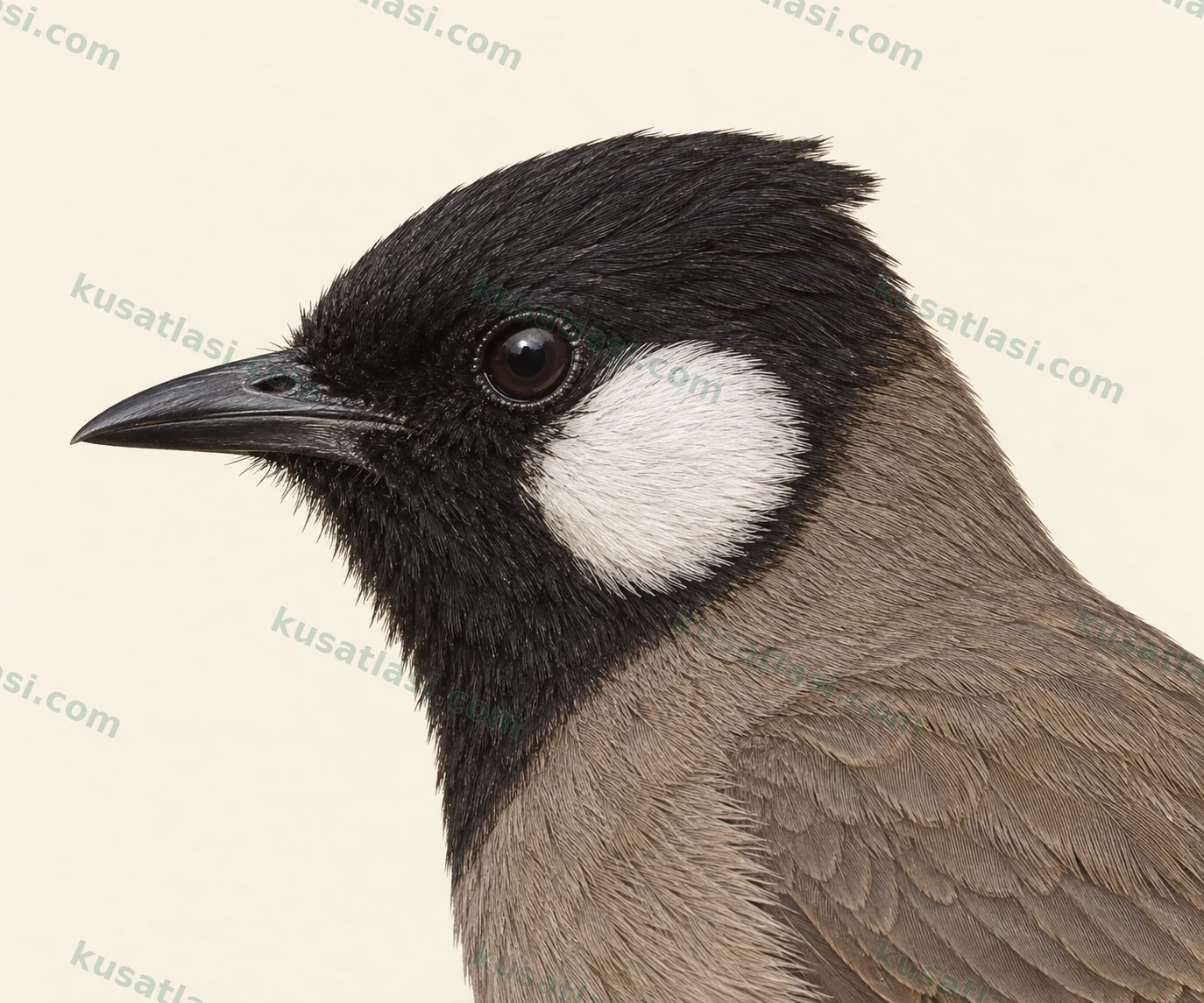
White-eared Bulbul is a long-tailed, grey-brown songbird with a black head and throat, a conspicuous white cheek and a bright yellow vent.
- Sex and Age
Adult sexes look very similar.
- Wings and Tail
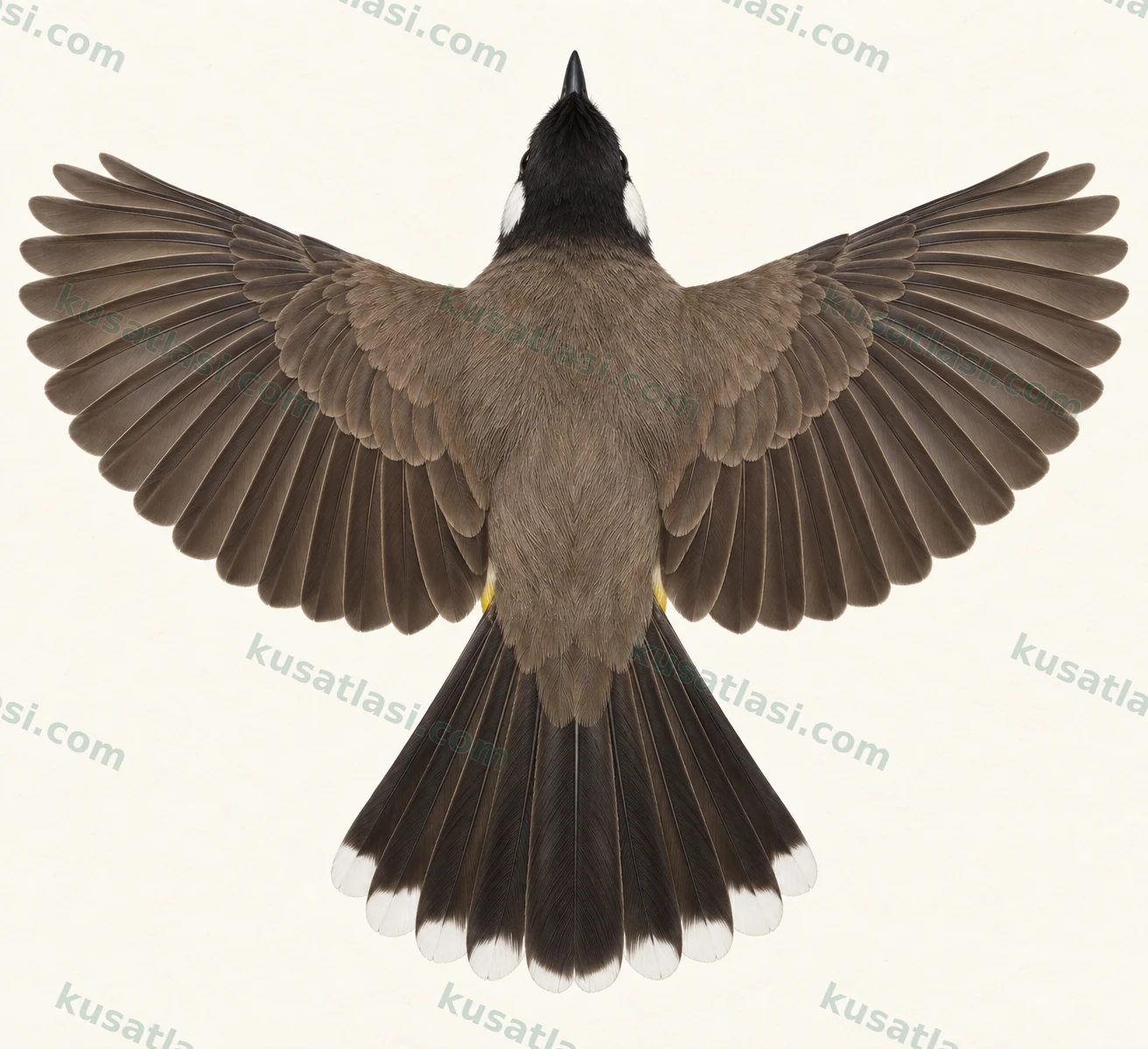
The back and wings are generally plain grey-brown, not strongly scaled.
Biometrics
Length
- Male
- 18–19 cm
- Female
- 18–19 cm
Wingspan
- Male
- 22–28 cm
- Female
- 22–28 cm
Weight
- Male
- 29–35 g
- Female
- 29–35 g
Detailed explanations of these measurements are available on our website, on the same species page.
World distribution
White-eared Bulbul
Customize map layers
Observation Sites
Bird Atlas recordsLoading observations…
Monthly record intensity
12 monthsRecord intensity is affected by observation effort.
Rotate the globe and compare the supported layers. Colours show broad range areas, not exact sightings or nests.
- Jan
- Apr
- Jul
- Oct
- Dec
Generalised data and method
Basemap: Natural Earth (public domain).
Bibliography ↗Authentic bird sound and ethical use
Voice and listening
See the detailed species account below.
Spoken guide
Narration has not been recorded; no audio file has been created.
Observe without approaching the nest
Breeding
A cup of fine twigs, grass and roots is placed in a shrub or tree. Accounts give 2–4 eggs, including 2–3 in the Saudi guide. Female incubation is reported as 10–12 days in Iraq/Saudi accounts and 13–14 in Pakistan. Both adults feed young. These regional figures do not establish a Turkish nesting calendar.
Scientific species guide
Detailed account
A White Cheek Within a Black Head
White-eared Bulbul is a long-tailed, grey-brown songbird with a black head and throat, a conspicuous white cheek and a bright yellow vent. The dark tail has white tips. Identify the combination, not merely one yellow patch seen briefly through foliage.
Sex and Age
Adult sexes look very similar. Brightness in a photograph is not a reliable sexing criterion: lighting, feather position and wear also affect it. Young birds have a browner head and weaker contrasts. A small raised crown is possible, but a pronounced pointed crest calls for comparison with the separate Himalayan Bulbul, Pycnonotus leucogenys.
Wings and Tail
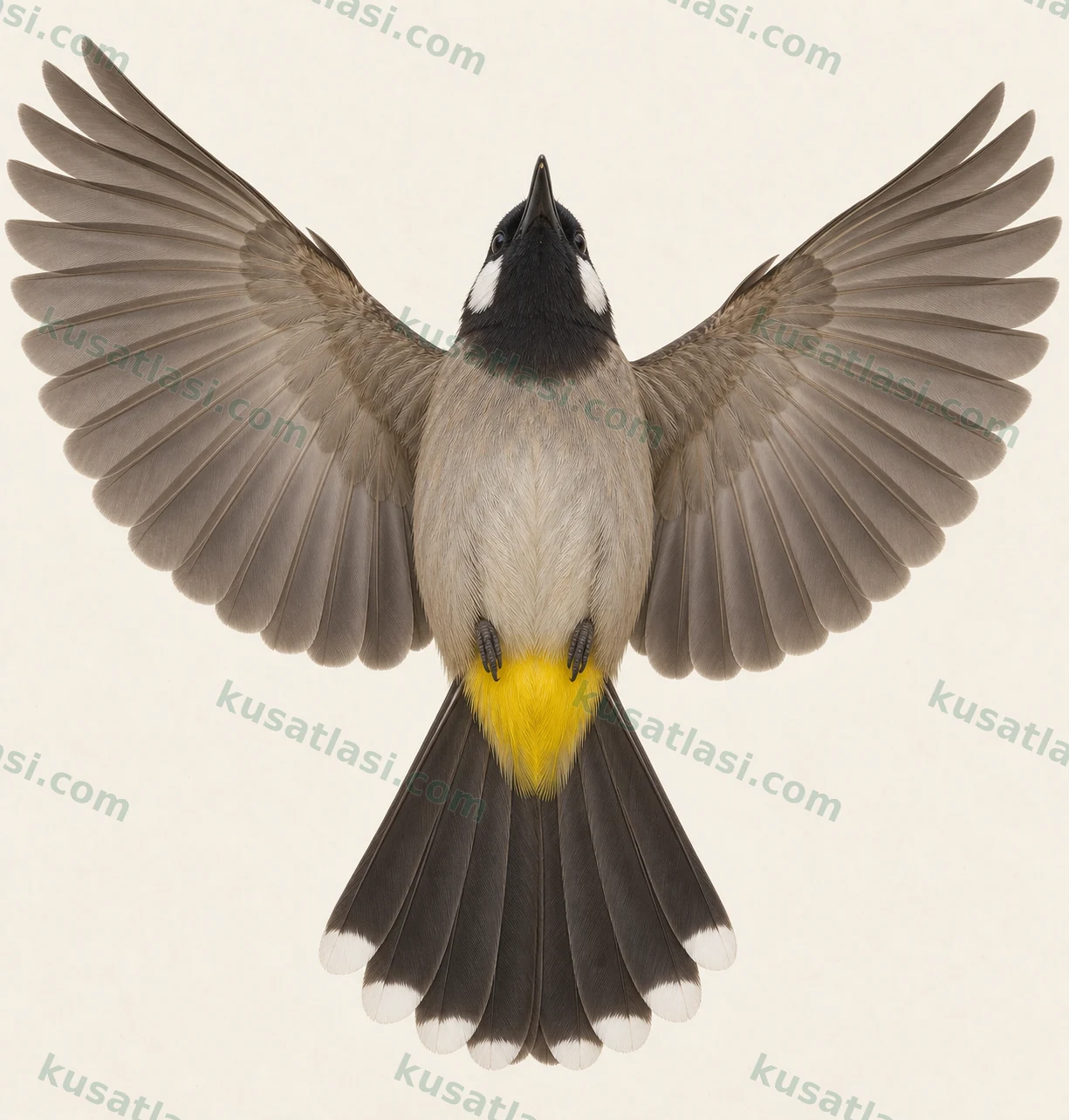
The back and wings are generally plain grey-brown, not strongly scaled. A repeatedly barred tail is not the normal identification pattern. White tail tips may become clearer as the bird turns. Yellow beneath the tail must not be interpreted as yellow on the upper back. Combine flight views with a settled side view of the head.
Measurements
Length and mass are shared regional Saudi guide values, not separate Turkish measurements. Single-wing length is not wingspan.
Nesting
A cup of fine twigs, grass and roots is placed in a shrub or tree. Accounts give 2–4 eggs, including 2–3 in the Saudi guide. Female incubation is reported as 10–12 days in Iraq/Saudi accounts and 13–14 in Pakistan. Both adults feed young. These regional figures do not establish a Turkish nesting calendar.
Turkish Records
White-eared Bulbul is not widespread across Turkey. The records committee lists Silopi on 15 January and 21 December 2020, Cizre on 1 October 2021 and 8 April 2024. These southeastern examples span different seasons; they do not imply equal monthly likelihood nationwide or a measured migration peak.
Identity and Origin Are Separate
The 2017 regional report treats birds in Avcilar, Istanbul, as escapees. This does not prove the same origin for every southeastern record, nor does a border-area observation establish a distant urban bird as naturally occurring. Identification answers which species is present; provenance asks how that individual arrived.
Main Range and Movement
The principal range includes parts of the Middle East, Iran, Pakistan and northwestern India, with introduced populations in some areas. Often associated with residency, it may nevertheless make regional movements. Connecting a few Turkish dots does not create a tracked migration route or a defensible mileage.
Record Useful Evidence
Document side and front views of the head, vent colour, tail tips and natural sounds. Note a ring or feather damage if visible; approachability alone cannot prove captivity. Preserve originals with locality, date and count. Several birds together are not automatically evidence of successful breeding, which requires separate supporting observations.
Scrub and Wooded Edges
White-eared Bulbul uses scrub, open tree cover and edge habitats rather than depending on dense forest interiors. Fruiting plants and sheltering branches may occur together in dry country. Scan bushes, small trees and their connecting routes rather than bare ground alone.
Gardens and Cultivation
Orchards, parks and village vegetation are used within its main range. Proximity to people is not intrinsically abnormal. Nevertheless, the origin of an unusual Turkish city record still needs separate assessment; suitable-looking habitat is not proof of natural occurrence.
Nest Supports and Cover
The open cup is placed among supporting branches of shrubs or trees. A Barmer field study recorded nests 1.5–4 metres above ground in varied vegetation and thorn fencing. Those are study-site results, not universal limits. Both the plants used and available construction materials can differ between localities.
Observation Without Intrusion
Do not enter bushes or spread branches to obtain nest photographs. Keep the approach route of provisioning adults clear and respect private orchards and gardens. Retaining cover and native vegetation matters more than leaving a single conspicuous perch. One tree used by a rare visitor cannot summarise the entire species' habitat requirements.
A Mixed Diet With Much Fruit
Fruit is important, alongside buds, nectar and invertebrates. Regional accounts include larvae, ants and termites. A list of foods is not a fixed percentage: fruiting season, insect availability and local vegetation affect what birds use.
Searching and Short Sallies
Birds can move through fruiting branches, pick small prey from vegetation and make brief sallies after flying insects. Following the vegetation corridor helps keep track of a bird without pushing into cover. Also distinguish a carried food item from nest material before interpreting the journey.
Feeding Young
Both adults participate in provisioning. Leave access clear when repeated food-carrying trips reveal nesting nearby. One delivery photograph does not establish the full diet of either chicks or parents, just as one fruit-feeding observation does not exclude animal food at another time.
Scraps Are Not a Feeding Recommendation
Use of human leftovers is reported, but this is not advice to provide bread or processed foods. Baiting for photographs alters the behaviour being documented and can complicate interpretation of an unusual visitor. Preserving naturally fruiting vegetation is different from supplying scraps. If a plant or prey item cannot be identified confidently, record the uncertainty rather than a guessed name.
Similar Names, Different Species
White-eared Bulbul refers here to Pycnonotus leucotis. Older common names and other white-cheeked bulbuls can cause confusion. Himalayan Bulbul, P. leucogenys, is separate. Checking the scientific name matters when comparing crest shape, photographs or breeding data.
A Nest Reflects Its Surroundings
The 2022–2024 Barmer study recorded diverse plant fibres, twigs, roots, cotton and spider webs in nests. Some urban nests also contained paper, plastic and thread. Their presence is not evidence that such items are safe: do not offer entangling or swallowable litter as nest material. Construction choices also reflect what is available nearby.
White Cheeks Do Not Indicate Sex
Both adult sexes have white cheeks. A brighter white patch or yellow vent in one image does not establish a male. Nor are two birds together necessarily a pair. Separate measurement boxes aid reading but must not imply a visual distinction that cannot reliably be made.
Rarity and Provenance
A globally Least Concern species can remain scarce or local in Turkey. Local rarity and global extinction risk are different measures. Similarly, correct species identification alone does not resolve natural origin. Photographs, dates and behavioural notes make that second question easier to evaluate, especially well away from the usual distribution.
Text and plates come from existing atlas records; references are in the central bibliography.
Open bibliography