
Existing atlas plates
Ruddy Shelduck identification views
Swipe left or right through all five plates.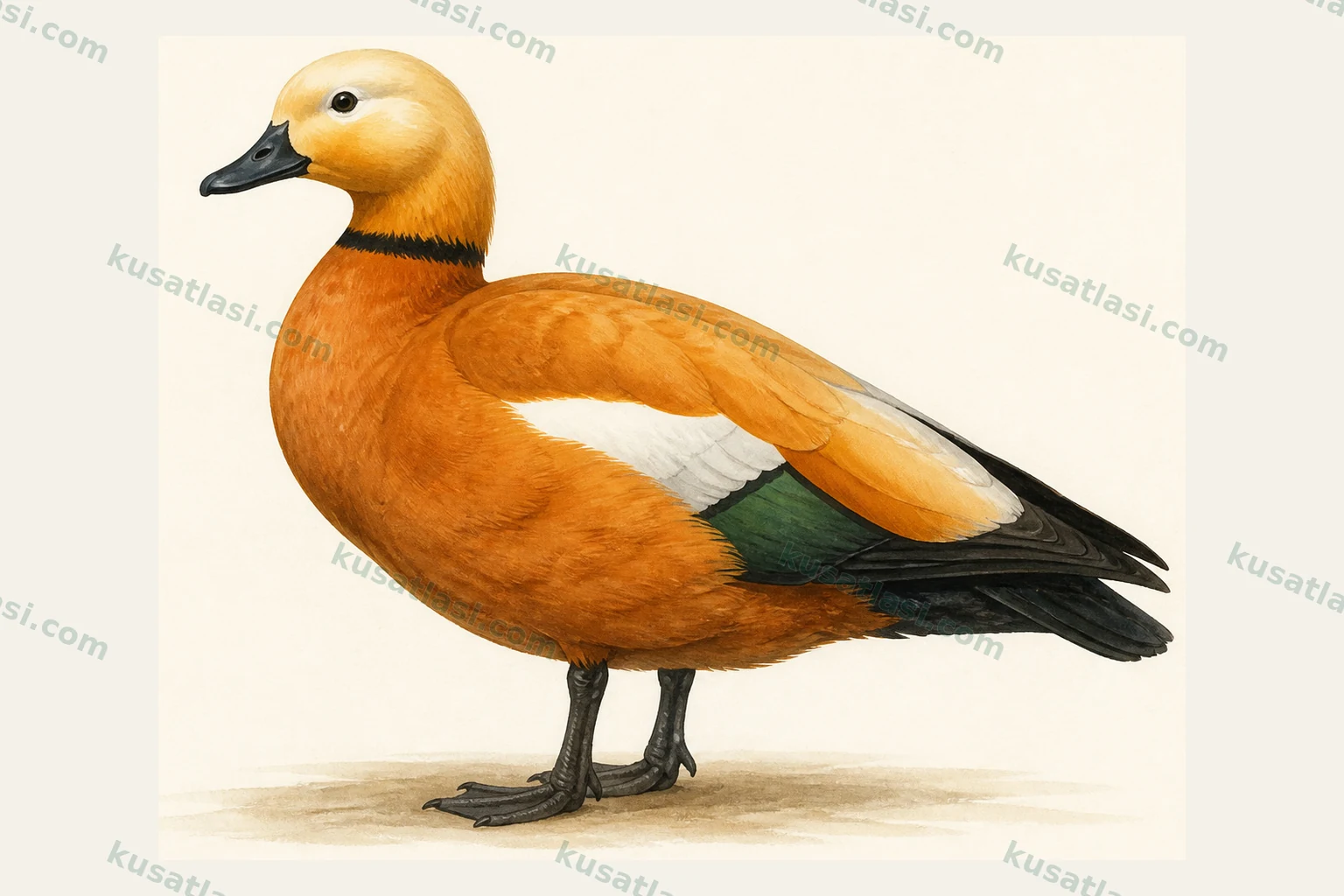
Ducks, Geese, and Waterfowl
Ruddy Shelduck
Tadorna ferruginea
Angıt
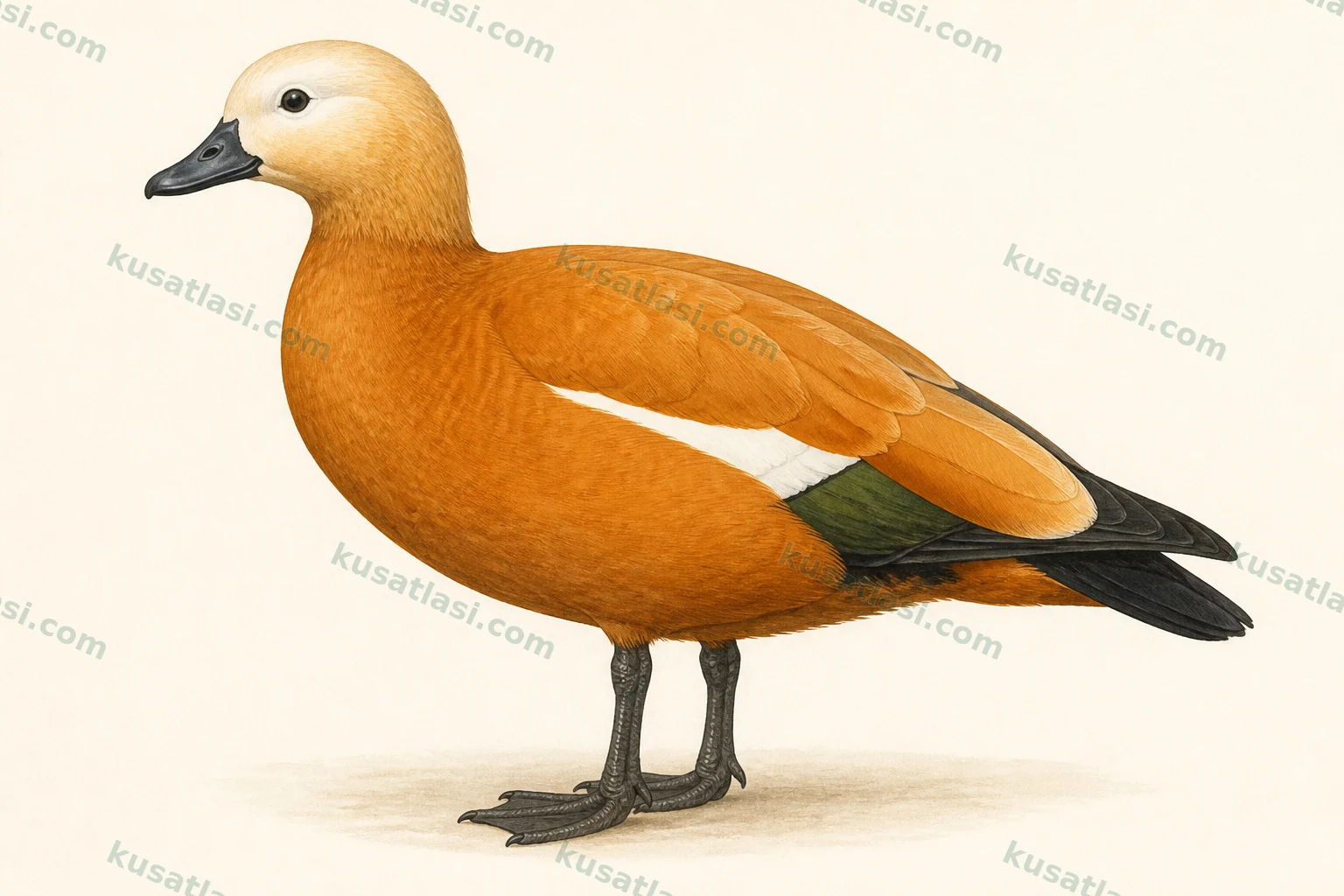
Combine orange body, pale head and white wing areas; interpret the neck ring with age and season.
- Order
- Anseriformes
- Conservation status
- LC Least Concern
First look in the field
Quick identification
- Orange Body, Pale Head
This large duck has a gooselike shape, a warm orange body and a paler head, with dark bill and legs.
- Sex and Age
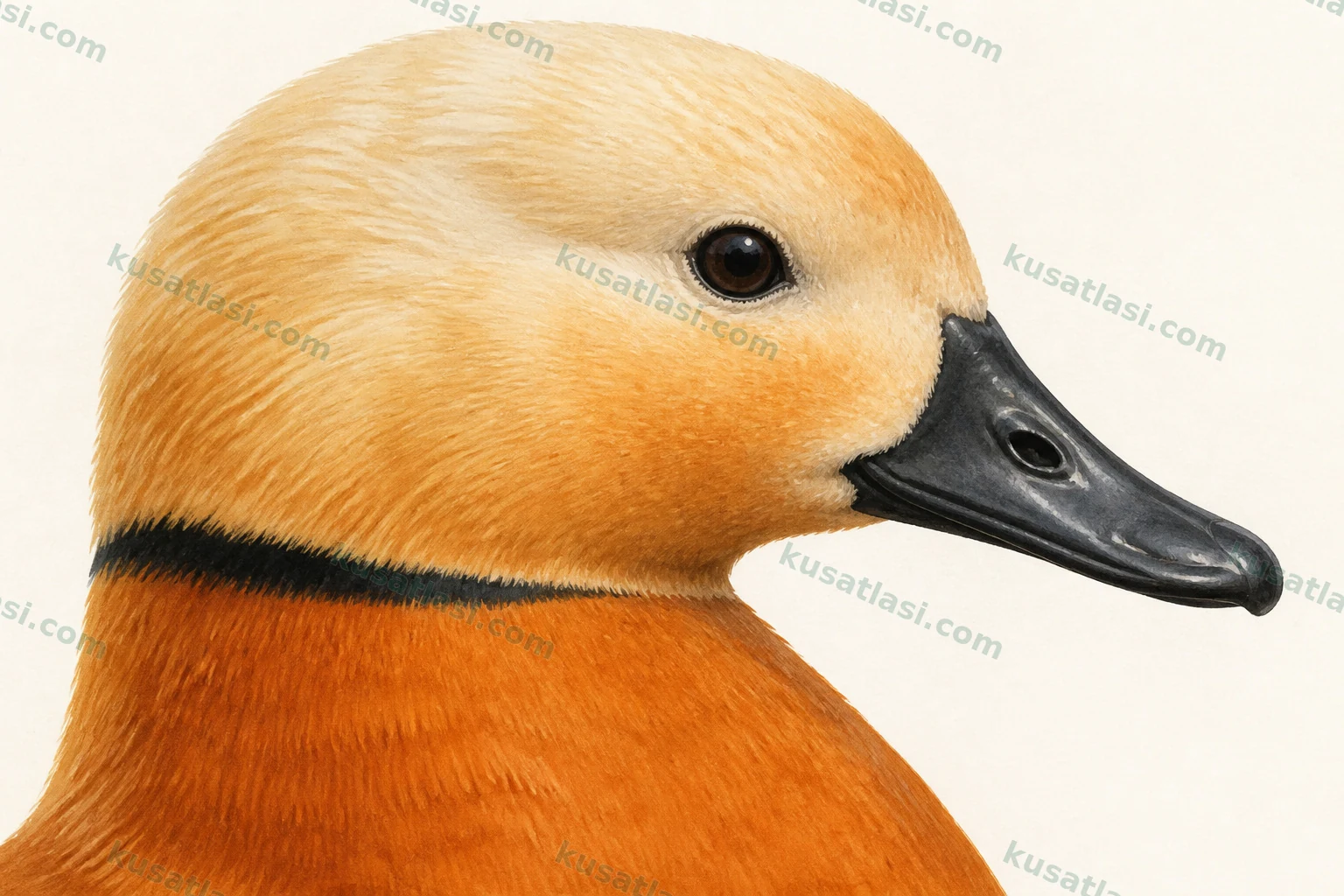
A breeding male has a narrow black neck ring.
- Measurements and Nest
MME gives shared length 61–67 cm and wingspan 121–145 cm; male mass is 1,260–1,600 g and female mass 925–1,500 g.
Biometrics
Length
- Male
- 61–67 cm
- Female
- 61–67 cm
Wingspan
- Male
- 121–145 cm
- Female
- 121–145 cm
Weight
- Male
- 1,260–1,600 g
- Female
- 925–1,500 g
Detailed explanations of these measurements are available on our website, on the same species page.
World distribution
Ruddy Shelduck
Customize map layers
Observation Sites
Bird Atlas recordsLoading observations…
Monthly record intensity
12 monthsRecord intensity is affected by observation effort.
Rotate the globe and compare the supported layers. Colours show broad range areas, not exact sightings or nests.
- Jan
- Apr
- Jul
- Oct
- Dec
Generalised data and method
Basemap: Natural Earth (public domain).
Bibliography ↗Authentic bird sound and ethical use
Voice and listening
See the detailed species account below.
Spoken guide
Narration has not been recorded; no audio file has been created.
Observe without approaching the nest
Breeding
MME gives shared length 61–67 cm and wingspan 121–145 cm; male mass is 1,260–1,600 g and female mass 925–1,500 g. Nests may occupy a rock crevice, burrow or tree cavity, lined with feathers and down.
Scientific species guide
Detailed account
Orange Body, Pale Head
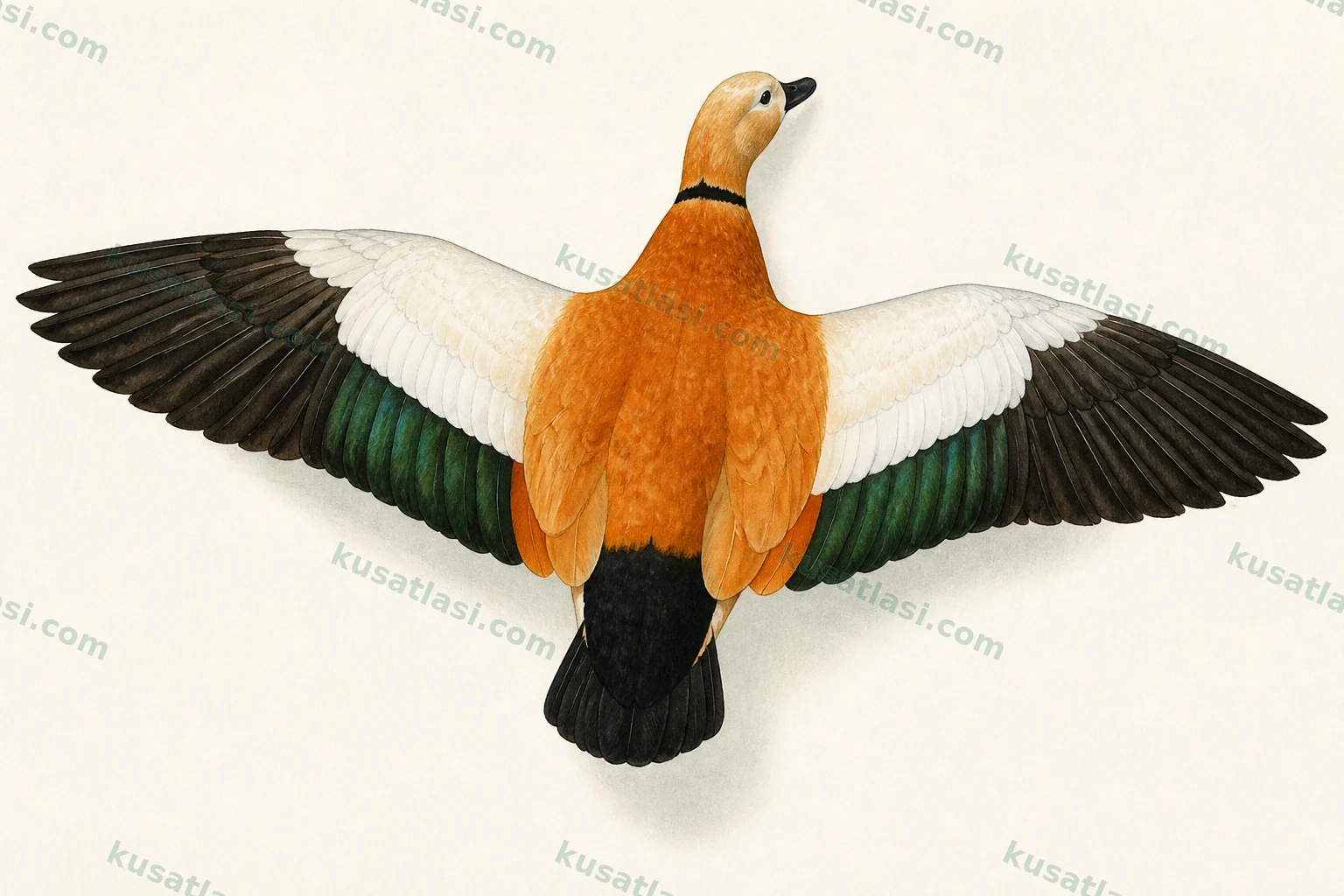
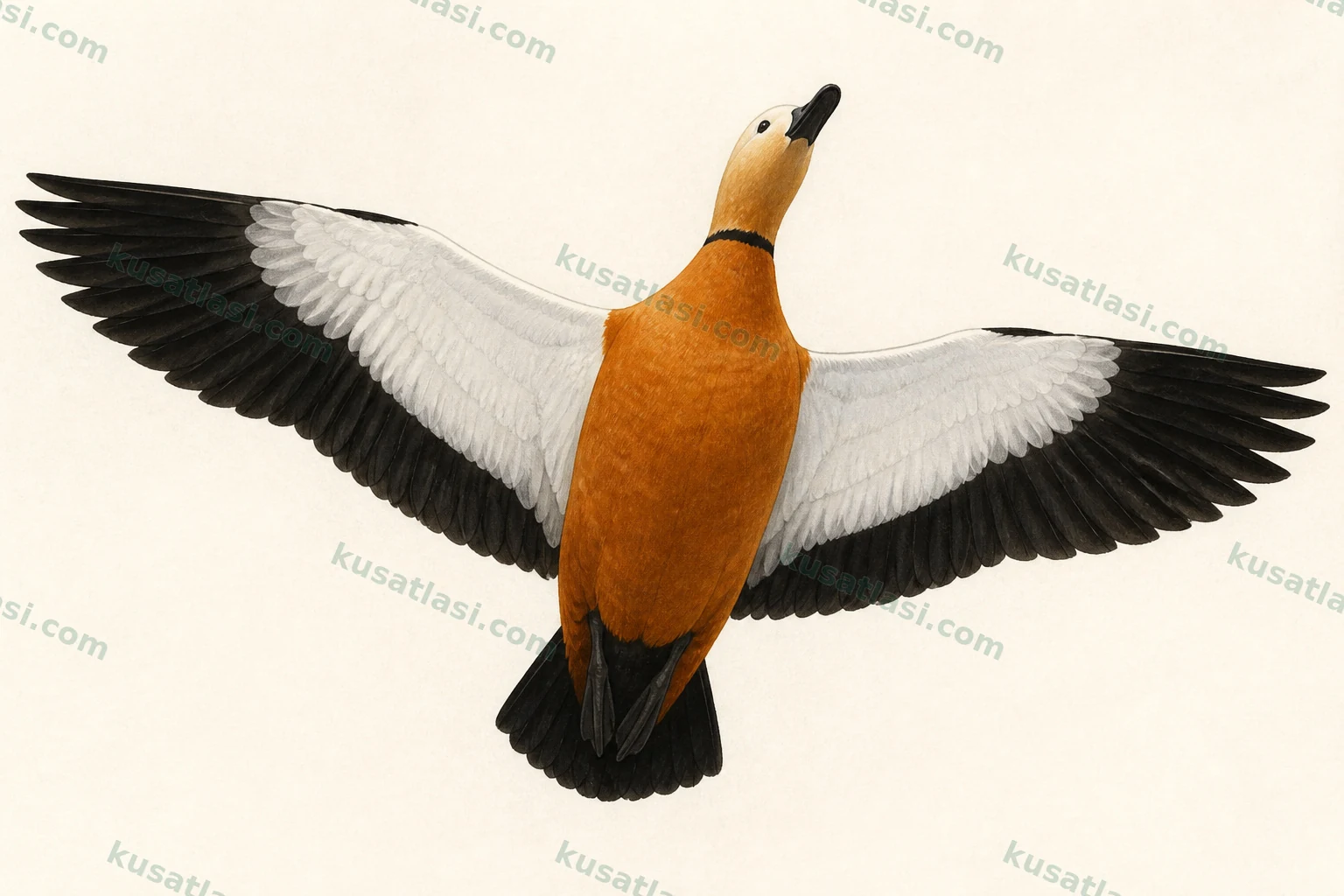
This large duck has a gooselike shape, a warm orange body and a paler head, with dark bill and legs. In flight, white wing areas contrast with dark flight feathers. Verify head, bill and wing pattern on the same bird rather than using orange alone; low sunlight and shade alter colour impressions.
Sex and Age
A breeding male has a narrow black neck ring. Females lack it and may show a whiter face. An invisible ring does not automatically indicate female: season, age and posture matter. Young are duller. The preserved pictures illustrate broad differences but are not scale drawings for measuring sex-related size.
Measurements and Nest
MME gives shared length 61–67 cm and wingspan 121–145 cm; male mass is 1,260–1,600 g and female mass 925–1,500 g. Nests may occupy a rock crevice, burrow or tree cavity, lined with feathers and down. Typically 8–9 eggs are incubated for about 28–29 days by the female while the male guards; both care for young.
Both Breeding and Wintering in Turkey
Turkish populations include breeders and wintering birds; this is not simply a summer visitor absent in winter. Numbers at a lake can change with water conditions, breeding and movement. A large winter flock does not establish that all its members nested at that site.
Broad Range, Not One Route
The natural range extends from southeastern Europe across much of Asia, with separate African populations. Some birds migrate while others move locally. Without individual tracking, origins, destinations and flight distances cannot be assigned to each Turkish sighting. Independent map points are not a reconstructed journey.
Dates and Units Matter
BirdLife's 2021 tables give 10,000–15,000 Turkish breeding pairs for 2002–2012 and 16,800–31,300 winter individuals for 2013–2019. Different units and periods cannot establish increase or decline by simple subtraction. Neither is a 2026 census. Record counting conditions and avoid adding repeated views of the same flock as new birds.
Lakes and Open Shores
Saline, brackish and fresh lakes, reservoirs and open shores can be used. Searching only on the coast misses important inland settings. Scan both open water and adjacent ground; low banks may hide resting birds. Keep counts of visible groups distinct before combining them.
Water and Farmland Are Connected
Resting and feeding places need not coincide. Research at Kuyucuk demonstrated daily movements involving surrounding farmland. Protecting a lake while ignoring feeding habitat overlooks part of the system. Historical use of a field, however, does not guarantee its current role; record present behaviour.
Nesting beyond the Waterline
Holes and crevices provide nest sites, sometimes away from immediate shorelines. Do not inspect cavities or block adults. Retreat if birds alarm or young begin to scatter. Stay on permitted routes and let birds fly naturally; flushing a flock to inspect wing patterns is unnecessary.
Plants and Seeds
Much of the diet is plant material, including grasses, leaves, seeds and aquatic vegetation. Grazing on land and shallow-water feeding can occur on the same day. A submerged bill does not reveal the exact item eaten; record feeding method and substrate when prey or plants cannot be identified.
Not Exclusively Vegetarian
Insects, small molluscs and other invertebrates are also taken. Proportions vary with place and season. Captive pellets or vegetable mixes do not describe a wild diet. Feeding birds bread or bait changes the behaviour being observed and is not needed for a closer view.
Feeding Flights Are Not Necessarily Migration
Morning and evening flights recorded at Kuyucuk in September 2006 were daily movements between resting and feeding areas. A large departing flock is therefore not automatically beginning long-distance migration. Note its direction and time, and any later return, while keeping observed movement separate from interpretation of its purpose.
A Gooselike Duck
An upright stance and long neck can suggest a goose, but Ruddy Shelduck belongs to Tadorna. Shape is an initial impression, not a complete identification. Combine bill, body, head and wing pattern. Broad white wing areas also occur in Common Shelduck and Egyptian Goose.
Leaving the Nest Is Not Flying
Young can leave the nest early but develop flight at roughly 55 days. A walking, flightless duckling is not automatically abandoned. Adults may be nearby, and approach can scatter a family. Withdraw and observe; never handle a youngster merely for a better photograph.
Identity and Origin Are Different Questions
Outside its native range this species may occur as an escape from waterfowl collections. That does not make every Turkish record an escape: Turkey is within its natural breeding range. Rings, context and behaviour may help investigate an unusual bird but are not individually conclusive. Global LC status does not make local wetland loss unimportant. Identification, origin and conservation status should be considered separately.
Text and plates come from existing atlas records; references are in the central bibliography.
Open bibliography