
World Birds
Field identification plates
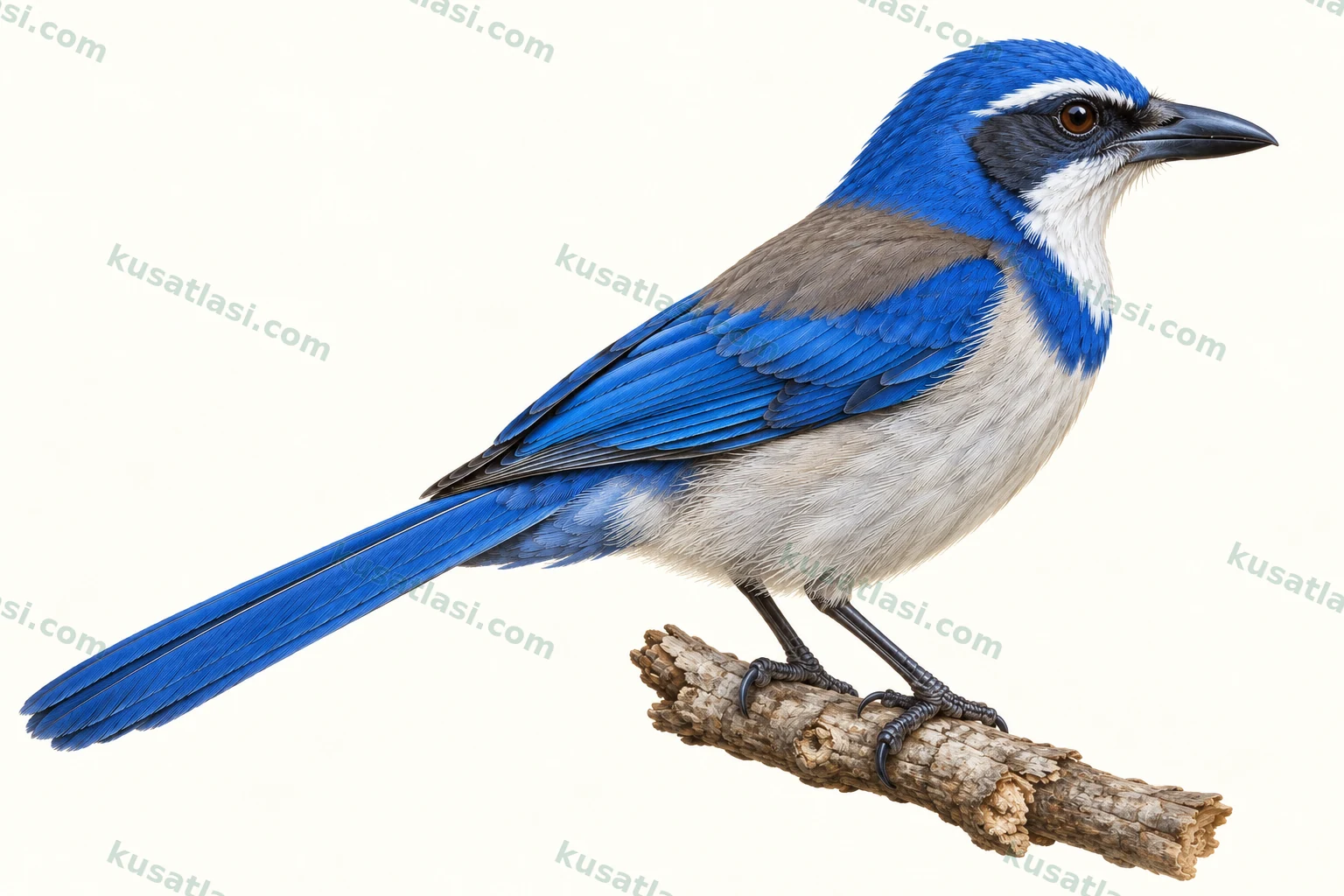
Swipe left or right between the two adult plates.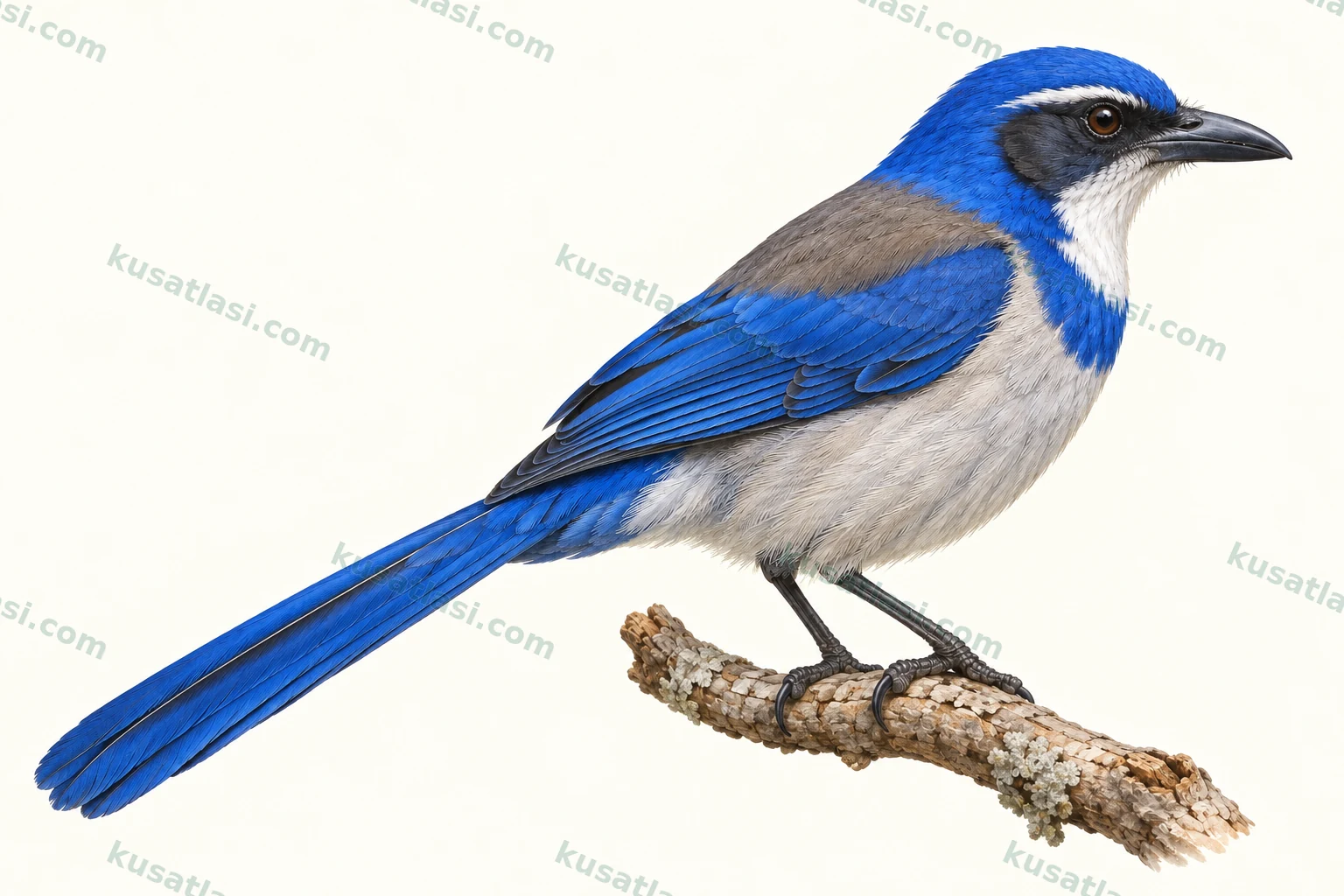
Corvidae
Island Scrub Jay
Aphelocoma insularis
Its natural resident range is Santa Cruz Island off southern California.
- Order
- Passeriformes
- IUCN status
- Source-taxon assessmentGlobal IUCN. BirdLife v10 (2025); taxon matching: AviList 2026 / IOC 15.2; checked 29 October 2026. Checklist year is not the species assessment date. Source and method
At a glance
- Santa Cruz only
Its natural resident range is Santa Cruz Island off southern California.
- Blue, grey and dark face
Examine blue head, wings and tail with grey underparts and dark eye area.
Biometrics
Length
- Male
- 33 cm
- Female
- 33 cm
Wing length
- Male
- 13.96 cm
- Female
- 13.96 cm
Weight
- Male
- 100–147 g
- Female
- 99–117 g
Length: Shared species value Wing length: Shared species value
World distribution
Island Scrub Jay
Customise map layers
Observation points
Preparing globe…
Monthly record count
Bars show record counts in this sample, not bird abundance or a breeding calendar. They are affected by recording and observation effort.
Rotate the globe and compare layers. Coloured areas are not exact observation or nest locations.
The source does not provide verified monthly range boundaries. All areas are shown; the month slider and monthly playback are therefore disabled.
- Jan
- Apr
- Jul
- Oct
- Dec
Generalised data and method
Base map: Natural Earth · Public domain
Open central bibliography ↗Calendar
Resident on Santa Cruz year-round; regular migration off the island was not verified.
All months: Monthly data unverified.
January
February
March
April
May
June
July
August
September
October
November
December
Habitat
Santa Cruz Island, southern California
The island’s immediate surroundings; neighbouring islands are not coloured as resident range.
Sound
Pairs communicate vocally all year. Written voice information alone does not identify.
Do not play recordings to attract birds; observe quietly, especially near nests.
Breeding
Both partners build the cup-shaped nest. The female incubates the eggs, and both parents feed the young. The clutch contains 2–5 eggs; incubation lasts 17–21 days and young remain in the nest for 19–27 days. The study showed that approaching the nest can create a risk.
Compare
Compare male and female
Examine blue head, wings and tail with grey underparts and dark eye area.
Species information
Quick Identification
The Island Scrub Jay Aphelocoma insularis is a corvid confined, under current IOC and AviList species limits, to Santa Cruz Island off southern California. Head, wings and tail look dark blue, the back brownish grey and the underparts pale grey. The dark area around the eye gives a masked impression. Locality is almost unique when assessing its name and colours: a scrub jay away from Santa Cruz is not made this species by a similar photograph alone.
Santa Cruz's oak woodland and dense scrub matter as much as plumage colour. Cornell describes dark blue upperparts, pale underparts and dark facial area across the eye together. California Scrub Jay is a very close mainland relative; the sea helps separate where these taxa live. Yet not every blue bird seen at an island edge is automatically Island Scrub Jay. Bill shape, size, dark facial line and tail feathers must be checked together, with geographic location added to photographs.
Overall Appearance and Posture
On a treetop or dense shrub branch, the large head, strong bill and long tail stand out. It often stands upright as if surveying its surroundings. It may hop on the ground or move short distances among low branches. Cornell places it in both oak woodland and scrub. Different island vegetation affects where and how it is seen; a posture in one photograph is not an unchanging trait of every bird. Considering strong bill and long tail together reduces confusion with other island birds.
In 2021 Desrosiers and colleagues studied body size and early breeding opportunities in marked Santa Cruz birds. Larger young males were more likely to obtain territories and breed; the same relationship was not shown for females in that sample. This observed association cannot mean larger birds always produce more young every year. The authors state that lifetime reproductive success needs separate measurement. A field guide should not encourage prediction of an individual's age, sex and future success from size alone.
Its restriction to a small island matters for conservation. An older IUCN label reported by the National Park Service is not used as the current global category for this page's independent taxon. Loss of an oak patch or a large island fire could affect a larger proportion than in birds spread over a broad mainland. That possibility is not presented as an observation of a specific number dying today. Island scrub recovered after removal of herbivores, and scientific studies examine effects on nesting success. Population estimates from different years should not be lined up as exact numbers independent of counting method.
Males, Females and Young Birds
Since adult males and females lack a clear reliable colour difference, blue tone alone does not determine sex. Weight can vary with time of year and feeding.
Young birds may look duller, browner and less neat than adults. Feather wear, gape and moult signs require expertise for ageing; not every bird pale in poor light is young. Cornell's life history distinguishes family groups from non-territorial adults. Several birds in one bush are not all necessarily that year's young. Desrosiers and colleagues show that some birds do not immediately acquire breeding territories even as adults. Calling them “chicks” by appearance alone misrepresents age and behaviour.
Appearance in Flight
In short flight, blue wings and long blue tail may be seen with brownish back and pale underparts. Cornell describes mostly short movements rather than long migratory flights. This explains movements among trees, bushes and ground feeding sites on Santa Cruz, not annual travel to another island. We avoid making one underwing shade a reliably verified, definitive species-specific mark. Differences from California Scrub Jay are evaluated with island location and other structural features.
Voice and Behaviour
Scrub jays are vocal. Cornell describes Island Scrub Jay pairs defending year-round territories vocally and keeping contact during the day. Locality, scrub cover and visible colours should be recorded when the voice is heard. Written sound description alone does not identify reliably; relatives may have similar calls. Without a recording, no detailed note sequence is written as if heard. Noise and distance can alter tone, so a few short calls do not represent the full repertoire.
Collecting acorns and caching them in different places is important behaviour. Pesendorfer, Sillett and Morrison found on Santa Cruz that birds did not leave acorns randomly in open grassland, but disproportionately chose scrub and coastal sage cover. Oak seedlings were denser there too. The study suggests caching can help habitat recovery; attributing every seedling difference only to jays would require excluding all other factors. They can also eat insects, small vertebrates and other foods. A single prey sighting is not a fixed annual dietary percentage.
Confusable Species
1. California Scrub Jay Aphelocoma californica is the closest-looking mainland species. Island Scrub Jay is generally larger, darker blue and stronger-billed. Localities and the combined colour and structural features must be checked.
2. Woodhouse's Scrub Jay Aphelocoma woodhouseii is another, more inland taxon. Records under the old broad “Western Scrub-Jay” name are not used as this island species' measurements or range before assignment to current species.
3. Florida Scrub Jay Aphelocoma coerulescens lives in another geographic and ecological setting. Family systems in which other individuals help raise young are documented in studies of that species, not to be confused with Santa Cruz's nesting behaviour.
World Distribution
Under current IOC, AviList and Clements treatments, Island Scrub Jay is endemic to Santa Cruz Island off southern California. Cornell and the US National Park Service independently confirm this narrow range. Mainland California Scrub Jay is a separate taxon across the sea. Santa Cruz is not uniform habitat: oak woodland, scrub, clearings and human-used areas have different value.
Status in Its Natural Range
Map scale must show where the island lies, without colouring all the sea or neighbouring islands as habitat. Old sources may treat Island Scrub Jay as a subspecies within broad Western Scrub-Jay. The 2025 HBW/BirdLife list also treats it under Aphelocoma californica insularis; this page uses Aphelocoma insularis accepted by the local IOC catalogue. When species limits differ, quietly mixing numbers is wrong.
Migration Journey
This is a Santa Cruz resident; Cornell reports pairs defending territories year-round. That does not prove every bird flies no more than a few kilometres in its lifetime; young and non-territorial birds may seek new places within the island. However, no regular annual route between Santa Cruz and other islands or the mainland was found in the examined sources. Acorn movement within the island does not mean migration to the mainland. Unverified seasonal arrows and distances are not created.
Breeding Habitat
Santa Cruz oak woodland and dense coastal scrub are principal habitat. Cornell names oak woods and chaparral. Caldwell and colleagues in 2013 studied nesting success in different vegetation. Some sites with better concealment and taller vegetation differed in protection against nest predators. This applies to the island and years studied, not equal success of all scrub or predators finding every nest. Protecting regrowing scrub may affect potential breeding habitat.
Nest Site
Both partners build a large cup of live-oak and other woody twigs, lining it with rootlets, grasses and sometimes hair. In Caldwell and colleagues' 2013 Santa Cruz study, 323 nests averaged 3.1 m high, with an actual published range of 0.8–16 m. The average does not put every nest exactly at 3.1 m. Cornell gives a typical clutch of 2–5 eggs, incubation of 17–21 days and a nestling period of 19–27 days. The female incubates and both parents feed young. The same study found observer approach could increase predation pressure; disturbance during nest searches should be avoided.
Daily Habitat Use
Pairs gather and cache acorns and find other food in territories defended all year. Non-territorial adults may range more widely. Open grassland, dense chaparral and oak woodland are not used equally. The caching study found more use of scrub than open grassland. This is spatial choice specifically in caching, not a single map of all movements. Vegetation, behaviour and position within the island are recorded separately.
What Does It Eat?
Acorns are important food. Cornell's expert life history also lists pine and grass seeds, insects, lizards, small snakes, mice and sometimes other birds' eggs and young. This does not mean every bird eats every item daily or that fixed percentages apply. Oak and pine distribution varies within the island, and available food may depend on season and place. A scientific study of caching a particular oak's acorns does not alone measure their exact annual dietary share. Unseen prey names and proportions are not invented.
How Does It Feed?
The bird may hop on ground and branches to forage, hold and open acorns with its strong bill, and cache them separately for later. Pesendorfer and colleagues observed non-random transport more often to vegetated areas such as chaparral and coastal sage scrub. This may contribute to oak seed dispersal; not every cached acorn sprouts, and rainfall and other factors affect seedling density. Seeing capture of an insect or small vertebrate directly is stronger feeding evidence than a bird merely moving towards a leaf. Identical hunting methods in different habitats are not assumed.
A Species Restricted to One Island
Under current IOC treatment, Island Scrub Jay's natural range is Santa Cruz. This restriction gives large fire, disease and habitat loss possibilities special weight in conservation planning. A current global IUCN category for this page's separate taxon could not be verified. Narrow range matters, but alone does not assign an IUCN category. Even apparently suitable scrub on another island is not itself proof of a resident population.
An Acorn Carrier
In 2017 Pesendorfer, Sillett and Morrison found more frequent caching in scrub and coastal sage than open grass. Denser oak seedlings there suggest seed transport can help vegetation recovery. This is an association, not conclusive proof that birds alone cause every seedling-distribution difference. Within-island caching preferences should not be confused with long-distance migration to other continents.