
World Birds
Field Guide Plates
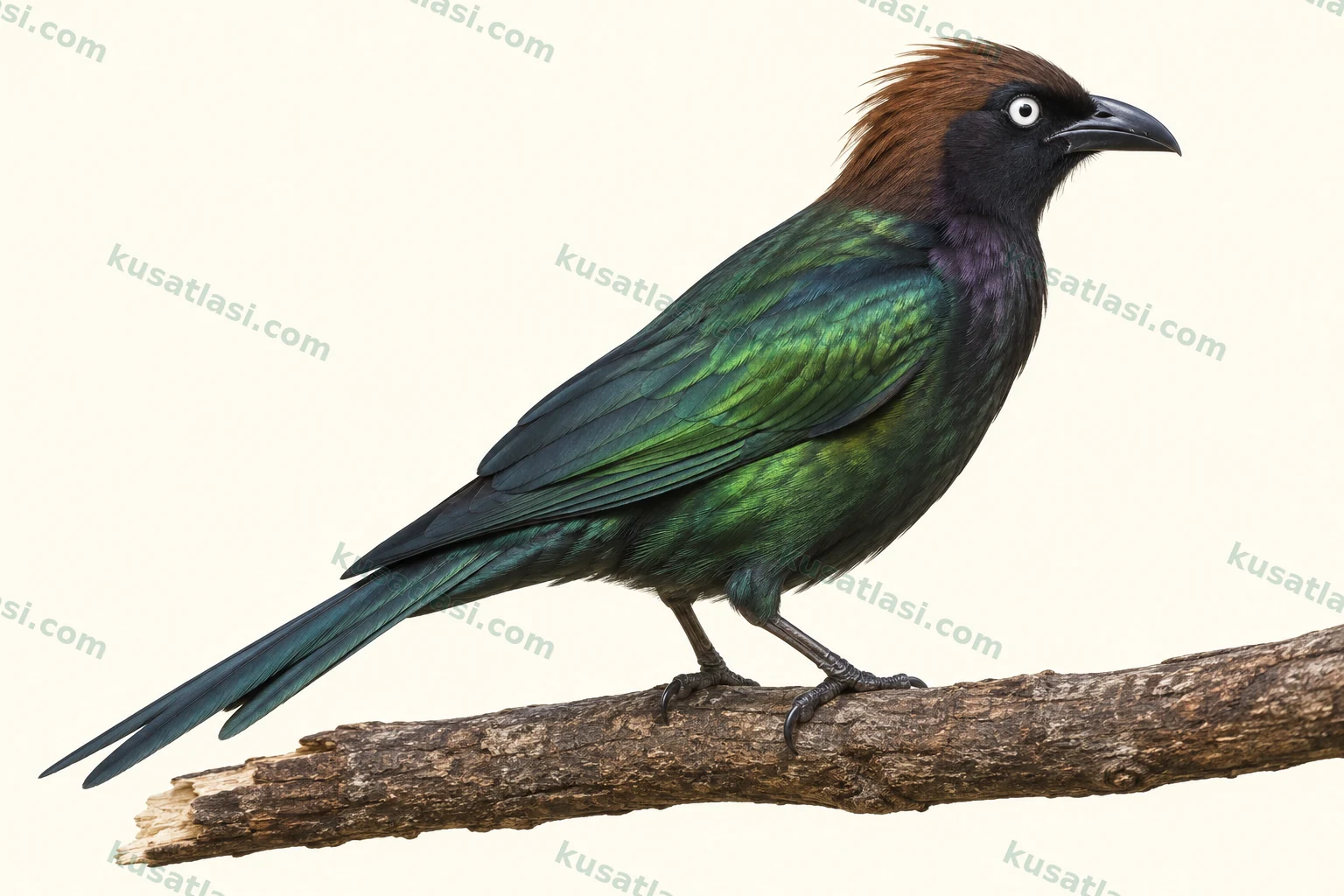
Swipe between the two adult plates.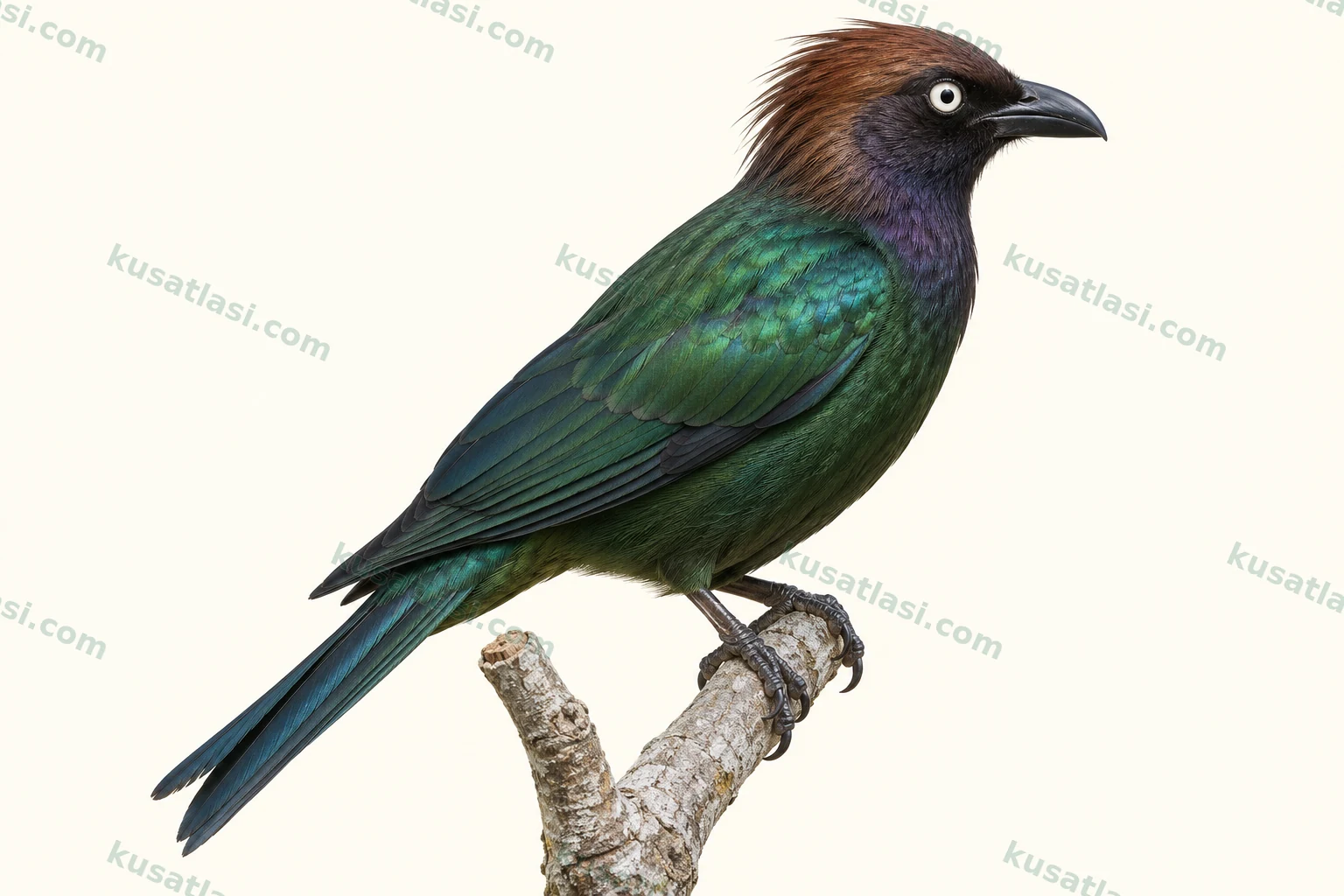
Sturnidae · Passeriformes
White-eyed Starling
Aplonis brunneicapillus
Ak Gözlü Sığırcık
In adults, assess the white iris, strongly curved stout bill and two slender central tail-streamers together.
- Order
- Passeriformes
- IUCN Status
- VUVulnerable
Biometrics
Length
- Male
- 23 cm
- Female
- 23 cm
Wing length
- Male
- 10.65 cm
- Female
- 10.65 cm
Weight
- Male
- 59.5–76.5 g
- Female
- 59–73.5 g
Detailed explanations of these measurements are available on our website, on the same species page.
At a Glance
- White adult iris
Assess with bill and tail.
- Two slender streamers
Damage or absence alone does not rule out the species.
- Glossy dark body
Green, purple and bronze tones vary with light.
Females look similar; adult streamers can also be reduced or broken. Young have darker eyes.
Calendar
Breeding records include January on Bougainville and July–August on Guadalcanal; a complete monthly calendar for all islands is unknown.
Species Information
Quick Identification
White-eyed Starling is a glossy dark forest bird with a restricted range in the Solomon archipelago. Adults combine a white iris, strong black bill with a markedly curved upper profile, and two potentially very elongated central tail feathers. Streamers can be broken or reduced, so identification should not depend solely on seeing a long tail.
Appearance and Posture
The basic plumage is black with green, purple and bronze iridescence. Described tones include bronze on the crown, purple-bronze between eye and bill, purple on the throat and emerald green along the moustachial line. Mantle, wing coverts, rump and underparts can show strong green gloss. These colours do not appear equally bright from every angle.
Modified forehead feathers can form a small crest; crown and throat feathers are elongated. Flight feathers are blackish-brown, with purple gloss possible on their outer edges. The glossy black tail has slender flexible central streamers extending well beyond the outer feathers. Bill and legs are black.
Occurs on high canopy branches and perches around nesting colonies. A field observer on Bougainville could distinguish the pale iris but did not find the strongly arched bill equally apparent. Details that stand out in an illustration should therefore not be expected to show as clearly at a distance or in poor light.
Males, Females and Young Birds
Females share the male’s dark glossy appearance; the expert account describes slightly weaker iridescence and potentially shorter central streamers. However, adult streamers can also be lost or broken, so a short tail alone does not establish female sex. Some sex assignments in older field notes were explicitly presumptive.
Young lack the forehead crest and long adult tail-streamers. Underparts may be darker brownish, with pale streaking on breast and central belly. Irides can range from olive tones to dark brown. The bill may initially be grey, becoming black in older immatures. Juvenile details have not been documented equally clearly in every record, so one feather or eye colour should not establish a precise year of age.
Appearance in Flight
In flight, look for the dark body together with slender central streamers. Iris and bill shape may be invisible in a bird passing through canopy cover or a distant flock. Do not reject an individual solely because streamers are unseen; inspect the other characters. The reviewed sources do not establish a wingbeat rhythm that diagnoses the species on its own.
Voice and Behaviour
Whistled sequences, thin metallic notes and harsher sounds have been described around colonies. The expert account distinguishes a short courtship “chreep” from harsh alarm “kwaik” and short encounter chatter. Birds returning in flight can also give whistled calls. These different sounds should not be assigned one function or treated as a single song type.
Nests colonially and generally forages in small groups. At one Bougainville colony, birds departed and returned together on feeding trips. Joint travel does not demonstrate that all adults care for one another’s offspring; detailed cooperative care has not been established for this species.
Similar Species
1. Metallic Starling (Aplonis metallica): Adults have red or orange-red irides and a long graduated tail forming a more continuous tail outline. Adult White-eyed’s white iris and two very slender central extensions are important comparisons. Both species can have darker eyes when young, so iris colour alone is insufficient. Since both are glossy dark birds, assess tail, head and eye together.
World Distribution
Endemic to the Solomon archipelago, with records from Bougainville, Choiseul, Rendova and Guadalcanal. Bougainville is politically part of Papua New Guinea, while the other three islands belong to the state of Solomon Islands. Archipelago endemism therefore does not mean occurrence in that country alone.
Records from these four islands do not establish presence on every island between them. Suggestions of a wider island distribution remain possibilities for investigation rather than sufficient evidence to add islands to a verified range.
Status within Its Range
Poorly recorded and patchily distributed. Forest loss, reduced availability of large trees and historical records of nestling harvest are conservation concerns. Failure to find it for long periods after older Guadalcanal records led to suggestions of disappearance around Betilonga. However, the paper reporting 2013 field observations explicitly confirms continued presence in that area. The older interpretation should therefore not be repeated as certain, current absence.
Seasonal Movements
Presumed resident, with movements poorly known. Groups have been observed flying between colonies and nearby feeding trees. Those trips do not establish regular inter-island migration, a seasonal route or a fixed travel distance. Migration recorded in some populations of Metallic Starling must not be transferred to this species.
Breeding Habitat
Occurs in lowland and hill forest, including swamp forest, and also uses forest edges, secondary vegetation, gardens and trees retained in clearings. One Bougainville breeding colony was in waterlogged lowland forest, whereas Guadalcanal colony records involved hill forest. It should not be restricted conceptually to breeding only in hills.
Nest Site
Colonies can occupy high branches of a large tree within dense growth of ferns, mosses and other plants. The nest is a short horizontal tunnel lined with moss. The expert synthesis reports colonies of ten to forty nests in a tree, without implying that every colony must fall within that range.
Eggs are whitish with grey and dark brown speckling. Typical clutch size, incubation duration and nestling duration could not be verified in the reviewed sources. Adults have been recorded carrying food in their bills to nestlings, but division of care between the sexes remains poorly known.
Breeding records include January on Bougainville and July–August on Guadalcanal. These island-specific records do not provide a complete annual calendar. Observe without removing nest cover or blocking access.
Daily Habitat Use
Usually forages in the canopy, descending lower in gardens and around clearings. At the Bougainville colony, birds roosted in nest tunnels and emerged at first light to preen on nearby branches before feeding. That local observation does not establish an identical daily timetable on every island.
What Does It Eat?
Fruit is the principal food, including figs. The expert account also mentions fruits with large stones, but subsequent regurgitation of those stones is a presumption rather than a directly established behaviour. It should not be presented as a confirmed digestive process. Detailed dietary proportions and a complete plant list for all islands are unavailable.
How Does It Forage?
Usually gathers food from fruiting branches high in trees. Small groups can visit fruiting trees; berries were observed being collected near one Bougainville colony. In the 2013 Guadalcanal observations, birds also appeared to feed on small fruits, without the plant being identified. These records do not establish an insect-hunting technique or obligatory dependence on one fruit species.
How Many Species Are in a Flock?
A starling flock observed on Guadalcanal in 2013 contained about twenty to thirty birds, but the observers could distinguish only four or five as White-eyed Starlings and explicitly allowed for other species. The full flock total therefore cannot be reported as the number of this species. Poor light and distance also hindered counting during the brief colony observation. A group seen, individuals identified and an island’s total population are different quantities.
A Possible Courtship Display
Older Bougainville field notes describe a pair-bonding display in which the bird lowered its body, raised its crown feathers and moved its flexible streamers. In the 2013 Guadalcanal observation, a bird raised its tail and thrust it down towards another; the authors interpreted this as possible courtship. Observing a movement is distinct from experimentally establishing its function. A tail movement alone cannot prove sex, mate choice or successful breeding.